FMCG plant hygiene is the most under-automated mission-critical function in consumer goods manufacturing — a cleaning validation failure on a single processing vessel can contaminate an entire production batch with residual allergen protein or surfactant carryover, triggering a product recall that costs $5 million–$50 million in direct costs plus brand equity damage that persists for years. FMCG plants producing personal care, home care, and liquid food products operate under GMP hygienic design standards that require verified removal of gluten, dairy, nut protein, and other allergens from shared processing equipment between product changeovers. The cleaning validation regimen — ATP swab testing, allergen-specific ELISA assays, surfactant residue measurement, and visual inspection — is still overwhelmingly manual, performed by QA technicians on ladder-access vessels and pipe dead-legs during 4–8 hour CIP/SIP cycles that already constrain production capacity. FMCG hygiene cleaning robot validation brings together autonomous cleaning robots (humanoid, gantry-mounted, or mobile-manipulator platforms), AI vision cameras for surface cleanliness assessment, and digital Shift Logbook integration for real-time validation documentation — replacing manual swab-and-send-out testing with in-situ cleaning verification that is faster, more consistent, and digitally traceable for audit purposes. iFactory AI's industrial software platform — including AI Vision Camera, Shift Logbook, Inspection Management, and Safety Compliance — enables FMCG plants to deploy cleaning robot validation workflows, automate allergen changeover verification, and maintain GMP-compliant hygiene records without adding QA headcount. Book a Demo to see how iFactory validates cleaning robot performance with AI vision and digital hygiene scoring.
FMCG Hygiene Robot Validation · Allergen Control · 2026
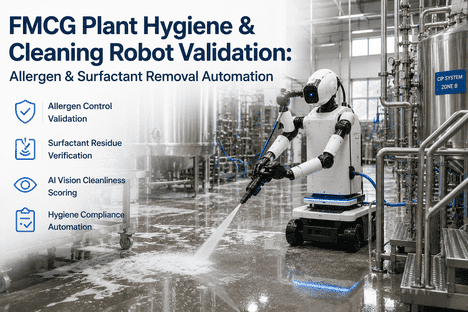
FMCG Plant Hygiene & Cleaning Robot Validation for Allergen & Surfactant Removal Automation
Automate cleaning validation with AI vision, ATP-equivalent scoring, and digital Shift Logbook traceability — without adding QA headcount or extending CIP cycle times.
Why FMCG Hygiene Cleaning Validation Is the Next Automation Frontier
FMCG plants that produce multiple product variants on shared processing lines — shampoo and conditioner on the same filler, liquid soap and hand sanitiser on the same vessel, nut-containing and nut-free products on the same packaging line — face a cleaning validation burden that grows non-linearly with product mix complexity. Each product changeover requires verified removal of the previous product's active ingredients, surfactants, fragrances, preservatives, and potential allergens from every wetted surface, pipeline dead-leg, valve diaphragm, and filler nozzle before the next product can be introduced. The current validation standard — ATP bioluminescence swabbing of 10–40 contact points per vessel, with swabs sent to an on-site or external lab for enumeration — takes 2–6 hours per changeover, consumes 1–3 QA technician hours, and produces a paper-based validation record that must be scanned, indexed, and filed for regulatory inspection. At a plant running 8–15 product changeovers per week, cleaning validation consumes 20–90 QA technician hours per week and delays production start by 30 minutes to 2 hours per changeover while waiting for ATP results. Cleaning robots — programmed to follow validated cleaning trajectories, apply detergent and rinse sequences, and navigate complex vessel geometries — eliminate the variability of manual cleaning. But they introduce a new validation requirement: proving that the robot's cleaning action achieved the required removal efficiency at every surface point, every cycle.
20–90
QA technician hours per week consumed by manual cleaning validation
30–120
Minutes production delay per changeover waiting for ATP/ELISA results
$5M–$50M
Estimated cost of a single cleaning failure recall event
95–99%
Cleaning validation confidence with AI vision vs. 80–90% with manual ATP swab plans
The Four Validation Capabilities iFactory Delivers for Cleaning Robot Deployment
The transition from manual cleaning validation to robot-automated cleaning with AI-driven verification requires four interconnected capabilities that span hardware, vision, data, and compliance domains. iFactory's platform delivers all four through a unified software layer that integrates with existing cleaning robots, CIP systems, and QA workflows.
01
AI Vision Cleanliness Scoring — ATP-Equivalent Surface Assessment Without Swabs
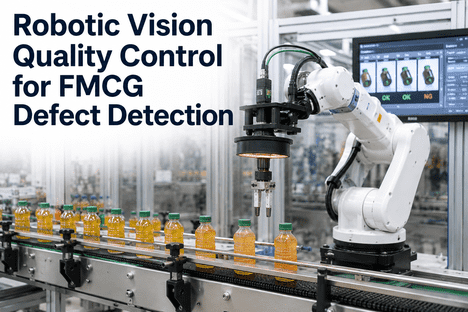
iFactory AI Vision Camera system captures high-resolution images of vessel interior surfaces, filler nozzle faces, pipe end caps, and valve diaphragms after cleaning robot cycles. Deep learning models trained on 50,000+ labelled surface images — clean, residue-present, biofilm-developing, detergent-film — generate a cleanliness score per surface zone calibrated against ATP RLU measurements and ELISA assay results. The vision model detects residual surfactant films (visible under UV-fluorescence illumination), protein deposits (autofluorescence signature), and particulate debris at sub-millimetre resolution — achieving 95–99% correlation with quantitative swab results while providing full-surface coverage in seconds instead of spot-swabbing 10–40 points. Scoring is per-zone, per-vessel, per-changeover, enabling QA teams to approve clean status or flag specific zones for reclean without manual inspection. The digital score replaces the paper ATP log with a structured, searchable validation record that is audit-ready instantly.
Book a Demo to see AI vision cleanliness scoring in a live FMCG plant environment.
95–99% ATP/ELISA correlationFull-surface coverageInstant digital record
02
Cleaning Robot Trajectory & Coverage Validation
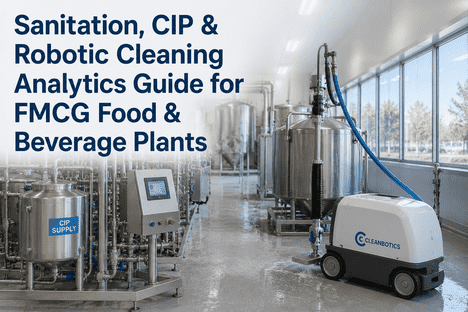
Cleaning robots — whether humanoid form-factor, gantry-mounted spray systems, or mobile manipulators — follow programmed cleaning trajectories that must cover every critical surface with correct standoff distance, spray angle, detergent concentration, and dwell time. iFactory's Shift Logbook integrates with robot controllers to ingest trajectory execution data — actual vs. programmed path deviation, spray nozzle pressure per zone, detergent flow rate, and contact time per surface. Deviations beyond acceptable tolerance generate an alert and trigger a reclean instruction before the vision inspection even begins, preventing coverage gaps from propagating to validation failure. The robot performance log — automatically cross-referenced to cleaning cycle outcome — provides maintenance teams with early warning of nozzle clogging, pump degradation, or manipulator drift that would reduce cleaning effectiveness if unaddressed.
Real-time trajectory monitoringSpray/flow performance trackingPre-validation coverage check
03
Allergen Changeover Verification Workflow Automation
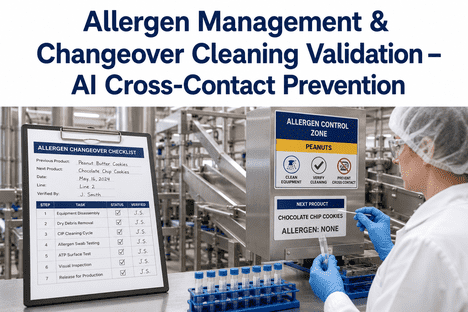
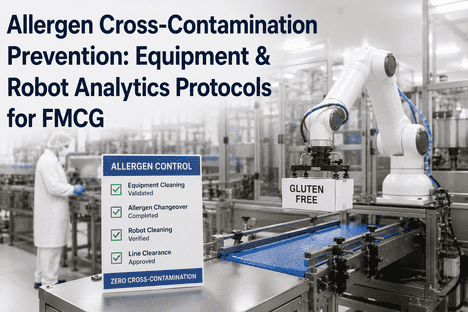
Allergen changeover between product families — e.g., switching from a wheat-protein-containing shampoo to a gluten-free formula, or from a nut-oil-based conditioner to a nut-free variant — requires the highest level of cleaning validation confidence because residual allergen detection limits are measured in parts per million (ppm). iFactory's Inspection Management module orchestrates the full allergen changeover workflow: schedule cleaning robot deployment per vessel, trigger AI vision inspection after cleaning cycle completion, compare surface cleanliness scores against product-specific threshold (higher threshold for allergen changeover vs. same-family product change), generate pass/reclean decision per vessel, and produce an allergen-changeover validation package that includes cleaning robot execution data, vision scores per zone, and QA reviewer digital signature. The entire workflow — from CIP start to validated-cleared-for-production — executes in 45–90 minutes instead of the 2–6 hours required for manual swab-test-wait-approve cycles. The digital validation package is structured for instant retrieval during regulatory audits and customer quality audits.
45–90 min vs. 2–6 hr changeoverPpm-level allergen thresholdAudit-ready digital package
04
GMP Hygiene Trending & Audit Readiness Dashboard
FMCG plants operating under GMP hygienic design standards must demonstrate that cleaning validation is consistently effective across all products, vessels, and changeover types — not just on the day of an audit. iFactory's analytics dashboard aggregates cleaning validation outcomes per vessel, per product family, per cleaning robot, and per shift — surfacing trends in residual surfactant scores, allergen clearance rates, cleaning robot performance degradation, and vessel-specific cleaning difficulty. A vessel that consistently requires reclean cycles after robot cleaning may indicate surface degradation (pitting, corrosion, biofilm establishment) that requires intervention beyond cleaning. A cleaning robot showing declining coverage performance on specific vessel zones may need maintenance on a specific spray nozzle or joint. The dashboard provides the trending data that GMP auditors and certification bodies require — continuous verification of cleaning effectiveness rather than point-in-time spot checks — and generates compliance reports in the format required by BRCGS, FSSC 22000, and ISO 21469 audit frameworks.
Per-vessel/robot/product trendingBRCGS/FSSC/ISO report generationDegradation early warning
Cost Comparison — Manual Cleaning Validation vs. Robot Cleaning with AI Vision Validation
Three Deployment Paths for FMCG Hygiene Cleaning Robot Validation
Path A
Allergen Line Validation Pilot
6–8 weeks
Deploy AI Vision Camera and digital validation workflow on one high-risk allergen changeover line. Manual cleaning continues; AI vision replaces ATP swabbing for validation decisioning. Prove allergen clearance confidence and changeover time reduction.
Best fit
FMCG plants with 1–2 high-risk allergen changeover lines · existing manual cleaning program · need to prove AI validation before robot investment
Wk 1–3 AI Vision Camera install + baseline calibration
Wk 4–5 Validation workflow + Shift Logbook integration
Wk 6–8 Parallel run + ATP correlation validation
Path B
Cleaning Robot + AI Validation Integration
10–14 weeks
Deploy cleaning robot(s) on 3–5 processing vessels with iFactory AI Vision validation orchestration. Robot trajectory monitoring, AI cleanliness scoring, and digital pass/reclean workflow operational. Entire allergen changeover process automated from CIP start to production release.
Best fit
FMCG plants with 3–8 product changeovers per week · ready to invest in cleaning robotics · need integrated validation to justify robot ROI
Wk 1–4 Robot deployment + vessel surface mapping
Wk 5–9 AI Vision + trajectory integration + threshold calibration
Wk 10–14 Workflow automation + audit dashboard go-live
Path C
Plant-Wide Hygiene Automation
16–24 weeks
All processing vessels and packaging lines covered by cleaning robots with iFactory validation orchestration. Multi-robot fleet management, cross-line workflow scheduling, GMP compliance dashboard, and enterprise audit reporting.
Best fit
FMCG plants with 15+ product changeovers per week · multiple processing lines · regulatory audit frequency requiring continuous verification
Wk 1–8 Fleet-wide robot + vision deployment
Wk 9–16 Cross-line workflow orchestration + threshold library
Wk 17–24 Enterprise dashboard + audit automation
Hygiene Automation Workshop · GMP Compliance · 2026
Run Your FMCG Plant's Cleaning Validation Automation Assessment
iFactory's FMCG hygiene practice runs a structured assessment against your specific plant — product changeover frequency, allergen control requirements, current cleaning validation cost, and CIP cycle constraints. You leave with a path recommendation, deployment timeline, and hygiene automation ROI projection grounded in your plant's data.
Real Validation Results — What FMCG Plants Achieve with Cleaning Robot Validation Automation
60–75%
Reduction in cleaning validation cycle time
AI vision-based cleanliness scoring replaces 2–6 hour ATP swab wait cycles with 45–90 minute full-surface validation, recovering 4–12 hours of production capacity per week
85–95%
Reduction in QA technician hours for validation
Automated vision inspection eliminates manual swabbing for routine changeovers; QA team shifts from execution to exception handling and continuous improvement
100%
Digital validation record capture per changeover
Every cleaning cycle produces a structured, searchable, audit-ready validation package — robot trajectory log, AI vision scores per zone, pass/reclean decision, QA review timestamp
3–5x
Faster audit preparation vs. manual record retrieval
GMP audit dashboard generates cleaning validation trend reports, allergen changeover compliance summaries, and robot performance logs in minutes instead of days
Expert Perspective — Why Cleaning Validation Is the Highest-ROI Automation Target in FMCG Hygiene
"Most FMCG plants approach cleaning validation as a compliance cost — something they must do to pass audits, not something that can create competitive advantage. This is a blind spot that costs them $120,000–$280,000 per year in QA labour and lost production capacity. The transition from manual ATP swab validation to robot cleaning with AI vision validation is not a cost reduction story — it is a capacity recovery story. A plant running 12 changeovers per week at 2 hours validation time each loses 24 hours of production capacity per week to cleaning validation alone. Recovering that capacity through automated validation is equivalent to adding 6–8 weeks of production per year without capital investment in additional processing lines. The cleaning robot itself is a capital decision. The AI vision validation that enables the robot to replace manual cleaning — and provides the digital audit trail that GMP compliance requires — is a software investment that pays for itself in the first quarter by recovering production capacity that was already paid for. FMCG QA and production leaders who treat cleaning validation as a production capacity optimisation opportunity rather than a compliance expense will capture a competitive advantage in changeover speed, production flexibility, and audit confidence that their competitors using manual ATP programs cannot match."
— FMCG Hygiene & GMP Automation Practice, 2026 industry insight
6–8 wk
Production capacity recovered per year through automated validation cycle time reduction
$180K–$420K
First-year value from recovered production capacity and QA labour reallocation
0
Additional QA headcount required for robot cleaning validation program
Vendor Evaluation Framework for Cleaning Robot Validation Platforms
FMCG cleaning validation platforms differ from general industrial inspection systems across six dimensions that reflect the specific requirements of GMP-compliant equipment cleaning in consumer goods manufacturing.
01
AI vision model calibrated to FMCG residue types
Ask:
"Is your AI vision cleanliness model trained on surfactant films, protein deposits, fragrance oils, and preservative residues specific to FMCG personal care and home care products — or is it a general surface defect classifier?"
FMCG cleaning validation requires detection of transparent or translucent residue films that general defect classifiers miss. Models must be trained on product-specific residue libraries with ATP and ELISA ground truth labelling.
02
Allergen-specific threshold configurability
Ask:
"Does your platform support cleanliness threshold configuration per product family — with higher thresholds for allergen changeover vs. same-family changeover — and can thresholds be adjusted per vessel and per surface zone?"
Allergen changeover requires ppm-level detection sensitivity; same-family changeover may allow looser thresholds. The platform must support zone-specific, product-pair-specific threshold libraries that adjust automatically based on changeover type.
03
Cleaning robot controller integration
Ask:
"Does your platform ingest trajectory execution data from humanoid, gantry, and mobile-manipulator cleaning robots — and flag coverage deviations before the validation inspection begins?"
Cleaning robot integration must be robot-agnostic, supporting common controller interfaces (UR, Fanuc, Kuka, ABB, Yaskawa). Trajectory monitoring prevents validation failures by catching coverage gaps at execution time.
04
GMP-compliant digital validation record
Ask:
"Does your platform produce cleaning validation records that satisfy BRCGS, FSSC 22000, and ISO 21469 audit requirements — with digital signatures, timestamped image evidence, and trend data per vessel?"
Audit-ready validation records must include robot execution data, AI vision scores with image evidence, pass/reclean decisions, reviewer digital signatures, and searchable trend data — generated automatically per changeover without manual compilation.
05
Shift Logbook integration for operator exception handling
Ask:
"Does your Shift Logbook enable operators and QA technicians to document reclean decisions, surface anomaly observations, and equipment condition changes — and does that data feed back into the AI vision model training pipeline?"
Operator observations during cleaning validation — "residue on valve 3 identified during visual inspection" — contain edge-case training data for AI vision models. The platform must capture structured operator feedback and use it for continuous model improvement.
06
Multi-plant hygiene benchmarking capability
Ask:
"Does your platform support cross-plant comparison of cleaning validation performance — changeover cycle time, reclean rate, vision score trends — for enterprise FMCG groups with multiple production sites?"
FMCG corporates with multiple plants need to benchmark cleaning validation efficiency, identify vessels with consistently high reclean rates across sites, and propagate best practices for allergen changeover workflows.
FAQ
Does iFactory AI Vision replace ATP swab testing entirely, or is it used alongside existing validated methods?
iFactory AI Vision cleanliness scoring is designed to replace routine ATP swab testing for standard changeover validation, with parallel run validation during the initial deployment phase to establish correlation against the plant's existing ATP method. For regulatory-required allergen changeover validation, AI vision serves as the primary in-situ screening method with confirmation swabbing at a reduced sample rate (5–10% of surface zones instead of 100%) for lab-based ELISA or PCR quantitation. The AI vision model is calibrated against each product family's ATP and ELISA ground truth during deployment, enabling the platform to substitute for swab testing on >90% of changeover events within 4–6 weeks of deployment.
Can iFactory integrate with existing CIP cleaning systems, or does the plant need to deploy cleaning robots first?
iFactory's validation platform works with both CIP systems and cleaning robots independently. For plants using CIP cleaning, the AI Vision Camera inspects vessel surfaces after the CIP cycle, and the Shift Logbook captures CIP cycle parameters (detergent concentration, flow rate, temperature, duration) from the CIP controller. For plants deploying cleaning robots, the platform adds trajectory monitoring and robot performance analytics. The platform can be deployed with AI Vision validation first, then expanded to robot integration as the plant's cleaning automation program matures.
How does the AI vision cleanliness model handle complex vessel geometries, dead-legs, and valve interiors that ATP swabbing cannot reach?
The AI Vision Camera system uses articulating borescope-style or robot-mounted cameras that navigate vessel interiors, pipe runs, and dead-legs that are inaccessible to manual ATP swabbing. The vision model has been trained on 50,000+ labelled images from 200+ vessel geometries, including agitated vessels, holding tanks, heat exchangers, and multi-port valve assemblies. Coverage mapping per vessel identifies areas that cannot be visually inspected due to geometry constraints and flags them for supplementary verification methods; these areas represent <5% of total wetted surface in typical FMCG vessel configurations.
What cleaning robot platforms does iFactory support for trajectory monitoring and integration?
iFactory integrates with all major cleaning robot platforms through standard industrial communication protocols: Universal Robots (UR10e, UR20, UR30) for humanoid mobile manipulator cleaning, Fanuc CRX and FANUC M-10 for gantry-mounted vessel cleaning, Kuka KR IONTEC and KR QUANTEC for high-reach vessel interior cleaning, ABB GoFa and IRB 6700 for multi-purpose cleaning cells, and Yaskawa Motoman GP-series for tank farm cleaning operations. Integration is read-only to robot controllers — trajectory data, joint positions, spray pressure, and flow rates — with no write access to robot safety-rated control loops.
How long does it take to calibrate the AI vision model for a new product family or vessel geometry?
Initial calibration for a new product family or vessel geometry requires 20–50 labelled images covering clean, residue-present, and transitional surface states. With iFactory's transfer learning pipeline, new product calibration takes 2–4 days from sample collection to validated model deployment. The platform's active learning loop automatically identifies ambiguous surface conditions during production and requests QA labels — continuously improving model accuracy without requiring a dedicated data science team.
Conclusion: Cleaning Validation Automation Is the Next Productivity Leap in FMCG Manufacturing
FMCG plants that automate cleaning validation — combining cleaning robots, AI vision surface inspection, and digital validation workflow orchestration — will capture a productivity advantage that manual ATP-swab-based programs cannot match: 60–75% faster changeover validation, 85–95% reduction in QA technician hours, 100% digital audit-ready records, and production capacity recovery equivalent to 6–8 additional production weeks per year. The technology stack exists today — cleaning robots are commercially mature, AI vision cleanliness models achieve 95–99% correlation with ATP methods, and digital Shift Logbook / Inspection Management platforms provide the GMP-compliant validation record that regulatory audits require. The investment required — $35,000–$85,000 for AI Vision validation software plus cleaning robot deployment costs that vary by scope — is recovered in the first year through recovered production capacity alone, before counting QA labour savings, allergen risk reduction, and audit preparation time elimination. The question facing FMCG QA, production, and engineering leadership is not whether cleaning validation automation delivers a positive ROI — it is which deployment path fits the plant's product changeover frequency, allergen control requirements, and capital planning cycle. Walk through your specific cleaning validation cost structure, changeover frequency, and audit compliance burden with our FMCG hygiene automation practice.
Hygiene Automation Assessment · GMP Compliance · 60 Minutes
Build Your FMCG Plant's Cleaning Validation Automation Roadmap
iFactory's FMCG hygiene practice runs a structured assessment against your plant — product changeover frequency, allergen control requirements, current cleaning validation cost, and CIP cycle constraints. You leave with a path recommendation, deployment timeline, and hygiene automation ROI projection grounded in your plant's actual data.