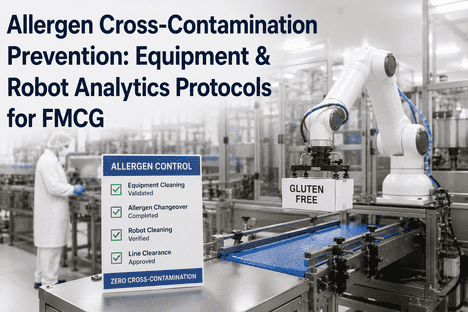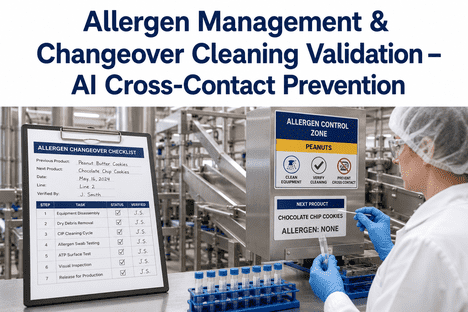
In food, beverage, and pharmaceutical manufacturing, allergen changeover cleaning is one of the highest-risk operations in the production cycle — a single incomplete clean between an allergen-containing run and an allergen-free run can produce cross-contact that triggers a recall, generates a customer complaint, or fails a regulatory inspection. Traditional changeover cleaning validation relies on visual inspection, ATP swabbing, and allergen-specific ELISA testing at scheduled intervals — providing point-in-time verification that misses the gradual degradation of cleaning effectiveness between validation events. AI-driven allergen changeover cleaning validation platforms ingest real-time CIP parameter data, swab result trends, production schedule information, and equipment history to assess cross-contact risk continuously, detect cleaning effectiveness drift 1–3 weeks before it produces a positive allergen result, and recommend targeted corrective actions that reduce cross-contact risk by 40–60 % while optimising changeover time and cleaning resource consumption. iFactory AI's platform, including its Shift Logbook and cleaning validation analytics engine, enables process engineers to manage allergen changeover cleaning validation, track cross-contact risk across product SKUs, and automate cleaning effectiveness documentation from a single dashboard — without replacing existing CIP skid controllers, laboratory workflows, or allergen testing protocols. Book a Demo to see how iFactory delivers AI-driven allergen changeover cleaning validation for hygienic manufacturing operations.
What Is AI Allergen Changeover Cleaning Validation?
AI allergen changeover cleaning validation applies machine learning algorithms to multivariate cleaning data — CIP parameter trends, ATP swab results, allergen-specific ELISA test outcomes, production schedule sequences, equipment contact surface history, and cleaning interval records — to continuously assess cross-contact risk between production runs. Unlike traditional changeover validation that relies on scheduled swab testing and visual inspection at fixed intervals, AI systems analyse every cleaning cycle in real time, detect parameter drift patterns that precede cleaning effectiveness degradation, and assign a cross-contact risk score to each changeover before the next production run begins. Process engineers evaluating AI-driven changeover cleaning validation Book a Demo to see how iFactory AI connects with existing CIP systems, laboratory databases, and production scheduling platforms.
| Capability | Traditional Changeover Validation | AI-Driven Validation |
|---|---|---|
| Validation Method | Scheduled visual inspection, ATP swab, ELISA test at fixed intervals | Continuous AI analysis of every cleaning cycle with real-time risk scoring |
| Cross-Contact Detection | Detected at next scheduled swab or customer complaint | Detected 1–3 weeks before allergen residue exceeds threshold |
| Data Sources | Isolated lab results, manual inspection logs | CIP parameters, swab trends, production schedule, equipment history |
| Risk Assessment | Binary pass/fail per swab event | Continuous risk score per changeover with trend projection |
| Documentation | Manual logbooks and spreadsheet records | Automated audit-ready cleaning validation reports |
Three AI Approaches for Allergen Changeover Cleaning Validation
Three primary AI approaches power allergen changeover cleaning validation in hygienic manufacturing. Each method addresses different allergen types, cleaning validation maturity levels, and production scheduling complexity. Process engineers evaluating AI approaches Book a Demo to see which fits their facility profile and allergen portfolio.
Cleaning Effectiveness Prediction uses supervised learning models trained on historical allergen swab results, CIP parameter trends, and equipment surface data to predict the probability that a changeover cleaning cycle has achieved sufficient allergen removal. Models like gradient-boosted trees and logistic regression analyse conductivity curves, temperature profiles, flow rates, and contact time for each cleaning phase and compare them against validated cleaning signatures. When a cleaning cycle deviates from the validated pattern, the system predicts the residual allergen risk before the next production run begins — enabling process engineers to order additional cleaning cycles or targeted swab testing before releasing the line for allergen-free production.
Cross-Contact Risk Scoring applies multivariate risk algorithms that combine cleaning effectiveness predictions with production sequence context, equipment configuration, allergen potency, and product sensitivity to assign a composite cross-contact risk score to each changeover event. The risk model weighs factors including previous product allergen level, cleaning cycle quality score, time since last full validation, equipment complexity (dead legs, gaskets, valves), and the sensitivity of the next product. The output is a continuous risk score from 0–100 that process engineers use to prioritise high-risk changeovers for additional verification or to release low-risk changeovers with confidence, reducing unnecessary swab testing and cleaning time.
Changeover Optimisation uses reinforcement learning and scheduling algorithms to recommend the optimal changeover sequence across a production shift — minimising cross-contact risk while maximising line utilisation. The system considers allergen groups (milk, egg, soy, wheat, peanut, tree nut, sesame), product potency, cleaning duration per changeover type, and production deadline constraints to generate a changeover sequence that reduces total cleaning time by 15–25 % while maintaining cross-contact risk below the validated threshold. Process engineers can adjust risk tolerance per product category and receive real-time recommendations as production schedules shift.
AI vs. Traditional Changeover Cleaning Validation
The gap between scheduled swab validation and continuous AI-driven risk assessment is measured in detection speed, risk visibility, and resource efficiency. The table below evaluates both approaches across capabilities that matter most to process engineers in hygienic manufacturing.
| Capability | Traditional Changeover Validation | AI-Driven Validation |
|---|---|---|
| Validation Frequency | Scheduled per production cycle or batch — gap between events | Every cleaning cycle analysed continuously |
| Detection Timeline | 24–72 hours swab turnaround + 1–4 weeks to investigation | Real-time risk alert within minutes of cycle completion |
| Cross-Contact Visibility | Binary pass/fail per sample point | Continuous risk heatmap across all zones and changeovers |
| Resource Efficiency | Fixed swab schedule regardless of actual risk | Risk-based swab allocation — high-risk runs tested more, low-risk runs tested less |
| Regulatory Documentation | Manual compilation for each audit | Automated audit-ready cleaning validation reports with full traceability |
Measured Outcomes — Cross-Contact Risk Reduction and Cleaning Optimisation
Hygienic manufacturing facilities deploying iFactory's AI allergen changeover cleaning validation platform consistently document measurable improvement in cross-contact risk reduction, cleaning efficiency, and regulatory audit readiness. The following results represent average performance across iFactory's food and beverage sector deployments.
Beyond the headline metrics, AI-driven allergen changeover cleaning validation produces structural improvements that compound over time. The cross-contact risk model improves as more cleaning cycles, swab results, and production sequences are analysed — projecting an additional 15–20 % risk reduction in year two as the model accumulates facility-specific pattern data. Process engineers reviewing their allergen management infrastructure Book a Demo to see the full ROI model for their facility and product portfolio.
Conclusion
AI allergen changeover cleaning validation transforms cross-contact prevention from a scheduled swab compliance activity into a continuous, intelligence-driven allergen control capability. Machine learning models analyse every changeover cleaning cycle in real time, predict residual allergen risk before the next production run begins, and allocate verification resources based on actual cross-contact probability rather than a fixed schedule. Process engineers achieve 40–60 % reduction in cross-contact risk events, 15–25 % reduction in changeover cleaning time, 50–70 % reduction in unnecessary swab testing, and 80 % faster audit documentation generation. Food safety and process engineering leaders ready to eliminate allergen cross-contact risk from their changeover operations Book a Demo to see iFactory AI allergen changeover cleaning validation deployed in live hygienic manufacturing environments with full Shift Logbook integration.
Frequently Asked Questions — Allergen Changeover Cleaning Validation
How does AI allergen changeover cleaning validation differ from traditional scheduled swab validation?
Traditional scheduled swab validation provides point-in-time verification at fixed intervals — typically once per week, per production cycle, or per month depending on allergen risk classification. AI-driven validation analyses every changeover cleaning cycle continuously, using CIP parameter trends, swab history, and equipment data to predict cleaning effectiveness for each individual changeover before the next production run begins. The key difference is detection speed: scheduled swab validation may miss cleaning degradation that develops between swab events, while AI validation detects parameter drift the moment it deviates from the validated cleaning signature.
What data sources does AI allergen changeover cleaning validation require?
The platform ingests data from CIP skid controllers (conductivity, temperature, flow rate, pH for each cleaning phase), laboratory information systems (ATP swab results, allergen-specific ELISA test outcomes), production scheduling platforms (product sequences, allergen classification, run durations), and equipment maintenance records (gasket replacement, valve overhaul, surface condition). iFactory connects to all these sources through standard OPC-UA, Modbus TCP, and REST API connectors — no sensor retrofit or control system replacement required.
Does AI allergen changeover validation eliminate the need for allergen-specific swab testing?
No. AI allergen changeover cleaning validation complements allergen-specific swab testing by optimising where and when swab resources are deployed. The risk model identifies high-risk changeovers that warrant additional swab verification and low-risk changeovers where scheduled swab testing can be reduced. Most facilities reduce total swab testing by 50–70 % while maintaining or improving cross-contact risk detection. Allergen-specific ELISA testing remains the definitive verification method — AI makes it smarter by targeting the right changeovers at the right time.
How does the platform handle multiple allergens with different potency levels and cross-contact thresholds?
The platform maintains a separate risk model instance per allergen type, calibrated to each allergen's specific regulatory threshold (FDA Big 9, EU FIC, CFIA priority allergens), potency level, and facility-specific action limits. Cross-contact risk scoring accounts for allergen potency — peanut and tree nut receive higher risk weighting than soy or wheat, for example — and the production sequence context determines whether the changeover is from a high-potency allergen to a sensitive product or between low-risk ingredients. Multi-allergen facilities manage all allergen models from a single dashboard.
What is the typical deployment timeline for AI allergen changeover cleaning validation in a hygienic manufacturing facility?
Stage one — CIP system integration, laboratory data connectivity, and historical cleaning data ingestion — typically takes 3–5 weeks. Stage two — cleaning effectiveness signature calibration per allergen type and equipment configuration — requires 4–6 weeks of parallel validation against existing swab results. Stage three — risk model deployment with live cross-contact scoring and verification optimisation — takes 3–4 weeks. Full production deployment with audit-ready documentation is achievable within 3–5 months from project initiation, depending on data availability and integration readiness. Book a Demo for a detailed deployment timeline customised to your facility.