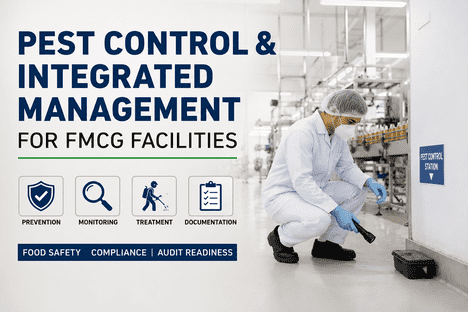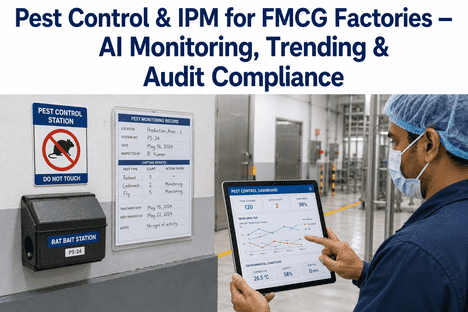
In FMCG food manufacturing, pest control is not simply a hygiene function — it is a regulatory requirement under BRC Global Standard Food Issue 9, SQF Code Edition 9, and FSSC 22000 Scheme Version 6, each of which demands documented pest management programmes, trending analysis, and evidence of corrective action. Traditional pest control relies on scheduled external contractor visits, manual trap checks, and paper-based logbooks that produce snapshots of pest activity at isolated points in time — making it nearly impossible to detect emerging infestations before they become audit findings or contamination risks. AI-driven pest control and integrated pest management (IPM) platforms ingest real-time trap catch data, environmental sensor readings, treatment records, and historical infestation patterns to detect activity trends 2–4 weeks before they exceed threshold, correlate pest pressure with seasonal and operational variables, and generate audit-ready documentation automatically. iFactory AI's platform, including its Shift Logbook and monitoring analytics engine, enables maintenance managers to manage pest control programmes across multiple FMCG production sites, track trap service compliance and corrective actions, and produce BRC/SQF/FSSC 22000 pest control documentation from a single dashboard — without replacing existing pest control contractor workflows or trap infrastructure. Book a Demo to see how iFactory delivers AI-driven pest control monitoring and compliance for FMCG factory operations.
Deploy AI Pest Control Monitoring Across Your FMCG Factory
Replace manual pest logbooks with continuous AI-driven trap monitoring, trend analysis, and automated audit documentation. Get a personalised pest control compliance assessment and IPM optimisation plan for your facility.
What Is AI-Driven Pest Control and IPM for FMCG Factories?
AI-driven pest control and integrated pest management (IPM) applies machine learning algorithms to multivariate pest monitoring data — trap catch counts by location and pest species, environmental conditions (temperature, humidity, seasonal patterns), treatment records, facility maintenance activities, and historical infestation trends — to continuously assess pest pressure across production areas, detect activity shifts that precede infestations, and generate actionable intelligence for maintenance managers and pest control contractors. Unlike traditional IPM that relies on scheduled contractor visits and manual logbook entries reviewed weeks after collection, AI systems analyse every trap check in real time, correlate pest activity with environmental and operational variables, and assign risk scores to each monitoring zone before pests reach threshold levels. Maintenance managers evaluating AI-driven pest control for their FMCG facility Book a Demo to see how iFactory AI connects with existing trap systems, environmental sensors, and contractor workflows.
Manual Data Fragmentation
Pest activity data lives in paper logbooks, contractor reports, and isolated spreadsheets — making cross-site trend analysis, root cause identification, and audit evidence assembly a manual, error-prone process that consumes 4–8 hours per audit cycle.
Reactive Instead of Preventive
Without continuous trend analysis, pest activity increases are detected only at the next scheduled trap check or when product contamination occurs — weeks after the infestation began, turning a preventable situation into an audit finding.
Audit Documentation Burden
BRC Issue 9 and SQF Edition 9 require documented pest trend analysis, corrective action records, and proof of review at specified intervals. Manual documentation often fails to meet auditor expectations, resulting in major non-conformances that can delay certification.
Why AI Pest Control Monitoring Matters for Maintenance Managers
For maintenance managers in FMCG factories, pest control is a direct line to certification success or failure. A single pest-related major non-conformance during a BRC or SQF audit can trigger a 6–12 week re-audit cycle, disrupt production schedules, and damage customer relationships. Beyond compliance, uncontrolled pest activity leads to product contamination risks, recall exposure, reputational damage, and significant financial liability. AI-driven pest control monitoring transforms pest management from a compliance checkbox into a continuous improvement tool — providing maintenance managers with real-time visibility into trap activity across all zones, automated trend analysis that correlates pest pressure with facility conditions, and audit-ready documentation that satisfies even the most rigorous third-party certification requirements. Maintenance managers targeting BRC/SQF/FSSC 22000 compliance Book a Demo to see the iFactory pest control monitoring deployment timeline for FMCG operations.
| Capability | Traditional Pest Control | AI-Driven IPM |
|---|---|---|
| Data Collection | Paper logbooks, contractor reports, manual spreadsheets | Real-time digital capture from traps, sensors, and contractor mobile entries |
| Trend Analysis | Manual spreadsheet review — 4–8 hours per reporting period | Automated AI trending — continuous, with email alerts at threshold breaches |
| Infestation Detection | Detected at next scheduled trap check or after contamination event | Detected 2–4 weeks before threshold breach via predictive trend analysis |
| Audit Documentation | Binders of paper records assembled manually before each audit | Digital dashboards with one-click audit report generation |
| Corrective Action Tracking | Email chains and paper forms — easy to lose follow-up | Automated workflows with assignment, deadline, and closure verification |
| Cross-Site Visibility | Each site maintains separate records — no consolidated view | Unified dashboard across all FMCG production sites with comparative analytics |
How AI Monitoring and Trending Transform FMCG Pest Control
AI pest control monitoring uses a continuous analytics engine that ingests trap catch data, environmental sensor readings, treatment records, and facility activity logs to build a real-time pest pressure model for every monitoring zone in the factory. When trap catch rates increase, environmental conditions shift toward pest-favourable ranges, or treatment effectiveness declines, the platform flags the change, correlates it with operational variables, and recommends targeted corrective actions — before the infestation reaches threshold levels. The AI layer distinguishes between normal seasonal pest activity variation and genuine infestation signals, reducing false alerts while ensuring maintenance managers respond to the events that matter.
Real-Time Trap Data Aggregation
Platform ingests catch counts from electronic and manually logged traps across all monitoring zones — rodent bait stations, insect light traps, glue boards, pheromone traps — unified into a single activity timeline per species and location.
Environmental Correlation Engine
Machine learning models correlate pest activity with temperature, humidity, seasonal patterns, and facility events (maintenance shutdowns, ingredient deliveries, construction) to identify conditions that precede infestation and recommend preventive environmental adjustments.
Predictive Threshold Alerting
AI models trained on 24+ months of pest activity data predict when trap catch rates will exceed threshold levels, generating alerts 2–4 weeks in advance so maintenance managers can deploy preventive treatments before contamination risk materialises.
Automated Compliance Documentation
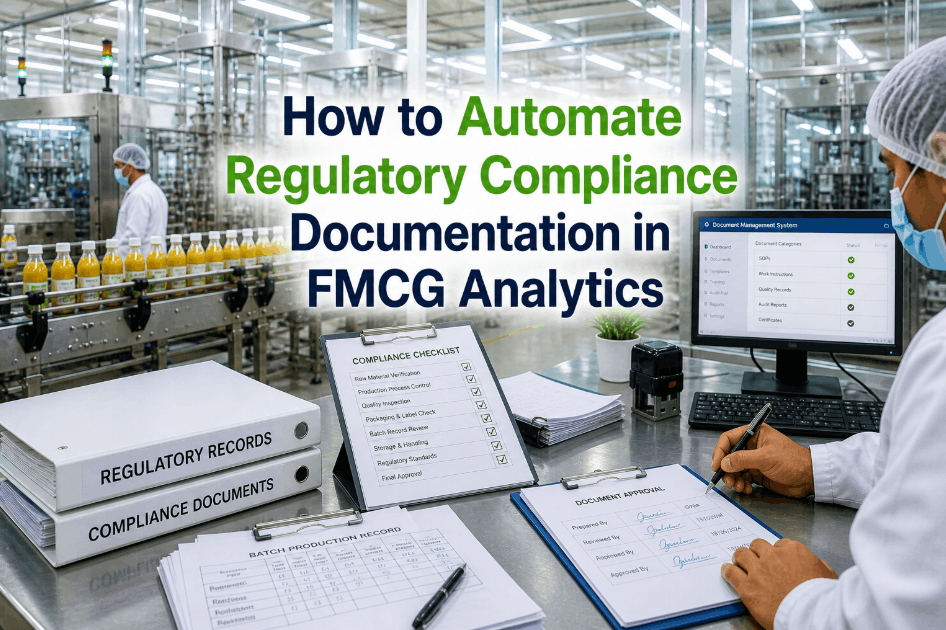
BRC Issue 9, SQF Edition 9, and FSSC 22000 pest control documentation — including trend reports, corrective action records, service schedules, and management review summaries — generated automatically and available on demand for auditor review.
AI Pest Control vs Traditional Pest Management in FMCG
The operational difference between AI-driven pest control and traditional paper-based pest management is visible across every dimension of IPM programme execution — from data quality and trend visibility to audit outcomes and pest pressure reduction. The following comparison shows measured performance across FMCG factories that have transitioned from manual to AI-driven pest control monitoring.
| Capability | Traditional Pest Management | AI-Driven IPM | Improvement |
|---|---|---|---|
| Data Capture Method | Paper logbook entries reviewed weekly or monthly | Digital capture in real time from every trap check | Immediate visibility |
| Trend Analysis Frequency | Monthly manual spreadsheet review | Continuous automated analysis with daily alerts | 30x faster insight generation |
| Infestation Detection Lag | 2–6 weeks after onset | 2–4 weeks before threshold breach | 4–10 week prevention window |
| Audit Preparation Time | 8–16 hours per site per audit | < 30 minutes for report generation | 95% time reduction |
| Cross-Site Visibility | None — each site managed independently | Unified dashboard with comparative analytics | Centralised governance |
| Corrective Action Closure | Average 14–21 days to documented closure | Average 3–5 days via automated workflow | 75% faster resolution |
Our previous pest control system relied on a binder full of paper trap check sheets that the contractor filled out monthly. When the BRC auditor asked for trend analysis, we had to pull three years of paper records and build the trends manually over a weekend. After deploying iFactory's AI pest control monitoring, we produce automated trend reports in minutes, our corrective actions are tracked to closure, and our last BRC audit had zero pest-related findings for the first time in five years.
Move from Paper Pest Logbooks to AI-Driven Compliance in Four Weeks
iFactory's AI pest control monitoring platform deploys across FMCG factory sites in four weeks with no trap infrastructure replacement. Real-time activity tracking, automated trend analysis, and BRC/SQF/FSSC 22000 audit-ready documentation deliver measurable pest pressure reduction and compliance confidence from day one.
AI Pest Control Monitoring Turns Compliance from a Burden into a Continuous Advantage
The gap between scheduled paper-based pest control and continuous AI-driven monitoring is the source of most pest-related audit findings, contamination risks, and reactive treatment costs in FMCG factories. AI pest control and IPM platforms close that gap by ensuring every trap check, environmental reading, and corrective action feeds a live intelligence system — detecting infestations 2–4 weeks earlier, reducing audit findings by 60%, and cutting documentation time by 95%. Maintenance managers evaluating their pest control technology roadmap Book a Demo to review the iFactory pest control monitoring deployment plan for your FMCG operations.
AI Pest Control and IPM for FMCG Factories — Frequently Asked Questions
BRC Issue 9 Clause 4.13 requires documented pest management programmes that include trend analysis, corrective action records, and evidence of management review at specified intervals. iFactory's AI pest control platform generates automated trend reports with activity charts by species and zone, maintains a complete corrective action history with closure verification, and provides management review summaries that satisfy BRC auditor requirements — all accessible from a single dashboard with one-click audit report generation.
The platform integrates with all common pest monitoring devices including electronic rodent bait stations, insect light traps (ILTs), glue boards, pheromone traps, and bird monitoring systems. Data can be captured via IoT sensors, contractor mobile app entry, or manual dashboard input. No existing trap infrastructure needs to be replaced — the platform layers digital intelligence on top of whatever monitoring systems are currently deployed across your FMCG factory sites.
Platform deployment across a single FMCG factory site requires approximately four weeks including trap mapping, contractor onboarding, system integration, and dashboard configuration. Multi-site deployments scale incrementally at 2–3 weeks per additional site. Pre-configured IPM templates achieve 90% operational readiness at deployment, with full AI model calibration completing within 6–8 weeks as the system absorbs site-specific pest activity patterns and environmental correlations.
No — the platform is designed to work alongside your existing pest control contractor, not replace them. Contractors use a mobile app to log trap checks, treatments, and observations in real time, eliminating paper forms while maintaining their established workflow. The platform unifies contractor data with environmental sensor readings and facility records, giving maintenance managers complete visibility without disrupting established contractor relationships or service agreements.
FMCG factories with 3+ production sites and active BRC/SQF/FSSC 22000 certification programmes typically recover platform investment within 3 to 5 months. Primary ROI drivers include eliminated audit preparation labour (8–16 hours per site per audit cycle), reduced pest-related non-conformances (up to 60% reduction), avoided production downtime from infestation events, and streamlined contractor management through digital workflows. A personalised ROI analysis is provided during the Book a Demo consultation with iFactory's FMCG pest control team.
Schedule an AI Pest Control Walkthrough for Your FMCG Factory
iFactory's AI pest control monitoring platform replaces paper logbooks with real-time trap activity tracking, automated trend analysis, and BRC/SQF/FSSC 22000 audit-ready documentation. Schedule a personalised walkthrough with your maintenance team.