The quality manager at a mid-size FMCG facility was six months out from her FSSC 22000 certification audit. The prerequisite programs were in place — cleaning schedules, pest control, supplier approval — but one gap kept appearing in every internal audit: there was no documented equipment analytics program. The food safety management system required evidence that equipment performance was monitored, that maintenance was driven by data rather than calendar intervals, and that trends in equipment condition were analyzed and acted upon. Without an equipment analytics program that generates documented evidence of proactive monitoring, the facility risked a non-conformance that could delay certification by months and cost hundreds of thousands in lost customer contracts. This guide covers exactly what FSSC 22000 requires for equipment analytics, how to build a compliant program, and how AI-driven analytics platforms like iFactory AI simplify the certification process.
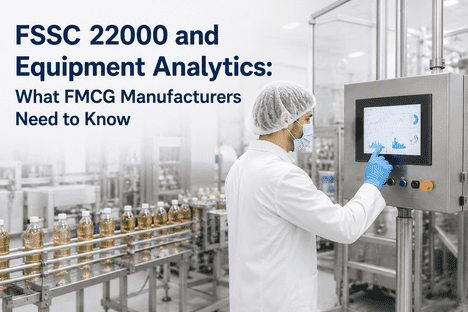
FSSC 22000 and Equipment Analytics: What FMCG Manufacturers Need to Know
FSSC 22000 certification demands documented evidence of equipment monitoring, predictive maintenance, and data-driven continuous improvement. This guide breaks down every analytics requirement, shows how to build a certification-ready program, and demonstrates how AI-driven automation reduces the audit preparation burden by up to 70 percent.
What FSSC 22000 Actually Requires for Equipment Analytics
FSSC 22000 is built on ISO 22000 and ISO/TS 22002 prerequisite programs (PRPs). The standard does not explicitly mention "equipment analytics" by name, but the requirements for equipment monitoring, maintenance program effectiveness, and data-driven decision-making create a de facto analytics mandate. Clause 8.3 of ISO 22000 requires organizations to establish, implement, and maintain a PRP for maintenance and cleaning of equipment. ISO/TS 22002-1 further specifies that maintenance programs must be documented, that equipment must be monitored to verify its ability to produce safe products, and that corrective actions must be triggered by equipment condition data. The certification auditor will look for documented evidence that the facility collects, analyzes, and acts on equipment performance data — exactly what an equipment analytics program delivers.
An equipment analytics program for FSSC 22000 must cover five specific areas: vibration monitoring for rotating equipment, temperature profiling for heat-treatment and refrigeration systems, pressure trend analysis for closed-process equipment, cycle-time consistency tracking for forming and filling machines, and lubrication condition monitoring for food-contact equipment. For each area, the facility must maintain documented records of measurement frequency, acceptable ranges, out-of-trend detection criteria, and corrective action history. iFactory AI's analytics platform automates the data collection, trend analysis, and documentation for all five areas, generating audit-ready reports with zero manual effort.
| FSSC 22000 Area | Analytics Requirement | Documentation Evidence |
|---|---|---|
| Clause 8.3 — PRP Maintenance | Documented maintenance program with analytics-driven scheduling | Maintenance logs with condition-based triggers, trend reports, calibration records |
| Clause 8.4 — Monitoring & Measuring | Equipment capability verification through continuous monitoring | Control charts, capability indices (Cp/Cpk), OEE trends, alarm logs |
| Clause 8.5.1 — Calibration | Analytics-driven calibration scheduling and drift trending | Calibration records with drift analysis, out-of-tolerance reports, adjustment history |
| Clause 10.1 — Improvement | Corrective actions triggered by equipment analytics trends | CAPA records linked to equipment data, trend analysis reports, effectiveness verification |
| ISO/TS 22002-1 PRP | Preventive maintenance driven by equipment condition monitoring | Condition monitoring logs, predictive maintenance triggers, maintenance effectiveness metrics |
The certification auditor will examine each of these areas for documented evidence that the equipment analytics program is not just collecting data but actually using that data to drive decisions. This is where most FMCG facilities fall short — they have the data but cannot show the audit trail linking equipment analytics to maintenance actions and corrective measures. Book a Demo to see how iFactory AI creates that complete audit trail automatically.
Top Equipment Analytics Gaps That Lead to FSSC 22000 Non-Conformances
Based on analysis of FSSC 22000 audit findings from 2024 and 2025, equipment analytics gaps are the third most common source of non-conformances in FMCG facilities. The gaps fall into four distinct categories that facility managers can address systematically.
No Documented Analytics Program
The facility collects vibration, temperature, and pressure data but has no formal document describing the analytics program. There are no defined measurement frequencies, no documented threshold values, and no standard operating procedure for responding to out-of-trend conditions. Auditors classify this as a major non-conformance under Clause 8.3 because the facility cannot demonstrate that equipment monitoring is systematically managed.
Data Without Action Trails
The facility has months of equipment condition data but no evidence that any decisions were based on that data. Temperature trends indicating drift, vibration levels exceeding thresholds, and cycle-time variability all went into the data historian but never generated maintenance work orders or corrective actions. Without the action trail, the data is not audit evidence — it is just noise.
Manual Documentation Cannot Scale
Spreadsheets and paper logs for equipment analytics documentation are the norm in mid-size FMCG facilities. These manual systems produce documentation that is incomplete, inconsistent, and impossible to audit efficiently. When the auditor requests trend reports for specific equipment over a defined period, the manual system cannot deliver — resulting in a finding under Clause 8.4.
No Link to Preventive Maintenance
Equipment analytics data exists in one system and the preventive maintenance program exists in another. The auditor cannot see a clear connection between condition monitoring trends and maintenance actions. The standard requires that equipment analytics drive maintenance — not just that both programs exist independently. Most facilities fail to demonstrate this linkage.
How to Prepare Your Equipment Analytics Program for FSSC 22000 Audit
Audit preparation for the equipment analytics component of FSSC 22000 follows a repeatable five-step process that aligns documentation, data collection, analytics workflows, and corrective action procedures. Each step generates specific documented evidence that the certification auditor will examine.
Get FSSC 22000 Audit-Ready with Automated Equipment Analytics
iFactory AI's platform automates the five-step audit preparation process — from sensor data collection to auditor-ready compliance reports. Schedule a demo to see how FMCG facilities reduce FSSC 22000 audit preparation time by 70 percent and eliminate equipment analytics non-conformances.
Industry Perspective on Equipment Analytics for FSSC 22000 Certification
"In my 18 years of conducting FSSC 22000 audits across more than 200 FMCG facilities, the equipment analytics gap has grown from a minor finding to a critical compliance issue. The standard has not changed dramatically, but the expectation for documented, data-driven equipment monitoring has intensified as technology has made analytics more accessible. I see facilities spending tens of thousands on certification preparation, only to receive a non-conformance because they cannot produce a clean trend report with an action trail attached. The facilities that pass the equipment analytics portion of the audit without findings are the ones that have automated the process — they are not relying on spreadsheets or manual logs. They have a platform that collects data, analyzes trends, triggers actions, and documents the entire chain automatically. That comprehensiveness is exactly what the auditor is looking for."
How AI-Driven Analytics Simplifies FSSC 22000 Certification
Traditional equipment analytics programs require dedicated data analysts, manual report generation, and extensive audit preparation effort. AI-driven analytics platforms like iFactory AI transform this workflow by automating the three most labor-intensive aspects of FSSC 22000 equipment analytics compliance: data collection and validation, trend analysis and anomaly detection, and compliance documentation generation.
The iFactory AI platform uses machine learning models trained on food manufacturing equipment data to automatically detect subtle trends that human analysts would miss. A gradual temperature drift in a cooking vessel that would be invisible in daily readings becomes a statistically significant trend that the AI flags three weeks before it reaches the critical limit. The platform automatically generates a preventive maintenance work order, logs the trend analysis in the compliance record, and includes the corrective action documentation in the next audit report. The entire process runs without manual intervention, eliminating both the analytics skills gap and the documentation burden that cause most FSSC 22000 equipment analytics non-conformances.
The platform's compliance dashboard provides real-time visibility into the status of every equipment analytics requirement. The facility manager sees at a glance which equipment has current analytics data, where trends are approaching thresholds, and which compliance reports are due for review. When the auditor arrives, the facility manager generates a complete equipment analytics evidence package with a single click — organized by FSSC 22000 clause, timestamped, and fully traceable. Book a Demo to see the iFactory AI compliance dashboard in action.
Building vs Buying Your FSSC 22000 Equipment Analytics Program
FMCG facilities face a build-versus-buy decision for their equipment analytics programs that mirrors the broader analytics staffing debate. Building an in-house equipment analytics program requires data infrastructure investment, analytics software licensing, personnel training, and ongoing maintenance — typically costing $80,000 to $150,000 in initial setup and $40,000 to $70,000 annually. Buying an AI-driven platform like iFactory AI eliminates the setup cost, reduces the annual operating cost by 60 percent, and delivers the documentation completeness that auditors require.
Sensors, software, integration, team training
Hiring, training, configuring, iterating
Audit prep remains a labor-intensive effort
Pre-built connectors, templates, AI models
Pre-configured for FSSC 22000 requirements
One-click auditor-ready evidence packages
For most mid-size FMCG facilities, the buy decision is clear: the cost of an AI-driven analytics platform is lower than the cost of building in-house capability, and the compliance outcome is more predictable. iFactory AI's platform is pre-configured for FSSC 22000 equipment analytics requirements, with templates that map directly to the standard's clauses and audit evidence expectations.
Frequently Asked Questions About FSSC 22000 and Equipment Analytics
Equipment Analytics Is No Longer Optional for FSSC 22000 Certification
The FSSC 22000 certification landscape has evolved. Equipment analytics that was once considered a best practice is now an implicit requirement enforced by auditor expectations and the increasing availability of affordable analytics technology. FMCG facilities that invest in automated equipment analytics programs reduce their certification risk, eliminate the largest source of non-conformances in the PRP portion of the audit, and reduce audit preparation effort by 70 percent. The facilities that continue to rely on manual logs, spreadsheets, and ad hoc data collection will face increasing audit scrutiny and a higher probability of non-conformances that delay certification and cost customer contracts.
iFactory AI is purpose-built for FMCG manufacturers pursuing or maintaining FSSC 22000 certification. The platform's equipment analytics module is pre-configured for the standard's requirements, integrates with existing sensors and systems, and generates the documented evidence trail that auditors demand. Whether the facility is preparing for initial certification, a surveillance audit, or recertification, iFactory AI eliminates the equipment analytics documentation burden and ensures the analytics program meets every applicable FSSC 22000 requirement. Book a Demo to learn how iFactory AI can prepare your facility for FSSC 22000 certification with a fully automated equipment analytics program.
Ready to Simplify Your FSSC 22000 Equipment Analytics Compliance?
iFactory AI is the next-generation industrial software platform that automates equipment analytics, generates auditor-ready compliance documentation, and links condition monitoring directly to maintenance and corrective actions. Schedule a demo to see the platform in action with your facility's data — deployment takes less than two weeks.