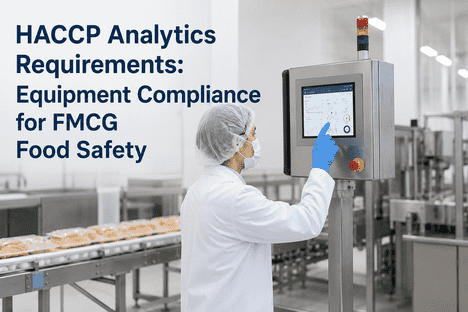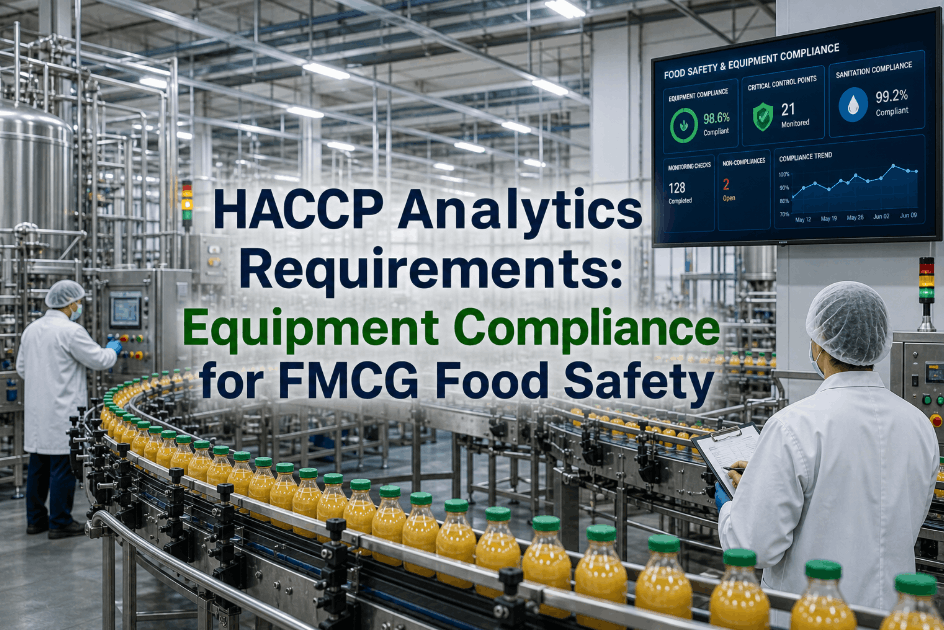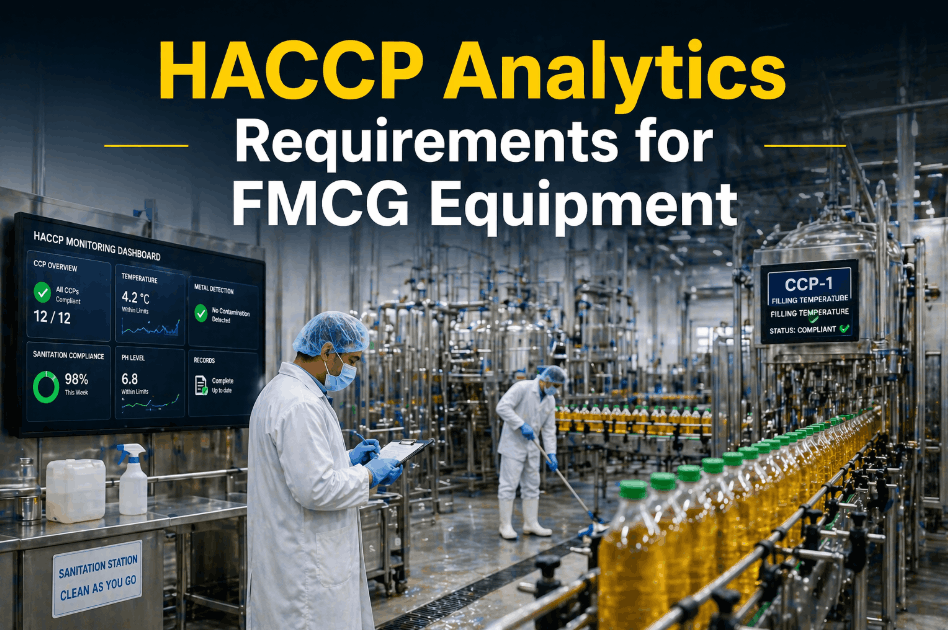
In FMCG manufacturing, HACCP analytics has evolved from a regulatory checkbox into a mission-critical operational intelligence layer. Every food safety programme depends on the reliability of equipment at Critical Control Points — and yet most facilities still manage HACCP compliance through paper logs, reactive inspections, and disconnected spreadsheets. The gap between what HACCP regulations demand and what legacy monitoring systems deliver is where food safety failures, costly recalls, and audit non-conformances breed. Understanding HACCP analytics requirements for FMCG equipment is the foundation of a proactive, data-driven food safety programme. If you want to see how leading food manufacturers close this gap with real-time compliance intelligence, you can book a demo of our production intelligence platform today.
Is Your FMCG Facility Meeting Every HACCP Analytics Requirement?
Deploy real-time CCP monitoring, automated sanitation scheduling, and audit-ready compliance documentation — all in one production intelligence platform.
What HACCP Analytics Means for FMCG Equipment Compliance
HACCP — Hazard Analysis and Critical Control Points — is the internationally recognised framework for identifying, evaluating, and controlling food safety hazards in manufacturing environments. Within FMCG operations, HACCP analytics extends this framework into the digital domain: continuously capturing, processing, and surfacing equipment data at every Critical Control Point to verify that safety parameters are being met in real time. For food manufacturers supplying major retailers, the requirements of a HACCP food safety programme are non-negotiable. Regulatory frameworks including BRCGS, SQF, FSSC 22000, and FDA FSMA all mandate documented CCP monitoring, verification records, and corrective action evidence — and the volume of compliance documentation required at scale makes manual systems structurally inadequate.
Modern HACCP analytics platforms address this by connecting directly to production equipment — pasteurisers, metal detectors, X-ray inspection systems, temperature-controlled conveyors, and sealing machines — and delivering continuous CCP verification data that is audit-ready by design. The shift from reactive HACCP documentation to proactive HACCP analytics is not just a technology upgrade; it is a structural improvement in how FMCG manufacturers control and demonstrate food safety at every point in the production process. You can book a demo to explore how real-time CCP monitoring works across different FMCG equipment categories.
CCP Equipment Identification
Every HACCP programme begins with formally identifying which equipment assets constitute Critical Control Points in the production process — the specific machines where hazard control must be verified continuously.
Critical Limit Monitoring
For each CCP, scientifically validated critical limits — temperature thresholds, detection sensitivity, pressure parameters — must be monitored in real time and immediately flagged when deviations occur.
Corrective Action Records
When a CCP deviation is detected, the HACCP programme requires documented corrective actions — including the nature of the deviation, the product disposition decision, and the root cause resolution evidence.
Verification Procedures
Periodic verification that the HACCP system is working as intended — including equipment calibration records, review of monitoring logs, and scheduled challenge testing of detection systems — is mandatory under all major food safety standards.
Sanitation Schedule Compliance
HACCP food safety programmes require documented sanitation schedules for all food-contact equipment, with time-stamped completion records and deviation reporting that links directly to production and quality management systems.
Audit-Ready Documentation
All HACCP monitoring records, corrective actions, verification activities, and sanitation logs must be retrievable on demand — structured for external audits by certification bodies and regulatory inspectors with zero preparation lead time.
HACCP CCP Equipment Requirements by Category: FMCG Benchmarks
Not all FMCG equipment carries the same HACCP compliance burden. The specific monitoring requirements, critical limits, and documentation obligations vary significantly by equipment type and the hazard category being controlled — biological, chemical, or physical. The table below provides a benchmark overview of HACCP analytics requirements by equipment category, supporting more precise compliance programme design for food manufacturers. For any facility where HACCP preventive analytics is being formalised or upgraded, understanding the per-asset compliance obligation is essential before selecting a monitoring platform.
| Equipment Type | Hazard Category | Critical Limit Type | Monitoring Frequency | Compliance Risk |
|---|---|---|---|---|
| Pasteuriser / Heat Exchanger | Biological | Temperature + Hold Time | Continuous | Critical |
| Metal Detector | Physical | Detection Sensitivity (Fe/Non-Fe/SS) | Per Production Run + Hourly Checks | Critical |
| X-Ray Inspection System | Physical | Contaminant Detection Threshold | Continuous + Scheduled Validation | Critical |
| Retort / Autoclave | Biological | Temperature, Pressure, Time | Continuous + Chart Recorder | Critical |
| Chilled Storage / Cold Chain | Biological | Temperature Threshold | Continuous | High |
| Checkweigher | Regulatory | Weight Limits (Min/Max) | Per Unit + Statistical Sampling | Medium |
| Sealer / Closure Equipment | Biological / Physical | Seal Integrity Parameters | Frequency-Based Sampling | Medium |
| Allergen Changeover Equipment | Chemical / Allergen | Validated Cleaning Protocol | Post-Changeover Verification | Critical |
These benchmarks represent standard industry HACCP requirements and should be validated against your specific product risk profile, customer code of practice requirements, and applicable certification standard. To build a HACCP analytics configuration mapped to your facility's CCP equipment list, you can book a demo with our food safety engineering team.
How HACCP Preventive Analytics Architecture Works in FMCG Production
The architecture of a robust HACCP preventive analytics programme in FMCG manufacturing operates across five interconnected layers — from the physical sensor at the equipment level to the board-level compliance dashboard. Understanding how these layers interact is essential for food safety managers and operations directors who are evaluating whether their current HACCP documentation infrastructure is fit for modern audit and regulatory demands. Leading FMCG manufacturers who have implemented data-driven HACCP food safety analytics programmes consistently report faster audit preparation, fewer non-conformances, and higher confidence in their real-time safety controls. The cascade of value runs from the shop floor upward — but it must be built from the CCP equipment layer first.
Equipment-Level Sensor Integration
Sensors and PLCs at each CCP asset transmit real-time process data — temperature, detection events, pressure readings, seal parameters — directly into the HACCP analytics platform, eliminating manual data entry and transcription errors at the source.
Critical Limit Comparison Engine
Incoming CCP data is continuously compared against the validated critical limits defined in the HACCP plan. Deviations trigger immediate automated alerts — enabling operators and food safety managers to respond within the corrective action timeframe specified by the programme.
Corrective Action Workflow Capture
When a CCP deviation is detected, the platform initiates a structured corrective action workflow — capturing who was notified, what action was taken, and what product disposition decision was made — creating a complete, timestamped compliance record automatically.
Sanitation Schedule Integration
Planned sanitation events are managed within the platform, with scheduled prompts, completion sign-off, and deviation logging all captured in the same compliance record as CCP monitoring data — providing a unified food safety documentation environment.
Audit-Ready Reporting Layer
All HACCP monitoring records, corrective actions, verification activities, and sanitation completions are compiled into structured audit reports — exportable on demand in formats aligned with BRCGS, SQF, FSSC 22000, and regulatory inspection requirements.
HACCP Sanitation Requirements for FMCG Equipment: What Digital Compliance Delivers
HACCP sanitation requirements form one of the most documentation-intensive components of any FMCG food safety programme. Every food-contact equipment asset requires a defined cleaning frequency, a validated cleaning procedure, a competency-verified operator, and a completion record — all of which must be available for inspection at any time. Traditional paper-based sanitation schedules fail this requirement systematically: records are incomplete, illegible, or unavailable at audit, and schedule adherence is impossible to verify retrospectively without physical log retrieval. Digital HACCP sanitation management addresses all three failure modes. Scheduled cleaning tasks are assigned automatically to the correct equipment, completion is recorded in real time at the point of execution, and non-compliance is flagged immediately — creating a traceable, tamper-resistant sanitation record that satisfies audit requirements across all major FMCG food safety certifications. You can book a demo to see how automated sanitation scheduling integrates with your existing HACCP programme documentation.
HACCP programmes require equipment-specific sanitation intervals based on product type, allergen risk, and microbiological hazard profile. Digital scheduling enforces these intervals automatically, preventing undocumented overruns that create compliance exposure during audits.
Each sanitation event must follow a validated cleaning procedure — including chemical concentrations, contact times, temperature requirements, and rinse verification steps. Digital platforms surface the correct procedure at execution time and record step-by-step completion.
Allergen changeover cleaning is one of the highest-risk sanitation events in FMCG manufacturing. HACCP food safety analytics platforms manage allergen changeover workflows with mandatory verification steps, sign-off chains, and integration with production scheduling to prevent premature line restart.
Regulatory and retailer audit requirements demand that sanitation records can be linked directly to the production batches manufactured on each equipment asset. Digital HACCP sanitation systems create this linkage automatically, eliminating the manual reconciliation that consumes food safety team capacity before every third-party audit.
HACCP Compliance Documentation: From Manual Records to Intelligent Data Management
The documentation burden of a comprehensive FMCG HACCP compliance programme is substantial — and it is growing. Retailer codes of practice are demanding more granular CCP evidence, regulatory frameworks are increasing verification frequency requirements, and the consequences of incomplete documentation during unannounced audits are severe. The average BRCGS-certified FMCG facility generates thousands of individual HACCP monitoring records per month across all CCP equipment assets. Managing this volume manually is not only inefficient; it creates structural compliance risk every time a record is missing, illegible, or unable to be retrieved within the audit timeframe. Intelligent HACCP documentation systems transform this challenge into a competitive advantage. Facilities that operate with real-time digital HACCP records consistently achieve higher audit grades, faster certification renewals, and lower food safety management resource overhead than those relying on hybrid paper and spreadsheet approaches. If your facility is preparing for a BRCGS, SQF, or FSSC 22000 audit and your current documentation posture relies on manual records, you can book a demo to review how our platform prepares your compliance record automatically.
Centralise All CCP Records in a Single Platform
Eliminate disconnected logbooks, spreadsheets, and standalone temperature loggers by consolidating all HACCP equipment monitoring data into a single, searchable compliance record. This single-source-of-truth architecture is the prerequisite for credible, audit-ready HACCP documentation at any scale.
Automate Deviation Detection and Corrective Action Capture
Remove the dependency on operator vigilance for critical limit breach detection by automating the alert, response, and documentation workflow. Every CCP deviation must be captured with a corrective action record — automated systems ensure this happens without exception, eliminating the documentation gaps that cause audit non-conformances.
Integrate Calibration and Verification Schedules
HACCP verification requirements mandate periodic calibration of all CCP monitoring equipment — thermometers, metal detector test pieces, X-ray phantoms. Integrating calibration schedules into the HACCP analytics platform ensures that verification activities are completed, documented, and linked to the production records they validate.
Build Batch-Level Traceability Across All CCP Assets
Modern HACCP compliance requires that every production batch can be traced to the CCP monitoring records that were active during its manufacture. Building this linkage automatically — connecting batch identifiers to temperature charts, detection logs, and sanitation records — eliminates the retrospective data mining that currently consumes food safety management time before every audit.
Conduct Quarterly HACCP System Reviews with Data
HACCP programmes require periodic management reviews that assess whether the system is delivering effective hazard control. Data-driven quarterly reviews — using trend analysis of CCP deviation frequency, corrective action recurrence, and sanitation compliance rates — provide the evidence base for continuous HACCP programme improvement and demonstrate due diligence to certification bodies.
Manual vs. Digital HACCP Analytics: The Compliance Performance Gap
The performance difference between manual HACCP documentation and a digital HACCP analytics programme is not marginal — it is structural. Facilities that have transitioned from paper-based CCP records to real-time digital monitoring consistently report measurable improvements across every HACCP compliance dimension, from deviation detection speed to audit grade outcomes. The comparison below helps food safety managers and operations directors articulate the business case for HACCP analytics investment to senior leadership teams. When expressed in terms of audit risk, recall exposure, and food safety management resource efficiency, the financial case for digital HACCP equipment monitoring is typically decisive. To understand what a transition to digital HACCP analytics would look like for your specific facility, you can book a demo with our food safety compliance team.
| HACCP Compliance Dimension | Manual / Paper-Based | Digital HACCP Analytics | Compliance Gain |
|---|---|---|---|
| CCP Deviation Detection Speed | Minutes to hours (operator-dependent) | Seconds (automated alert) | Critical |
| Corrective Action Documentation Rate | 60–75% captured consistently | 99%+ automated capture | High |
| Audit Preparation Time | 3–10 days of manual record retrieval | Hours (automated report generation) | High |
| Sanitation Schedule Adherence | Difficult to verify retrospectively | 100% traceable, real-time compliance | High |
| BRCGS / SQF Audit Grade Outcome | B/C grade typical with manual records | A/AA grade achievable consistently | Critical |
| Recall Risk Exposure | High — delayed detection, incomplete records | Low — real-time control, full traceability | Critical |
| Food Safety Management Overhead | High — manual monitoring and documentation | Low — automated capture and reporting | Medium |
Stop Relying on Paper Records to Prove HACCP Compliance. Start Using Real-Time Intelligence.
Our production intelligence platform gives FMCG food manufacturers continuous CCP verification, automated sanitation scheduling, and audit-ready HACCP documentation — all in one connected system.
Frequently Asked Questions: HACCP Analytics Requirements for FMCG Equipment
What is HACCP analytics and how does it differ from traditional HACCP monitoring?
HACCP analytics refers to the use of real-time equipment data, automated critical limit monitoring, and digital documentation systems to manage and verify HACCP food safety programme requirements. Unlike traditional HACCP monitoring — which relies on manual observation, paper logs, and periodic operator checks — HACCP analytics platforms continuously capture CCP data at the equipment level, detect deviations automatically, and generate audit-ready compliance records without manual intervention. The result is a faster, more reliable, and more defensible HACCP compliance posture across all certified FMCG food safety standards.
Which FMCG equipment types require continuous HACCP CCP monitoring?
Equipment types that typically require continuous CCP monitoring under HACCP food safety programmes include pasteurisers and heat treatment systems (temperature and hold time), metal detectors and X-ray inspection systems (detection sensitivity), retorts and autoclaves (temperature, pressure, and time), and cold chain equipment (storage and transport temperature). Allergen changeover equipment requires mandatory documented verification at each changeover event rather than continuous monitoring, but carries equally high HACCP compliance criticality in mixed-allergen FMCG environments.
What documentation does a HACCP programme require for FMCG equipment?
A compliant HACCP documentation set for FMCG equipment must include: the HACCP plan identifying each CCP and its validated critical limits; continuous monitoring records for each CCP asset; corrective action records for every documented deviation, including product disposition decisions; verification records demonstrating that monitoring equipment is calibrated and performing as specified; sanitation schedule completion records for all food-contact equipment; and periodic HACCP programme review records demonstrating management oversight. All records must be retrievable on demand and retained for the period specified by the applicable food safety standard — typically a minimum of two years.
How do HACCP analytics platforms support BRCGS and SQF certification audits?
Digital HACCP analytics platforms support BRCGS, SQF, and FSSC 22000 certification audits by providing structured, searchable, tamper-resistant compliance records that cover all mandatory HACCP documentation requirements. Audit preparation time is reduced from days to hours because all CCP monitoring records, corrective actions, sanitation logs, and verification activities are consolidated in a single system. Real-time dashboards also allow food safety managers to identify and address compliance gaps proactively — before an external auditor finds them — which is the primary driver of improved audit grade outcomes in facilities that adopt digital HACCP analytics.
Can small and mid-size FMCG manufacturers implement HACCP analytics cost-effectively?
Yes. Modern HACCP analytics platforms are scalable by design and can be deployed on the highest-risk CCP assets first, with the implementation scope expanding as return on compliance investment is demonstrated. For small and mid-size FMCG manufacturers supplying major retailers with mandatory food safety certification requirements, the risk cost of inadequate HACCP documentation — including audit failures, product holds, and recall exposure — typically justifies a targeted digital HACCP analytics investment well within the first year of deployment.