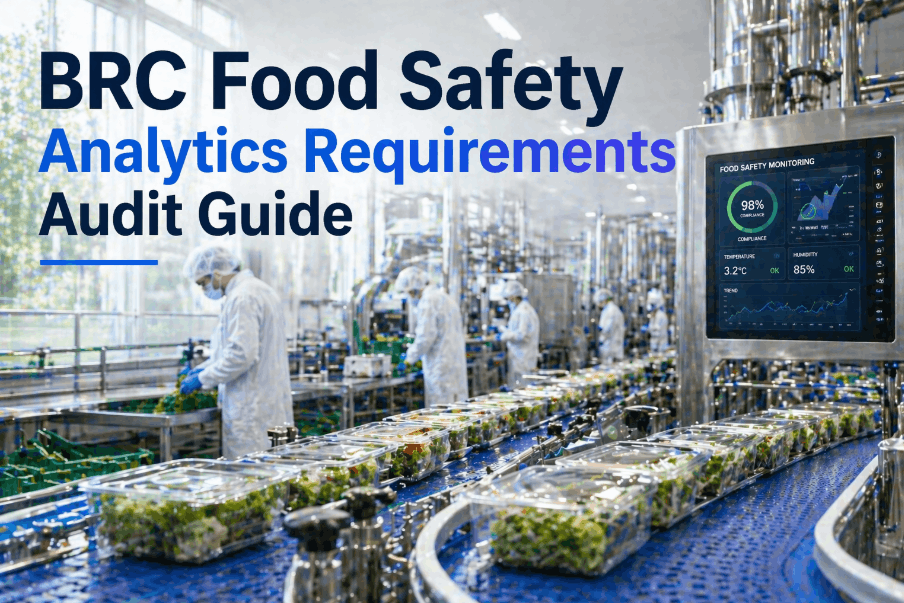
The BRC Global Standard for Food Safety (Issue 9) has significantly elevated the technical requirements for "demonstrable process control," making traditional manual documentation a high-risk strategy for modern high-volume manufacturers. To achieve an AA or AA+ grade, plants must transition from reactive, paper-based logging to proactive, digital BRC food safety analytics that provide absolute transparency. This guide explores how AI-driven platforms like iFactory (Book a Demo) automate Clause 6 compliance, real-time equipment monitoring, and continuous audit readiness—ensuring that your facility is technically prepared for high-stakes unannounced inspections 365 days a year, rather than just during a frantic preparation window.
Ready to Secure Your BRC AA+ Certification with AI?
See how iFactory automates BRC documentation, tracks equipment health in real-time, and centralizes your global audit vault for instant, sub-minute data retrieval during inspections.
Mapping Food Safety Analytics to BRC Global Standard Requirements
Under BRCGS Issue 9, the burden of proof rests on the continuous validity and integrity of production data. Most BRC audit failures stem not from inherent safety issues, but from documentation gaps and data silos in equipment calibration, CCP monitoring, and environmental hygiene logs. Analytics software bridges these gaps by creating a live, immutable record of every production parameter, adhering to ALCOA+ principles (Attributable, Legible, Contemporaneous, Original, and Accurate). Instead of searching through physical folders, quality managers can now demonstrate technical mastery by surfacing sub-minute traceability data during an audit, effectively turning "data retrieval" into a competitive advantage for the facility.
Implementing an AI-driven BRC framework requires focusing on four critical data layers: automated CCP logging, predictive equipment maintenance, environmental pathogen tracking, and real-time supplier certification management. Many plants Book a Demo after realizing that manual logs represent a 14–22% audit risk margin that can be eliminated through sensor integration. This digital transformation allows the food safety team to move away from administrative record-keeping and toward high-value root cause analysis and proactive risk mitigation.
CCP Performance (Section 2)
Automate the continuous, time-stamped monitoring of Critical Control Points (CCPs). iFactory logs every temperature profile, pressure reading, and metal detector test with millisecond precision, ensuring 100% Clause 2.2 compliance. The system also identifies control-limit trends before a breach occurs, allowing for preventative intervention.
Equipment Calibration (6.4)
Digital tracking of scales, checkweighers, and vision sensors. The platform triggers automated alerts for calibration drift, preventing the "Major Non-Conformance" associated with unverified or failed hardware. Detailed history logs provide proof of calibration frequency and accuracy required by Section 6.4.
Environmental Tracking (4.11)
Integrate environmental monitoring programs (EMP) directly into the plant-floor digital twin. Map pathogen swabs to specific zones and automate corrective action workflows based on BRC thresholds. This visibility ensures that sanitation efforts are data-driven and targeted toward high-risk micro-zones.
Supplier Hub (Section 3.5)
Consolidate and automate the verification of supplier food safety certifications. iFactory proactively "chases" expired GFSI/BRC certs, ensuring zero gaps in your raw material supply chain audits. AI filters identify high-risk suppliers based on historical quality drift and recall signals.
Mastering the BRC 4-Hour Traceability & Mass Balance Audit
Clause 3.9 of the BRC Global Standard requires a full traceability test to be completed within 4 hours. For plants with complex ingredient streams or high SKU counts, this is often a logistical nightmare involving dozens of spreadsheets and manual batch logs. iFactory’s traceability analytics engine links raw material lots, intermediate production stages, and finished goods shipping records into a single, searchable data graph. This allows quality teams to execute a full "upward and downward" trace in seconds, providing the auditor with an immediate and accurate map of the product flow.
Beyond simple tracing, the platform automates the complex mass balance calculations required during a BRC audit. By correlating input quantities with final output and waste metrics, iFactory identifies yield variances that might indicate process loss, undetected contamination, or material substitution risks. This level of technical depth ensures that your facility not only meets the 4-hour window but does so with a degree of accuracy that manual systems cannot replicate. Book a Demo to see a live traceability simulation.
BRC Compliance Horizon: Transitioning to Grade AA+ Through Analytics
Effective BRC audit readiness separates the compliance roadmap into three distinct phases: Foundational Digitization (Months 1–3), Integrated Monitoring (Months 4–8), and Autonomous Audit Readiness (Month 9+). Plants that consistently achieve the AA+ grade are those that have completely eliminated the "Audit Prep Month" in favor of continuous, AI-driven evidence generation. This "Always-Ready" posture is the only technical way to satisfy the requirements for unannounced audits in a high-volume manufacturing environment. Book a Demo to explore the AA+ roadmap.
During the Foundation phase, the primary focus is on replacing physical paper logs with IoT-connected sensors at every Critical Control Point. This initial technical investment eliminates human error and ensures that data is captured contemporaneously. iFactory’s BRC engine then layers predictive AI over this data to identify which equipment is likely to fail its next verification check—allowing maintenance teams to intervene before a deviation occurs or an auditor arrives. You can Book a Demo to see how we map specific BRC clauses to your physical production layout before any capital is committed.
| Compliance Horizon | Primary Analytics Focus | Technical Deployment | Expected BRC Grade | Audit Risk Level |
|---|---|---|---|---|
| Months 1–3 Foundational | Digital Recordkeeping, IoT sensor integration, CCP automation | Scale/Sensor connectivity, Cloud Log Vault | Grade B / A | Moderate (Manual Gap Risk) |
| Months 4–8 Integrated | Calibration alerts, EMP mapping, Supplier hub automation | API Integration, Digital Twin Mapping | Grade A / AA | Low (Automated Verification) |
| Month 9+ Autonomous | Predictive compliance, unannounced audit vault, Culture score | AI Risk Modeling, Andon Board visibility | Grade AA+ | Minimal (Unannounced Ready) |
Forecast Your BRC Audit Success with Live Evidence
iFactory replaces audit anxiety with visual, time-stamped evidence. Centralize every sensor log, maintenance record, and supplier certificate into one unannounced-ready digital vault.
Optimizing Section 5.5: Analytics for Foreign Body Detection Systems
BRC Sections 5.5 and 6.3 place critical emphasis on the management of foreign body detection systems, including X-ray units, metal detectors, and optical sorters. iFactory’s inspection analytics module captures real-time data from these detection systems, logging every rejection event and the corresponding corrective action. This provides the auditor with absolute proof that the detection systems are not only operational but that the rejection mechanism is functioning correctly and that rejected products are handled according to site standards.
By applying AI to rejection trends, the platform can identify systemic issues—such as a specific raw material batch triggering an abnormal number of metal detector rejections—allowing quality teams to investigate supplier issues before they impact final product safety. This data-driven approach to Section 5.5 transitions your facility from "Testing the Probe" to "Managing the Detection Ecosystem," a level of technical rigor that auditors look for when awarding Grade AA+ status. Book a Demo to see foreign body detection analytics.
Quantifying the Risk: The Hidden Cost of Deferred BRC Analytics
Operating with manual BRC documentation creates a "compliance debt" that compounds every year, increasing the probability of a major non-conformance. This debt is often invisible in the profit-and-loss statement until an audit failure occurs, resulting in a grade drop from AA to C. The financial impact of such a drop is catastrophic, often leading to the immediate termination of supply contracts with major retailers who mandate Grade A or B minimums for their private label and branded vendors.
Industry benchmarks show that plants using manual logs spend 300% more on pre-audit "clean-up" labor than plants with digital analytics. A single major non-conformance can trigger mandatory re-audits costing $15,000–$30,000 in direct fees alone, plus the internal overhead of corrective action reporting. When viewed as risk insurance, a $100,000 investment in BRC analytics delivers a 5x return in preserved contract value and administrative recovery. Book a Demo to quantify your specific compliance risk exposure.
How AI-Driven Analytics Automates the BRC Audit Cycle
Traditional BRC preparation is a cyclical, high-stress event that drains internal resources. AI-driven analytics inverts this model by making every single production day "Audit Day." The platform continuously scores your plant against BRC Clause requirements in real-time, surfacing gaps in maintenance, training, or documentation as they happen, rather than during an internal audit review months later when the evidence trail has gone cold.
iFactory’s "Audit Vault" correlates maintenance work orders with BRC Section 6 requirements automatically. When an auditor asks for the calibration record of a specific checkweigher from six months ago, the system retrieves the time-stamped log, the verification signature, and the master technician's certificate in under 15 seconds. This level of responsiveness builds immense confidence with the auditor, demonstrating that food safety is ingrained in the facility's technical DNA. Book a Demo to see the Audit Vault in action.
BRC Readiness Roadmap: From Grade B to AA+ Autonomy
BRC Food Safety Analytics — Frequently Asked Questions
Does BRCGS Issue 9 specifically require digital analytics software?
While the standard allows for manual records, it mandates "demonstrable process control" and "traceability integrity" within a 4-hour window. In modern, high-volume plants, digital analytics is the only technical way to ensure 100% accuracy during unannounced audits, which is critical for Grade AA or AA+ ratings. Manual systems simply cannot provide the real-time visibility required for the latest unannounced audit protocols.
How does the platform help with Food Safety Culture (Section 1.1)?
iFactory makes compliance data visible on the plant floor via digital andon boards. When operators see live CCP scores and calibration statuses, food safety transitions from a management task to a shared frontline culture, fulfilling the "demonstrable culture" requirement of Section 1.1. This visibility drives accountability at every level of the production team, from operators to site directors.
Can iFactory integrate with my existing scale and metal detector hardware?
Yes. Modern analytics platforms use universal API and PLC connectors to pull data directly from legacy equipment. iFactory supports bidirectional data exchange with most major hardware vendors (Mettler Toledo, Ishida, Loma, etc.), allowing you to digitize existing lines without expensive replacements. This ensures a unified "Source of Truth" across the entire facility regardless of equipment age.
What happens if an auditor asks for CCP records from a year ago?
With iFactory, you simply enter the date, batch number, or product SKU into the Audit Vault. The system retrieves the time-stamped sensor logs, supervisor sign-offs, and corrective action records in seconds—compared to the 40+ minutes typically required to retrieve paper records from long-term storage. This rapid response significantly improves the auditor's perception of the site's technical control.
How does digital analytics handle the BRC requirement for "Internal Audits"?
The platform includes an internal audit module that replicates the BRC checklist. You can assign clause-specific audits to your team, and the system automatically links the relevant live production data and maintenance logs to each answer. This ensures that internal audits are evidence-based and highlight actual operational risks rather than just "ticking a box."
Build Your BRC Compliance Strategy with Real Data
iFactory delivers live BRC Clause tracking, unannounced audit readiness, and risk quantification — purpose-built for food safety leaders who target Grade AA+ status.