Food safety compliance in 2026 demands more than periodic HACCP plan reviews and paper-based audit checklists. The convergence of regulatory enforcement intensity — FDA's Food Safety Modernization Act (FSMA) Preventive Controls rules, EU Regulation 2021/382 on allergen cross-contact, Codex Alimentarius HACCP annex updates, and GFSI benchmark scheme revisions — has elevated the HACCP audit from a compliance exercise to a continuous operational analytics function. Food manufacturers processing meat, poultry, dairy, baked goods, beverages, canned products, and frozen meals now face audit intervals as short as 90 days for high-risk CCP categories, with non-compliance penalties reaching $35,000 per violation per day under FDA jurisdiction. The HACCP audit checklist must expand beyond the seven HACCP principles to include sanitation zone verification, equipment hygiene sensor analytics, digital documentation integrity, supplier food safety performance trending, and real-time CCP monitoring system validation. iFactory AI's Compliance & Audit Trail Management platform, combined with Shift Logbook and the broader iFactory AI industrial software suite, provides food safety managers with a digital HACCP audit analytics framework that transforms checklist completion from a reactive documentation exercise into a predictive, data-driven compliance assurance system. Book a Demo to see how iFactory AI digitizes HACCP audit checklists and CCP compliance monitoring for food manufacturing operations.
HACCP Audit Checklist Framework — Critical Control Points & Compliance Zones
The modern HACCP audit checklist must address six distinct compliance dimensions that extend beyond the traditional seven HACCP principles. Each dimension requires specific evidence types, monitoring frequencies, and documentation standards that food safety auditors evaluate during on-site and remote audits. The iFactory AI platform structures HACCP audit checklists around these six dimensions, assigning digital inspection points, automated evidence collection triggers, and real-time compliance scoring to each CCP and prerequisite program element within the facility's food safety plan.
| Audit Dimension | Key Inspection Points | Monitoring Frequency | Evidence Type |
|---|---|---|---|
| CCP Monitoring Validation | Critical limit compliance at each CCP (cook temperatures, metal detector sensitivity, magnet strength, chiller temps, pH levels, water activity, container closure integrity) | Continuous sensor + hourly operator verification + daily supervisor audit | Time-series sensor logs, operator CCP checklist timestamps, deviation investigation reports, calibration certificates |
| Sanitation Zone Verification | Zone 1 (product contact), Zone 2 (splash contact), Zone 3 (non-contact adjacent), Zone 4 (remote/facility) — ATP swab results, allergen swab results, microbiological indicator counts per zone | Zone 1: post-op and pre-op every shift / Zone 2: daily / Zone 3: weekly / Zone 4: monthly | ATP RLU readings, allergen ELISA swab results, environmental monitoring lab reports, pre-op sanitation inspection checklists |
| Equipment Hygiene & Maintenance | Filler valves, conveyor belts, heat exchanger plates, slicer blades, homogenizer seals, tank CIP verification, vacuum pump oil quality, oven belt scrapers | Per-equipment schedule: daily visual + weekly deep inspection + monthly tear-down verification | Equipment hygiene inspection forms, CIP cycle data logs, lubrication records, wear part replacement history, maintenance work orders |
| GMP & Prerequisite Program Compliance | Employee hygiene compliance (handwash stations, hairnets, beard covers, glove changes), glass & hard plastic register, pest control monitoring, water quality testing, compressed air purity, allergen storage segregation | Per-shift GMP walk-through + daily pest station check + weekly water quality + monthly compressed air | GMP audit checklists, pest control station inspection records, water quality lab reports, compressed air microbial test results, shift logbook GMP observations |
| Supplier Food Safety Performance | Approved supplier list currency, COA review completion, supplier HACCP certificate validity, incoming raw material testing results, supplier audit score trend, allergen declaration verification | Per-receiving lot verification + quarterly supplier performance review + annual re-approval audit | COA database, supplier certificate repository, incoming inspection records, supplier scorecards, deviation notification correspondence |
| Documentation Integrity & Traceability | HACCP plan version currency, record retention compliance, corrective action documentation completeness, mock recall execution records, training records currency, document change control log | Pre-audit completeness review + quarterly documentation audit + annual HACCP plan revalidation | Digital document management system audit trail, automated retention compliance report, training matrix, mock recall completion reports, change control approval history |
Sanitation Verification & Equipment Hygiene Audit — Zone-Based Inspection Analytics
Sanitation verification is the most scrutinized element of any HACCP or GFSI audit, accounting for approximately 35% of audit non-conformances in food processing facilities according to 2025 SQF and BRC certification data. The zone-based sanitation approach — dividing the facility into four contamination risk zones — provides a structured framework for audit checklist design, but the manual nature of ATP swabbing, allergen testing, and microbiological sampling creates data fragmentation that undermines trend analysis and preventive action. iFactory AI's sanitation analytics module consolidates zone-by-zone testing results, equipment hygiene inspection data, and CIP cycle performance metrics into a unified sanitation compliance dashboard that generates real-time zone risk scores, trend alerts when swab results show degrading hygiene, and automated corrective action workflows when zone thresholds are exceeded.
Zone 1 — Product Contact Surfaces: All surfaces that directly contact food products during processing, filling, and packaging. Audit inspection points include filler nozzles, heat exchanger plates, conveyor belts in product zones, slicer and dicer blades, homogenizer valves, multi-head weigher funnels, form-fill-seal machine forming tubes, and packaging film contact rollers. The audit checklist requires ATP swab results below 15 RLU (for stainless steel) or 30 RLU (for plastic/rubber) per manufacturer specifications, allergen swab validation after allergen changeover, and microbiological contact plate or swab results within facility specification limits. iFactory AI's sanitation module integrates with ATP handheld readers and LIMS systems to capture results in real time, flagging out-of-specification readings directly to the shift supervisor's mobile device and initiating automated re-cleaning work orders.
Zone 2 — Non-Food Contact Splash and Adjacent Surfaces: Surfaces adjacent to food contact areas where splashed product or condensate may create cross-contamination risk. Includes equipment exteriors immediately above or adjacent to open product zones, overhead sensor housings, cable trays above exposed product, drip pans, equipment frame cross-members, and control panel faces within 1 meter of product exposure. The audit checklist specifies visual inspection for product residue buildup, ATP swab targets below 50 RLU, and environmental sponge sampling for Listeria spp. and Salmonella indicator organisms at frequencies determined by facility risk category. The iFactory platform enforces zone-specific cleaning frequencies, generates pre-operational inspection checklists with photographic evidence capture, and trends ATP results by zone, line, and shift to identify recurring hygiene gaps. The Shift Logbook module captures Zone 2 inspection findings at shift handover, ensuring that sanitation status is communicated between cleaning crews and production teams without reliance on verbal handover. Talk to an Expert to learn how iFactory AI's sanitation analytics module can digitize your zone-based verification workflows.
Zone 3 — Non-Contact Adjacent Areas: Areas within the processing environment that are adjacent to Zone 2 surfaces but do not contact product or splash zones directly. Includes floors within processing rooms, floor drains, walls (lower 2 meters), support pillars, fire extinguisher mounts, utility conduits, and HVAC grilles within processing areas. The audit checklist requires visual cleanliness verification, ATP swab targets below 100 RLU on floors and walls, and environmental swabbing for Listeria species and Listeria monocytogenes at drain locations and floor-wall junctions on a rotating schedule that covers all processing zones within a 30-day cycle. The iFactory analytics platform generates environmental monitoring trend reports that correlate positive findings with production schedules, line utilization, and sanitation crew assignments — enabling root cause analysis when environmental positives cluster on specific lines, shifts, or sanitation crew rotations.
Zone 4 — Remote Facility Areas: Areas outside the processing environment that may serve as harborage or entry points for pathogens and pests. Includes warehouse floors and racking, employee break rooms and locker areas, maintenance workshops, utility tunnels, roof access points, exterior perimeter drains, waste holding areas, and raw material receiving docks. The audit checklist frequency is typically monthly and includes visual inspection for pest activity signs, water intrusion evidence, structural integrity issues, and general sanitation condition. The iFactory platform enables scheduled Zone 4 inspection checklists with photographic evidence, automated task assignment to facility maintenance teams, and cross-zone correlation analysis that identifies when Zone 4 conditions (e.g., standing water near receiving docks, pest activity in warehouse) create elevated risk for Zone 1–3 contamination pathways.
We transitioned from paper-based HACCP audit checklists to iFactory AI's digital compliance platform across our three processing facilities in Q1 2026. The immediate impact was the elimination of the two-week audit preparation scramble that preceded every SQF and FDA inspection. Our audit checklist completion rates went from 87% to 99.8% within the first month because the platform enforces checklist completion before production can start — operators cannot bypass CCP verification steps. The real transformation came in audit execution: during our most recent SQF audit, we closed 100% of evidence requests within the audit session by searching the digital audit trail for CCP records, sanitation zone swab results, and equipment hygiene inspection logs. The auditors specifically noted the completeness and accessibility of our HACCP documentation as a best-practice example. Our non-conformance count dropped from 8 (previous audit) to 2, and both were minor observation-level findings with no corrective action required.
— Director of Food Safety & Quality, Multi-Site protein processing and frozen food manufacturer — 3 facilities, 450,000 sq. ft. combinedCCP Deviation Analytics — Predictive Monitoring and Automated Corrective Action Documentation
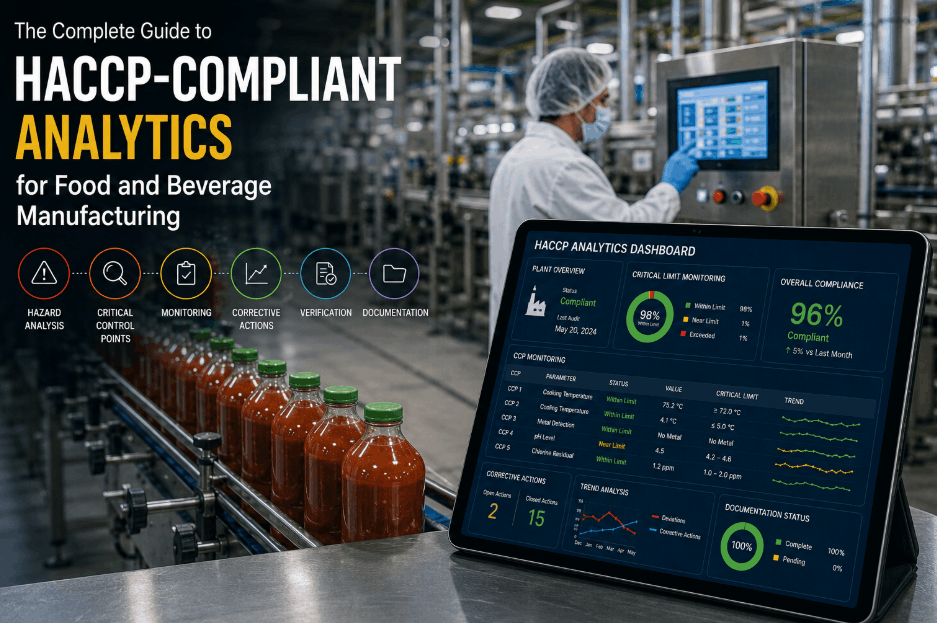
Critical control point deviations represent the highest-risk audit findings in any HACCP or regulatory audit. When a cook temperature drops below the critical limit, a metal detector rejects a contaminated product, or a chiller temperature exceeds specification for more than the allowable time, the HACCP plan requires immediate corrective action documentation — including root cause analysis, product disposition decision, and preventive measure implementation. Traditional paper-based or spreadsheet-based deviation tracking creates documentation gaps that auditors identify as systematic failures, often resulting in major non-conformances and extended audit durations. iFactory AI's CCP deviation analytics module monitors continuous sensor data from every CCP in the facility, applies statistical process control models to detect critical limit trends before deviations occur, and automatically generates corrective action documentation when deviations are confirmed.
HACCP Documentation Analytics — Digital Audit Trail Compliance
HACCP documentation requirements under FSMA, Codex, GFSI benchmarked schemes (SQF, BRCGS, FSSC 22000), and FDA 21 CFR Part 120/123 mandate that food safety records be retained for specified periods (typically 1–2 years depending on product category), be readily retrievable within 24 hours of regulatory request, and demonstrate a complete audit trail from CCP monitoring through corrective action closure. Digital documentation analytics transform compliance from a storage challenge to a continuous audit readiness capability. The iFactory AI platform provides automated documentation completeness scoring, retention compliance monitoring, and instant evidence retrieval — enabling food safety managers to demonstrate HACCP compliance at any moment without audit preparation periods.
How iFactory AI Enables HACCP Audit Analytics and Digital Checklist Management
iFactory AI provides the operational compliance software layer that enables food safety managers and quality assurance teams to transform HACCP audit checklists from paper-based reactive documentation into predictive, data-driven compliance assurance systems. The iFactory platform integrates with existing sensor infrastructure, food safety LIMS, ERP systems, and shift management workflows to deliver six core capabilities specifically designed for HACCP audit checklist management: continuous CCP monitoring analytics, sanitation zone verification automation, equipment hygiene inspection digitization, supplier food safety performance tracking, documentation integrity assurance, and cross-scheme compliance mapping. The platform's Shift Logbook module ensures that every food safety observation — from CCP parameter readings to sanitation zone ATP results to equipment hygiene inspection findings — is captured with operator attribution, time stamping, and digital evidence in the context of the shift during which it was recorded. Book a Demo to see how iFactory AI digitizes HACCP audit checklists and transforms food safety compliance management for food processing operations.
Conclusion
HACCP audit checklists in 2026 must evolve beyond paper-based checkbox verification to become continuous compliance analytics systems that monitor CCP performance, sanitation zone hygiene, equipment cleanliness, supplier food safety metrics, and documentation integrity in real time. The regulatory landscape — FSMA preventive controls enforcement, GFSI benchmark scheme updates, EU food safety regulation revisions — demands that food manufacturers demonstrate not just HACCP plan compliance at a point in time, but continuous compliance assurance between audit cycles. iFactory AI's Compliance & Audit Trail Management platform, combined with Shift Logbook, predictive CCP analytics, sanitation zone verification automation, and digital documentation management, provides the unified operational compliance layer that enables food safety teams to maintain continuous audit readiness, reduce non-conformance risk, and transform HACCP compliance from a periodic audit burden into a continuous quality improvement capability. Book a Demo to schedule your HACCP audit readiness assessment and discover how iFactory AI can digitize your food safety compliance checklists and CCP monitoring workflows.
Frequently Asked Questions
The six dimensions are: (1) CCP Monitoring Validation — critical limit compliance at each CCP including cook temperatures, metal detector sensitivity, chiller temps, pH, water activity, and container closure integrity; (2) Sanitation Zone Verification — ATP swab results, allergen verification, and microbiological indicator testing across all four sanitation zones (product contact through remote facility areas); (3) Equipment Hygiene & Maintenance — filler valves, conveyor belts, heat exchanger plates, slicer blades, CIP cycle verification, and wear part replacement tracking; (4) GMP & Prerequisite Program Compliance — employee hygiene, glass register, pest control, water quality, compressed air purity, and allergen storage segregation; (5) Supplier Food Safety Performance — approved supplier list currency, COA review, incoming raw material testing, and supplier audit score trending; (6) Documentation Integrity & Traceability — HACCP plan version control, record retention compliance, corrective action documentation completeness, and mock recall execution records.
iFactory AI digitizes HACCP audit checklists through a multi-layer platform approach. The Compliance & Audit Trail Management module provides configurable digital inspection checklists for each CCP, sanitation zone, and prerequisite program element — with automated evidence collection from connected sensors, ATP handheld readers, and LIMS systems. CCP monitoring data is collected continuously from temperature sensors, metal detectors, X-ray systems, pH probes, and other process instruments via PLC integration, with time-stamped records stored in a tamper-evident audit trail database. When CCP parameters approach critical limits, the predictive analytics engine alerts operators and supervisors proactively, enabling preventive intervention before deviation occurs. The Shift Logbook module captures operator observations, sanitation verification results, and equipment hygiene inspection findings with digital evidence (photos, sensor readings, operator notes) linked to the specific shift and operator. All documentation is organized in the digital document management repository with version control, retention scheduling, and role-based access for auditor review. The result is continuous audit readiness — complete HACCP documentation available for auditor review at any time without preparation lead time.
The four sanitation zones classify food processing facility areas by contamination risk level, with each zone requiring specific monitoring frequency and hygiene targets. Zone 1 (Product Contact) includes all surfaces that directly touch food — filler nozzles, conveyor belts in product zones, slicer blades, heat exchanger plates — and requires ATP swab verification after every sanitation event (typically pre-op and post-op per shift) with targets below 15 RLU on stainless steel. Zone 2 (Splash Contact) includes surfaces adjacent to product zones where splashed product may create contamination risk — equipment exteriors above open product, control panel faces, overhead sensor housings — with daily ATP swabbing and targets below 50 RLU. Zone 3 (Non-Contact Adjacent) includes floors, drains, walls, and pillars within processing rooms — with weekly visual inspection and ATP targets below 100 RLU. Zone 4 (Remote Facility) includes warehouse, break rooms, utility tunnels, and exterior areas — with monthly inspection focused on pest activity, water intrusion, and structural integrity. The iFactory platform enforces zone-specific inspection frequencies and automatically escalates out-of-specification results to shift supervisors with corrective action workflow initiation.
iFactory AI's compliance platform maps HACCP audit checklist requirements across multiple food safety schemes simultaneously, enabling food manufacturers operating under multiple certification schemes (e.g., SQF for retail customers, BRCGS for international distribution, FSSC 22000 for GFSI compliance, FDA FSMA for US regulatory compliance) to maintain a single documentation system that satisfies all scheme requirements. The platform includes configurable compliance templates for each major scheme, cross-scheme requirement mapping that identifies overlapping and unique requirements, and automated gap analysis that flags when a documentation element meets one scheme requirement but not another. Audit evidence can be tagged with relevant scheme categories, enabling auditors from any scheme to access scheme-specific evidence views without navigating unrelated documentation. When scheme requirements are updated (e.g., BRCGS Issue 9 or SQF Edition 10 revisions), the platform provides impact analysis identifying which documentation elements require updates and automated workflow for document revision assignment and approval.
Food safety teams require three levels of training for digital HACCP checklist implementation. Line operators and sanitation technicians need 2–4 hours of hands-on training covering mobile device checklist navigation, CCP parameter entry, ATP swab result capture, photographic evidence capture, and deviation alert acknowledgment — typically delivered in small groups on the production floor during the first week of deployment. Quality assurance technicians and HACCP team members need 4–8 hours of training covering corrective action workflow management, root cause analysis template completion, documentation retrieval, trend report interpretation, and shift logbook review procedures. Food safety managers and HACCP plan administrators need 8–12 hours of training covering platform configuration, compliance template customization, user role and permission management, audit evidence aggregation, supplier documentation management, and management review dashboard configuration. iFactory AI provides on-site training sessions during the deployment phase, virtual refresher training sessions, and ongoing access to the iFactory knowledge base with video guides and documentation templates.