HACCP compliance is not a checkbox exercise — it is the continuous, documented proof that your food manufacturing operation controls every hazard that could harm a consumer. Yet the majority of food and beverage manufacturers still manage HACCP programs through paper-based checklists, disconnected spreadsheets, and manual audit documentation that creates as many compliance risks as it resolves. The gap between a well-designed HACCP plan and a food safety failure is almost always an execution gap — a missed CCP monitoring record, a temperature deviation that was not escalated, a corrective action that was never closed. HACCP-compliant analytics platforms close this gap by digitizing the entire food safety management system into a structured, auditable, real-time intelligence layer. Facilities that make this transition routinely achieve full audit readiness in days rather than weeks. If your food safety program is still running on paper, Book a Demo to see how iFactory's compliance and audit trail management transforms HACCP execution into a measurable, defensible operational system.
Why Traditional HACCP Programs Fail Under Modern Food Safety Audit Standards
HACCP — Hazard Analysis and Critical Control Points — was conceived as a systematic, science-based framework for identifying and controlling biological, chemical, and physical hazards in food production. In principle, every food manufacturer with a HACCP plan has a documented system for preventing food safety failures. In practice, the gap between documented plans and operational execution is where the majority of food safety incidents and audit non-conformances originate.
The root cause is almost never a poorly designed HACCP plan — it is a failure of the operational systems that are supposed to execute it. Paper-based CCP monitoring logs get missed during busy production runs. Temperature deviation records are completed retrospectively rather than in real time. Corrective action documentation is stored in disconnected files that auditors cannot efficiently verify. The result is a food safety management system that performs on paper but fails under scrutiny — precisely the opposite of what modern GFSI certification standards demand. HACCP-compliant analytics platforms resolve this systematically by replacing manual execution with structured digital workflows, automated monitoring, and an unbroken audit trail. You can see this system in your specific production environment by choosing to Book a Demo with iFactory's food safety compliance team.
Manual Documentation Failure
Paper-based CCP monitoring records are susceptible to completion errors, backdating, and loss. Under BRC, SQF, and FDA 21 CFR Part 117 audit standards, a single missing or incomplete CCP record can trigger a major non-conformance that jeopardizes certification — regardless of whether the underlying process was actually under control at the time.
Root CauseDeviation Response Latency
When CCP deviations are identified manually — through periodic operator checks rather than continuous monitoring — the window between a control limit breach and corrective action can extend to hours. In food manufacturing, every minute of undetected deviation increases product safety risk and the potential scope of a hold, rework, or recall event.
Operational RiskAudit Preparation Burden
Preparing documentation packages for GFSI, customer, or regulatory audits from paper-based or disconnected digital systems typically requires days of manual compilation. The labor cost is significant, the risk of documentation gaps is high, and the anxiety of audit preparation is a persistent operational distraction that diverts resources from production and quality improvement.
Efficiency LossCorrective Action Traceability Gaps
HACCP corrective action records must demonstrate that the root cause was identified, the deviation was controlled, and the affected product was appropriately managed. When corrective action documentation exists across multiple paper logs, email threads, and spreadsheets, assembling a complete, defensible corrective action history for an auditor is a time-consuming and risk-laden exercise.
Compliance ExposureHow HACCP-Compliant Analytics Creates a Continuous, Unbroken Food Safety Audit Trail
A HACCP-compliant analytics platform does not replace the HACCP plan — it is the operational execution layer that ensures the plan is followed, documented, and continuously verified in real time. The architecture operates across three interconnected layers: automated CCP monitoring, structured workflow execution, and an immutable audit trail that satisfies the documentation requirements of every major food safety certification standard.
Food and beverage manufacturers that have implemented digital HACCP analytics consistently report that their first post-deployment audit is the fastest, lowest-stress certification review they have experienced — not because the auditors were less thorough, but because every record was instantly retrievable, complete, and timestamped. That transformation begins at sensor level, where continuous monitoring removes the human execution dependency from CCP compliance. To see how this architecture maps to your specific HACCP plan and certification requirements, Book a Demo with our food safety integration team.
Automated CCP Monitoring & Real-Time Deviation Alerts
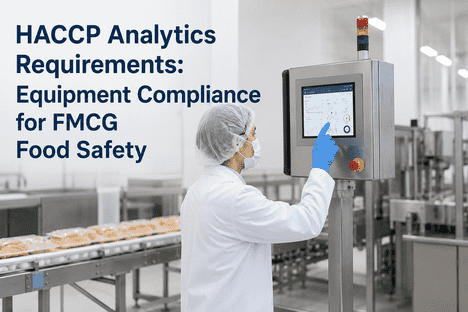
Temperature sensors, pH monitors, flow meters, and metal detection systems feed continuously into the analytics platform, which compares incoming readings against defined CCP critical limits in real time. When a limit is approached or breached, the system immediately triggers a timestamped deviation alert — escalated to the relevant operator, supervisor, or quality manager — eliminating the latency between deviation occurrence and corrective action initiation that characterizes manual monitoring systems.
Digital HACCP Checklists & Structured Corrective Action Workflows
Digitized HACCP monitoring checklists replace paper-based forms with structured, mandatory workflows that enforce complete data entry before sign-off. When a CCP deviation is recorded, the system automatically initiates a corrective action workflow — prompting the operator through the required verification, product hold, root cause, and resolution steps — and generates a complete, timestamped corrective action record that satisfies HACCP plan requirements and auditor expectations without any manual documentation assembly.
Immutable Audit Trail & Instant Compliance Reporting
Every CCP monitoring record, deviation event, corrective action, verification activity, and system access is stored in an immutable, timestamped audit trail that cannot be edited, deleted, or backdated — satisfying the integrity requirements of FDA 21 CFR Part 11, BRC Issue 9, SQF Edition 9, and other leading food safety regulatory frameworks. On-demand compliance reports compile complete HACCP documentation packages for any time period in minutes, converting audit preparation from a days-long exercise into a one-click process.
Digital HACCP Analytics vs. Paper-Based Compliance: A Comparative Analysis
The performance differential between digital HACCP-compliant analytics and traditional paper-based food safety management systems is measurable across every dimension that matters to food safety managers, quality directors, and operations executives evaluating a compliance technology investment. The table below captures the operational impact across the key metrics that determine audit outcomes and food safety program effectiveness.
| Compliance Metric | Paper-Based HACCP Management | HACCP-Compliant Analytics Platform | Performance Gain |
|---|---|---|---|
| CCP Deviation Detection Time | Minutes to hours (manual checks) | Seconds (continuous monitoring) | Real-time detection |
| Corrective Action Response Time | 30–120 min (manual escalation) | Under 5 min (automated alert) | –90% response latency |
| Audit Preparation Time | 3–7 days (manual compilation) | Under 30 minutes (on-demand report) | –95% preparation time |
| Documentation Completeness | Variable (human execution gaps) | 100% (system-enforced) | Zero documentation gaps |
| Non-Conformance Frequency | High (execution and record gaps) | Minimal (structured workflows) | –60–80% non-conformance rate |
| Product Hold & Rework Rate | Elevated (late deviation detection) | Significantly reduced | –35% hold and rework events |
| Recall Readiness | Days (manual traceability) | Hours (digital lot traceability) | Near-instant traceability |
Six Mission-Critical Capabilities of a HACCP-Compliant Food Safety Analytics Platform
iFactory's compliance and audit trail management platform is engineered around the six capabilities that directly determine food safety program performance and audit readiness in food and beverage manufacturing environments. Each capability is designed to be operational within weeks of deployment and to deliver measurable impact on compliance documentation completeness, deviation response time, and certification audit outcomes. To see a full capability demonstration mapped to your HACCP plan and current certification requirements, Book a Demo with our food safety team.
Digital CCP Monitoring Checklists
Configurable digital checklists enforce complete, timestamped CCP monitoring records for every critical control point — eliminating the documentation gaps that create audit non-conformances and replacing paper-based systems with structured workflows that satisfy GFSI, FDA, and customer audit requirements.
Automated Deviation Alert & Escalation
Real-time sensor monitoring triggers immediate deviation alerts when CCP critical limits are approached or breached — with automated escalation pathways that ensure the right person receives the right notification within seconds, minimizing product safety risk and the scope of any required corrective action.
Corrective Action Workflow Management
Structured corrective action workflows guide operators and quality teams through every required step — deviation documentation, product hold decision, root cause analysis, resolution verification, and preventive action planning — generating a complete, defensible corrective action record that meets HACCP plan and auditor requirements automatically.
GMP & Sanitation Analytics
Digital GMP inspection checklists and sanitation verification workflows ensure that prerequisite programs — cleaning schedules, sanitation verification, pest control, allergen management — are executed, recorded, and traceable within the same unified compliance platform that manages CCP monitoring, creating a complete food safety management system in a single interface.
Immutable Audit Trail & Compliance Reporting
An unbreakable, timestamped audit trail captures every monitoring record, deviation event, corrective action, and verification activity — with on-demand compliance reports that compile complete HACCP documentation packages for BRC, SQF, FSSC 22000, or FDA audit purposes in minutes rather than days.
Lot Traceability & Recall Readiness
Digital lot-level traceability links raw material inputs, production records, CCP monitoring data, and finished goods distribution to a single traceable record — enabling mock recall exercises to be completed in hours and providing the upstream and downstream traceability required by GFSI and customer certification standards.
The Financial and Operational Return: How HACCP Analytics Pays for Itself
The Compounding ROI of Digital HACCP Compliance Management
The return from investing in a HACCP-compliant analytics platform is not limited to audit cost avoidance — it compounds across three distinct value layers that grow in magnitude as the platform matures and compliance performance improves. Quality directors who implement digital HACCP analytics consistently find that the platform recovers its cost within the first avoided product recall event or major non-conformance — after which every subsequent improvement in deviation response time, documentation completeness, and audit efficiency compounds the return. To model the compliance ROI specific to your facility, Book a Demo and receive a facility-specific compliance projection.
Immediate: Recall & Non-Conformance Avoidance
A single food product recall event — including direct costs, retailer penalties, legal exposure, and brand damage — typically exceeds $10 million for a mid-sized food manufacturer. A major GFSI audit non-conformance that triggers suspension or withdrawal of certification can cost multiples of that in lost customer contracts and market access. Preventing one of these events through earlier deviation detection and complete documentation is a compelling single-event ROI that dwarfs the cost of the platform.
Short-term value driverIntermediate: Quality Labor Optimization
Digital HACCP analytics platforms consistently reduce the labor hours devoted to compliance documentation, audit preparation, and corrective action record management by 40–60%. For food manufacturers with dedicated quality teams, this represents a significant operational cost reduction — and an equally significant reallocation of quality professional time toward improvement projects rather than documentation maintenance.
Medium-term efficiency driverLong-Term: Customer Retention & Market Access
Major retail and foodservice customers are increasingly requiring digital compliance documentation, real-time food safety monitoring, and rapid recall traceability as conditions of supply agreements. Food manufacturers with HACCP-compliant analytics platforms are better positioned to satisfy these requirements, retain key customers, and access new retail channels that are closed to facilities still operating on paper-based compliance systems.
Long-term strategic advantageContinuous CCP monitoring replaces periodic manual checks — detecting deviations in seconds rather than the minutes or hours characteristic of paper-based monitoring programs.
On-demand compliance reporting reduces HACCP documentation preparation from days of manual compilation to under 30 minutes of one-click report generation.
Digital HACCP analytics platforms reduce audit non-conformance rates by eliminating documentation gaps, incomplete records, and corrective action traceability failures.
Average reduction in quality team hours devoted to compliance documentation, audit preparation, and corrective action record management following digital HACCP deployment.
How HACCP-Compliant Analytics Serves Every Food Safety Stakeholder
One of the most powerful attributes of a unified food safety analytics platform is its ability to serve the competing priorities of every stakeholder in the compliance process simultaneously. Quality teams gain the real-time monitoring and automated documentation that eliminates execution risk. Operations teams gain the structured corrective action workflows that replace informal verbal escalation. Leadership teams gain the audit-ready documentation and traceability that protects the business from regulatory and customer risk.
Real-Time CCP Control Visibility
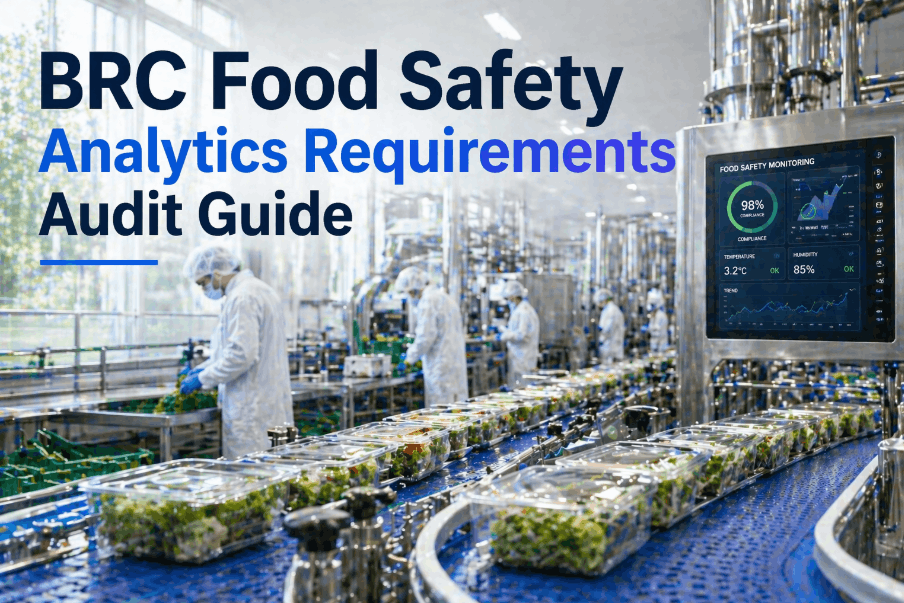
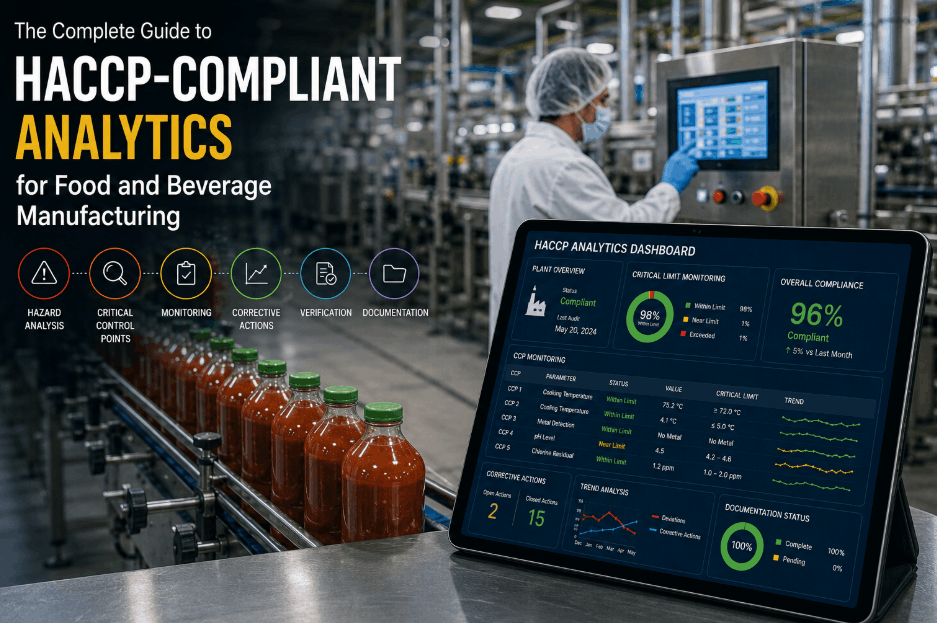
Monitor every CCP across every production line in real time from a single dashboard — with immediate deviation alerts, automated corrective action initiation, and complete documentation records that ensure HACCP plan execution is verifiable, defensible, and audit-ready at all times, without relying on manual record review cycles that introduce latency and risk.
Tool: HACCP Compliance DashboardStructured Compliance Workflows
Replace informal, paper-based operator compliance tasks with structured digital workflows that guide every team member through required HACCP monitoring, GMP verification, and sanitation checks — ensuring consistent execution regardless of shift, team experience level, or production pressure, and eliminating the execution variability that creates food safety risk.
Tool: Digital Checklist EngineAudit-Ready Compliance Documentation
Access on-demand compliance reports that compile complete HACCP documentation packages for BRC, SQF, FSSC 22000, FDA, or customer audit purposes in minutes — with an immutable audit trail that provides the record integrity, timestamp verification, and corrective action traceability that modern food safety audit standards require.
Tool: Compliance Audit ReporterDeploying HACCP-Compliant Analytics: A Three-Phase Food Safety Digitization Roadmap
Transitioning from paper-based HACCP management to a fully digital compliance analytics platform follows a structured, low-disruption pathway that preserves existing HACCP plan logic while systematically eliminating the execution and documentation risks that create audit non-conformances and food safety incidents.
HACCP Plan Digitization & CCP Connectivity
Existing HACCP plans, CCP critical limits, and monitoring frequencies are digitized into the platform within 2–4 weeks. Sensor connectivity is established for automated CCP parameter monitoring, and digital checklist templates are configured to mirror existing manual monitoring workflows — eliminating paper records while preserving existing HACCP program logic without requiring plan re-validation.
Timeline: 2–4 Weeks · FoundationCorrective Action & GMP Program Integration
Corrective action workflows, GMP inspection checklists, and sanitation verification programs are integrated into the unified platform during weeks 4–8. The audit trail begins accumulating complete, timestamped compliance records from day one of deployment — meaning that facilities deploying ahead of an upcoming certification audit gain immediate documentation completeness benefits even before the full platform is operational.
Timeline: 4–8 Weeks · IntegrationFull Compliance Intelligence & Continuous Improvement
With a complete digital compliance record accumulating over time, the platform begins surfacing trend analytics — recurring deviation patterns, high-frequency corrective action categories, sanitation program performance gaps — that enable proactive HACCP program improvement rather than reactive non-conformance response. This converts food safety compliance from a documentation burden into a continuous improvement engine.
Timeline: Ongoing · MaturityHACCP-Compliant Analytics — Food Safety Manager FAQs
Which food safety certification standards does the platform support?
The platform is designed to support the documentation, monitoring, and corrective action requirements of all major GFSI-benchmarked food safety standards — including BRC Global Standard Issue 9, SQF Edition 9, FSSC 22000 Version 6, IFS Food Version 8, and FDA 21 CFR Part 117 (FSMA Preventive Controls). Audit trail and record integrity features also satisfy 21 CFR Part 11 electronic records requirements for US-regulated facilities.
Does implementing the platform require re-validating our existing HACCP plans?
No. The platform digitizes existing HACCP plan logic — CCP definitions, critical limits, monitoring frequencies, and corrective action procedures — without requiring changes to the underlying hazard analysis or re-validation of established control measures. The transition from paper to digital execution does not constitute a modification to the HACCP plan itself and does not trigger a re-validation requirement under standard food safety regulatory frameworks.
How does the platform handle temperature monitoring for pasteurization or cold chain CCPs?
Temperature sensors integrate directly with the platform to provide continuous, real-time CCP monitoring for thermal process controls, cold storage, and cold chain management. Critical limit thresholds are configured to match HACCP plan specifications, and deviation alerts are triggered immediately when temperatures approach or breach defined limits — with full timestamp, product lot, and process context captured automatically in the corrective action record.
Can the platform generate audit documentation packages for scheduled certification audits?
Yes. On-demand compliance reporting compiles complete HACCP documentation packages for any defined time period — including CCP monitoring records, deviation logs, corrective action histories, verification activities, and prerequisite program records — in a structured, auditor-friendly format that satisfies the documentation review requirements of BRC, SQF, FSSC, and FDA audit processes. What previously required days of manual preparation is reduced to a one-click, under-30-minute process.
How does the platform support allergen management and sanitation verification?
Digital GMP and sanitation checklists within the platform cover allergen changeover verification, sanitation procedure completion, and ATP or rinse sample result recording as structured, mandatory workflow steps — ensuring that allergen control and sanitation prerequisite programs are executed, documented, and traceable to the same audit trail standard as CCP monitoring records.
How quickly can we be fully operational with digital HACCP compliance?
Most food and beverage facilities achieve full digital CCP monitoring and checklist deployment within 2–4 weeks of kickoff, without disrupting ongoing production or compliance programs. Facilities preparing for imminent certification audits often choose to deploy digital checklists and audit trail recording in the first two weeks to begin accumulating compliant digital records immediately, even ahead of full sensor integration.