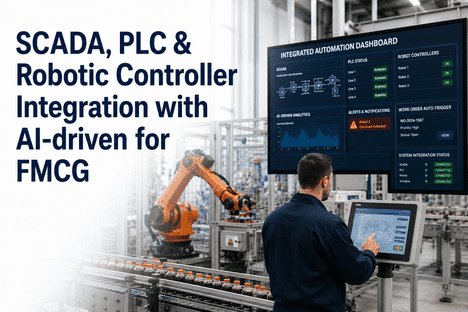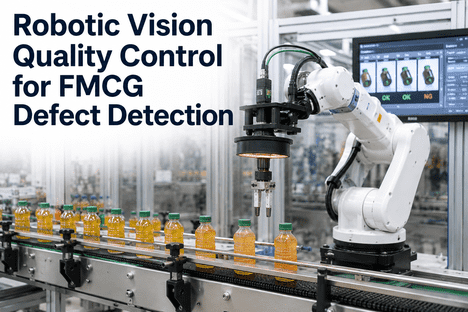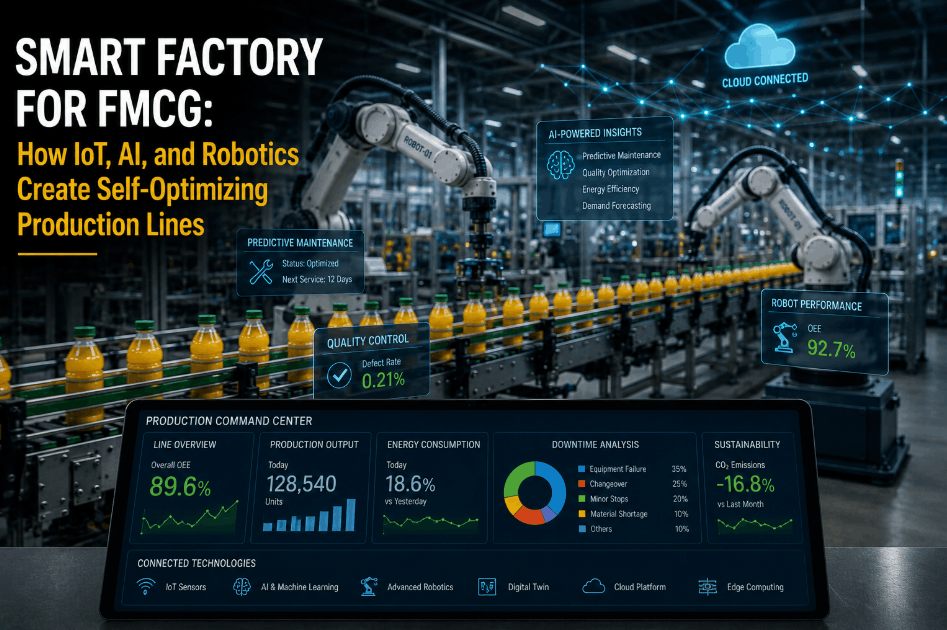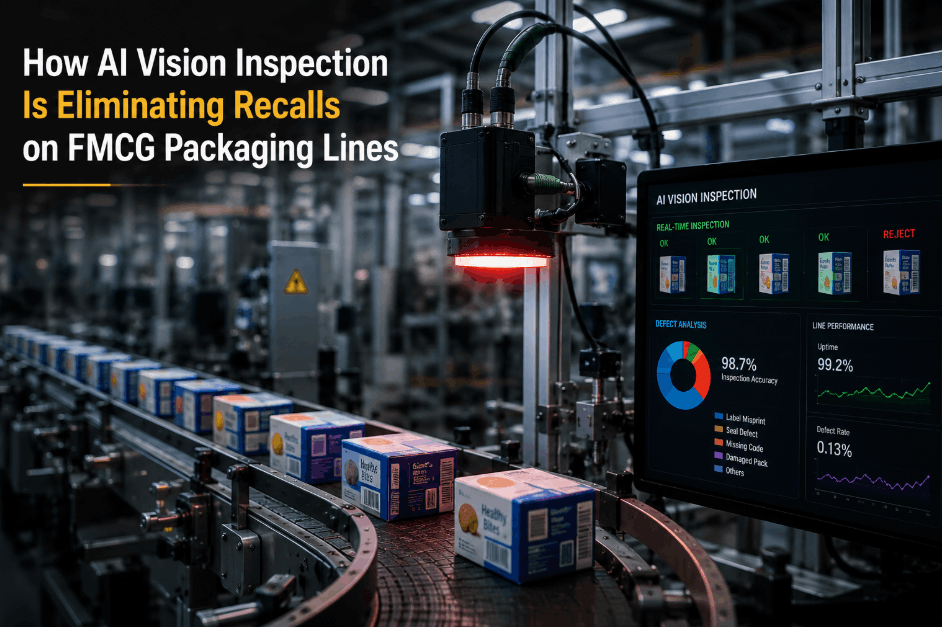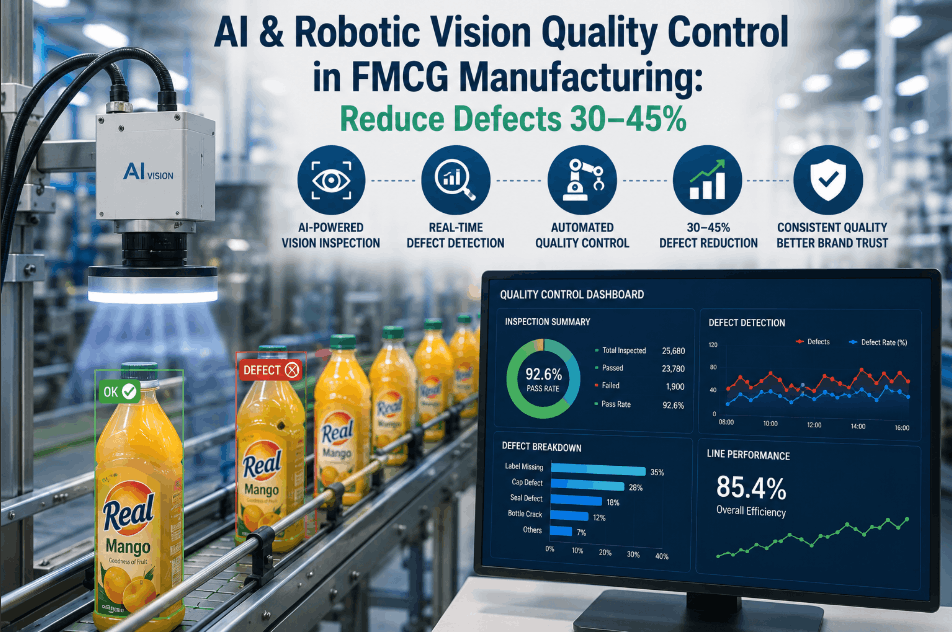
A single FMCG product recall costs an average of $10 million in direct expenses — and multiples of that in brand equity damage, retailer relationship disruption, and regulatory scrutiny. Yet most consumer goods manufacturers continue to rely on inspection methodologies at the end of their packaging lines that have not fundamentally changed in decades: a combination of inline sensors, periodic sampling, and human visual checks that collectively miss 15–25% of defects before they enter the distribution chain. Robotic end-of-line inspection, powered by AI vision systems, is the proven technology that eliminates this defect escape rate at full production speed. Book a Demo to see how iFactory's AI Vision Inspection Integration is helping FMCG manufacturers achieve 99.5%+ defect detection at their end-of-line quality gates.
Eliminate Defect Escapes from Your FMCG Line with Robotic End-of-Line Inspection
iFactory's AI-powered robotic inspection systems detect 99.5%+ of defects at full production speed — stopping recalls before they start.
Why FMCG Product Recalls Are a Systemic Quality Gate Failure
FMCG product recalls are not random events — they are the predictable outcome of inspection systems with insufficient defect detection capability deployed at critical quality gates. The FDA's recall database consistently shows that the majority of food and consumer goods recalls are triggered by defects that were detectable in-plant using available technology: under-filled containers, mislabeled allergen information, compromised seal integrity, foreign object contamination, and incorrect date codes. The defects existed; they were simply not caught before product entered distribution.
The end-of-line inspection station is the last opportunity to intercept non-conforming product before it reaches retail shelves. In most FMCG facilities, this critical quality gate is guarded by a combination of inline checkweighers, metal detectors, and periodic manual sampling — inspection coverage that is fundamentally inadequate for the full range of defect types that drive recalls. Robotic end-of-line inspection with integrated AI vision closes this detection gap comprehensively and permanently.
How Robotic End-of-Line Inspection Systems Work: Architecture and Capabilities
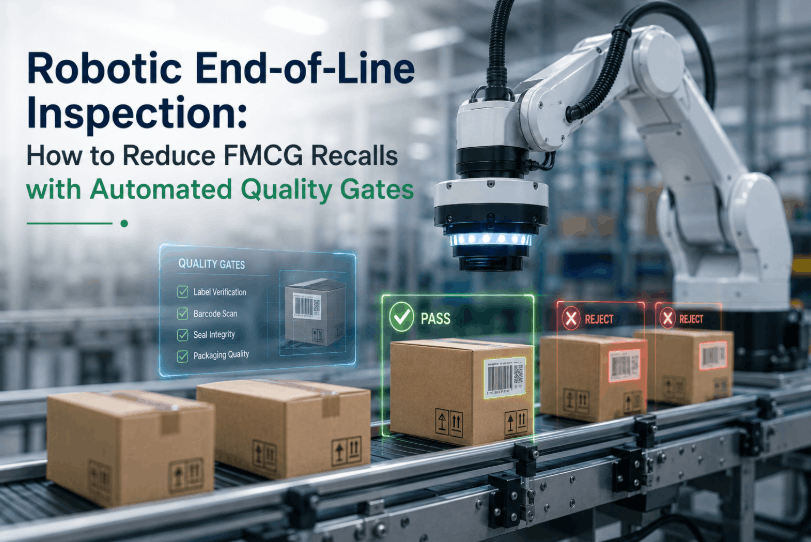
Modern robotic end-of-line inspection systems integrate four core technology layers into a single automated quality gate: industrial robot arms with multi-axis positioning capability, high-resolution AI vision cameras with multi-spectrum imaging, real-time defect classification models trained on product-specific defect libraries, and automated reject arms that remove non-conforming units from the production stream without interrupting line throughput.
iFactory's AI Vision Inspection Integration deploys this architecture as a fully integrated quality gate positioned between the final packaging operation and the case packing or palletizing station. Every unit passing through the gate receives a complete 360-degree inspection — top, bottom, all four sides, and seal/closure condition — in under 80 milliseconds per unit. Units flagged as non-conforming by the AI model are rejected to a segregated hold area with full traceability data attached to the reject event. Book a Demo to explore the robotic inspection system architecture in detail.
360-Degree AI Vision Inspection
Multi-camera arrays capture complete product surface images from all angles simultaneously. Deep learning models trained on thousands of defect examples classify surface defects, label anomalies, and structural failures with 99.5%+ accuracy at full line speed.
Seal & Closure Integrity Inspection
High-resolution imaging detects hermetic seal defects, contaminated seals, cap torque anomalies, and closure damage invisible to inline sensors — the most common category of defects driving FMCG product recalls across beverage, food, and personal care categories.
Label Verification & OCR
OCR-powered label inspection verifies barcode readability, best-before date correctness, lot code formatting, and allergen declaration presence at 1,000+ units per minute — preventing mislabeled product from entering distribution channels that trigger FDA-reportable recall events.
Foreign Object Detection
Multi-spectrum imaging layers — combining visible light, near-infrared, and X-ray data — detect foreign objects as small as 0.8mm within product containers and packaging, providing a final contamination verification check that supplements upstream HACCP CCP systems.
Automated Reject & Segregation
Pneumatic reject arms remove flagged units within 40 milliseconds of AI classification — directing non-conforming product to segregated, locked hold areas with full defect documentation attached. Prevents rejected product from re-entering the production stream.
Case & Secondary Packaging Check
Robotic case inspection verifies correct product count, case label accuracy, and outer packaging integrity before palletizing — catching mixed SKU loads, short-count cases, and damaged outer packaging that generate retailer chargebacks and distribution non-conformances.
Defect Escape Rate: The Metric That Determines Your Recall Risk
Defect Escape Rate (DER) — the percentage of non-conforming units that pass through end-of-line inspection undetected — is the single most important quality metric for FMCG recall risk management. A DER of 15% on a line producing 500,000 units per day means 75,000 potentially defective units enter the distribution chain daily, with recall consequences that scale with distribution velocity and defect severity.
The table below compares defect escape rates across inspection methodologies, based on validated performance data from FMCG facilities operating in the beverage, food, and personal care sectors. The performance gap between legacy inspection systems and robotic AI vision is not incremental — it represents a fundamentally different risk profile for product recalls and regulatory non-compliance. Book a Demo to calculate your current defect escape rate with iFactory's benchmarking tools.
| Inspection Method | Defect Escape Rate | Detection Speed | Defect Types Covered | Recall Risk Level |
|---|---|---|---|---|
| Manual Visual Inspection | 20–30% | 100–200 units/min | Surface only (limited) | Very High |
| Inline Checkweigher + Metal Detector | 15–22% | 400–600 units/min | Weight + Metal only | High |
| 2D Machine Vision (Legacy) | 8–14% | 600–800 units/min | Surface + Label (partial) | Moderate |
| AI Vision (Single Camera) | 3–6% | 800–1000 units/min | Surface + Label + Seal | Low–Moderate |
| Robotic AI Vision (iFactory) | Under 0.5% | 1,200+ units/min | 360° Surface, Label, Seal, Foreign Object | Near Zero |
Building a Recall-Prevention Architecture with Automated Quality Gates
Effective recall prevention in FMCG manufacturing requires more than a single high-performance inspection technology — it requires an integrated quality gate architecture that combines upstream process monitoring, at-line inspection, and end-of-line robotic verification into a layered defense system. iFactory's platform provides all three layers in a single integrated solution, with data flowing continuously between each inspection point to build a complete quality intelligence picture across the entire production run.
Upstream Process Quality Monitoring
iFactory monitors critical process parameters — fill weight sigma, seal bar temperature, closure torque, label registration — in real time throughout the production run. SPC alerts flag process deviations that are likely to generate defective product before the end-of-line gate, enabling process corrections that prevent defect accumulation.
At-Line AI Vision Inspection
Inline AI vision cameras positioned at key production stages (post-fill, post-cap, post-label) provide continuous 100% inspection of critical defect categories at each process stage — creating early rejection points that prevent defective product from accumulating in downstream buffer zones.
Robotic End-of-Line Quality Gate
The final robotic EOL inspection station performs comprehensive 360-degree product verification against the complete defect classification library — acting as the definitive quality gate that intercepts any non-conforming units that passed upstream inspection points due to combined-defect complexity or borderline condition scores.
Automated Traceability & Lot Control
Every product unit is linked to its production lot, shift, and time window through automated barcode or RFID reading at the EOL gate. If a downstream complaint triggers a traceability investigation, iFactory's inspection records allow instant lot boundary identification — limiting recall scope to precisely the affected production window. Book a Demo to see the traceability system in action.
Regulatory Compliance Documentation from Robotic Inspection: FDA, SQF & BRC Standards
Regulatory frameworks governing FMCG product quality — FDA 21 CFR Part 110, FSMA Preventive Controls, SQF Code Edition 9, and BRC Global Standard Issue 9 — all require documented evidence that end-of-line inspection systems are capable of consistently detecting the defect categories they are designed to control. Paper-based inspection logs and manual sampling records no longer satisfy the evidentiary burden that FDA investigators and third-party auditors apply during facility inspections and recall investigations.
iFactory's robotic inspection platform auto-generates complete, tamper-proof compliance records for every inspection session. System capability validation reports — including statistical detection performance studies (Ppk/Cpk) for each defect type, calibration records for all inspection hardware, and trend analysis of defect rate by lot and shift — are stored automatically in searchable, audit-ready format. When an SQF auditor requests evidence of your end-of-line inspection system's detection capability for mislabeling events, the complete performance history is available in under 15 seconds.
FDA FSMA Documentation
Automated monitoring records for all EOL inspection events, including defect classification logs, reject traceability records, and corrective action documentation — providing the supply chain evidence FDA investigators require during FSMA-triggered facility inspections.
SQF & BRC Audit Ready
iFactory generates GFSI-aligned inspection system performance evidence, including capability studies, calibration records, and defect trend analysis — making SQF Level 3 and BRC Grade A re-certification audit preparation a matter of minutes rather than days.
Lot Traceability & Recall Scope Control
Full lot-level inspection traceability allows instant production window identification when a recall investigation is triggered — limiting recall scope to the precise affected lot boundaries and providing documented evidence to regulators of your inspection system's operational effectiveness.
ROI of Robotic End-of-Line Inspection: Recall Prevention Value vs. Investment Cost
FMCG manufacturers evaluating robotic end-of-line inspection investment often frame the decision as a capital expenditure question — comparing system cost against current inspection labor. This framing dramatically underestimates the true ROI, because it ignores the recall prevention value, which is by far the largest component of financial return. A single avoided recall event typically delivers 3–5x the total cost of a robotic inspection system installation.
| Value Category | Without Robotic EOL | With iFactory Robotics | Annual Value |
|---|---|---|---|
| Recall Risk (Direct Cost) | $500K–$10M exposure | Near-zero defect escape | $500K–$10M avoided |
| End-of-Line Inspection Labor | $220,000/yr per line | $28,000/yr monitoring | $192,000/line |
| Retailer Chargebacks (Defects) | $85,000–$200,000/yr | Under $8,000/yr | $77,000–$192,000 |
| False Rejection Product Waste | 6–10% over-rejection | Under 1.2% rejection | $112,000+/yr |
| Audit Prep Labor | 45+ hours per audit | Under 1 hour | $22,000/yr |
For a mid-size FMCG facility with 3 packaging lines, iFactory robotic inspection customers report total annual value realization exceeding $1.5 million — exclusive of recall event avoidance — with full ROI achieved within 8–12 months of deployment.
Deploying Robotic End-of-Line Inspection in a Live FMCG Environment: The 90-Day Roadmap
One of the most common operational objections to robotic EOL inspection deployment is concern about production disruption during installation and commissioning. iFactory's deployment methodology is engineered specifically for live FMCG environments — with robot arm installation, camera rigging, and software commissioning all executed during scheduled sanitation windows and planned downtime, requiring no unscheduled production interruption in most facility configurations.
Robotic System Installation & Integration
Robot arm positioning, camera array installation, lighting systems, and automated reject hardware commissioned during scheduled sanitation windows. PLC/SCADA integration completed. Line conveyor interface configured for zero production impact.
AI Model Training & Defect Library Creation
Deep learning models trained on your specific product formats, packaging designs, and known defect types — including surface defects, label anomalies, seal failures, and contamination signatures. Detection thresholds calibrated per SKU to minimize false rejections.
Live Inspection & System Validation
Full robotic inspection goes live across all active SKUs. Detection capability validation studies (Ppk/Cpk) conducted for each defect type. First compliance documentation records generated automatically. Defect trend dashboards activated for quality and production management teams.
Full Quality Gate Optimization
Traceability integration with ERP and WMS systems completed. Recall scope control workflows tested. AI model continuously refined using accumulated production inspection data. First SQF/BRC audit cycle completed using auto-generated iFactory compliance records.
Frequently Asked Questions: Robotic End-of-Line Inspection for FMCG
Can robotic EOL inspection systems handle multiple SKUs and packaging formats on a single line?
Yes. iFactory's robotic inspection system stores separate AI inspection profiles for each SKU and packaging format. When a changeover is initiated on the production line, the system automatically switches to the appropriate product inspection profile — including updated defect classification thresholds, label reference images, and dimensional tolerances — without requiring manual camera repositioning or recalibration.
What happens to rejected units — can operators incorrectly return them to the line?
iFactory's reject system directs all non-conforming units to a physically segregated and access-controlled hold area. Rejected units cannot be re-introduced to the production stream without a documented quality management review and authorization from a designated quality supervisor — creating an auditable hold management process that satisfies GFSI standard requirements for non-conforming product control.
How does the AI maintain detection accuracy for products with high natural appearance variation?
iFactory's AI models are trained on a statistically representative sample of normal product appearance variation — including natural color variation, texture differences, and dimensional tolerances inherent to each product. This allows the system to distinguish genuine defects from acceptable natural variation, maintaining low false rejection rates while preserving the high defect detection sensitivity required for HACCP compliance.
What is the maximum line speed at which robotic inspection can operate?
iFactory's robotic inspection systems are configured to match your specific line throughput requirements, with standard configurations supporting 800–1,200 units per minute and high-speed configurations available for lines running at 1,500+ units per minute. Detection accuracy remains at 99.5%+ across all line speed configurations, with AI processing latency under 40 milliseconds per unit.
How does iFactory's system integrate with our existing ERP for traceability?
iFactory integrates with leading ERP and MES platforms via REST API, enabling real-time lot traceability data exchange between the inspection system and your production management systems. Every inspection event — including timestamp, lot code, defect classification, and reject decision — is automatically written to the ERP traceability record, creating a complete quality audit trail without manual data entry.
Stop Defects from Reaching Retail Shelves — Start at the End of Your Line
iFactory's robotic end-of-line inspection platform is protecting FMCG operations at leading brands and co-manufacturers across food, beverage, and personal care. See a live walkthrough configured for your line — no obligation.