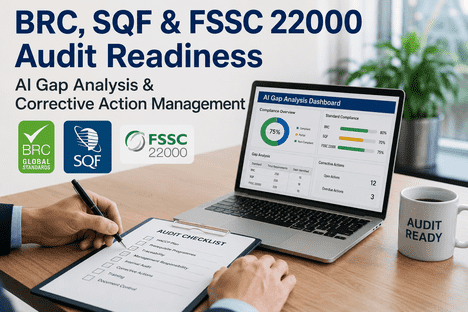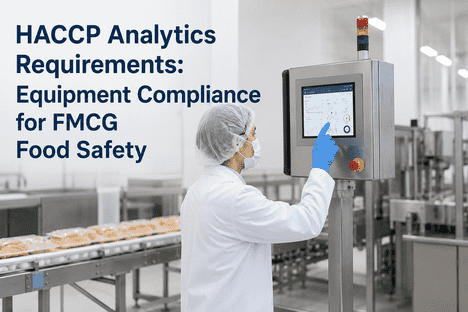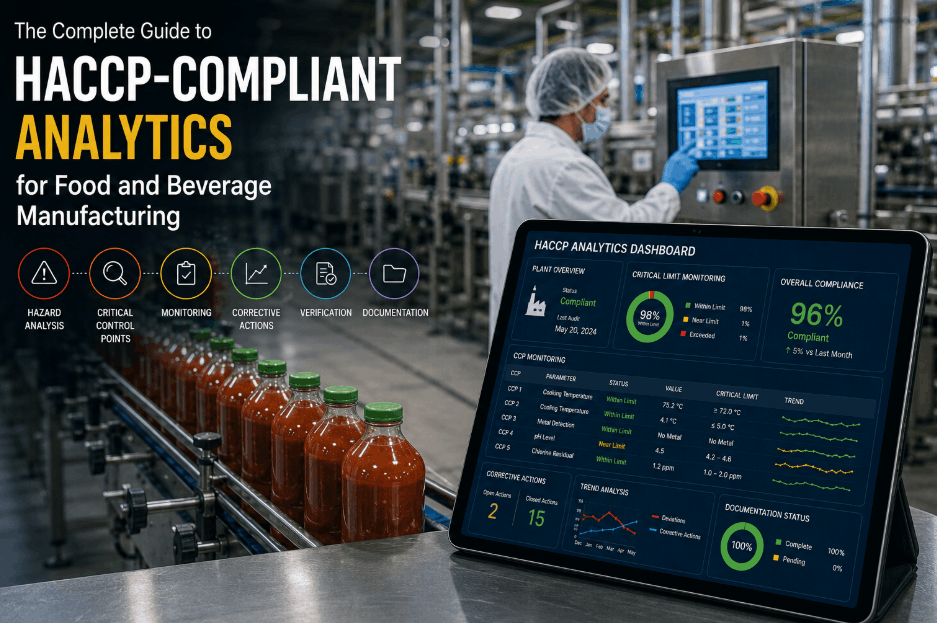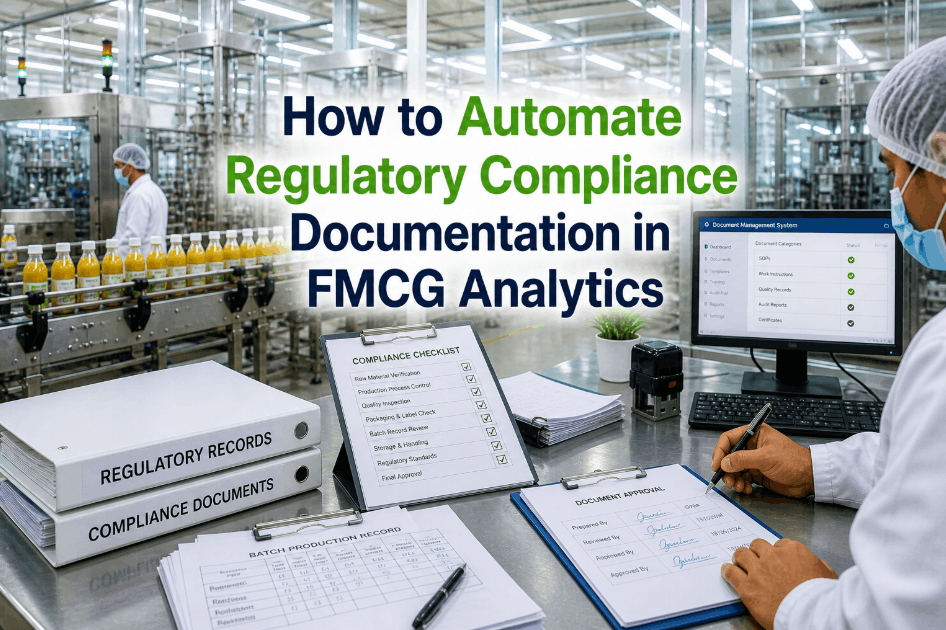
A multi-site food manufacturer producing 2,400 SKUs across six North American facilities deployed iFactory's Compliance & Audit Trail Management platform — combining automated digital checklists, real-time compliance dashboards, and AI-driven audit readiness scoring — to reduce non-compliance events by 72% and cut audit preparation time from 120 person-hours to 14 person-hours per facility per audit cycle. The platform ingests data from 1,800+ HACCP monitoring points, supplier documentation feeds, temperature and humidity sensors, sanitation records, and training logs — mapping every data point to its corresponding FDA, FSMA, SQF, BRC, and ISO 22000 requirement. By correlating real-time operational data against regulatory frameworks, the system surfaces compliance gaps before they become non-conformances, enabling quality assurance leaders to remediate findings proactively rather than reacting to audit observations. The deployment delivered a 100% pass rate on two consecutive SQF and BRC audits across all six sites, saving an estimated $1.4 million annually in re-audit costs, remediation labor, and lost production time. Quality and compliance managers evaluating automated compliance analytics for FDA and GFSI-benchmarked food operations.
72% Fewer Non-Compliance Events — 100% Audit Pass Rate — 86% Faster Audit Prep
iFactory's Compliance & Audit Trail Management platform correlates real-time operational data across FDA, FSMA, SQF, BRC, and ISO 22000 frameworks — automating documentation, surfacing compliance gaps before audits, and enabling quality leaders to achieve certification confidence every day, not just during audit season.
Why Fragmented Compliance Management Threatens Food Safety and Certification
Food manufacturers operating across multiple regulatory frameworks face a fragmented compliance landscape. FDA Current Good Manufacturing Practice (CGMP) requirements under 21 CFR Part 117 mandate preventive controls for human food, while FSMA's Foreign Supplier Verification Program (FSVP) and Sanitary Transportation of Human and Animal Food rules extend compliance obligations across the entire supply chain. Simultaneously, GFSI-benchmarked certification schemes — SQF Edition 9, BRC Global Standard for Food Safety Issue 9, and ISO 22000:2018 — each impose additional documentation, monitoring, and audit readiness requirements that overlap with but are not identical to FDA mandates. When quality teams manage these frameworks in separate spreadsheets, document repositories, and email threads, critical compliance data becomes siloed, audit trail gaps go undetected until the external auditor identifies them, and non-compliance risk accumulates silently. Automated compliance analytics addresses this fragmentation by ingesting all regulatory requirement data into a single platform, mapping every operational data point to its corresponding requirement across all five frameworks, and surfacing gaps in real time. A quality manager evaluating digital compliance solutions for multi-framework food safety certification management.
Comprehensive Coverage Across FDA, FSMA, SQF, BRC, and ISO 22000
The compliance analytics platform maps every operational data point to its corresponding requirement across five interconnected regulatory and certification frameworks. Quality leaders interact with a unified compliance dashboard that surfaces gap scores per framework, documentation completeness metrics, and recommended remediation actions.
FDA 21 CFR Part 117 (CGMP & Preventive Controls) and FSMA Rules Coverage — The platform automates compliance with FDA's Preventive Controls for Human Food rule by ingesting data from all required monitoring points: process preventive controls (metal detection, magnet separation, sieve inspection, x-ray inspection, time/temperature controls for cooking, cooling, and hot holding), food allergen preventive controls (production scheduling, cleaning verification, label review), sanitation preventive controls (pre-operational and operational sanitation logs, ATP swab results, allergen swab results), supply-chain preventive controls (approved supplier list management, certificate of analysis tracking, FSVP compliance documentation), and recall plan documentation (traceability lot number capture, mock recall execution records, distribution records). The platform automatically generates the Food Safety Plan, hazard analysis documentation, preventive controls justification, and monitoring record review logs in the format required by FDA investigators. For FSMA compliance, the platform tracks FSVP importer obligations including foreign supplier approval based on hazard analysis, supplier performance monitoring, corrective action records, and annual FSVP reassessment documentation. The Sanitary Transportation rule is addressed through temperature monitoring integration for inbound and outbound shipments, carrier sanitation agreement management, and transportation equipment inspection records. Each data point is timestamped, user-attributed, and immutable — creating a complete audit trail that satisfies FDA recordkeeping requirements under 21 CFR Part 117 Subpart F.
SQF Edition 9 and BRC Global Standard Issue 9 Certification Management — For SQF Edition 9 certification, the platform maps all operational data to the SQF Code's food safety fundamentals modules for facility type (processing, storage, distribution) and the applicable food sector category. The platform automates SQF requirements including food safety plan documentation and verification (Element 2.5.1), food quality plan monitoring (Element 2.5.2), food fraud vulnerability assessment (Element 2.7.1), food allergen management program (Element 2.8.1), microbiological environmental monitoring program (Element 2.4.1), and internal audit program execution and documentation (Element 2.3.1). For BRC Global Standard Issue 9, the platform addresses all nine clauses: senior management commitment and continual improvement (Clause 1), the food safety and quality management system (Clause 2), site food safety and quality standards (Clause 3 — including fabric maintenance, equipment calibration, pest management, and foreign body detection), product control (Clause 4 — including incoming goods inspection, allergen management, traceability, and product labeling), process control (Clause 5 — including process validation, temperature control, and weight control), personnel (Clause 6 — including hygiene requirements, training, and visitor management), high-risk production zone requirements (Clause 7), traded product requirements (Clause 8), and the requirement for unannounced audit readiness (Clause 9). The platform's audit readiness scoring engine evaluates completeness across all SQF and BRC elements in real time, generating a percentage readiness score and prioritized gap list.
ISO 22000:2018 Food Safety Management System Compliance — The platform maps operational data and documentation to all clauses of the ISO 22000:2018 standard using the Annex SL high-level structure that integrates with other ISO management system standards. Clause 4 (Context of the Organization) is addressed through automated documentation of external and internal issues relevant to food safety, interested party requirements identification, and FSMS scope definition. Clause 5 (Leadership) is supported through food safety policy documentation, role and responsibility assignments with electronic sign-off, and management review meeting agenda and minutes generation from platform data. Clause 6 (Planning) covers risk and opportunity identification for the FSMS, food safety objectives tracking with real-time KPI dashboards, and change management documentation. Clause 7 (Support) includes resource management records, competency and training tracking with certification expiry alerts, communication logs for external and internal food safety communications, and documented information management with version control and access permissions. Clause 8 (Operation) is the most data-intensive section — it encompasses operational planning and control, PRP (Prerequisite Program) monitoring and verification (including cleaning and sanitation, pest control, waste management, and utilities management), traceability system exercise records with lot-level granularity, emergency preparedness and response procedure documentation, hazard analysis records (HAZARD identification, severity and likelihood assessment, control measure determination), validation of control measure effectiveness, HACCP plan monitoring and verification records, updating PRPs and the HACCP plan based on verification results, and control of monitoring and measuring equipment with calibration records. Clause 9 (Performance Evaluation) is addressed through internal audit program automation, FSMS performance analysis dashboards, and management review data aggregation. Clause 10 (Improvement) covers non-conformity and corrective action management with root cause analysis workflows, and continual improvement tracking with trend analytics.
12-Week Deployment: From Regulatory Mapping to Audit-Ready Operations
The deployment follows a structured four-phase methodology designed for multi-site food manufacturing environments with existing HACCP plans and varying levels of digital maturity. Each phase includes framework coverage validation, data pipeline verification, and quality team training. Book a Demo to review the complete deployment protocol for your specific certification portfolio and facility configuration.
Regulatory Gap Analysis
Map existing HACCP plans, monitoring records, and documentation against FDA, FSMA, SQF, BRC, and ISO 22000 requirements. Identify coverage gaps, documentation format issues, and data accessibility problems. Establish baseline compliance scores per framework. Duration: 3 weeks.
Data Pipeline & Integration
Connect to existing sensor infrastructure, ERP systems, LIMS, and CMMS platforms via API or OPC UA. Ingest temperature logs, CCP monitoring records, sanitation data, supplier documentation, and training records. Map every data point to regulatory requirements. Duration: 4 weeks.
Pilot on Single Facility
Deploy compliance dashboard and audit trail automation on one production facility. Validate framework coverage and gap detection accuracy. Tune compliance scoring thresholds. Train quality team on dashboard and remediation workflow. Conduct mock audit. Duration: 3 weeks.
Multi-Site Rollout
Expand to remaining facilities with standardized framework mappings. Monitor compliance score improvement per facility and per framework. Implement automated audit trail generation for upcoming certifications. Deploy compliance analytics dashboards across all quality leadership roles. Duration: 2 weeks.
I have spent 22 years in food safety and quality management — starting as a quality technician in a frozen food plant, then moving through HACCP coordinator and quality systems manager roles, and for the last eleven years serving as vice president of food safety and quality for a multi-site prepared foods manufacturer supplying retail, food service, and private label customers across North America. When our team evaluated automated compliance analytics, I was skeptical that a platform could meaningfully map operational data across the complexity of FDA, FSMA, SQF, BRC, and ISO 22000 requirements simultaneously. The results exceeded my expectations. Within eight weeks of pilot deployment across our largest facility, the platform had identified 47 compliance gaps that had gone undetected through our manual audit preparation process — including three documentation deficiencies that would have been written up as major non-conformances in our upcoming SQF audit. Our audit preparation time dropped from 120 person-hours to 14 person-hours per facility, and our quality team shifted their focus from document compilation to genuine food safety improvement. The most transformative outcome was the cultural change: instead of compliance being a periodic panic before each audit, it became a continuous, data-driven process that our team monitors daily. For food safety leaders evaluating this technology, the key insight is that automated compliance analytics does not just make audits easier — it makes food safety management more effective by connecting regulatory requirements to operational data in real time.
Start Your Compliance Transformation — Free Regulatory Gap Assessment
iFactory's Compliance & Audit Trail Management platform integrates with your existing infrastructure to automate documentation, surface compliance gaps, and maintain audit-ready operations across FDA, FSMA, SQF, BRC, and ISO 22000 frameworks. Our regulatory gap assessment evaluates your current compliance posture, documentation maturity, and highest-impact certification readiness opportunities — delivered at no cost with no commitment required.
Automated Compliance Analytics Transforms Food Safety Management from Reactive to Continuous
Automated compliance analytics represents a fundamental shift in how food manufacturers approach regulatory and certification management. By ingesting operational data from 1,800+ HACCP monitoring points and mapping every data point to its corresponding FDA, FSMA, SQF, BRC, and ISO 22000 requirement, the platform enables quality leaders to surface compliance gaps before they become non-conformances. The 12-week deployment across six facilities demonstrated a 72% reduction in non-compliance events, 100% pass rate on consecutive SQF and BRC audits, and an 86% reduction in audit preparation time — saving an estimated $1.4 million annually. The integration of automated digital checklists, real-time compliance dashboards, and AI-driven audit readiness scoring transforms compliance management from a periodic documentation exercise to a continuous, data-driven operational capability. Food safety and quality leaders evaluating automated compliance analytics for multi-framework food manufacturing operations Book a Demo to review the platform tailored to their specific certification portfolio, facility configuration, and compliance improvement targets.
Food Safety Compliance Analytics — Frequently Asked Questions
Traditional document management systems store compliance records in organized folders but require quality teams to manually retrieve, review, and compile documentation for each audit and to manually identify gaps. Automated compliance analytics goes beyond storage — it ingests operational data from sensors, ERP systems, and manual entries; maps each data point to specific regulatory requirements across FDA, FSMA, SQF, BRC, and ISO 22000 frameworks; and continuously evaluates whether each requirement is satisfied by available data. When a gap is detected — a missing temperature log, an expired supplier certificate, a training record that is due for renewal — the platform surfaces it in real time along with recommended remediation actions. The key difference is time: document management tells you what you have stored, while compliance analytics tells you what you are missing before an auditor finds it.
The platform integrates with a wide range of data sources common in food manufacturing environments: temperature and humidity sensors from refrigeration systems, cooking and holding equipment, and storage areas (via OPC UA, Modbus, or API); ERP systems for supplier documentation, raw material lot tracking, finished goods traceability, and COA management; LIMS for microbiological and chemical testing results; CMMS systems for sanitation records, equipment calibration data, and maintenance logs; time and attendance systems for training record verification; manual HACCP log entries via mobile forms and digital checklists; and document repositories for food safety plans, SOPs, and prerequisite program documentation. The platform's data pipeline is designed to work with existing infrastructure — most facilities can connect without installing new sensors or replacing existing systems. Data ingestion is configurable to the specific monitoring points and documentation formats used at each facility.
Yes — the compliance analytics engine maintains separate but interconnected requirement mappings for each certification framework. When a data point satisfies the SQF requirement for environmental monitoring (Element 2.4.1), the platform also evaluates whether it satisfies the BRC equivalent under Clause 5.4 (environmental monitoring for high-risk and high-care zones) and surfaces any gaps in the BRC mapping even if the SQF requirement is fully met. The platform supports facilities that maintain multiple certifications by providing both a unified compliance dashboard showing overall readiness across all frameworks and framework-specific views that show element-by-element compliance status for each standard individually. Audit trail documentation is generated in the format required by each certification body, with framework-appropriate language, clause references, and evidence presentation. This multi-framework capability is particularly valuable for facilities that supply both retail customers (typically requiring BRC certification) and food service customers (who may accept SQF certification), as it eliminates the duplication of documentation effort across overlapping but distinct certification requirements.
The platform addresses FSMA traceability under the Food Traceability Rule (21 CFR Part 1120) by capturing Key Data Elements (KDEs) at each Critical Tracking Event (CTE) — receiving, transforming, creating, shipping — and maintaining lot-level traceability records that can be retrieved within 24 hours as required by the FDA. The platform supports the FDA's electronic recordkeeping format and can generate traceability lot records, distribution records, and receipt records in the required schema. For food defense, the platform supports FSMA's Intentional Adulteration (IA) rule compliance by documenting the food defense plan, actionable process step (APS) identification, mitigation strategy implementation and monitoring records, and food defense training documentation. The platform also supports vulnerability assessment documentation and mitigation strategy reanalysis records at the required three-year interval or whenever significant changes occur.
ROI timelines vary by facility count, certification portfolio complexity, and current compliance documentation maturity, but the deployment described above achieved full payback within 18 weeks — six weeks after the 12-week deployment completed. The primary ROI drivers are audit preparation labor reduction (86% reduction — for a typical multi-site operation with 4–6 facilities, this represents $200,000 to $400,000 in annual labor savings); re-audit cost avoidance (SQF and BRC re-audit fees range from $15,000 to $35,000 per site); non-compliance event cost reduction (each major non-conformance can require $50,000 to $150,000 in remediation costs, lost production, and corrective action implementation); and certification-driven revenue protection (retaining retail and food service customer certification requirements that would be at risk without compliance documentation). iFactory provides a detailed ROI projection specific to your facility count, current compliance maturity, and certification portfolio as part of the free regulatory gap assessment, with no commitment required.