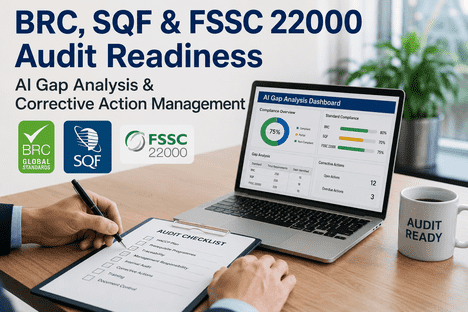
Preparing for a BRC, SQF, or FSSC 22000 audit has traditionally meant weeks of manual evidence gathering pulling corrective action records from disparate systems, verifying that every gap identified in the last audit was closed, and hoping the documentation stands up to an auditor's scrutiny. AI-driven gap analysis and corrective action management changes this fundamentally. Quality managers who Book a demo see how iFactory's GFSI audit readiness platform transforms the certification cycle from a reactive sprint into a continuous state of audit readiness.
The GFSI Certification Challenge: Why Traditional Audit Preparation Falls Short
The Global Food Safety Initiative (GFSI) benchmarks multiple food safety certification schemes — BRC Global Standard for Food Safety Issue 9, SQF Code Edition 9, and FSSC 22000 Version 6 — each with its own audit protocol, documentation requirements, and non-conformance classification system. Quality and compliance teams responsible for maintaining certification across multiple schemes face a structural challenge: each standard requires different evidence formats, different corrective action timelines, and different audit presentation methods, yet all three ultimately demand the same thing — verifiable proof that the food safety management system is effective, documented, and continuously improved. Operations that Book a demo discover how unified AI-driven gap analysis eliminates the duplication of effort that plagues multi-standard certification programs.
- Manual gap identification against each standard — repeated for every certification cycle
- Corrective action records scattered across spreadsheets, email threads, and paper files
- Audit evidence gathering starts 4-6 weeks before each audit — reactive scramble
- No cross-standard visibility — gaps in BRC may duplicate gaps in FSSC 22000
- Corrective action close-out verification relies on manual follow-up and memory
- Root cause analysis quality varies by investigator — inconsistent audit defense
- Automated gap analysis mapped to each standard's clause structure — continuous monitoring
- Unified corrective action management with cross-standard traceability and deadline tracking
- On-demand audit evidence packages organized by standard clause — zero preparation time
- Cross-standard gap correlation — resolve one root cause, close gaps across BRC, SQF, and FSSC
- Closed-loop verification with automated effectiveness checks and audit trail generation
- AI-assisted root cause analysis with consistent methodology — every finding, every time
The AI-Powered Gap Analysis Lifecycle: From Gap Identification to Audit Closure
iFactory's AI-driven gap analysis maps every element of your food safety management system against the clause structures of BRC Issue 9, SQF Edition 9, and FSSC 22000 Version 6 — identifying gaps, prioritizing corrective actions, and generating audit-ready evidence packages continuously throughout the year, not just in the weeks before an audit. Quality leadership teams that Book a demo receive a live walkthrough of the automated gap analysis workflow using their own facility's quality data.
Key Capabilities for GFSI Audit Readiness Management
iFactory's platform delivers four integrated capabilities that create a continuous audit readiness cycle. Each capability addresses a specific challenge in multi-standard GFSI certification management, and together they eliminate the reactive audit preparation cycle. Quality teams that Book a demo receive a customized capability assessment mapped against their specific certification requirements and gap history.
Platform Evaluation Matrix: GFSI Audit Readiness
When evaluating platforms for GFSI audit readiness, each capability must be assessed against the specific requirements of BRC, SQF, and FSSC 22000 standards. The following comparison matrix provides a structured evaluation framework for assessing platform capabilities across the regulatory dimensions that matter most to multi-standard certification management.
| Evaluation Criterion | Essential Requirement | Advanced Capability | Applicable Standards |
|---|---|---|---|
| Gap Analysis | Manual checklist against each standard | AI-driven cross-standard gap mapping with root cause correlation | BRC, SQF, FSSC 22000 |
| Corrective Action Tracking | Spreadsheet with manual status updates | Unified platform with deadline automation and evidence management | BRC 3.11, SQF 2.5, FSSC 8.5 |
| Root Cause Analysis | Free-form text in investigation reports | AI-assisted RCA with structured methodology and trend analysis | BRC 3.11.2, SQF 2.5.2, FSSC 8.5.2 |
| Audit Evidence Management | Folder-based document storage | On-demand evidence packages organized by standard clause | BRC, SQF, FSSC 22000 |
| Effectiveness Verification | Manual follow-up at next audit | Automated verification scheduling with recurrence detection | BRC 3.11.3, SQF 2.5.3, FSSC 8.5.3 |
| Cross-Standard Visibility | Separate tracking per standard | Unified dashboard with cross-standard gap correlation | BRC, SQF, FSSC 22000 |
Performance Benchmarks from GFSI Audit Readiness Deployments
Food manufacturing facilities deploying AI-driven audit readiness platforms report measurable improvements across gap closure rates, corrective action cycle times, and audit preparation efficiency. The following benchmarks represent aggregated results from iFactory deployments at GFSI-certified food processing facilities.
Expert Perspective: What AI Audit Readiness Changes in Food Safety Certification
The food industry has treated GFSI certification audits as discrete events — prepare, audit, certify, relax, repeat. That cycle is exhausting, expensive, and fundamentally misaligned with what continuous improvement actually requires. What AI-driven audit readiness changes is the structural relationship between the facility and the standard. Instead of preparing for the audit, you are living the standard every day — and the evidence is generated naturally as part of operations rather than manufactured in the weeks before the auditor arrives. The quality team I work with had been certifying facilities for over a decade, and they told me the first year with continuous AI-driven gap analysis was the first year they actually felt audit-ready before the audit started — not scrambling, not guessing, not hoping. That shift from reactive to continuous readiness is what makes AI audit readiness a fundamentally different approach to food safety certification.Book a demo
Frequently Asked Questions: GFSI Audit Readiness
The platform maintains a complete clause structure database for each standard, including the specific language, compliance criteria, and non-conformance classification system for each. When the AI engine performs gap analysis, it evaluates each element of the food safety management system independently against each standard's requirements — identifying gaps specific to BRC, SQF, or FSSC 22000. The platform also cross-references gaps across standards to identify common root causes: for example, a training record deficiency might appear as a BRC clause 7.1 gap, an SQF element 2.4.2 gap, and an FSSC 22000 ISO 22000:2018 clause 7.2 gap — but resolving the underlying training system deficiency closes all three gaps simultaneously.
Yes. The platform supports configurable evidence package templates that can be adapted to the specific documentation format requirements of each certification body. Standard templates are provided for BRCGS, SQF Institute, and FSSC 22000认可的 certification body formats, and custom templates can be created for certification bodies with unique documentation requirements. All evidence packages include complete traceability to the original source documents and are time-stamped with the evidence collection date for audit trail integrity.Book a demo
The platform provides structured root cause analysis workflows that support multiple methodologies — including 5-Why analysis, Fishbone diagrams, and Fault Tree Analysis — selected based on the non-conformance classification and standard requirements. The AI engine assists by analyzing historical gap data to identify patterns that suggest deeper systemic root causes. For example, if three different BRC clauses generated non-conformances related to documentation control, the platform would flag the systemic documentation management gap rather than treating each finding as an isolated issue. All RCA records are linked to the specific standard clause, non-conformance record, and corrective action plan for complete audit traceability.
A phased deployment typically spans 8 to 16 weeks, beginning with a multi-standard gap assessment that maps the existing food safety management system against BRC Issue 9, SQF Edition 9, and FSSC 22000 Version 6 requirements. Phase one (weeks 1-4) establishes the gap analysis engine, corrective action tracking, and basic evidence management. Phase two (weeks 5-10) adds AI-assisted root cause analysis, automated deadline management, and cross-standard gap correlation. Phase three (weeks 11-16) deploys on-demand audit evidence package generation, audit performance analytics, and certification body-specific reporting templates. An accelerated timeline is achievable for facilities with mature food safety management systems and digital documentation practices.