FSSC 22000 certification is the most widely recognized Global Food Safety Initiative (GFSI) benchmark for food safety management systems. For food manufacturers and FMCG producers, achieving and maintaining FSSC 22000 certification requires documented evidence that every piece of equipment touching the product — from receiving conveyors and blending vessels to packaging lines and cold-chain storage — is designed, maintained, calibrated, and cleaned to prevent contamination. Equipment analytics data — temperature logs, CIP cycle records, calibration certificates, maintenance histories, and hygienic design audit findings — forms the backbone of the FSSC 22000 documentation that certification auditors require. Without a digital system that captures, trends, and retrieves this data on demand, food plants spend hundreds of hours manually compiling evidence for each surveillance audit. iFactory AI's Preventive Maintenance and Compliance modules give food manufacturers the digital infrastructure to maintain FSSC 22000-compliant equipment records, auto-generate audit documentation, and prove due diligence across every piece of food-contact equipment in the facility.
FSSC 22000: Equipment Analytics for Certification
Build FSSC 22000-compliant equipment analytics programs. ISO 22000 requirements, prerequisite programs, and analytics documentation for food safety management certification.
Why FSSC 22000 Certification Demands Equipment Analytics
FSSC 22000 certification requires organizations to implement and maintain a Food Safety Management System (FSMS) that covers the entire food supply chain. The certification is based on ISO 22000 requirements plus FSSC-specific Prerequisite Program (PRP) specifications. Equipment analytics is not an optional add-on — it is woven into multiple ISO 22000 clauses including 7.1.3 (infrastructure), 7.1.4 (environment of operation), 8.2 (prerequisite programs), 8.5 (control of nonconformities), and 8.8 (verification activities). Every piece of food-contact equipment must have a documented history of maintenance, calibration, cleaning, and performance verification. When the certification auditor arrives, the quality team must produce this evidence within minutes — not hours or days. Food plants that manage equipment data on paper or disconnected spreadsheets consistently fail this test. The plants that pass without nonconformities use digital compliance systems that link every equipment record to the relevant FSSC 22000 clause and make auditor-ready documentation available on demand.
Section 1: FSSC 22000 Equipment Documentation Requirements
The foundation of every FSSC 22000 certification is documented evidence that food safety is systematically managed across every process and piece of equipment. Equipment analytics documentation must cover the entire equipment lifecycle from procurement and hygienic design validation through maintenance, calibration, cleaning, and decommissioning. The documentation framework must demonstrate that food safety requirements are established, implemented, maintained, and continually improved. Below is the complete equipment documentation structure required for FSSC 22000 compliance, organized by ISO 22000 clause and FSSC PRP category.
Section 2: Prerequisite Programs — Equipment Cleaning & Sanitation Analytics
FSSC 22000's Prerequisite Program (PRP) requirements are more detailed than ISO 22000 baseline expectations. PRP Category 5 (cleaning and sanitizing) requires documented evidence that all food-contact equipment is cleaned and sanitized according to validated procedures, at defined frequencies, with verifiable results. Equipment analytics data is the most defensible evidence: CIP cycle data confirms flow rates, temperatures, detergent concentrations, and contact times — all trending toward established validation parameters. ATP swab results linked to specific equipment on specific dates demonstrate hygienic condition at handover. Without a digital system that stores, trends, and reports this data by equipment, the audit trail is fragmented and fragile.
Section 3: Equipment Analytics for HACCP and CCP Monitoring
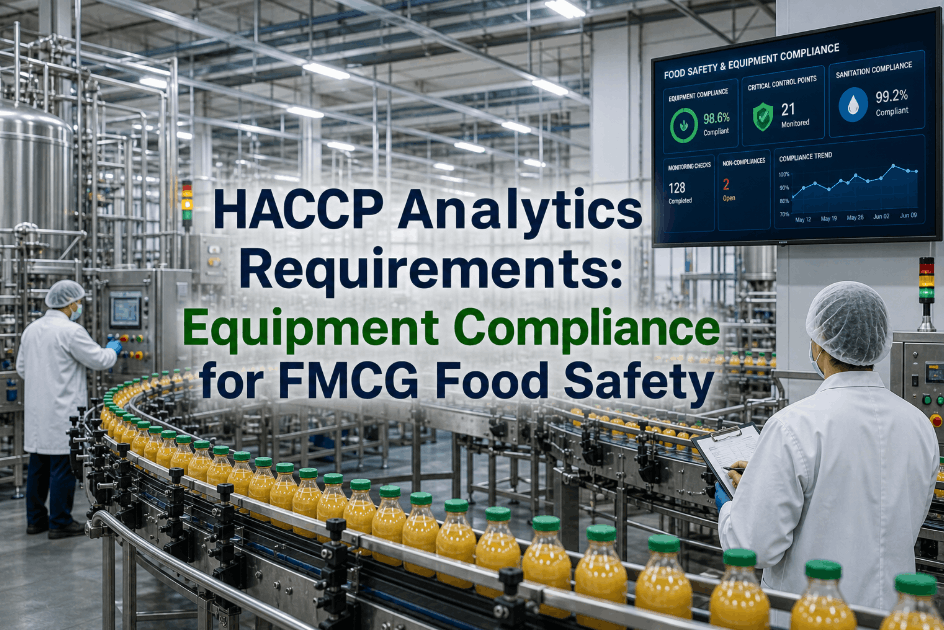
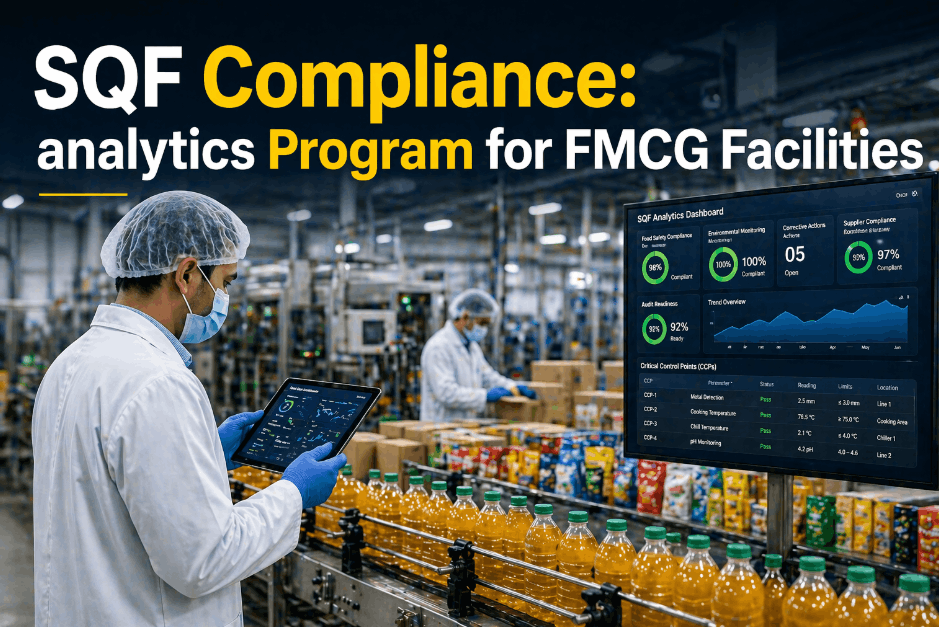
HACCP (Hazard Analysis and Critical Control Points) is the systematic preventive approach at the center of FSSC 22000. Equipment analytics plays a direct role in HACCP implementation by providing the data that validates Critical Control Points (CCPs) are operating within established critical limits. Metal detectors, X-ray inspection systems, temperature-controlled equipment, and cooking/cooling systems are all CCP candidates, and each requires continuous or batch-level analytics to demonstrate control. iFactory AI's equipment analytics platform directly supports HACCP compliance by ingesting CCP monitoring data from sensors and automation systems, logging it against specific equipment and production batches, and triggering alerts when critical limits are approached or breached. When a deviation occurs, the system captures the event with timestamp, equipment ID, product batch, corrective action, and disposition — producing the complete HACCP record that FSSC 22000 auditors require.
CCP Monitoring Data Logging
Continuous temperature, metal detector status, and X-ray rejection data captured at equipment level. Every reading is timestamped and linked to the specific production batch running at the time of the reading.
Critical Limit Trending
Equipment analytics charts show CCP data trending over time — enabling the HACCP team to identify drift toward critical limits before a breach occurs. Proactive adjustment replaces reactive deviation management.
Deviation & Corrective Action Records
CCP breaches automatically generate deviation records with stop-time, duration, root cause, corrective action, and product disposition — meeting ISO 22000:8.5.2 and 8.7 requirements without manual paperwork.
HACCP Validation Evidence
Validation studies require documented evidence that CCP equipment consistently operates within critical limits. iFactory AI stores historical CCP data that supports HACCP revalidation at each audit cycle.
Audit-Ready HACCP Reports
One-click HACCP documentation export per equipment item, per CCP, per date range. Generate the complete HACCP evidence package for any FSSC 22000 audit in under 10 minutes.
Equipment-to-Batch Traceability
Every CCP record, PM completion, calibration event, and cleaning verification linked to the product batches that ran on that equipment. Full traceability from end product back to equipment condition at time of production.
Section 4: Foreign Body Prevention Equipment Analytics
FSSC 22000 Category 6 and 13 PRPs require documented controls for foreign body contamination. Equipment analytics supports these controls by monitoring the performance of metal detectors, X-ray inspection systems, magnet separators, sieves, and filters. Each detection and rejection device requires documented proof that it is functioning within specified parameters at all times during production. Test probe challenges at defined intervals with documented results are the standard evidence — but equipment analytics takes this further by trending rejection rates, false-positive rates, and sensitivity drift over time, enabling the food safety team to identify calibration degradation before it creates a food safety risk.
| FSSC PRP Category | Equipment Analytics Requirement | Documentation Frequency | Audit Evidence |
|---|---|---|---|
| PRP 6 — Foreign Material Control | Metal detector/X-ray sensitivity verification, magnet strength testing, filter integrity checks | Each production run or per shift | Test log with product run linkage, rejection records, sensitivity drift trending |
| PRP 7 — Maintenance | PM completion, food-grade lubricant verification, spare parts food-grade certification | Scheduled PM intervals + monthly review | PM work orders, lubricant application records, parts material certificates |
| PRP 13 — Equipment | Hygienic design certification, calibration records, temperature mapping, surface finish verification | Annual + on new equipment purchase | EHEDG/3-A certs, calibration certificates, mapping reports, RA data |
| PRP 5 — Cleaning | CIP cycle parameter logs, ATP swab results, microbiological surface data, allergen-clean verification | Per CIP cycle + scheduled swabbing | CIP trend charts, swab result trending, cleaning schedule compliance |
| CCP Data | Continuous temperature, metal detector status, cooker/oven temperature profile data | Continuous + batch-level summary | CCP monitoring records, deviation reports, corrective action documentation |
Section 5: Supplier Equipment Verification and Records
FSSC 22000 requires organizations to manage food safety risks associated with outsourced processes and purchased equipment. When equipment is supplied by third-party manufacturers or refurbishers, the receiving organization must verify that it meets hygienic design requirements, material-of-construction specifications, and food safety standards before it enters food-production areas. Equipment analytics must include supplier documentation management, incoming inspection records, and commissioning verification — all linked to the specific equipment asset. Non-conforming equipment identified at receipt triggers the same ISO 22000:8.7 nonconformity management process as a production deviation. iFactory AI's supplier equipment module centralizes design specifications, material certificates, hygienic design assessments, and commissioning checklists so that every piece of food-contact equipment entering the facility has a complete, auditable food safety record from the moment it arrives.
"The single most common nonconformance I wrote in FSSC 22000 audits was not about the quality of the food safety program — it was about the inability to produce records on demand. The quality manager would disappear for 45 minutes to find calibration certificates, then return with a binder from 2022 missing the right date range. In the age of digital maintenance systems, there is no defensible reason for that. Equipment analytics should be searchable by asset, by date range, by certification clause, and by CCP. If your maintenance system cannot produce a temperature verification record for a specific piece of equipment on a specific production date in under 60 seconds, your FSSC 22000 certification is at risk — and you are spending hours of unnecessary labor preparing for each audit."
How iFactory AI Supports FSSC 22000 Certification
iFactory AI's Preventive Maintenance and Compliance modules are purpose-built for food manufacturers pursuing or maintaining FSSC 22000 certification. The platform centralizes all equipment analytics data — PM records, calibration certificates, temperature monitoring, CIP verification, CCP data, and supplier documentation — in a single searchable, reportable system. Every record is timestamped, linked to a specific equipment asset, and retrievable by FSSC 22000 clause, date range, or audit category. When the certification auditor asks for temperature calibration records for all coolers in the high-risk zone for the past six months, the response is a single click and a print-ready report — not a two-hour manual search through four different filing systems.
Frequently Asked Questions
What equipment records are required for FSSC 22000 certification?
How often do FSSC 22000 equipment records need to be reviewed?
Can iFactory AI integrate with existing temperature monitoring systems?
How does equipment analytics support HACCP revalidation?
What happens if equipment analytics data is missing during an FSSC audit?
Ready to Build Your FSSC 22000 Equipment Analytics Program?
iFactory AI gives food manufacturers the digital platform to maintain FSSC 22000-compliant equipment records, CCP monitoring data, cleaning verification logs, calibration documentation, and supplier equipment records — all linked to specific assets and production batches for instant audit retrieval.