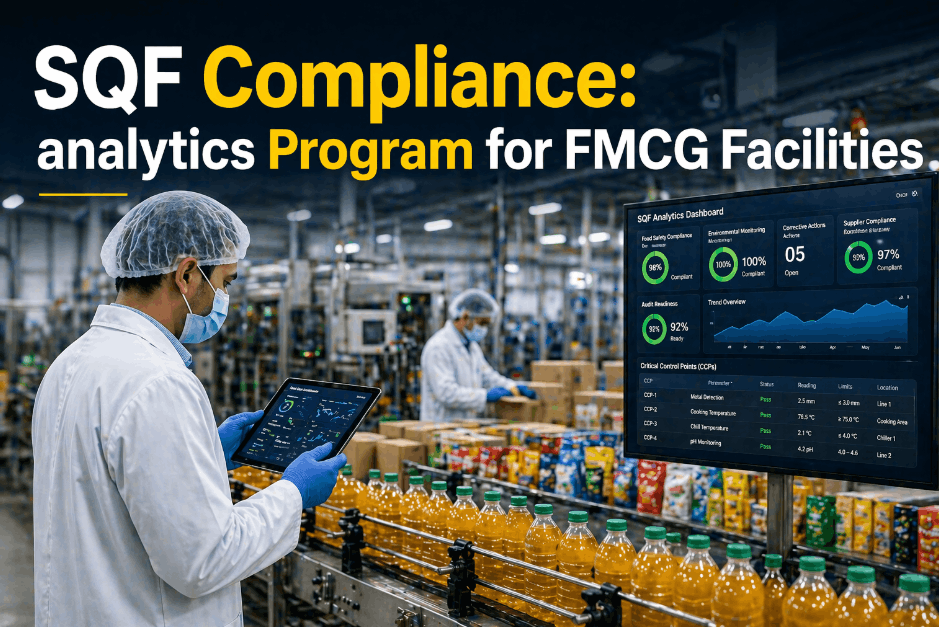
SQF compliance is no longer optional for FMCG manufacturers competing for premium retail shelf space. As Safe Quality Food certification becomes a baseline requirement across food, beverage, personal care, and household goods supply chains, building a robust SQF Analytics program is the operational foundation that separates audit-ready facilities from those perpetually playing catch-up. An effective SQF compliance framework integrates equipment analytics, environmental monitoring, corrective action documentation, and real-time production data into a single intelligence layer — one that satisfies SQF auditors, protects brand equity, and drives continuous food safety improvement across every production line. Book a demo with iFactory to see how AI-powered analytics accelerates SQF certification readiness across your FMCG facility.
Accelerate SQF Certification Across Your FMCG Plant
iFactory delivers equipment analytics, environmental monitoring, and audit-ready documentation — purpose-built for SQF compliance in food and beverage manufacturing.
What SQF Compliance Requires from FMCG Manufacturing Operations
The Safe Quality Food Institute's SQF Code — now in its ninth edition — is one of the most comprehensive food safety management standards applied to FMCG manufacturing globally. Unlike simpler third-party audits, SQF certification demands verified implementation across Good Manufacturing Practices (GMPs), Hazard Analysis and Critical Control Points (HACCP), food safety management systems, and supplier management protocols. For FMCG facilities producing under contract for major retailers, SQF Levels 2 and 3 certification is often a non-negotiable supply requirement — and maintaining it demands documentation depth that manual systems structurally cannot sustain across high-volume, multi-SKU production environments.
Why FMCG Plants Fail SQF Audits
The four documentation and process gaps auditors find most often
38%
Of SQF non-conformances tied to incomplete or missing corrective action records
61%
Of facilities cite manual documentation gaps as their top SQF preparation challenge
3.2×
Longer audit investigation time in plants without digital traceability infrastructure
$85K
Average cost of a failed SQF audit cycle including re-audit fees and production disruption
Building a High-Performance SQF Analytics Program: The Core Framework
A structured SQF Analytics program for FMCG manufacturing is built across five interdependent pillars: equipment performance monitoring, environmental and hygiene analytics, HACCP critical control point tracking, supplier and incoming materials data integration, and audit documentation automation. When these pillars are connected through a unified analytics platform, SQF compliance shifts from a periodic audit event to a continuous operational state. Production managers who book a demo with iFactory consistently report that their existing sensor and PLC infrastructure already generates the data needed to power all five pillars — the missing element is an AI layer that translates raw data into SQF-formatted intelligence.
01
SQF Equipment Analytics and Calibration Management
AI-powered equipment analytics continuously monitor vibration signatures, temperature performance, and actuator behavior to detect calibration drift before it produces non-conforming product. For CCP-linked equipment — checkweighers, metal detectors, heat sealers, pasteurizers — real-time monitoring converts into automatically generated calibration event records aligned to SQF Module 11 requirements.
02
Environmental Monitoring Analytics for SQF Food Safety Plans
AI analytics platforms automate EMP schedule management — generating sampling task assignments, capturing swab results digitally, running trend analysis across ATP and pathogen-specific sampling zones, and flagging anomalies that require documented corrective action responses. FMCG facilities that
book a demo can see how automated EMP analytics eliminates environmental non-conformance risk continuously.
03
HACCP Critical Control Point Real-Time Tracking
Every CCP deviation is captured in real time with automated operator alerts, corrective action prompts, and timestamped electronic records generated per shift — giving SQF auditors complete, unbroken HACCP documentation coverage across all production lines and shift patterns.
04
Supplier and Incoming Materials Data Integration
Incoming material inspection results, supplier certificate of analysis (COA) capture, and non-conformance tracking are linked directly to production batch records — giving quality teams complete SQF supply chain documentation and enabling rapid root cause investigation when supplier-linked issues arise.
05
Audit Documentation Automation and CAPA Management
AI-linked CAPA workflows capture non-conformance root cause, corrective action steps, verification evidence, and closure timestamps — formatted to SQF audit requirements and instantly retrievable for auditor review without manual assembly or document hunting across paper-based systems.
SQF 01
HACCP CCP Monitoring
Real-time monitoring of critical control points with automated deviation alerts, corrective action prompts, and SQF-formatted electronic records for every production shift.
100% CCP documentation coverage
SQF 02
Equipment Calibration Records
AI-triggered calibration schedules with automatic record generation — linked to equipment asset IDs, calibration standards, and SQF Module 11 compliance requirements.
Zero missed calibration events
SQF 03
Environmental Monitoring Automation
Automated EMP schedule generation, digital result capture, zone trend analytics, and corrective action documentation — ready for SQF auditor review at any time.
Audit-ready EMP records always live
SQF 04
Batch Traceability & Lot Control
End-to-end digital lot tracking from raw material receipt to finished goods dispatch — with full batch record generation meeting SQF traceability and recall readiness requirements.
Recall simulation complete in under 4 hrs
SQF 05
Corrective Action Management
AI-linked CAPA workflows that capture non-conformance root cause, corrective action steps, verification evidence, and closure timestamps — formatted to SQF audit requirements.
CAPA closure rate improved by 55%
SQF 06
Supplier Quality Integration
Incoming material inspection data, supplier COA capture, and non-conformance tracking — linked to production batch records for complete SQF supply chain documentation.
Supplier non-conformance traceability end-to-end
SQF Audit Preparation: What Digital Analytics Delivers That Manual Systems Cannot
The distinction between SQF-certified facilities that achieve consistent high scores and those that struggle through each audit cycle is almost always documentation quality and real-time traceability depth. SQF auditors probe for system integrity — asking for on-demand batch history, requesting corrective action trend data, testing recall readiness within defined time windows. FMCG facilities relying on paper-based or spreadsheet-driven SQF compliance systems structurally cannot satisfy these demands at the speed modern auditors expect. AI-powered SQF Analytics platforms close this gap by making every compliance record instantly retrievable and every CCP deviation historically queryable. FMCG quality managers who book a demo with iFactory see this audit-readiness infrastructure modeled against their actual facility configuration in the first session.
Scroll to view →
| SQF Audit Requirement |
Manual / Paper-Based Systems |
AI Analytics Platform (iFactory) |
| CCP monitoring records |
Paper logs; gaps common on night shifts and weekends. |
Continuous automated capture. 100% shift coverage with timestamped electronic records. |
| Corrective action documentation |
Inconsistent. Root cause often undocumented. Closure dates missing. |
Structured CAPA workflow. AI links non-conformance to root cause category and tracks closure with verification evidence. |
| Environmental monitoring trends |
Results in isolated spreadsheets. Trend analysis rarely performed between audits. |
Automated zone trend analytics. Anomaly alerts triggered in real time. Historical trend report generated instantly for auditors. |
| Recall simulation readiness |
Manual lot tracing. Typical completion time: 24–72 hours. |
Full recall simulation completed in under 4 hours with end-to-end lot and supplier batch linkage. |
| Equipment calibration records |
Paper-based logs; frequently outdated or missing for ancillary assets. |
AI-scheduled calibration with auto-generated digital records. Overdue calibration alerts prevent compliance gaps. |
SQF Compliance Checklist: Key Documentation Areas for FMCG Facility Certification
A practical SQF compliance checklist for FMCG facilities covers eleven documentation domains under the SQF Code. Understanding which areas AI analytics platforms address — and where they deliver the most audit preparation value — helps quality and operations teams prioritize their compliance investment. Food manufacturers preparing for SQF Level 2 or Level 3 certification who want a facility-specific compliance gap assessment can book a demo with iFactory to see exactly which documentation gaps their existing data infrastructure can close immediately.
SQF Code Documentation Domains — AI Analytics Coverage
Food Safety Management System
AI Covered
Automated policy version control, document management, and employee training record linkage.
HACCP Food Safety Plan
AI Covered
Real-time CCP monitoring, deviation alerts, and electronic HACCP log generation per shift.
Good Manufacturing Practices
AI Covered
GMP inspection schedules, digital checklists, and non-conformance corrective action documentation.
Environmental Monitoring Program
AI Covered
Automated sampling schedules, digital result capture, zone trend analytics, and CAPA linkage.
Equipment Maintenance & Calibration
AI Covered
Predictive maintenance scheduling, calibration event auto-records, and overdue equipment alerts.
Traceability & Recall Management
AI Covered
End-to-end digital lot tracking from supplier to dispatch, with recall simulation under 4 hours.
Corrective & Preventive Action (CAPA)
AI Covered
Structured AI-linked CAPA workflows with root cause categorization, action tracking, and closure verification.
Allergen Control Program
Partial
Changeover and line clearance documentation supported; formulation risk assessment requires QA team input.
Supplier Approval & Management
AI Covered
Supplier COA capture, incoming inspection digital records, and non-conformance traceability to batch.
Deploying an SQF Analytics Platform in FMCG Manufacturing: Implementation Roadmap
One of the most common barriers to SQF Analytics program deployment is the assumption that digital compliance infrastructure requires a lengthy IT transformation project. Modern AI platforms — including iFactory — are designed for rapid deployment alongside existing FMCG production environments without modifying PLCs, SCADA systems, or MES configurations. Most FMCG facilities with 3 to 5 production lines reach full SQF Analytics deployment in 6 to 10 weeks, with automated CCP monitoring and corrective action documentation active within the first 30 days.
SQF Analytics Deployment Roadmap for FMCG Plants
Phase 1
SQF Gap Assessment & Documentation Audit
Weeks 1–2
Review of current SQF documentation systems, identification of non-conformance risk areas, CCP monitoring coverage mapping, and calibration record gap analysis. Output: prioritized compliance roadmap.
Foundation
Phase 2
Equipment Sensor Integration & CCP Monitoring Activation
Weeks 3–6
IoT sensor deployment on CCP-linked equipment, PLC/SCADA integration via OPC-UA, real-time CCP monitoring activation, and automated electronic log generation begin. Non-intrusive and read-only throughout.
Deployment
Phase 3
EMP Automation & CAPA Workflow Launch
Weeks 7–10
Environmental monitoring program automation activated. CAPA workflow configuration aligned to SQF non-conformance categories. Traceability module deployed. First automated SQF audit documentation packages generated.
Compliance
Phase 4
Full SQF Intelligence & Audit Readiness
Month 3+
Supplier quality integration, recall simulation testing, and continuous SQF KPI dashboards go live. Facility enters a continuous audit-ready state with live compliance score visibility for quality management teams.
Scale
Verified SQF Compliance Outcomes Across FMCG Deployments
Performance improvements in food, beverage, personal care, and household goods manufacturing
94%
First-Time SQF Audit Pass Rate
Facilities using AI analytics platforms achieve certification on first attempt at significantly higher rates.
78%
Reduction in Documentation Non-Conformances
Automated record generation eliminates the manual gaps that trigger most SQF audit findings.
4 hrs
Recall Simulation Completion
End-to-end lot traceability compresses recall simulations from days to hours for SQF readiness.
55%
Faster CAPA Closure
Structured AI-linked CAPA workflows reduce average corrective action closure time across facilities.
SQF Food Safety Certification: Selecting the Right Analytics Platform for FMCG Operations
Not every industrial analytics platform is designed for the specific compliance demands of SQF-certified FMCG manufacturing. Generic IoT or MES tools often lack SQF-formatted documentation outputs, HACCP-aware CCP monitoring configurations, and the environmental monitoring automation that food safety auditors require. When evaluating analytics platforms for SQF food manufacturing compliance, quality and operations teams should assess five critical capabilities: SQF Code-aligned documentation templates, real-time CCP deviation alerting, automated EMP trend analytics, end-to-end lot traceability with recall simulation, and mobile-first interfaces for plant floor QA teams. iFactory is purpose-built across all five dimensions for FMCG and food safety compliance environments. Engineering and quality leads ready to evaluate SQF Analytics capabilities can book a demo with iFactory for a detailed compliance capability review.
Frequently Asked Questions: SQF Analytics Programs for FMCG Manufacturing
What does an SQF Analytics program cover in an FMCG manufacturing facility?
An SQF Analytics program covers equipment calibration management, environmental monitoring automation, HACCP CCP real-time tracking, CAPA documentation, batch traceability, and supplier quality integration — providing the complete documented evidence base SQF auditors require for Level 2 and Level 3 certification.
How does AI improve SQF compliance documentation in high-volume FMCG plants?
AI platforms automate data capture, timestamping, and record generation across all shifts — including nights and weekends — eliminating the manual documentation gaps that account for the majority of SQF non-conformance findings during audits.
How quickly can an FMCG facility become SQF audit-ready with an analytics platform?
Most FMCG facilities complete full SQF Analytics deployment in 6–10 weeks, with automated CCP monitoring active within 30 days. Full audit-ready documentation status is typically achieved within 90 days of platform activation.
Does SQF certification require electronic documentation, or are paper records still acceptable?
Paper records remain technically acceptable under the SQF Code, but auditors increasingly scrutinize documentation completeness and traceability depth in ways that paper systems consistently fail. Facilities with electronic SQF Analytics platforms achieve significantly higher certification grades.
Can SQF Analytics platforms integrate with existing SCADA, PLC, and MES systems in FMCG plants?
Yes. iFactory connects via OPC-UA, Modbus TCP, and MQTT without modifying control systems. Data collection is entirely read-only and non-intrusive, ensuring zero operational risk to production continuity during and after deployment.
iFactory AI · SQF Compliance & FMCG Food Safety
Deploy SQF Analytics Across Your FMCG Facility in Weeks
iFactory delivers automated CCP monitoring, environmental monitoring analytics, CAPA workflows, and end-to-end traceability — purpose-built for SQF compliance in food, beverage, and FMCG manufacturing. No lengthy IT projects. No disruption to production.