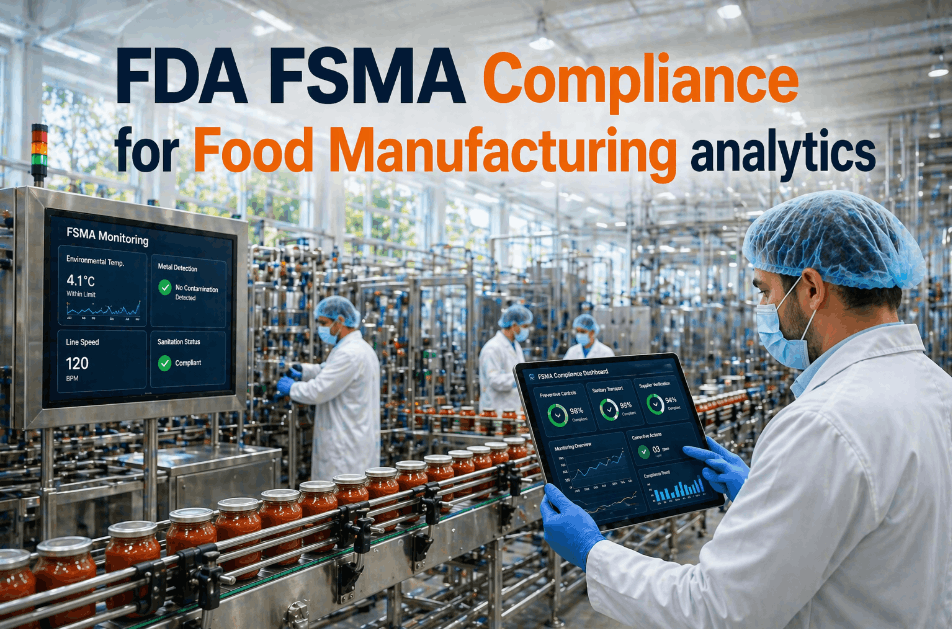
FDA FSMA compliance has fundamentally reshaped how food manufacturing operations collect, document, and act on production data. The Food Safety Modernization Act's seven foundational rules — from Preventive Controls for Human Food to the Intentional Adulteration rule — demand that FMCG analytics teams go beyond operational dashboards and build a compliance-first data infrastructure. For food manufacturers navigating multi-facility operations, co-manufacturer networks, and increasingly aggressive FDA inspection schedules, FSMA food manufacturing analytics is no longer a back-office function. It is a core operational competency that determines audit outcomes. Book a Demo to see how iFactory transforms production analytics into audit-ready FSMA documentation across your entire food manufacturing network.
Turn Your Food Manufacturing Analytics Into Continuous FDA FSMA Compliance
iFactory's FSMA compliance platform connects your HACCP data, CCP monitoring, supplier verification records, and production analytics into one audit-ready documentation system — purpose-built for food manufacturing FDA compliance at scale.
What FDA FSMA Compliance Actually Requires from Food Manufacturers
The Food Safety Modernization Act represents the most sweeping reform of U.S. food safety law since 1938. Its shift from reactive to preventive compliance fundamentally changed what FDA inspectors expect when they arrive at a food manufacturing facility. Understanding each rule's documentation requirements is the foundation of any FSMA compliance checklist for analytics teams.
FSMA's seven major rules create overlapping documentation obligations that food manufacturers must maintain simultaneously. The Preventive Controls for Human Food rule alone requires hazard analysis documentation, written preventive control plans, monitoring records for every critical control point, corrective action logs, and validation studies — all of which must be producible within 24 hours of an FDA inspection request.
The 7 FDA FSMA Rules Every Food Manufacturing Analytics Team Must Support
Effective FSMA compliance for food manufacturing requires analytics infrastructure that supports each applicable rule's specific data collection and documentation requirements. The following breakdown maps each rule to its core analytics obligations.
Preventive Controls for Human Food (21 CFR Part 117)
This foundational FSMA rule requires every food facility to maintain a written Food Safety Plan with documented hazard analysis, preventive controls, monitoring procedures, corrective actions, and verification activities. Analytics teams must capture real-time CCP monitoring data, automate out-of-limit alerts, and maintain complete calibration and corrective action records that link directly to production batch records.
Produce Safety Rule (21 CFR Part 112)
Fresh produce operations must document agricultural water quality testing, worker health and hygiene training, equipment sanitation verification, and biological soil amendment practices. Analytics infrastructure must support field-level data collection, testing result management, and training record documentation across geographically distributed growing operations.
Foreign Supplier Verification Programs (21 CFR Part 1, Subpart L)
Importers of food for human and animal consumption must maintain documented FSVP programs with hazard analysis for each imported food, supplier verification activities, corrective action procedures, and importer identification records. Analytics systems must track supplier verification status, document inspection results, and flag compliance gaps across multi-country supply chains.
Sanitary Transportation of Human and Animal Food (21 CFR Part 1, Subpart O)
Carriers, shippers, loaders, and receivers of human and animal food must document vehicle and equipment sanitation, temperature control maintenance, and written sanitary transportation agreements. The FSMA sanitary transport rule requires analytics platforms to capture temperature chain data, vehicle sanitation records, and agreement documentation across complex logistics networks.
Intentional Adulteration Rule (21 CFR Part 121)
Food facilities must conduct vulnerability assessments for actionable process steps and implement focused mitigation strategies with monitoring, corrective action, and verification procedures. The FDA intentional adulteration documentation requirement is among the most operationally complex — analytics teams must maintain complete mitigation activity logs and personnel training records for each identified vulnerability.
Preventive Controls for Animal Food (21 CFR Part 507)
Animal food manufacturers face parallel FSMA documentation obligations to human food facilities — written Food Safety Plans, hazard analysis, CCP monitoring records, and supplier program documentation. FMCG analytics teams managing mixed human and animal food portfolios must maintain segregated compliance documentation streams while supporting unified audit reporting.
Why Manual FSMA Documentation Fails at Scale
Food manufacturing operations that rely on paper-based FSMA recordkeeping, disconnected spreadsheets, and manual data entry face a compounding compliance risk as production volumes increase, facility counts grow, and FDA inspection frequency rises. Understanding where manual FDA food safety compliance documentation breaks down is essential for building the case for analytics automation.
Build an FSMA Compliance Program That Passes FDA Inspection Every Time
iFactory's food safety analytics platform automates FSMA documentation across all seven rules — from Preventive Controls CCP records to FSVP supplier verification and Intentional Adulteration mitigation logs — so your compliance posture is always current, never assembled in a panic.
FSMA Compliance Analytics: Core Documentation Requirements by Rule
The following table maps each major FSMA rule to its primary analytics data requirements, documentation outputs, and FDA inspection expectations — providing a practical FSMA compliance checklist for food manufacturing analytics teams.
| FSMA Rule | Key Analytics Data Required | Documentation Output | Record Retention | FDA Inspection Focus |
|---|---|---|---|---|
| PC Human Food (117) | CCP monitoring data, calibration records, allergen control logs | Food Safety Plan, monitoring logs, corrective action records | 2 years | Completeness of monitoring records, corrective action traceability |
| Produce Safety (112) | Water testing results, training records, sanitation data | Agricultural water assessments, training documentation | 2 years | Water quality documentation, worker hygiene records |
| FSVP (Part 1, Subpart L) | Supplier audit results, CoA records, hazard analysis data | FSVP program documentation, supplier verification records | 3 years | Completeness of supplier verification activities |
| Sanitary Transport (Part 1, O) | Temperature logs, sanitation records, agreement documentation | Transport agreement records, temperature chain documentation | 1 year | Temperature maintenance evidence, written agreements |
| Intentional Adulteration (121) | Vulnerability assessment data, mitigation activity logs | Written food defense plan, monitoring and corrective action records | 2 years | Vulnerability assessment completeness, mitigation documentation |
| PC Animal Food (507) | CCP monitoring data, sanitation records, supplier program data | Animal food safety plan, monitoring and verification records | 2 years | Consistency with human food PC requirements |
How FSMA Analytics Automation Works in Food Manufacturing
Purpose-built FDA FSMA compliance analytics platforms integrate directly with production line sensors, quality management systems, ERP platforms, and laboratory information management systems to create continuous, automated documentation — replacing the end-of-shift manual logging that creates compliance gaps. Here is how a modern FSMA analytics system operates across the food manufacturing environment.
Real-Time CCP Monitoring Data Capture
Temperature sensors, pH meters, water activity analyzers, and metal detection systems stream CCP monitoring data directly to the compliance platform with millisecond timestamps. Out-of-limit readings trigger immediate alerts and automatically initiate corrective action workflows — documenting the deviation, the response, and the affected product disposition in a single linked record that satisfies FDA Preventive Controls documentation requirements without manual entry.
Supplier Verification Program Management
FSVP and domestic supplier program documentation is centralized in a single platform with automated certificate of analysis intake, supplier audit scheduling, approved supplier status tracking, and hazard analysis version control. Supplier verification gaps trigger workflow alerts before they become compliance deficiencies — ensuring the complete supplier documentation package is always current and producible within the FDA's 24-hour records production window. Book a Demo to see automated FSVP documentation in action.
Environmental Monitoring Program Analytics
Environmental monitoring swab results are entered or imported directly into the compliance platform, linked to zone maps, correlated with sanitation records, and trended over time to identify Listeria indicator organism patterns. Positive findings automatically trigger corrective action documentation workflows, intensity sampling schedules, and root cause investigation records — giving FDA inspectors the complete environmental monitoring picture required by FSMA Preventive Controls guidance.
Food Defense Plan Documentation
Intentional Adulteration rule compliance requires continuous documentation of mitigation strategy monitoring activities at each actionable process step. The analytics platform captures mitigation monitoring data — access control logs, employee monitoring activity records, and physical security verification — and links this data directly to the written food defense plan. Mitigation gaps trigger immediate alerts to food defense coordinators with automatic documentation of the response actions taken.
Audit-Ready Report Generation
When an FDA investigator arrives for a routine inspection, a FSMA for cause inspection, or a follow-up visit after a recall, the compliance platform generates complete documentation packages for any time period, facility, or FSMA rule in minutes. Records are produced in FDA-expected formats with complete data lineage — from raw sensor readings to final documentation — that satisfies the evidentiary standard of the most rigorous federal food safety inspection. Book a Demo to see an FDA inspection documentation package generated live.
AI-Driven FSMA Compliance Intelligence for Food Manufacturers
Advanced food manufacturing analytics platforms don't just automate FSMA documentation — they apply machine learning to identify emerging food safety risks before they become FDA violations or consumer safety incidents. This shifts food safety compliance from reactive recordkeeping to predictive risk management.
Predictive CCP Deviation Detection
Machine learning models analyze CCP monitoring trends to identify parameter drift toward limit values before actual deviations occur. When a pasteurization hold temperature trends toward its lower critical limit over multiple production runs, the AI engine triggers a predictive alert 2–4 hours in advance — giving operations teams the response window needed to prevent a process deviation, halt production, or initiate preventive maintenance before a documented violation occurs.
Environmental Monitoring Pattern Analysis
Recurring Listeria indicator organism findings in the same environmental zone across multiple testing cycles indicate a harborage site that sanitation procedures are not eliminating. AI pattern analysis identifies zone correlations and frequency trends in environmental monitoring data — surfacing harborage risks that human review of individual test results misses, enabling targeted sanitation investigation before a positive pathogen finding triggers a regulatory response.
Supplier Risk Scoring
FSVP and domestic supplier program analytics aggregate CoA result history, audit findings, regulatory action records, and supply chain disruption signals into dynamic supplier risk scores. High-risk suppliers trigger enhanced verification requirements automatically — ensuring that FSMA supplier program intensity is proportional to demonstrated supplier hazard risk, exactly as FDA compliance guidance requires.
Cross-Facility Compliance Benchmarking
Multi-facility food manufacturers can benchmark FSMA compliance performance across sites — comparing CCP deviation frequency, corrective action response times, environmental monitoring positivity rates, and supplier verification completion rates. Facilities falling below enterprise benchmarks receive targeted compliance support before an FDA inspection identifies the performance gap, protecting the entire manufacturing network from systemic regulatory exposure.
FSMA Compliance Checklist: What Your Analytics System Must Document
Food manufacturing analytics teams building or evaluating FSMA documentation capability should validate against this core checklist. Each element reflects an FDA inspection expectation that has generated Form 483 observations or warning letter citations in food manufacturing contexts.
Written Food Safety Plan with Version Control
The current Food Safety Plan must be documentably current — signed by the Preventive Controls Qualified Individual, reviewed at least every 3 years or after a significant change, and version-controlled so that the plan in effect during any historical production period can be retrieved. Analytics systems must maintain complete plan history with effective dates and reanalysis documentation.
Complete CCP Monitoring Records with Timestamps
Every CCP monitoring observation must include the actual value recorded, the time and date of observation, the identity of the observer, and the critical limit for comparison. Automated sensor capture satisfies this requirement with timestamp precision that manual logs cannot match — and eliminates the transcription errors that FDA investigators identify during record review.
Corrective Action Records Linking Cause, Action, and Affected Product
FSMA corrective action documentation must demonstrate that the cause of the deviation was identified, that steps were taken to prevent recurrence, that affected food was evaluated for safety, and that the affected food was prevented from entering commerce if it may be injurious. Analytics platforms must link corrective action records to specific batch records and lot numbers to satisfy the traceability requirement.
Verification and Validation Activity Records
Validation studies establishing that preventive controls are capable of controlling identified hazards must be documented and retained. Ongoing verification activities — calibration records, periodic monitoring record review, and environmental monitoring program assessment — must be documented with completion dates and reviewer identification. FDA inspectors specifically evaluate whether validation is science-based and verification is systematic.
Supplier Program Documentation with Current Verification Status
Every ingredient and material supplier in the food safety plan must have a documented hazard analysis, an assigned verification method appropriate to the hazard risk, and current verification records demonstrating that the verification activity was completed within the required frequency. Lapsed supplier verification is one of the most common FSMA citation categories — analytics platforms must automate verification due date tracking and flag overdue activities before they become compliance gaps.
Training Records for PCQI and All Personnel
The individual performing the hazard analysis and overseeing preventive controls must be a qualified PCQI — with documented training or job experience qualifying them for this role. All employees working in roles covered by the Food Safety Plan must have documented food safety training appropriate to their responsibilities. Analytics platforms must track training completion, expiration dates, and qualification records for all covered personnel.
Frequently Asked Questions: FDA FSMA Compliance for Food Manufacturing
What is the difference between a HACCP plan and an FSMA Food Safety Plan?
While HACCP and FSMA Food Safety Plans share conceptual foundations, FSMA's Preventive Controls rule requires broader hazard coverage. FSMA hazard analysis must consider not just process hazards but also food allergen hazards, radiological hazards, and economically motivated adulteration. FSMA also requires supply chain preventive controls and sanitation preventive controls not typically documented in traditional HACCP plans. Facilities transitioning from HACCP-only documentation to full FSMA compliance must expand their hazard analysis scope and preventive control documentation accordingly.
How does FDA evaluate FSMA compliance during routine inspections?
FDA investigators conducting FSMA inspections review written Food Safety Plans for completeness and scientific adequacy, evaluate monitoring records for consistency and completeness, verify that corrective actions were taken appropriately for documented deviations, and assess whether verification activities were completed at required frequencies. The investigator will also observe current operations to confirm that documented procedures match actual practice — making operational-documentation consistency as important as documentation completeness.
Are small food manufacturers exempt from FSMA Preventive Controls requirements?
FSMA provides modified requirements for qualified facilities — those with food sales averaging less than $1 million per year and the majority of sales to consumers or to restaurants and retailers in the same state or region. Qualified facilities may comply with modified requirements rather than full Preventive Controls, but must still submit a form to FDA attesting to their qualified facility status and maintain records documenting that they meet the qualified facility criteria. Very small businesses have extended compliance timelines but are not permanently exempt.
What triggers an FDA "for cause" FSMA inspection versus a routine inspection?
For cause inspections are triggered by consumer complaints with illness reports, positive pathogen findings in finished product or environmental monitoring that reach FDA's attention, recall events, import alert records, and tip-off information from whistleblowers or state agencies. For cause inspections are more intensive and more likely to result in formal regulatory action than routine inspections. Maintaining continuous FSMA documentation — not just inspection-ready documentation — is essential because for cause inspection notice may be minimal or nonexistent. Book a Demo to see how continuous FSMA analytics documentation protects against for-cause inspection outcomes.
How does the FSMA Intentional Adulteration rule affect food manufacturing analytics requirements?
The Intentional Adulteration rule requires facilities to conduct vulnerability assessments identifying actionable process steps — those with significant vulnerability to intentional adulteration — and to implement focused mitigation strategies at each identified step. Analytics documentation must capture monitoring activities for each mitigation strategy, corrective actions taken when monitoring indicates a potential failure, and verification that mitigation strategies are consistently applied. The food defense plan itself must be reanalyzed at least every 3 years or after a significant change.
What ROI can food manufacturers expect from FSMA compliance automation?
Food manufacturers implementing automated FSMA compliance analytics typically document measurable ROI within the first compliance cycle, driven by reduction in quality staff time spent on manual documentation assembly, elimination of Form 483 observation response costs, accelerated FDA inspection preparation, and reduced risk of consent decree or injunction proceedings. The avoided cost of a single voluntary recall — averaging $10 million for a mid-sized food manufacturer — makes the ROI case for FSMA analytics automation compelling at virtually any facility scale.
Stop Assembling FSMA Records. Start Running a Food Plant That Is Always FDA-Ready.
Join food manufacturers across the country who have achieved continuous FSMA compliance, zero missed documentation deadlines, and faster FDA inspection outcomes with iFactory's food safety analytics platform — purpose-built for the preventive controls, supplier verification, and intentional adulteration documentation demands of modern food manufacturing compliance.