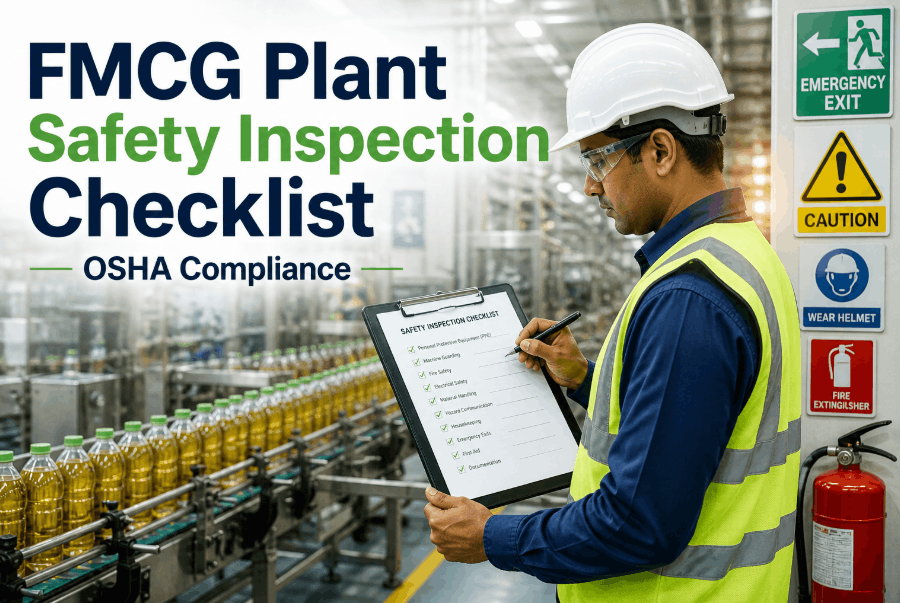
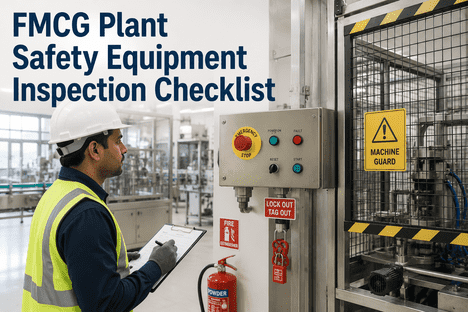
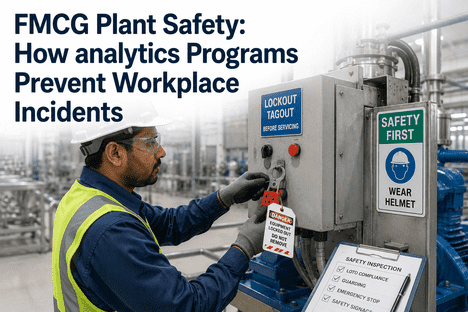
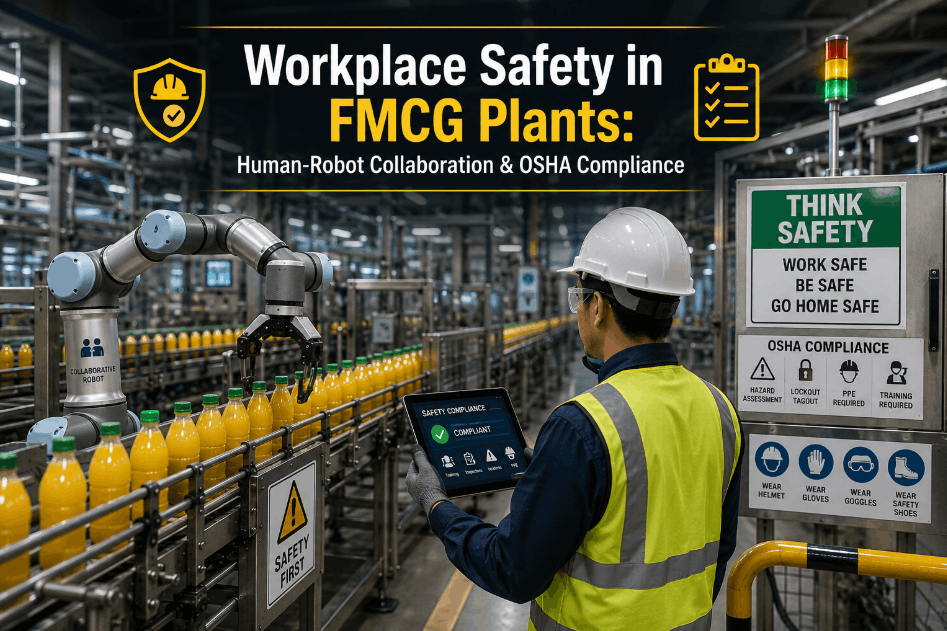
FMCG manufacturing plants operate under relentless production pressure — high-speed machinery, hazardous chemicals, and multi-shift workforces create a safety risk profile that demands structured, OSHA-aligned inspection at every level. A rigorous FMCG plant safety inspection checklist covering machine guarding, lockout/tagout, chemical handling, PPE compliance, and emergency preparedness is the backbone of any OSHA-compliant EHS program. Book a Demo to see how digital safety platforms replace paper logs with real-time hazard tracking and audit-ready compliance records.
OSHA COMPLIANCE
FMCG PLANT SAFETY
EHS MANAGEMENT
Automate FMCG Safety Inspections Across Every Production Zone
Digitize OSHA-compliant safety checklists, track hazard corrective actions in real time, and generate audit-ready EHS records for your next OSHA, ISO 45001, or GFSI safety inspection.
Why a Structured Safety Inspection Program Is Non-Negotiable in FMCG Plants
OSHA Violations Carry Severe Financial and Operational Consequences
FMCG facilities regularly appear on OSHA's top-cited lists for machine guarding failures, LOTO non-compliance, and inadequate hazard communication. A single willful citation can exceed $156,000 in penalties — making documented inspections the only defensible evidence of active preventive control.
High-Speed Production Lines Create Compounding Hazard Exposure Every Shift
FMCG plants combine automated machinery, chemical agents, repetitive handling tasks, and forklift traffic across the same floor — a hazard density that multiplies incident probability every hour. Without systematic inspection, critical deficiencies remain invisible until an injury or regulatory inspection forces a costly reactive response.
DIGITIZE YOUR EHS PROGRAM
OSHA AUDIT READINESS
Ready to Standardize OSHA-Compliant Safety Inspections Across Your FMCG Plant?
Automate machine guarding audits, LOTO verification, chemical compliance tracking, and incident management — and generate OSHA-ready records before your next planned or unprogrammed inspection.
Benefits of Digital FMCG Safety Inspection Management
Real-Time OSHA Violation Prevention
Structured digital checklists with mandatory sign-off fields catch machine guarding, LOTO, and HazCom deficiencies before an inspector or a recordable incident does.
Instant Audit-Ready Documentation
Timestamped records with technician identity and corrective action linkage satisfy OSHA requirements and are instantly retrievable during planned or referral inspections.
Accelerated Corrective Action Closure
Automated assignment, deadline tracking, and escalation notifications reduce average deficiency closure time and prevent findings from aging past abatement timelines.
Proactive Incident Risk Reduction
Near-miss trending and leading indicator dashboards identify recurring hazard types — enabling targeted safety interventions before patterns produce recordable injuries.
Multi-Shift Inspection Continuity
Digital platforms eliminate handover gaps between shifts, ensuring every hazard identified on a night shift is visible to day-shift supervisors before production resumes.
Enterprise-Wide Safety Performance Visibility
Centralized dashboards provide real-time inspection completion rates, open corrective action counts, and incident frequency trends across every FMCG facility.
FMCG Plant Safety Inspection FAQs
1. How frequently should FMCG plants conduct formal OSHA-aligned safety inspections?
Machine guarding, emergency exits, and fire extinguisher access should be verified at every shift start. A comprehensive inspection covering LOTO, PPE, and chemical storage should be completed monthly, with full-facility audits conducted quarterly and an annual program-level review for OSHA or ISO 45001 alignment.
2. What are the most commonly cited OSHA violations in FMCG manufacturing facilities?
The top citations in FMCG environments are machine guarding (1910.212), lockout/tagout (1910.147), hazard communication (1910.1200), respiratory protection (1910.134), and electrical safety (1910.303–308). Recordkeeping violations under 29 CFR 1904 — including OSHA 300 log inaccuracies — also appear consistently during food manufacturing inspections.
3. Is digital safety inspection software accepted as valid OSHA recordkeeping?
Yes — OSHA explicitly permits electronic maintenance of 300, 300A, and 301 forms and all supporting inspection documentation. Records must contain all required data fields and be producible in hard-copy format within four business hours upon OSHA request. Digital systems typically provide stronger audit evidence than handwritten paper logs.
4. What documentation is required for an FMCG LOTO program to be OSHA compliant?
OSHA 1910.147 requires machine-specific written energy control procedures, annual periodic inspection records for every authorized employee on every covered machine, and training records for both authorized and affected workers. Missing periodic inspection records — especially for seasonal or rotating staff — are the most common LOTO gap cited during FMCG inspections.
5. How should FMCG plants manage Safety Data Sheets under GHS requirements?
Facilities must maintain a 16-section GHS-format SDS for every hazardous chemical and make files immediately accessible at point-of-use across all shifts. Older pre-2012 MSDS documents are non-compliant. Digital SDS management systems are strongly recommended to ensure version currency and provide auditable access logs.
6. What is the OSHA penalty exposure for machine guarding violations in food manufacturing?
Serious machine guarding violations carry penalties up to $16,131 per instance under current OSHA schedules. Willful or repeat violations can reach $161,323 per citation. In FMCG facilities with multiple production lines, a systematic guarding non-compliance finding can generate total penalty exposure exceeding $500,000.
GET STARTED
DIGITIZE TODAY
Digitize Your FMCG Plant Safety Inspection Program Today
Join FMCG facilities that have eliminated reactive OSHA violations, automated safety documentation, and reduced recordable incident rates with structured digital EHS workflows across every production line and shift.