Industrial Mixer Preventive Analytics Checklist for FMCG Manufacturing

By Josh Turley on April 28, 2026

industrial-mixer-preventive-analytic-checklist-food-processing

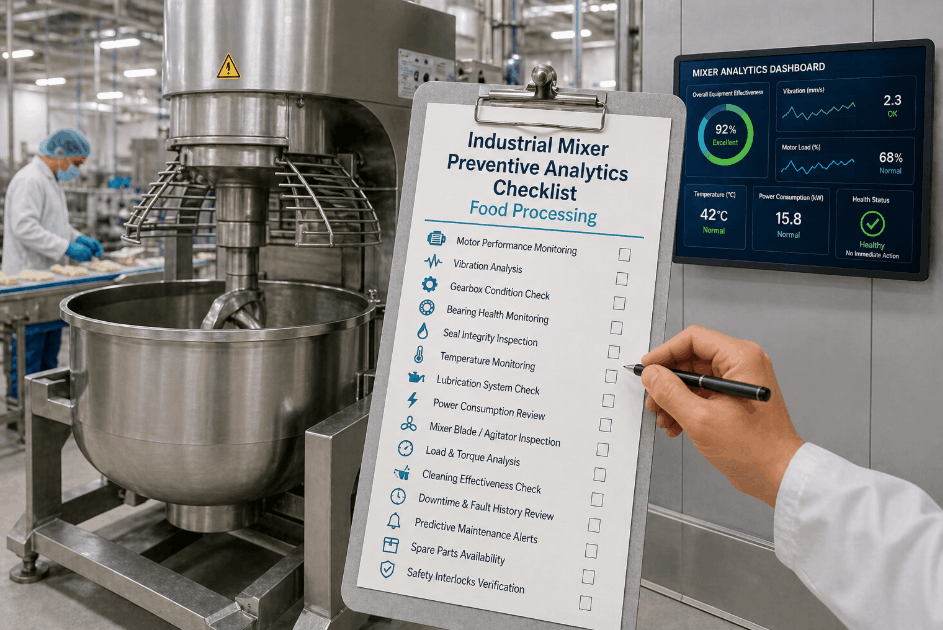
Industrial mixers demand more than scheduled downtime — they require continuous, data-driven oversight across every mechanical subsystem. From vibration anomalies at bearing housings to ferrous particle spikes in gearbox oil, early-stage degradation signals are invisible to manual inspection cycles. A structured industrial mixer preventive analytics checklist bridges that gap, giving food processing maintenance teams a repeatable framework for vibration monitoring, gearbox health, motor diagnostics, seal integrity, and FSMA-compliant documentation. Book a Demo to see how continuous condition monitoring replaces reactive repairs with precision-triggered maintenance actions.

MIXER RELIABILITY FOOD PROCESSING COMPLIANCE PREDICTIVE MAINTENANCE

Automate Industrial Mixer Analytics Across Every Production Line

Monitor gearbox condition, vibration trends, motor amperage, and seal integrity across all mixer assets — with audit-ready maintenance logs for your next FSMA, GFSI, or FDA inspection.

Why Preventive Analytics Is Non-Negotiable for Food Processing Mixers

Gearbox Failures Disrupt Entire Production Schedules

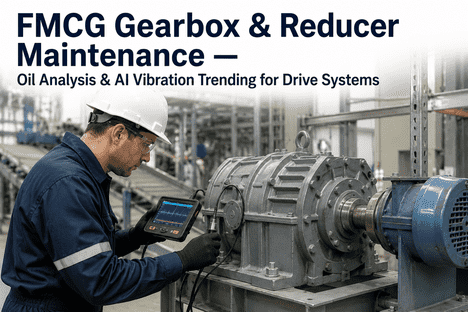
Industrial mixer gearboxes operate under sustained high-torque loads that accelerate gear tooth wear, bearing fatigue, and lubrication breakdown far faster than standard equipment. Without structured oil analysis and vibration trending, gearbox failures arrive without warning — causing multi-day shutdowns and emergency rebuild costs. Proactively Book a Demo to see how gearbox condition analytics detect degradation signatures weeks before failure.

Seal and Bearing Failures Create Direct Contamination Risk

A failed shaft seal or disintegrating bearing introduces metallic contamination, lubricant ingress, and particulate matter directly into the product stream. Structured seal inspection and vibration monitoring are mandatory preventive controls under FSMA — not discretionary maintenance activities. Book a Demo to see analytics-driven alerts that protect product integrity across multi-shift operations.

1. Vibration Monitoring & Baseline Analytics
2. Gearbox Inspection & Oil Analysis
3. Motor Health & Electrical Analytics
4. Shaft Seal & Bearing Integrity
5. Agitator Blade & Impeller Condition
6. Drive System & Coupling Analytics
7. Contamination Prevention & Hygiene Compliance
8. Maintenance Records & Compliance Documentation
PREDICTIVE ANALYTICS MIXER COMPLIANCE

Ready to Standardize Mixer Preventive Analytics Across Your Processing Facility?

Automate vibration trending, gearbox oil alerts, motor load analysis, and FSMA-compliant maintenance documentation — generating predictive work orders before mixer failures disrupt your production schedule.

Benefits of Digital Industrial Mixer Analytics Management

Early Gearbox Failure Detection

Oil particle trending and vibration spectrum analysis identify gear wear and bearing fatigue weeks before mechanical failure — preventing the product loss, unplanned downtime, and emergency rebuild costs that reactive gearbox replacements generate in high-volume food processing environments.

Foreign Body Contamination Prevention

Structured seal inspection, blade integrity checks, and fastener torque audits systematically eliminate the metallic contamination and coating delamination pathways that present the highest foreign body risk in mixer-based food production lines running multiple shifts.

FSMA and HACCP Audit Readiness

Timestamped digital inspection records with asset reference, technician ID, and corrective action linkage satisfy FSMA Preventive Controls equipment maintenance monitoring requirements — making compliance documentation instantly retrievable during FDA, GFSI, or customer audits.

Extended Motor and Drive Train Service Life

Precision shaft alignment verification, coupling element inspection, and motor insulation resistance trending eliminate the most common premature failure drivers in mixer drive systems — extending mean time between failures by 40–60% across high-cycle production assets.

Condition-Based Lubrication Optimization

Oil analysis results and bearing temperature trending replace calendar-based lubrication intervals with condition-triggered re-lubrication — simultaneously reducing over-lubrication contamination risk and under-lubrication bearing failures across all gearbox and bearing assets.

Multi-Line Reliability Visibility

Centralized analytics dashboards give maintenance and food safety managers real-time reliability status across every mixer on every production line — eliminating the inspection blind spots that develop in multi-shift operations relying on paper-based manual checklists.
Industrial Mixer Preventive Analytics — Frequently Asked Questions

1. How often should industrial mixers in food processing facilities be formally inspected?
Seal integrity, blade condition, and fastener security should be visually checked at every product changeover or cleaning cycle. A comprehensive documented inspection covering gearbox oil condition, vibration levels, motor amperage, and alignment should be performed monthly — with full drive train inspections and oil sampling conducted quarterly for high-cycle production mixers. Critical food safety components require documented inspection records at every PM cycle to satisfy FSMA Preventive Controls monitoring requirements.
2. What are the earliest detectable signs of industrial mixer gearbox wear?
The earliest reliable indicators are elevated ferrous particle counts in oil analysis samples — typically detectable weeks before any acoustic, vibration, or temperature change is measurable at the housing surface. As wear progresses, rising gearbox housing temperature during steady-state operation and the emergence of gear mesh frequency sidebands in vibration spectrum analysis provide additional confirmation. Waiting for audible noise or catastrophic temperature rise before acting on gearbox wear data typically means the gear set and input shaft bearing are already beyond economic repair.
3. Why is shaft seal failure in a food processing mixer considered a critical food safety event?
A failed agitator shaft seal creates two simultaneous food safety pathways: lubricant can be expressed into the product mix, and product can migrate into the bearing housing — creating a harborage site for microbial growth that is impossible to sanitize without a full strip and reassembly. Under FSMA Preventive Controls regulations, any equipment failure creating a reasonable potential for hazard introduction must be documented as a corrective action event with formal product disposition assessment before release to commerce.
4. What lubricant standards apply to food processing mixer maintenance?
All lubricants applied at mixer bearing, gearbox, and seal points in food-contact or food-splash zones must be NSF International H1-registered food-grade lubricants. H1 registration confirms the formulation is acceptable for incidental food contact. Facilities must maintain a documented lubricant control program identifying every lubrication point, specifying the approved product, defining the re-lubrication interval, and segregating food-grade lubricant storage from non-food-grade products.
5. How does vibration monitoring improve mixer reliability compared to time-based maintenance?
Time-based preventive maintenance replaces components on a fixed calendar interval regardless of actual condition — resulting in premature replacement of healthy components and missed failures that develop between scheduled intervals. Vibration monitoring provides continuous condition data that reveals bearing and gear wear as it develops, allowing maintenance to be triggered by actual degradation. In food processing environments, condition-based vibration monitoring typically reduces unplanned failures by 70–85% while extending average component service life by eliminating premature replacement cycles.
6. Can digital mixer maintenance records replace paper-based inspection logs for GFSI certification?
Yes — all major GFSI-recognized certification schemes including SQF, BRC, IFS, and FSSC 22000 accept digital maintenance records provided they include required data fields: asset identification, inspection date and time, technician identity, findings, corrective actions taken, and verification signatures where applicable. Digital records offer significant advantages for GFSI audits — they are instantly searchable, cannot be lost or damaged, support real-time corrective action tracking, and eliminate the transcription errors that frequently generate audit non-conformances from paper documentation systems.
GET STARTED DIGITIZE TODAY

Digitize Your Industrial Mixer Analytics Program Today

Join food processing facilities that have eliminated reactive mixer failures, automated FSMA-compliant maintenance documentation, and reduced contamination risk with structured digital analytics workflows across every production line asset.


Share This Story, Choose Your Platform!