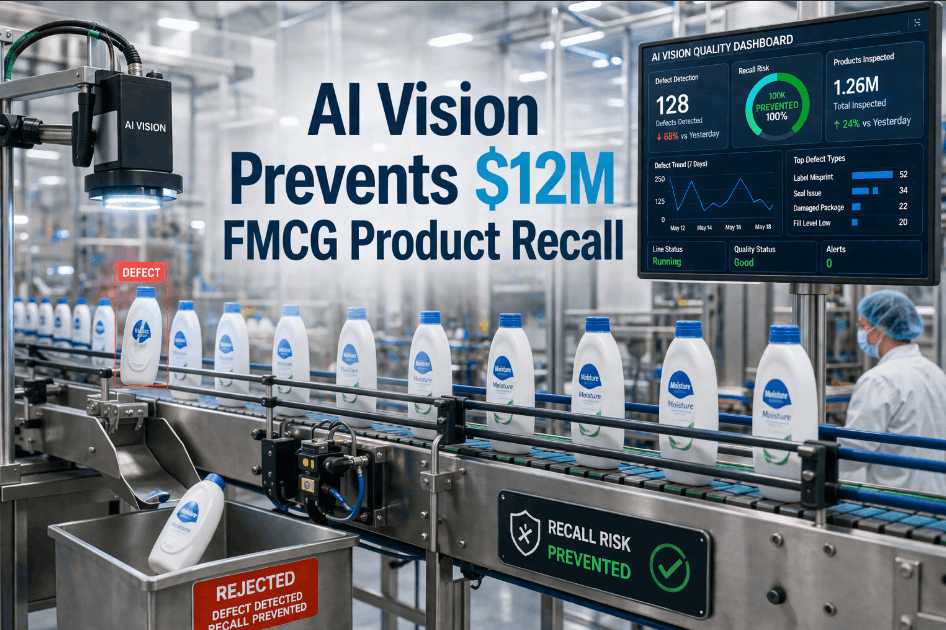
In 2023, a mid-sized FMCG manufacturer faced a quality crisis that nearly cost them $12 million — not from a production failure, but from a label defect that slipped past manual inspection at scale. Within weeks of deploying an AI vision inspection system, that same facility eliminated label error escapes entirely, flagged contamination risks in real time, and passed a surprise third-party audit without a single documentation gap. This case study breaks down exactly how AI vision prevented a catastrophic product recall, what the technology detected, and the measurable results achieved — so your facility can apply the same approach before a recall forces the decision.
The $12M Problem: Why Manual Inspection Failed This FMCG Facility
FMCG quality control has historically relied on human inspectors, spot-check sampling protocols, and end-of-line visual audits. For decades, this approach was considered sufficient. But as line speeds increased and SKU complexity multiplied, the mathematical reality of manual inspection became undeniable: at 600 units per minute, a human inspector checking one in every fifty units is statistically certain to miss recurring defects. That is precisely what happened at this facility.
The defect in question was a label misalignment on a batch of packaged food products — specifically, an allergen declaration that wrapped incorrectly during high-speed labeling, rendering the allergen text partially obscured. The misalignment was consistent across approximately 140,000 units before a downstream distributor flagged the issue during a receiving inspection. By that point, product had already entered three regional distribution networks. The financial exposure — including product retrieval, disposal, regulatory response, and brand recovery costs — was assessed at $12.4 million. The facility narrowly avoided a formal recall classification, but the root cause analysis that followed made one thing clear: no manual inspection protocol operating at production speed could have reliably caught this defect. AI vision inspection could have.
What Manual Inspection Cannot Detect at FMCG Production Speed
The limitations of manual FMCG quality inspection are not a reflection of workforce competence — they are a consequence of physics and human cognitive capacity. Research consistently shows that inspection accuracy degrades significantly after 20 minutes of continuous monitoring. At high-speed packaging lines, the defect detection window for a single unit is often under 100 milliseconds. No human visual system can reliably evaluate label alignment, print quality, seal integrity, and fill level simultaneously at that frequency across an entire production shift. AI vision inspection systems, operating with industrial-grade cameras and real-time image processing, evaluate every unit on every parameter with consistent accuracy — regardless of shift length, line speed, or SKU complexity. For FMCG manufacturers operating under FSMA, GFSI, and retailer-specific quality mandates, this capability difference is no longer a competitive advantage. It is a compliance requirement. Book a demo to see how AI vision inspection maps to your specific production line constraints.
AI Vision Inspection Deployment: How the System Was Configured
Following the near-recall event, the facility engaged an AI-driven vision inspection platform to achieve 100% inline inspection coverage across three high-speed packaging lines. The deployment covered label verification, seal integrity inspection, fill level validation, and foreign body contamination detection — with all inspection results logged automatically to a centralized quality intelligence dashboard accessible by QA, production, and compliance teams.
Label verification was the highest-priority inspection module given the nature of the near-recall event. The AI vision system deployed high-resolution cameras at the labeling station exit point, capturing full-label images of every unit at line speed. Machine learning models trained on approved label templates flagged misalignment deviations, barcode contrast failures, text legibility issues, and verified allergen declaration placement on every single unit.
Foreign body contamination remains among the highest-consequence defect categories in FMCG food safety. The deployment integrated X-ray and multispectral imaging systems, enabling detection of glass, metal fragments, hard plastic, and dense organic contaminants in packaged products — categories the existing metal detector could not identify. Book a demo to see how contamination detection integrates with your existing rejection and traceability systems.
Seal failures and under-fill events represent both quality and regulatory compliance risks. The module evaluated every sealed unit for seal width consistency, fold uniformity, and closure completeness, while fill level verification used volumetric image analysis to flag underfill and overfill events against defined acceptable limits — directly supporting the facility's SQF recertification audit.
AI Vision Case Study Results: Quantified Quality and Compliance Outcomes
The measurable outcomes from this FMCG AI vision inspection deployment are documented across quality performance, compliance posture, and operational efficiency categories. The results below reflect the first six months of full production coverage following complete system deployment.
Beyond defect detection, the AI vision platform generated continuous audit-ready inspection records for every production run — eliminating the manual documentation burden that previously consumed approximately 22 QA labor hours per week. When the facility's third-party GFSI audit occurred six weeks post-deployment, inspection records, rejection logs, and corrective action documentation were generated on demand within minutes. The audit closed with zero major non-conformances, compared to three major findings in the previous audit cycle. Book a demo to see how automated audit documentation is structured within the platform.
Product Recall Prevention: The Financial Case for AI Vision ROI
The financial argument for AI vision inspection in FMCG manufacturing is not theoretical — it is documented in recall cost data published by the FDA, USDA, and industry insurance carriers. The average FMCG product recall costs a food manufacturer between $10 million and $30 million when total exposure is calculated across product retrieval, regulatory response, legal liability, and brand damage. For allergen-related recalls, costs routinely exceed $15 million when consumer safety incidents occur. Against this exposure, AI vision inspection represents a capital investment with a documented payback period of under 18 months in the majority of food and beverage manufacturing deployments.
Vision Inspection ROI Calculation for FMCG Quality Programs
Calculating vision inspection ROI for an FMCG facility requires accounting for four value streams: direct recall risk mitigation, QA labor reallocation, product waste reduction from defect-driven yield loss, and compliance documentation efficiency gains. In this case study, the combined annual value across all four streams exceeded $2.1 million against a total system investment — hardware, software, and integration — of $380,000. The payback period was documented at approximately seven months. For facilities operating under retailer-mandated quality programs that carry financial penalty clauses for quality escapes, the ROI calculation is even more favorable. Book a demo to walk through a facility-specific ROI model based on your current production volume and quality program requirements.
Before and After: AI Vision Inspection Impact Summary
The table below documents the performance comparison across key FMCG quality metrics before and after full AI vision inspection deployment at this facility.
| Quality Metric | Before AI Vision | After Deployment | Improvement |
|---|---|---|---|
| Label Defect Escape Rate | ~6 per 100,000 units | 0 per 100,000 units | 100% elimination |
| Inspection Coverage | ~2% sample-based | 100% inline | Full coverage achieved |
| Foreign Body Detection | Metal only (detector) | Metal, glass, dense plastic | Multi-category detection |
| Audit Prep Time | 3–4 days manual prep | Under 30 minutes | ~95% reduction |
| QA Documentation Hours / Week | ~22 hours | ~3 hours | ~86% reduction |
| Major GFSI Non-Conformances | 3 (prior audit cycle) | 0 | Full compliance achieved |
| Estimated Annual Recall Risk Exposure | $12M+ documented near-event | Mitigated to near-zero | Risk eliminated |
Scaling AI Vision Quality Control Across Multi-SKU FMCG Operations
One of the most common objections to AI vision inspection deployment in FMCG environments is SKU complexity: facilities running hundreds of product variants across multiple lines question whether vision models can handle the breadth of label formats, package types, and inspection parameters required. Modern AI vision platforms address this directly through scalable model management — where approved label templates, fill specifications, and seal parameters are maintained in a centralized product library that updates inspection models at changeover without manual reconfiguration.
At this facility, the vision system managed 84 active SKUs across three lines, with average changeover time for inspection parameter updates documented at under 3 minutes. The ability to maintain inspection accuracy across a high-SKU environment without engineering-level reconfiguration at each changeover was identified by the facility's QA director as the single most operationally significant capability of the deployed platform — outweighing even the direct defect detection performance in terms of day-to-day operational impact. Book a demo to explore how multi-SKU inspection management works within the platform's product library architecture.
Implementation Guide: Deploying AI Vision Inspection in Your FMCG Facility
FMCG manufacturers evaluating AI vision quality systems consistently ask the same question: how disruptive is deployment? The answer, for purpose-built platforms designed for food and beverage production environments, is: minimally. Integration with existing conveyor systems, rejection mechanisms, and quality management platforms is accomplished through standard industrial communication protocols, with production interruption limited to scheduled changeover windows.
- Camera positioning and lighting commissioned on priority lines
- Integration with rejection systems verified
- Initial label template library populated
- QA team onboarded in under 6 hours
- 100% inline inspection activated on commissioned lines
- Defect classification models validated against production samples
- Automated audit log generation confirmed
- First defect events flagged and rejected automatically
- All production lines brought under inspection coverage
- Multi-SKU model library expanded to full product range
- Contamination detection modules calibrated
- First audit documentation package generated on demand
- Defect trend analysis driving upstream process corrections
- QA labor reallocation to higher-value activities
- Documented recall risk reduction quantified
- Inspection accuracy improving with accumulated production data