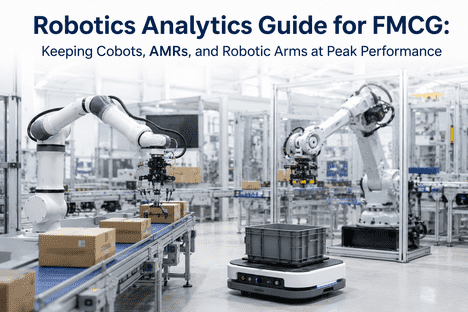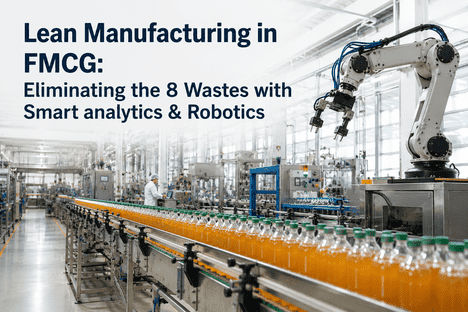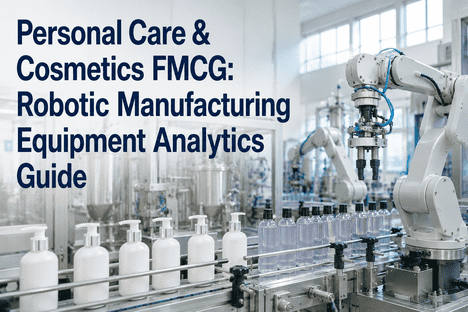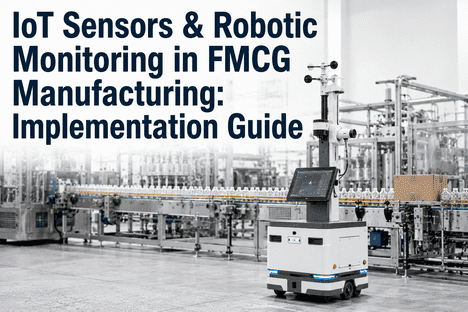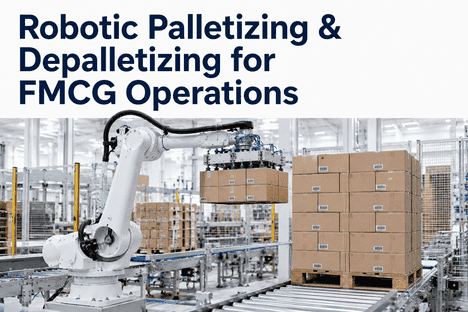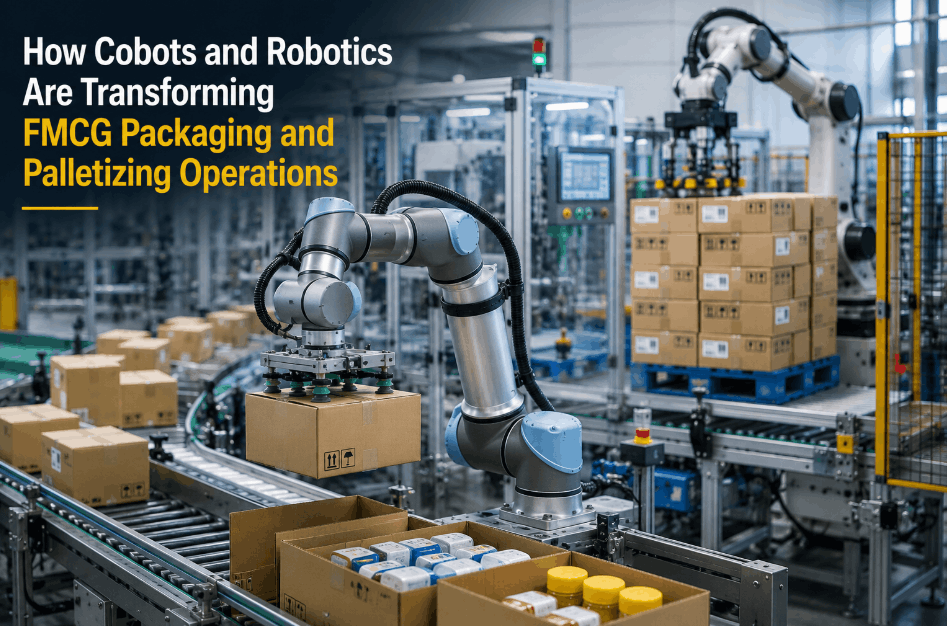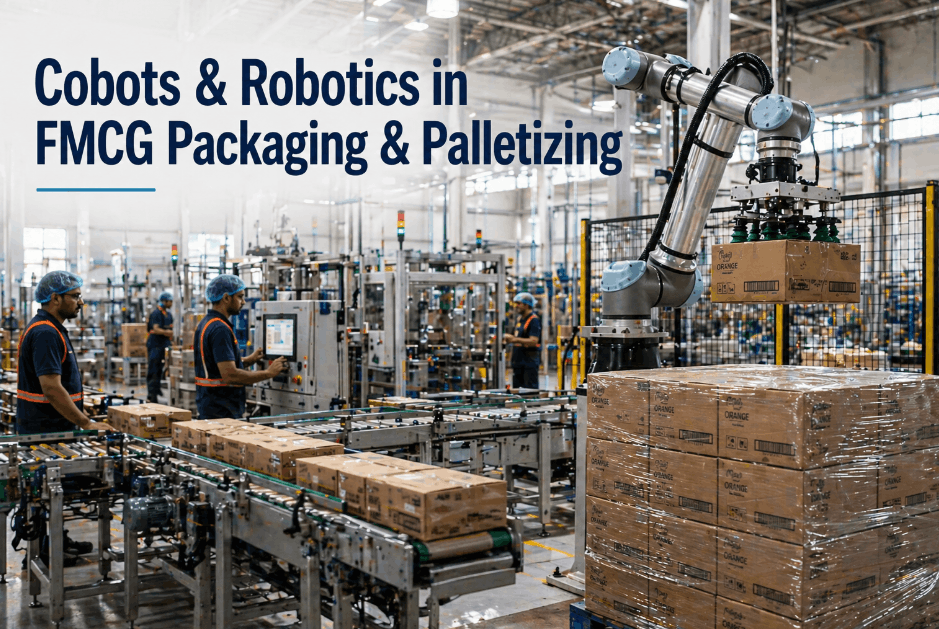
Cobots in FMCG packaging and palletizing are no longer an experimental investment — they are the operational standard that competitive food and consumer goods manufacturers are adopting at scale. As labor costs climb, throughput demands intensify, and product SKUs multiply, the case for FMCG robotics automation has shifted from compelling to unavoidable. This guide breaks down exactly how collaborative robots are transforming pick-and-place operations, case packing, and end-of-line palletizing across food manufacturing facilities — and what enterprise teams need to evaluate before deployment.
Deploy Cobot Packaging & Palletizing Lines — With Full Analytics Visibility
iFactory's manufacturing analytics platform gives FMCG enterprises real-time performance monitoring across every cobot line, shift, and facility — from pick-and-place throughput to palletizer cycle efficiency.
Why FMCG Manufacturers Are Deploying Cobots for Packaging & Palletizing Now
The inflection point for cobot packaging in FMCG arrived not from technology breakthroughs alone, but from converging operational pressures that traditional automation could not resolve. Legacy fixed-automation lines require lengthy changeovers for each SKU variant. Labor pools for repetitive end-of-line tasks have thinned across every major manufacturing region. And the cost of unplanned downtime on high-volume packaging lines now regularly exceeds what a full cobot deployment costs in its first year.
Collaborative robots address all three of these simultaneously. Unlike traditional industrial robots, cobots operate without safety caging in most configurations, can be redeployed across lines in hours rather than days, and integrate with modern packaging automation FMCG analytics platforms to surface real-time throughput and efficiency data that plant managers actually act on. FMCG teams that book a demo with iFactory consistently discover that their cobot lines are generating data they have never been able to use — until they deploy a unified analytics layer above the hardware.
Key Cobot Applications Across FMCG Packaging & End-of-Line Operations
Understanding where robotics packaging delivers the highest operational return requires mapping cobot capabilities against the specific task characteristics of FMCG end-of-line environments. Three application categories dominate current deployments.
Pick-and-Place Robots for Food & FMCG Lines
Pick-and-place robots for food manufacturing handle the highest-frequency, most ergonomically damaging tasks on packaging lines — repetitive item transfer from conveyor to tray, carton, or flow-wrap feed. Cobots excel here because their force-limiting technology allows them to handle fragile products — biscuits, ready meals, confectionery — without the product damage rates that plagued first-generation robotic systems.
Modern pick-and-place cobot systems achieve cycle rates of 60–120 picks per minute depending on product geometry. When integrated with vision systems, they handle mixed-SKU flows without manual reprogramming between product changeovers. FMCG manufacturers that book a demo with an analytics overlay typically find that pick-rate variance between shifts is 15–25% — a gap that real-time monitoring closes within weeks of deployment.
Case Packing Automation for Consumer Goods
Case packing sits at a critical junction in FMCG packaging lines where unit-level errors compound into downstream fulfillment failures. Cobot case packing systems operate with the precision and repeatability that manual packing cannot sustain across multi-shift operations. They also respond to real-time line speed adjustments driven by upstream fill rates — a critical capability for food manufacturers running continuous production schedules.
The measurable benefit of cobot packaging in case-packing applications goes beyond labor displacement. Vision-guided cobot systems reduce mispacks and short-fills by 40–60% compared to manual operations, directly reducing customer return rates and regulatory exposure for weight-sensitive categories. Enterprises evaluating this application should book a demo to model the defect-cost reduction against their specific product mix before committing to a configuration.
FMCG Palletizing Robots — High-Speed End-of-Line Automation
FMCG palletizing robots represent the highest-ROI cobot application category in food manufacturing. Traditional palletizing is physically demanding, injury-prone, and speed-constrained by human ergonomics. A cobot palletizer operates at consistent speed across all shifts with sub-millimeter placement precision — critical for pallet stability in cold-chain environments where improperly stacked pallets cause downstream damage and retailer chargebacks.
Palletizer robots in FMCG environments handle payloads from 5 kg to 1,000 kg+ depending on configuration. Collaborative palletizers in the 10–25 kg range are increasingly deployed alongside human workers in mixed operations where full automation is not yet justified by volume. The analytics layer above these systems — tracking pallets per hour, layer accuracy, and cycle deviation — is what separates enterprises that measure their ROI from those that estimate it.
Cobots vs. Traditional Robots for FMCG Packaging — Decision Framework
The choice between collaborative robots and traditional fixed-automation robots for FMCG packaging is not universal — it depends on volume consistency, SKU variety, footprint constraints, and workforce integration requirements. The table below provides the primary decision dimensions for FMCG operations teams.
| Decision Dimension | Traditional Industrial Robot | Collaborative Robot (Cobot) | FMCG Fit Score |
|---|---|---|---|
| Changeover Flexibility | Low — requires tooling and reprogramming | High — drag-and-teach or software-only changeover | Cobot: Preferred |
| Safety Footprint | Caged — significant floor space required | Cage-free in most configurations | Cobot: Preferred |
| Payload Capacity | Up to 2,000 kg+ | 5–35 kg (most models) | Industrial: Preferred for heavy palletizing |
| Speed (cycle rate) | Very high — 150+ picks/min | Moderate — 60–120 picks/min | Industrial: Preferred for high-volume lines |
| Integration Cost | High — custom engineering required | Low-to-medium — plug-and-play configurations available | Cobot: Preferred |
| SKU Variety Handling | Low — fixed tooling per product | High — vision-guided multi-SKU capability | Cobot: Preferred |
| Analytics Integration | Requires custom middleware | Native API connectivity to OT platforms | Cobot: Preferred |
| Workforce Interaction | Segregated — no human collaboration | Designed for human-robot collaboration | Cobot: Preferred |
Building the ROI Case for Cobot Packaging & Palletizing in FMCG
Quantifying the return on robotic packaging food investments requires more than a simple labor displacement calculation. FMCG operations teams that build rigorous cobot ROI models account for four cost categories that together define the actual payback period.
Direct Labor Cost Displacement
A single cobot palletizing cell replaces 2–4 FTE positions across multi-shift operations. At average FMCG labor costs including benefits and overtime, this typically generates $180,000–$320,000 in annual savings per cell. Multi-cell deployments compound this linearly.
Primary driverDowntime & Defect Cost Elimination
Cobot packaging systems reduce line stoppages caused by manual ergonomic limitations and human error. Mispack rates drop 40–60%. Pallet rejection rates at DC receiving fall 55–70%. These quality cost improvements often exceed the labor savings in high-volume operations.
Compounding driverThroughput Capacity Recovery
End-of-line bottlenecks caused by manual palletizing constrain upstream fill and pack rates. Cobot palletizers operating at consistent rated speeds unlock throughput that previously required additional shifts or overtime to achieve. Capacity recovery value frequently exceeds $400K annually for mid-volume lines.
Strategic multiplierInjury & Compliance Risk Reduction
Palletizing and case packing are among the highest musculoskeletal injury categories in food manufacturing. Deploying cobots in these applications reduces workers' compensation costs, OSHA recordable incident rates, and the operational disruption of workforce turnover driven by physical injury rates.
Risk mitigationHow to Deploy Cobots for FMCG Packaging & Palletizing — Phase by Phase
Cobot deployments that underdeliver are almost always the result of insufficient pre-deployment planning — specifically, skipping the analytics baseline and process standardization phases before hardware installation. FMCG enterprises that book a demo for a site assessment receive a line-specific deployment complexity score before any equipment is specified.
Line Audit, Task Mapping & Analytics Baseline
Audit current packaging and palletizing operations: task frequency, cycle times, error rates, injury incident data, and shift throughput variance. Establish analytics baselines using existing line sensors or temporary data loggers. Define the KPIs — pallet rate, mispack rate, OEE — that the cobot deployment will be measured against.
Cobot Selection, Integration Design & Safety Assessment
Select cobot platform based on payload, reach, and cycle rate requirements for each application. Design end-effector tooling for product-specific pick-and-place and palletizing tasks. Complete ISO/TS 15066 collaborative robot risk assessment. Define MES and analytics platform integration architecture before procurement.
Installation, Commissioning & Operator Qualification
Install and commission cobot cells with live line integration. Conduct structured operator qualification covering cobot programming interfaces, emergency stop procedures, and routine maintenance tasks. Run parallel manual/cobot operation for the first two weeks to validate throughput targets before full handover.
Analytics Activation, Optimization & Multi-Cell Expansion
Activate the manufacturing analytics layer to monitor cobot performance KPIs in real time. Use throughput and cycle deviation data to identify optimization opportunities. Build the ROI evidence base for multi-cell or multi-facility cobot expansion program — with analytics-supported business cases for each subsequent deployment.
Cobot Packaging & Palletizing — Verified FMCG Performance Benchmarks
Average operational improvements measured within 12 months of cobot deployment across FMCG packaging and palletizing applications in food and consumer goods manufacturing environments.
Cobot Robotics Use Cases by FMCG Function — Who Benefits & How
The operational impact of cobot food manufacturing deployments varies significantly by functional role. Here is how different FMCG operations stakeholders experience the measurable outcomes of collaborative robot packaging and palletizing programs.
Line Throughput & OEE Recovery
Cobot packaging lines deliver consistent throughput regardless of shift, absenteeism, or seasonal labor shortages. Real-time OEE monitoring surfaces underperforming cells immediately — replacing the lagging shift reports that traditionally defined packaging line governance.
Defect Reduction & Traceability
Vision-guided cobot systems generate item-level data logs at every pick — creating the traceability chain that FSMA, BRCGS, and retailer audit requirements increasingly mandate. Defect rates drop and audit readiness becomes continuous, not event-driven.
Pallet Quality & DC Acceptance Rate
Cobot palletizers build pallets to consistent weight, height, and orientation specifications — reducing DC receiving rejections, retailer chargebacks, and cold-chain damage claims that stem from unstable manual pallet builds across high-SKU product portfolios.
Labor Cost Structure & CapEx Justification
Cobot deployments convert variable labor cost centers into fixed CapEx with predictable depreciation schedules. The combination of labor displacement, defect cost reduction, and capacity recovery generates multi-dimensional ROI models that outperform traditional productivity improvement programs.
Predictive Cobot Health Monitoring
Modern cobot platforms expose joint torque, cycle deviation, and power consumption data through open APIs. Connected to a manufacturing analytics platform, these signals enable predictive maintenance scheduling that prevents cobot downtime — rather than reacting to it after production stops.
Ergonomic Injury Elimination & Workforce Redeployment
Replacing palletizing and case-packing tasks with cobots eliminates the highest-injury roles on the FMCG floor. Workers previously assigned to these tasks are retrained for cobot operation, quality inspection, and programming roles — improving retention and reducing turnover costs simultaneously.
Selecting Cobot Platforms for FMCG Packaging & Palletizing — Evaluation Criteria
The cobot vendor landscape for FMCG robotics automation has expanded significantly. Selecting the right platform requires evaluating hardware specifications against FMCG-specific operating conditions — not generic industrial automation benchmarks. FMCG teams assessing cobot platforms should evaluate these criteria before shortlisting vendors. Enterprises building multi-cell programs are advised to book a demo with an analytics-first platform before hardware selection — because the analytics integration architecture should define the cobot specification, not the other way around.
Payload & Reach Envelope
FMCG packaging applications typically require 3–15 kg payload capacity. Palletizing applications in consumer goods require 20–35 kg for cobot configurations, or industrial palletizer robots for heavier loads. Reach envelope must accommodate pallet height — typically 1,800–2,000 mm — without repositioning.
IP Rating & Washdown Compliance
Food manufacturing environments require cobot platforms rated IP54 minimum for dry areas and IP65–IP67 for wet processing zones. ECOLAB or NSF-certified materials are required for cobots operating in direct contact with food packaging surfaces or in humidity-intensive environments.
Changeover & Programming Interface
FMCG lines managing 20–80+ active SKUs require cobot platforms with operator-accessible programming — drag-and-teach, graphical interfaces, or pre-built recipe libraries. Platforms requiring specialist programmers for every changeover negate the flexibility advantage of collaborative over fixed-automation systems.
Analytics API & MES Connectivity
Open API connectivity to OPC-UA, MQTT, or REST endpoints is non-negotiable for enterprises building a manufacturing analytics layer above their cobot fleet. Proprietary data lock-in at the cobot level creates the same multi-plant visibility problem that exists with disconnected MES instances.
Cycle Rate & Vision System Integration
Pick-and-place applications in FMCG require minimum 60 picks/minute for most product categories to match manual line speeds. Vision system integration — 2D or 3D — is required for mixed-product or random-orientation picking. Validate with product samples at rated cycle rates before purchase commitment.
Vendor Support & Spare Parts SLA
Cobot downtime on a high-volume FMCG line costs $18,000–$65,000 per hour. Vendor support SLAs must guarantee on-site response within 4–8 hours and critical spare parts availability within 24 hours. Multi-plant enterprises should negotiate enterprise-level support agreements covering all sites.
Frequently Asked Questions
What is the difference between a cobot and a traditional palletizing robot?
A collaborative robot (cobot) is designed to work alongside human operators without requiring full physical separation by safety caging. Traditional palletizing robots operate at higher speeds and payload capacities but require safety-fenced enclosures, making them less flexible for FMCG lines where human-robot interaction is part of normal operations. Cobots offer superior changeover flexibility and lower integration cost; industrial palletizers offer superior throughput for single-SKU high-volume applications.
How long does a cobot packaging deployment take from decision to production?
A single cobot cell deployment in an FMCG packaging application typically requires 14–22 weeks from initial line audit to full production operation. Multi-cell deployments covering full end-of-line automation range from 6–12 months depending on the number of lines, MES integration complexity, and facility infrastructure readiness. Pre-deployment line audits and analytics baseline establishment are the highest-value activities in compressing this timeline.
What FMCG products are best suited for pick-and-place cobot automation?
Pick-and-place cobots in food manufacturing are most effective for products with consistent geometry and sufficient structural integrity — biscuits, packaged snacks, ready meals, canned goods, bottles, cartons, and pouches. Highly fragile, irregular, or extremely lightweight products (loose leaf products, delicate bakery) require advanced vision and force-control configurations. Most FMCG categories are compatible with current cobot platforms when the correct end-effector tooling is specified.
Can cobots handle multi-SKU palletizing on the same line?
Yes. Modern cobot palletizing systems with vision guidance and recipe-based programming can switch between SKU configurations in under 10 minutes without physical retooling — compared to 45–90 minutes for traditional fixed palletizer changeovers. This capability is particularly valuable for FMCG manufacturers running high-mix, lower-volume promotional or retailer-specific pallet builds alongside standard production patterns.
What analytics data should FMCG teams monitor from cobot packaging lines?
The primary KPIs for cobot packaging analytics are: pick success rate (%), cycle time per unit, throughput versus rated capacity (OEE), joint torque deviation (predictive maintenance signal), changeover duration, and downtime event classification. These metrics, monitored in real time through a manufacturing analytics platform, provide the operational intelligence required to continuously optimize cobot performance and build evidence-based expansion business cases.
How does iFactory's platform support cobot palletizing deployments?
iFactory's industrial analytics platform connects directly to cobot platforms via OPC-UA, REST, or MQTT APIs, ingesting real-time performance data into a centralized analytics environment. Plant managers get live dashboards showing pallet rates, cycle deviation, downtime events, and predictive maintenance signals across every cobot cell. Enterprise leadership gains cross-facility visibility into cobot fleet performance — enabling evidence-based decisions on automation program expansion.
Maximize Your Cobot Packaging & Palletizing ROI With Real-Time Analytics
iFactory's manufacturing analytics platform connects to your cobot fleet — delivering real-time throughput, OEE, predictive maintenance signals, and cross-facility performance intelligence purpose-built for FMCG food and consumer goods enterprises.