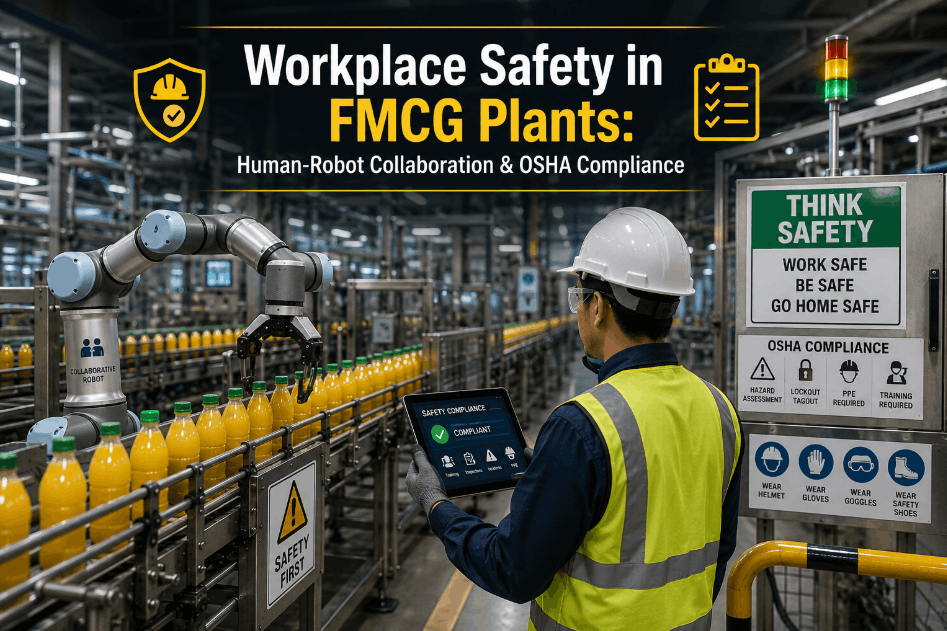
Workplace safety in FMCG plants has entered a new era. As automated packaging lines, robotic palletizers, and collaborative robots (cobots) become standard fixtures on high-speed production floors, the intersection of human-robot collaboration and OSHA compliance analytics is reshaping how safety managers operate. The stakes are enormous — a single preventable incident can cost hundreds of thousands in fines, lost productivity, and litigation. FMCG facilities that still rely on paper-based checklists and reactive incident reporting are falling dangerously behind the regulatory curve. If your safety program hasn't evolved to match your automation footprint, now is the time to book a demo and see how AI-driven safety management works inside a live FMCG environment.
Automate OSHA Compliance & Cobot Safety Zone Management
iFactory's Safety Checklist and Incident Tracking modules give FMCG enterprises real-time hazard reporting, automated safety inspection scheduling, and full OSHA compliance visibility — purpose-built for human-robot collaboration environments.
Why Traditional FMCG Plant Safety Programs Are Failing
The rapid deployment of cobots and industrial robots on FMCG production floors has outpaced the safety management systems designed to govern them. Legacy approaches — paper checklists, manual hazard logs, and quarterly OSHA audits — were designed for static human-only environments. They were never built to handle the dynamic risk profiles created by human-robot collaboration safety zones, variable robot operating speeds, or the intricate lockout/tagout analytics required for multi-robot production cells.
The consequences of this mismatch are measurable. OSHA's robotics-related citations in food and consumer goods manufacturing have increased steadily as automation density climbs. Each willful violation carries penalties that can exceed $150,000 per incident. Beyond regulatory exposure, untracked near-miss events create a compounding liability risk that only surfaces after a serious injury. FMCG safety managers serious about closing these gaps should book a demo to assess their current program against an automated safety compliance framework.
What AI-Driven FMCG Safety Management Actually Does
Modern safety platforms address three critical failure points in FMCG plant safety: untracked hazards, missed inspections, and delayed incident resolution. Here is how each capability closes those gaps in a human-robot collaboration environment.
Digital Safety Checklists & OSHA Compliance Automation
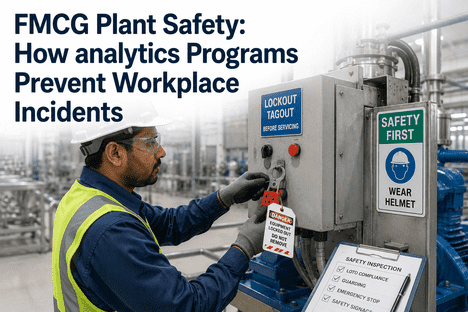
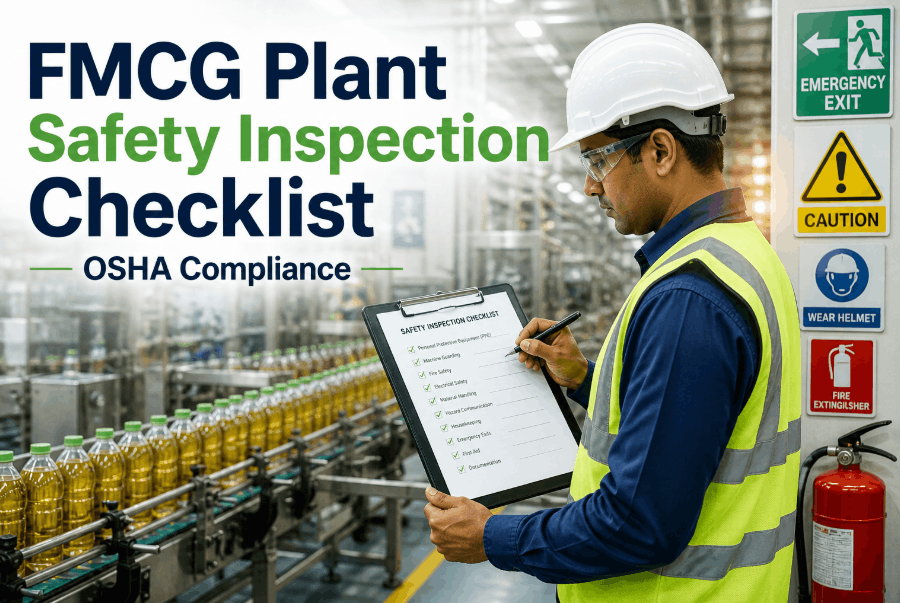
Manual paper-based safety checklists are unreliable in fast-moving FMCG environments — they get skipped, backdated, or lost. AI-driven digital safety checklists enforce completion in real time. Every pre-shift inspection, cobot safety zone verification, and lockout/tagout procedure is logged with a timestamp, technician ID, and mobile photo evidence. Non-compliance triggers immediate supervisor escalation, ensuring no inspection gap reaches audit time undetected. These structured checklists are also directly aligned with OSHA 29 CFR 1910.212 machinery safety standards and ISO 10218 robot safety requirements, dramatically reducing citation exposure during regulatory inspections.
Scheduling automation ensures that inspection cycles never lapse. The system automatically assigns daily, weekly, and monthly safety tasks to the responsible team members based on shift schedules, generating a verifiable compliance trail that makes OSHA audit preparation a structured process rather than a chaotic scramble.
Hazard Reporting AI-Driven Workflows
Near-miss incidents are the most underutilized data source in FMCG plant safety programs. Studies consistently show that for every serious injury, there are hundreds of unreported near-miss events that followed an identical causal chain. AI-driven hazard reporting platforms remove the friction that suppresses near-miss reporting. Mobile-first interfaces allow any floor employee to submit a hazard observation in under 60 seconds — attaching a photo, selecting the hazard category, and mapping the location to the plant's digital floor plan.
The platform's workflow engine then automatically routes the hazard to the responsible maintenance or safety supervisor, sets a resolution deadline, and tracks closure status in real time. Pattern recognition algorithms analyze submitted hazards to identify repeat locations, equipment types, or shift patterns where risks are clustering — enabling safety managers to intervene before a near-miss escalates into a recordable OSHA incident. Plants looking to deploy structured hazard reporting workflows should book a demo to see mobile hazard submission in a live FMCG setting.
Incident Tracking Analytics & Root-Cause Resolution
When a recordable incident does occur, the speed and completeness of the investigation determines both the corrective action quality and the regulatory defensibility of the plant's response. Incident tracking analytics platforms digitize the entire investigation lifecycle — from first notice of injury through root-cause analysis, corrective action assignment, OSHA 300 log entry, and final closure. Every field is structured and time-stamped, creating an auditable record that demonstrates proactive safety management to OSHA inspectors.
For human-robot collaboration incidents specifically, the system captures robot operational data at the time of the event, the active cobot safety zone configuration, and the last completed lockout/tagout verification — providing the critical technical context that determines whether a failure was procedural or equipment-related. This level of detail is what separates defensible safety programs from those that receive willful violation citations.
Cobot Safety Standards & Collaborative Robot Safety Zones in FMCG
Collaborative robots operating under ISO 10218 and ISO/TS 15066 standards introduce a fundamentally different risk model than traditional industrial robots. Because cobots are designed to work alongside humans without physical barriers, the safety margin is maintained entirely through software-defined speed and separation monitoring, force limits, and power limiting functions. In an FMCG environment where line layouts change seasonally and headcount varies by shift, these parameters must be actively verified — not assumed.
Speed & Separation Monitoring (SSM)
AI-driven platforms verify that speed-separation monitoring configurations are active and validated before each shift. Any modification to robot operating parameters automatically triggers a re-verification checklist, ensuring no unauthorized configuration change creates an unsupervised hazard in the collaborative workspace.
Cobot Safety Zone Boundary Audits
Floor tape degrades and safety barriers shift in high-throughput FMCG environments. Digital safety checklists mandate photographic confirmation of cobot safety zone boundary integrity at defined inspection intervals, creating a documented verification record that satisfies ISO 10218 compliance requirements.
Lockout/Tagout Analytics for Multi-Robot Cells
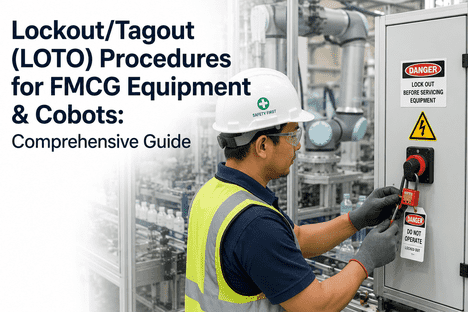
Multi-robot production cells require complex energy isolation sequences. Lockout/tagout analytics platforms digitize each LOTO procedure into step-by-step mobile workflows, verify each isolation point with photo evidence, and track which technician completed each step — eliminating the critical gaps that cause serious LOTO-related injuries.
Pre-Task Safety Risk Assessments
Before any maintenance work on robotic assets, the platform prompts technicians to complete a digital pre-task risk assessment. The assessment captures the task scope, energy sources involved, required PPE, and nearby operating equipment — ensuring workers have consciously evaluated hazards before entering the robot workspace.
Manual Safety Programs vs. AI-Driven OSHA Compliance Management
The operational and compliance differences between paper-based safety programs and AI-driven platforms are quantifiable across every dimension of FMCG plant safety performance.
| Safety Dimension | Manual Safety Programs | AI-Driven Safety Management | FMCG Compliance Impact |
|---|---|---|---|
| Inspection Scheduling | Manual calendar reminders, frequently missed | Automated scheduling with escalation alerts | Critical — eliminates audit compliance gaps |
| Hazard Reporting | Paper forms, low completion rates | Mobile submission, 60-second reporting | High — captures near-miss data systematically |
| Lockout/Tagout Verification | Paper LOTO procedures, unverifiable steps | Digital step-by-step with photo confirmation | Critical — eliminates OSHA LOTO violations |
| Incident Investigation | Slow, incomplete, narrative-based | Structured, time-stamped, OSHA 300 auto-populated | High — reduces citation exposure dramatically |
| Cobot Zone Compliance | Visual checks, no documentation | Photo-verified digital boundary audits | Critical — ISO 10218 compliance record |
| OSHA Audit Readiness | Chaotic document retrieval | Instant compliance dashboard export | Strategic — demonstrable proactive management |
| Safety Trend Analytics | Not available without manual analysis | Real-time hazard pattern identification | High — enables proactive risk elimination |
Building the Business Case for FMCG Safety Automation
The financial case for AI-driven FMCG safety management extends well beyond avoiding OSHA fines. Operations and EHS leadership teams building automation ROI models should account for four distinct value categories that accelerate the business case and shorten the payback period. Enterprises ready to quantify their current safety program cost should book a demo for a live ROI assessment.
OSHA Penalty & Citation Avoidance
Willful OSHA violations in FMCG robotics environments carry penalties exceeding $150,000 per citation. A single serious lockout/tagout failure or unreported cobot safety zone violation can generate multiple citations simultaneously. Documented, systematic compliance programs are the only reliable defense against willful classification.
Primary driverWorkers' Compensation Cost Reduction
Every recordable OSHA incident in a mid-size FMCG facility carries an average direct and indirect cost of $38,000–$60,000 when accounting for medical, lost productivity, investigation time, and modified duty. Systematic near-miss capture and hazard resolution prevents a significant portion of these incidents before they occur.
Cost multiplierAudit Preparation Labor Savings
EHS managers in document-heavy manual programs routinely spend 30–50 hours preparing for each OSHA inspection or internal corporate audit. AI-driven compliance dashboards reduce that to under 4 hours by consolidating inspection records, incident logs, and corrective action status into a single exportable audit package.
OpEx driverProduction Uptime Protection
A serious robotics-related incident in an FMCG plant doesn't only generate fines — it can trigger a production shutdown lasting days or weeks during investigation. Proactive cobot safety zone management and documented LOTO verification protect production continuity by eliminating the root conditions that cause stoppages.
Uptime valueFMCG Safety Program Automation — Verified Benchmarks
Average safety and compliance improvements measured within 12 months of deploying AI-driven safety management systems across FMCG manufacturing environments.
How to Implement AI-Driven FMCG Plant Safety — Phase by Phase
Safety automation deployments that fail to achieve measurable outcomes share a common root cause: launching digital tools without standardizing the underlying safety procedures they are meant to enforce. FMCG plants that digitize inconsistent, facility-specific inspection protocols simply scale the inconsistency. The roadmap below reflects the sequencing that consistently produces defensible, audit-ready safety programs. Teams ready to scope their deployment should book a demo to receive a safety process complexity assessment.
Safety Procedure Standardization & Checklist Design
Audit existing safety procedures, LOTO protocols, and inspection checklists across all production areas. Standardize procedures to align with OSHA 29 CFR 1910.147, ISO 10218, and facility-specific cobot risk assessments. Convert paper procedures into structured digital checklist templates with mandatory photo evidence fields and completion sign-offs.
Inspection Scheduling & Hazard Reporting Deployment
Activate automated inspection scheduling across all safety checklist categories — daily pre-shift, weekly equipment checks, and monthly OSHA compliance audits. Deploy the mobile hazard reporting interface to floor-level employees and conduct brief training sessions to maximize near-miss capture rates from launch.
Incident Tracking & OSHA 300 Log Integration
Configure the incident tracking module with structured investigation templates mapped to OSHA recordkeeping requirements. Integrate OSHA 300 log auto-population for recordable incidents and establish corrective action workflows with owner assignment, target completion dates, and verification sign-off requirements.
Predictive Analytics & Multi-Site Safety Governance
Activate safety trend analytics to identify repeat hazard locations, high-frequency incident types, and non-compliant shifts. For multi-facility enterprises, deploy enterprise-wide safety dashboards giving corporate EHS directors consolidated visibility into compliance rates, open corrective actions, and leading safety indicator trends across the entire plant network.
FMCG Safety Automation Use Cases — Who Benefits and How
The measurable impact of AI-driven safety management varies by functional role. Here is how key stakeholder groups experience the outcomes of a deployed intelligent safety program in an FMCG plant.
Real-Time OSHA Compliance Dashboard
EHS managers gain a live compliance dashboard showing inspection completion rates, open hazards by severity, and corrective action status — providing the enterprise-wide safety visibility needed to prioritize interventions before incidents occur.
Digital LOTO Procedures for Robot Cells
Technicians receive step-by-step digital lockout/tagout workflows on their mobile devices before entering any robot workspace, with mandatory confirmation at each energy isolation point and built-in safeguards that prevent task progress if any step is skipped.
Production Continuity Through Proactive Safety
Plant managers gain confidence that cobot safety zones are being actively verified each shift — not assumed — reducing the probability of a serious incident that triggers a production shutdown and OSHA investigation during peak manufacturing periods.
Automated Hazard Escalation & Closure Tracking
Supervisors receive instant mobile notifications when high-severity hazards are submitted, with automatic escalation timers that notify management if a hazard remains unresolved beyond the defined response window — eliminating the oversight gaps that allow critical hazards to persist unaddressed.
Robot Asset Safety History Mapping
Engineers maintain a complete safety event history mapped to individual robotic assets — linking near-miss events, inspection findings, and incident records to specific cobots or production cells, enabling data-driven decisions about robot redeployment, maintenance frequency, or safety zone redesign.
Multi-Site Safety Performance Governance
Directors oversee consolidated safety KPIs across the entire FMCG plant network — identifying which facilities are lagging on compliance rates, tracking enterprise-wide incident trends, and benchmarking performance to guide corporate safety investment priorities.
Frequently Asked Questions — FMCG Plant Safety & OSHA Compliance
What are the OSHA requirements for human-robot collaboration in FMCG plants?
OSHA regulations most relevant to human-robot collaboration in FMCG environments include 29 CFR 1910.212 (machine guarding), 29 CFR 1910.147 (lockout/tagout), and General Duty Clause obligations to address recognized hazards. For collaborative robots specifically, OSHA also references ANSI/RIA R15.06 and ISO 10218 as recognized industry standards for cobot safety zone design and risk assessment.
How does digital hazard reporting reduce FMCG plant safety incidents?
Digital hazard reporting platforms significantly increase near-miss capture rates by removing the friction associated with paper-based reporting. More near-miss data enables pattern recognition that identifies systemic hazards before they escalate. Studies indicate that FMCG facilities with active near-miss programs experience substantially lower recordable incident rates compared to those relying on reactive, post-incident reporting only.
What is ISO 10218 and why does it matter for FMCG cobot deployments?
ISO 10218 is the international standard governing the design and integration of industrial robots, including collaborative robots. For FMCG plants, it defines the risk assessment methodology, safety function requirements, and installation verification protocols required for cobot deployments. AI-driven safety checklists can enforce ISO 10218-aligned verification steps at each shift change, creating a documented compliance record that satisfies both internal audit and regulatory inspection requirements.
How does automated incident tracking support OSHA 300 log compliance?
AI-driven incident tracking systems auto-populate OSHA 300 log fields from structured investigation data collected at the time of the incident. This eliminates the common errors and delayed entries that create OSHA recordkeeping violations. The system also generates OSHA 300A annual summary data automatically and tracks the 300-day retention requirements, ensuring the plant's recordkeeping program is always audit-ready.
What is the ROI of investing in AI-driven FMCG safety management?
The ROI of safety automation in FMCG plants typically encompasses four value streams: OSHA penalty avoidance (up to $150K+ per willful violation), workers' compensation cost reduction ($38K–$60K per recordable incident avoided), audit preparation labor savings (30–50 hours per audit eliminated), and production continuity protection from incident-triggered shutdowns. Most multi-facility deployments achieve full payback within 4 to 8 months.
How does iFactory support OSHA compliance in FMCG plants?
iFactory provides a comprehensive AI-driven safety management platform natively integrated with its CMMS. The Safety Checklist module enforces digital inspection workflows with mandatory photo evidence and automated scheduling. The Incident Tracking module digitizes investigations end-to-end with OSHA 300 auto-population. Together, these capabilities create a defensible, auditable safety compliance record tailored to the unique demands of human-robot collaboration in high-speed FMCG environments.
Transform Your FMCG Plant Safety Program Today
iFactory's intelligent safety management platform connects your inspection workflows, hazard reporting, and incident investigations into a single compliance engine — purpose-built for FMCG environments where human-robot collaboration demands a higher standard of safety governance.