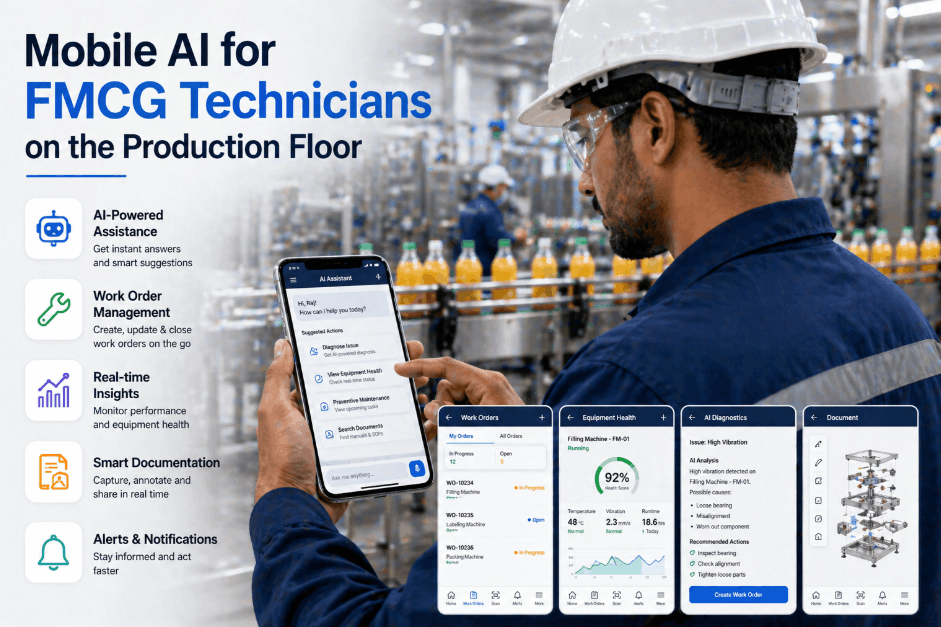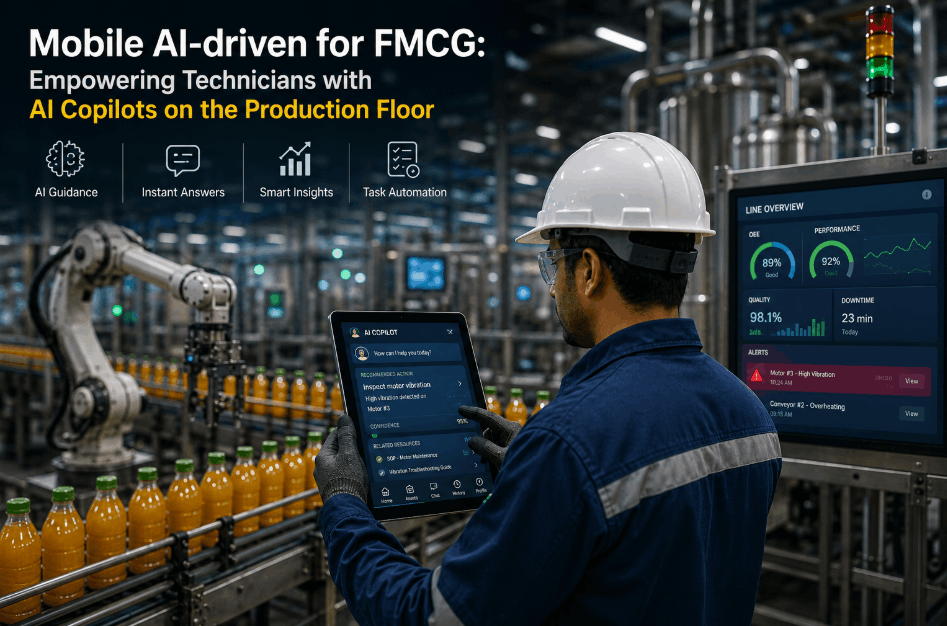
In the high-speed environment of FMCG manufacturing, the distance between the technician and the maintenance office is the greatest enemy of productivity. Traditional maintenance systems fail because they require technicians to abandon the production floor to log data, search for manuals, or check parts availability. This "travel time" and administrative burden reduce actual wrench time to less than 40% in many facilities. **Mobile AI-driven for FMCG** is fundamentally changing this dynamic by putting an AI Copilot in the pocket of every technician. By delivering real-time troubleshooting assistants, mobile work orders, and instant asset intelligence directly to the point of work, facilities are seeing a measurable 28% increase in technical productivity. If your team is still tethered to desktop terminals or paper logs, book a demo to see how AI-driven mobile tools transform the shop floor.
Empower Your Technicians with AI Copilots — Drive 28% More Wrench Time
iFactory's Mobile AI-driven delivers predictive troubleshooting, barcode scanning, and offline-first work orders — ensuring your team has the right data, at the right machine, at the right time.
Why Desktop-Bound Maintenance Is Failing the FMCG Floor
FMCG lines move at speeds where a 15-minute delay in data access translates into thousands of units of lost production. When a technician has to walk back to a central office to print a manual or check an exploded diagram, the line stays down. Furthermore, "post-event" data entry — where technicians log their work at the end of a shift — results in a 40-60% degradation in data accuracy. These information silos prevent reliability engineers from seeing the real-time health of the facility.
Mobile AI-driven replaces this friction with a "Point-of-Work" philosophy. Every interaction — from scanning a QR code on a high-speed filler to recording a voice-to-text repair note — happens instantly. This real-time synchronization ensures that the entire enterprise has a single, accurate version of the truth. Maintenance leaders looking to eliminate floor-to-office travel time should book a demo to map their current technician workflow against a mobile-first alternative.
How AI Copilots Transform Technical Decision Making
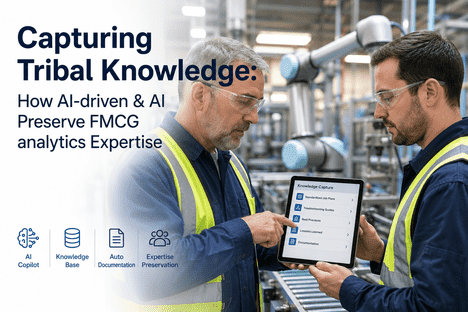
An AI Copilot is more than a digital manual; it is an intelligent layer that assists technicians in diagnosing complex multi-variable failures on the production line. Three core pillars define the iFactory mobile AI experience.
AI-Powered Predictive Troubleshooting Assistants
When a technician scans a machine's QR code, the AI Copilot immediately surfaces the most likely root causes based on real-time sensor data and historical failure patterns. If a palletizer is experiencing a "grip failure," the AI doesn't just show the manual; it analyzes current vibration spikes and suggests checking the specific solenoid that failed in similar conditions 4 weeks ago. This "Tribal Knowledge as a Service" ensures that even junior technicians can troubleshoot with the expertise of a 20-year veteran.
Photo Documentation & Visual Recognition
Instead of typing long descriptions, technicians take photos of worn components. The AI analyzes these images for wear patterns, automatically identifying the part number and suggesting a replacement. This visual documentation becomes part of the asset's digital twin, allowing reliability engineers to track component degradation over time through a visual audit trail. Facilities wanting to test AI part recognition should book a demo to see live visual search in action.
Offline-First Sync & Voice-to-Text Reporting
FMCG facilities often have "dead zones" where Wi-Fi is unreliable. The iFactory mobile app is built with an offline-first architecture, allowing technicians to execute work orders and safety checklists without a connection. Once they re-enter a signal area, the system syncs all data seamlessly. Furthermore, voice-to-text capabilities allow technicians to record detailed repair notes hands-free, significantly improving the quality of the technical history captured.
Manual Maintenance vs. Mobile AI-driven
The shift from desktop-centric management to mobile-first AI-driven creates measurable improvements in every phase of the maintenance lifecycle.
| Maintenance Dimension | Desktop / Paper Systems | Mobile AI-driven App | Productivity Impact |
|---|---|---|---|
| Work Order Access | Printed at start of shift | Instant, real-time dispatch | High — eliminates travel time |
| Technical Documentation | Stored in office binders | QR-linked on mobile device | Critical — ensures 100% data access |
| Troubleshooting | Trial and error / experience | AI Copilot guided diagnosis | High — 45% reduction in MTTR |
| Data Capture | Delayed (End of shift) | Immediate (Point of work) | Strategic — 99% data accuracy |
| Parts Verification | Walk to storeroom to check | Real-time mobile stock view | High — prevents wasted trips |
| Safety Checklists | Manual checkbox signing | Digital, time-stamped verification | High — guaranteed compliance |
| Reporting | Manual typing/entry | Voice-to-Text / Photo-based | Medium — massive time savings |
Quantifying the ROI of Mobile AI Empowerment
The business case for mobile AI-driven is built on recovering wasted time and preventing avoidable downtime through faster response. Reliability leaders focus on four value categories when building their ROI models.
Wrench Time Recovery
By eliminating the walk-time between the machine and the office, technicians recover 1-2 hours per shift. For a team of 10 technicians, this is equivalent to gaining 1.5 additional full-time employees without increasing headcount.
Labor efficiencyMTTR Reduction via AI Guidance
Mobile AI Copilots provide instant access to "best-fix" data. Reducing the Mean Time to Repair by even 15% across a high-speed bottling or packaging line can save hundreds of thousands in annual lost throughput.
Uptime multiplierData-Driven Reliability Insights
Point-of-work data capture provides the "clean data" required for true predictive analytics. Without mobile inputs, reliability models are built on shaky, delayed data, leading to incorrect failure predictions.
Strategic valueInventory & Freight Cost Reduction
Mobile barcode scanning during parts checkout ensures the storeroom is always accurate. This prevents the "phantom stockout" where parts are physically present but missing from the system, avoiding emergency freight.
OpEx driverDeploying Mobile AI-driven — A 4-Phase Strategy
A successful mobile rollout is as much about culture as it is about technology. Our roadmap focuses on gaining technician buy-in through immediate utility and friction-free interfaces. Teams ready to start their mobile transformation should book a demo to receive a mobile readiness checklist.
QR Code Infrastructure & App Setup
Deploy durable industrial QR codes to every critical asset on the floor. Configure the mobile app with facility-specific hierarchies and user permissions, ensuring every technician sees only the data relevant to their role and equipment line.
Mobile Work Order Adoption
Transition all Preventive Maintenance (PM) and reactive work orders to the mobile interface. Train technicians on "Point-of-Work" logging, focusing on using voice-to-text and photo documentation to reduce their administrative time.
AI Copilot & Troubleshooting Activation
Enable the AI Copilot features, feeding the system historical failure data and technical manuals. Technicians begin receiving guided troubleshooting suggestions during machine failures, drastically accelerating root-cause identification.
Continuous Improvement & Advanced Analytics
Leverage the high-accuracy mobile data to build advanced predictive reliability models. Managers use wrench-time heatmaps to optimize technician routing and identify training gaps based on troubleshooting performance.
Mobile AI-driven — Verified Performance Benchmarks
Average operational improvements measured within 12 months of deploying iFactory's Mobile AI-driven across FMCG manufacturing environments.
Mobile AI-driven Use Cases — Transforming Daily Workflows
The transition to mobile AI impacts every member of the maintenance and reliability team, creating a more agile and data-driven culture.
Instant Asset Intelligence at the Machine
Scanning a QR code on a vibrating motor instantly pulls up its last 5 work orders, its digital manual, and a step-by-step troubleshooting guide—no walking required.
Real-Time Floor Visibility & Dispatch
Supervisors track technician location and status in real-time, allowing them to dispatch the closest available technician to an emergency failure with a single tap.
High-Fidelity Visual Failure Data
Engineers review photo-based failure logs to identify systemic wear issues across the fleet, using visual evidence to justify equipment upgrades or PM shifts.
Digital LOTO & Safety Checklists
Technicians execute mandatory Lock-Out Tag-Out (LOTO) checklists on their device before starting work, with time-stamped photo verification for 100% compliance.
Mobile Part Checkout & Cycle Counts
Technicians scan a part's barcode as they remove it from the bin, instantly updating the inventory system and preventing "phantom stock" stockouts.
Real-Time OEE & Downtime Monitoring
Managers view a live dashboard of current floor activities, seeing exactly which lines are down and the progress being made on repairs in real-time.
Evaluating Mobile AI-driven Platforms — Selection Criteria
Not all mobile maintenance apps are equal. True industrial mobile AI-driven requires specific technical architectures to survive the production environment.
Native Offline-First Sync
The app must function 100% without a connection. Systems that require live Wi-Fi for every click will fail in the "dead zones" of large industrial plants.
Industrial QR/Barcode Integration
The scanning engine must be fast and capable of reading damaged or low-light codes. This is the primary interface for technicians on the floor.
Generative AI Troubleshooting
Ensure the platform uses LLMs/AI to analyze historical data and manuals, providing actual "how-to-fix" guidance rather than just displaying static PDFs.
Voice-to-Text Reliability
The app must accurately transcribe technical jargon in noisy industrial environments. This is critical for capturing high-quality repair notes.
Cross-Platform (iOS/Android)
Avoid systems that tether you to specific hardware. A web-based or cross-platform native app allows you to use consumer devices or ruggedized tablets.
Native Photo/Video Capture
Direct integration with the device camera for fast documentation of failures and part wear is a non-negotiable requirement for modern reliability.
Frequently Asked Questions — Mobile AI-driven
What is the "wrench time" benefit of mobile AI-driven?
Wrench time refers to the actual time a technician spends performing maintenance tasks. By moving work orders, parts visibility, and manuals to a mobile device, technicians eliminate 1-2 hours per shift of "travel and admin time," directly increasing their productive capacity.
How does an AI Copilot help with troubleshooting?
The AI Copilot ingest historical repair data and technical manuals. When a failure occurs, it suggests the most likely fixes based on the current symptoms and machine state, reducing the "guesswork" and helping technicians find the root cause faster.
Does the mobile app work without an internet connection?
Yes. iFactory's mobile app uses an offline-first architecture. Technicians can complete work orders, checklists, and parts lookups in dead zones; the app will automatically sync all changes once a connection is re-established.
Can I use existing mobile devices or do I need special hardware?
The platform is cross-platform and runs on standard iOS and Android devices. Many facilities use off-the-shelf smartphones with rugged cases, while others prefer industrial-grade tablets. The choice depends on your specific environment and safety requirements.
Is mobile AI-driven secure for enterprise use?
Absolutely. All data is encrypted both in transit and at rest. We use enterprise-grade SSO and multi-factor authentication (MFA) to ensure that only authorized personnel can access your maintenance and asset health data.
How does iFactory improve data accuracy?
By enabling "Point-of-Work" data entry, we eliminate the delay between the task and the logging. Capturing data in real-time via voice-to-text and photos is 5x more accurate than manual end-of-shift typing, providing a cleaner dataset for reliability engineering.
Unleash Your Technicians from the Office Today
iFactory's Mobile AI-driven puts an AI Copilot in every pocket — delivering real-time troubleshooting, mobile work orders, and instant asset intelligence to drive 28% more productivity on your shop floor.