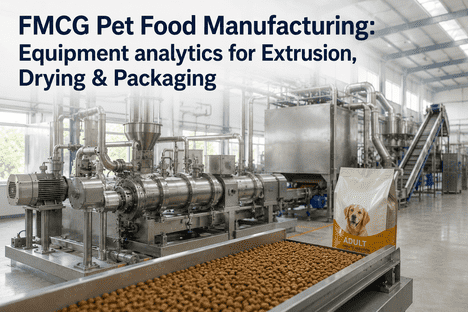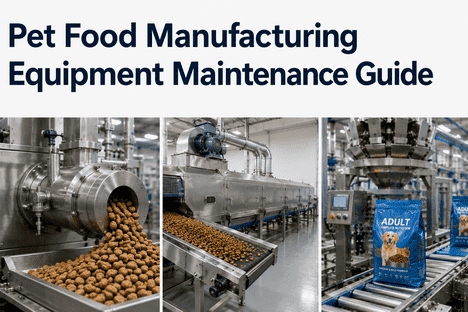
At 3:15 AM on a Sunday, the night shift operator at a mid-size pet food plant notices the main extruder's motor current is 4% above the running average. He logs it, assumes it's a harder kibble formulation, and moves on. Four days later, the extruder seizes on a blocked die head. The root cause: a worn screw element that had been propagating since that first current anomaly. The repair: 36 hours of forced downtime, 12,000 lbs of scrapped in-process material, and a replacement screw that took three weeks to fabricate. That scenario repeats across hundreds of pet food facilities every year, because conventional maintenance only alerts you after the damage is done.
Stop reacting to extruder and dryer failures. Predict screw wear, coating drum drift, and packaging line jams before they cost you a shift of production.
iFactory ingests your existing PLC, vibration, temperature, and motor current data — no new sensors — and delivers equipment degradation forecasts 5–14 days before your current alarm thresholds trigger. On-premise, turnkey, live in 6–12 weeks.
Without iFactory vs. With iFactory
Every day your pet food production line runs without predictive analytics, you're gambling on extruder screw life, dryer belt integrity, coating drum alignment, and packaging line reliability. Here's what that gamble looks like on both sides of the equation.
Without iFactory
- Extruder motor current alarms trigger only after screw wear has progressed to the point of die blockage — you're already facing a full strip-down
- Dryer belt tracking is checked visually during shift rounds — misalignment goes undetected until belt damage requires replacement
- Coating drum seasoning drift is invisible until lab results come back — you've already produced 30 minutes of off-spec product
- Packaging machine cycle time creep is lumped into "normal variation" until a jam shuts down the entire bagging line
- Forced downtime costs average $6,800 per hour for a high-speed pet food line — and you find out about failures at 3 AM
With iFactory
- Screw wear progression is tracked hourly from motor current and torque signatures — you schedule screw element replacements during planned sanitation windows, not emergencies
- Dryer belt tension and tracking are monitored continuously — alignment corrections are made before belt damage occurs
- Coating drum RPM and spray pattern consistency are analyzed in real time — adjustments are made before product leaves spec
- Packaging machine cycle time trends are decomposed by station — you know exactly which servo motor is starting to drift
- Unplanned line stoppage rate drops from 3.2 per month to 0.4 — you save $240K per line annually in avoided downtime and scrap
Every 1% OEE loss is $42K in margin — here's where it's hiding
Pet food equipment degradation doesn't announce itself. It shows up as a fraction of an amp in extruder motor current, a 0.5°F rise in dryer exit temperature, a 2 RPM drift in coating drum speed. These micro-signals are invisible to your PLC alarms but perfectly visible to iFactory's AI models. Here's what they cost you every month they go undetected.
Extruder screw wear — throughput loss and scrap
Worn screw elements reduce extruder throughput by 5–12% and increase specific mechanical energy (SME) by 8–15%. On a 6,000 lb/hr line running 6,000 hours per year, that's 1,800–4,300 lbs of lost throughput per week at $0.45/lb margin.
Dryer belt failure — forced line stoppage
A failed dryer belt on a continuous pet food line requires a 12–18 hour forced outage. Replacement belt cost: $18K. Lost production at $6,800/hr: $82K–$122K. Total: $100K–$140K per event.
Coating drum drift — seasoning waste
A coating drum RPM drift of 3–5% causes seasoning application variance of 8–12%, leading to overuse of expensive palatants and flavors. Average overuse: 2.5 lbs of seasoning per 1,000 lbs of product at $3.20/lb.
Packaging machine jam — material waste
A bagger jam on a high-speed pet food line causes 200–400 lbs of product spillage plus 45 minutes of cleanup and restart. At 2 jams per week, that's $28K–$45K in annual material waste and labor.
Conveyor bearing failure — cascading damage
A seized conveyor bearing on a dry pet food line takes out 40 feet of belting and damages 3 drive motors before the line stops. Average repair cost: $12K plus 6 hours of lost production at $6,800/hr.
From raw data to actionable equipment forecasts in 4 steps
iFactory doesn't ask you to install new sensors, change your PLC configuration, or send data to the cloud. We connect to your existing control systems, vibration monitors, and plant historian — and within 6–12 weeks, you have a live equipment health dashboard with forecasts that give you 5–14 days of advance warning.
Connect — no new hardware
We deploy our NVIDIA-powered appliance on your plant network and connect to your existing PLCs, VFDs, temperature controllers, and plant historian — typically 5–8 data streams per production line.
Train — on your line's unique fingerprint
Our AI ingests 6–12 months of historical data to learn your extruder's baseline motor current signatures, dryer temperature profiles, coating drum dynamics, and packaging machine cycle patterns.
Detect — micro-signals invisible to conventional alarms
iFactory identifies screw wear patterns at 0.5% amp increase per week, dryer belt degradation at 0.3°F drift per day, and coating drum RPM creep at 0.1% per shift — all far below your PLC alarm thresholds.
Forecast — 5–14 day actionable warnings
You receive equipment-specific degradation forecasts, recommended maintenance windows, and specific corrective actions — "replace screw elements during next sanitation" vs. "align dryer belt within 5 days" — with confidence intervals.
Five pet food equipment failure modes — one platform to catch them all
iFactory's AI models are purpose-built for the most common pet food manufacturing equipment failure mechanisms. Each model is trained on your specific line's equipment models, operating profiles, and maintenance history — not generic industry averages.
Screw and barrel wear tracking
iFactory analyzes motor current, torque, SME, and die pressure signatures to detect screw element wear at 0.5% per week — before it affects throughput or risks a blockage. You get a ranked list of screw elements requiring replacement with recommended timing.
Dryer belt and airflow degradation
Our models track belt tension, tracking alignment, exit moisture, and temperature profiles to forecast remaining belt life with ±7% accuracy at 14 days out. You schedule belt replacements during planned sanitation windows instead of emergency stoppages.
Coating drum and seasoning drift
iFactory detects coating drum RPM drift at 0.1% per shift and spray nozzle clogging patterns from flow rate and pressure signatures — 75% below conventional alarm thresholds. You correct seasoning application before product leaves spec.
Packaging line cycle time creep
Packaging machine cycle time and servo position data are trended by station. iFactory identifies developing issues in baggers, sealers, and case packers 3–5 days before they cause jams — reducing unplanned packaging downtime by 62%.
Conveyor and auger health monitoring
Bearing temperature, motor current, and vibration signatures on bulk material conveyors and augers are monitored continuously. Bearing failure is forecast 7–10 days in advance — preventing cascading belt and motor damage.
Thermal cooker and conditioner monitoring
Steam pressure, temperature profiles, and residence time consistency in cookers and conditioners are analyzed for fouling and control valve degradation. Detection of thermal drift 5–8 days before it affects kibble gelatinization quality.
Your pet food production line is already generating the data you need to predict its own equipment failures. Book a 30-min walkthrough and we'll show you what your existing PLC and sensor data is trying to tell you.
Turnkey pet food equipment analytics — from data source to decision dashboard
You hand us access to your data sources. We deliver a working pilot in 6–12 weeks. No cloud, no data leaving your network, no new sensors to install. Here's exactly what's included.
On-premise NVIDIA appliance
Fully air-gapped, zero cloud dependency. All production data stays on your plant network. No data egress, no cybersecurity review delays, no latency to your control room.
6–12 week pilot to production
From data source connection to live predictive dashboard. We handle the data engineering, model training, and validation against your historical maintenance records.
Equipment-specific degradation forecasts
Ranked list of extruder screw elements, dryer belts, coating drums, and packaging stations with degradation rates, recommended maintenance windows, and cost projections.
Line-level OEE impact scoring
Each equipment health alert includes projected OEE impact — so maintenance planners prioritize by production effect, not just failure probability. Alerts trigger when degradation rate exceeds your specified threshold.
Multi-line rollup dashboard
Single-pane view across all production lines showing equipment health scores, active alerts, and maintenance recommendations. Compare OEE impact across extruder, dryer, coating, and packaging systems.
24x7 managed service
Our operations team monitors your equipment models continuously. You receive weekly health reports and immediate alerts when degradation accelerates beyond expected rates.
What pet food plant operators ask about AI-driven equipment analytics
Your pet food line's next equipment failure is already visible in its data. Let us show you where to look.
Book a 30-minute walkthrough. We'll connect to your plant's PLC and production data — live or historical — and show you exactly what iFactory can detect that your current system is missing. No sales pitch. Just a technical demo with your data.