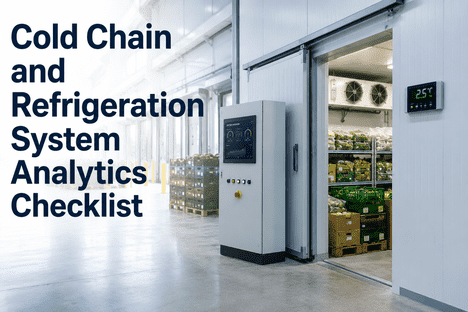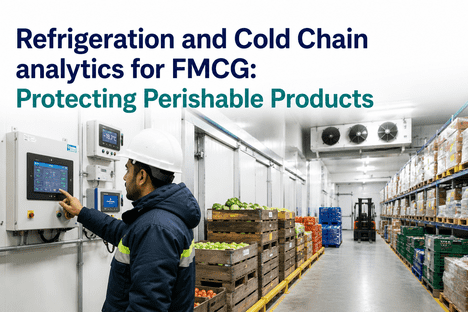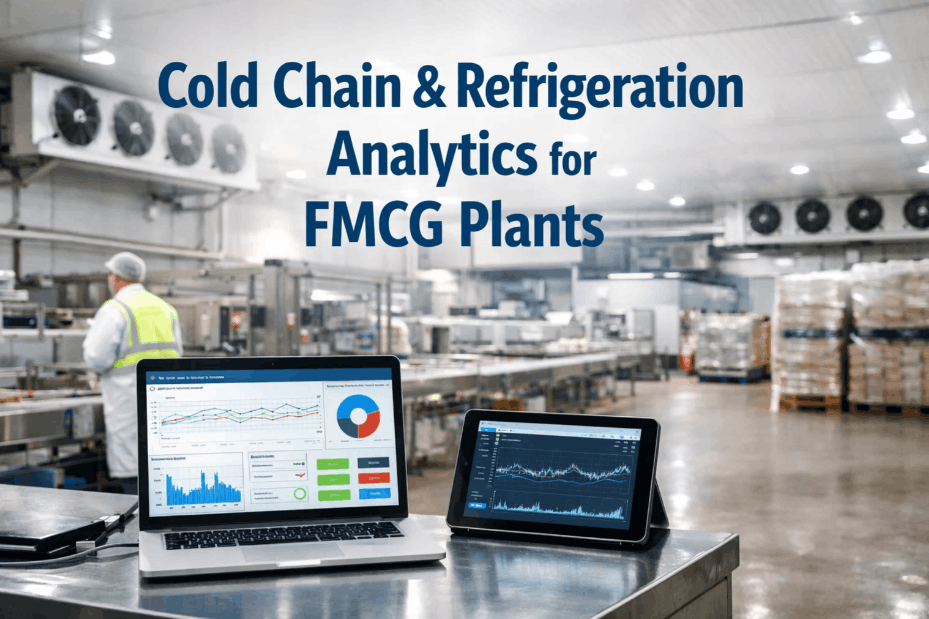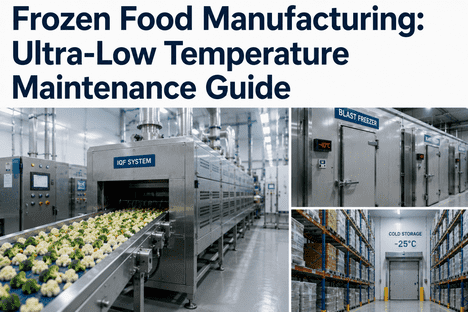
Frozen food manufacturing operates at the edge of what industrial equipment can withstand — blast freezers at -40°F, IQF systems cycling between sub-zero and ambient thousands of times per day, and ammonia refrigeration plants running 24/7 under constant regulatory scrutiny. In an industry where a 30-minute freezer outage can spoil $50,000+ of product, maintenance cannot be reactive. iFactory AI's CMMS and predictive maintenance platform delivers ultra-low temperature analytics purpose-built for frozen food producers — enabling real-time equipment health monitoring, refrigerant leak prediction, and freezer belt lifecycle management. Book a Demo to see how food processors reduce cold-chain disruptions by up to 67%.
Is Your Frozen Food Plant Running on Reactive Maintenance — or Cold-Chain Analytics?
iFactory AI delivers CMMS, preventive maintenance scheduling, predictive analytics, and real-time equipment monitoring purpose-built for blast freezers, IQF systems, spiral freezers, cold storage, and ammonia/CO₂ refrigeration — so your frozen food facility runs at peak OEE, not at the mercy of unplanned cold-chain failures.
The Four Core Ultra-Low Temperature Production Systems — and Why Each Demands Its Own Maintenance Strategy
Blast freezers, IQF systems, spiral freezers, and cold storage / refrigeration plants each create distinct failure modes, wear patterns, and maintenance intervals that a generic PM program will miss. Understanding the thermal and mechanical reality of each platform is the starting point for building a cold-chain maintenance strategy that actually protects uptime and prevents product loss.
Blast Freezer Maintenance
Blast freezers rapidly pull heat from product using high-velocity air at -30°F to -50°F. The primary wear mechanisms are evaporator coil icing, condenser fan motor burnout from lubricant thickening at extreme low temperatures, and door seal degradation. As frost accumulates on evaporator coils, heat transfer efficiency drops, forcing compressors to run longer and consuming excess energy — a self-reinforcing cycle that accelerates component wear.
Industry best practice from refrigeration OEMs including JBT Corporation and GEA Freezing calls for measuring coil temperature differential and defrost cycle effectiveness every 500 operating hours. Fan motor vibration analysis, door seal light-tests, and ammonia detector calibration complete the core blast freezer PM program.
- Measure evaporator coil temp differential every 500 operating hours
- Vibration testing on condenser fan motors quarterly
- Thermal imaging of defrost heater elements and drain pans
- Inspect and replace freezer door gaskets on manufacturer intervals
- Calibrate ammonia and CO₂ refrigerant detectors monthly
- Verify defrost termination thermostat operation each cycle
IQF System Maintenance
Individual Quick Freezing systems use fluidized bed or belt technologies to freeze individual pieces of product at ultra-low temperatures. Belt tracking misalignment, ammonia refrigerant pitting in plate heat exchangers, and bearing seizure in the freezing zone are the dominant failure modes — all of which accelerate in sub-zero environments where standard lubricants lose viscosity and metal embrittlement accelerates crack propagation.
FPSA (Food Processing Suppliers Association) guidelines and OEM recommendations from Key Technology and Intralox emphasize that IQF belt condition monitoring and heat exchanger plate inspection are the highest-impact preventive tasks in any IQF maintenance program. Vibration analytics on the drive train can predict belt failure 2-3 weeks in advance, allowing scheduled replacement during planned sanitation windows rather than emergency shutdowns that spoil product.
- Inspect IQF belt tracking and tension every 500 operating hours
- Clean and inspect heat exchanger plates for pitting monthly
- Monitor bearing temperatures in freezing zone continuously
- Check fluidized bed air distribution baffles each production run
- Verify product feed uniformity and belt speed calibration weekly
- Inspect drive chains and sprockets for cold-induced wear
Spiral Freezer Maintenance
Spiral freezers combine high-density vertical conveying with consistent airflow at -20°F to -35°F, making them one of the most throughput-efficient freezing platforms in frozen food manufacturing. The spiral belt drive chain and drum bearing are the leading failure points — both operating under continuous load at temperatures that cause standard greases to stiffen and standard steels to become brittle.
Thermal imaging integrated with iFactory AI identifies hot spots from friction or bearing degradation before they cause belt jams or structural failures. Evaporator coil placement within the spiral stack creates unique cleaning and inspection challenges — coil fouling in one zone can create temperature gradients across the spiral that cause uneven freezing and product quality defects. OEMs including Stein-DSI and Frigoscandia recommend zone-specific coil inspections and air velocity measurements on a rotating schedule.
- Monitor drum bearing temperature continuously with thermal sensors
- Inspect spiral belt drive chain lubrication and tension weekly
- Check air velocity uniformity across spiral zones monthly
- Clean evaporator coils on zone-rotation schedule
- Verify belt washer and drier system operation each sanitation cycle
- Inspect drum and rail wear surfaces for cold-induced cracking
Cold Storage & Refrigeration System Maintenance
Large cold storage facilities (-10°F to 0°F) house finished product for weeks or months, and the ammonia or CO₂ refrigeration systems that serve them are the circulatory system of any frozen food plant. Compressor oil carryover, condenser fouling, receiver level fluctuations, and floor heave from frost accumulation are top failure indicators. A single refrigerant leak can cost $250K+ in lost product, regulatory fines, and production downtime while the system is evacuated and repaired.
The International Institute of Ammonia Refrigeration (IIAR) standards and OSHA PSM requirements mandate regular inspection and documentation of ammonia refrigeration systems — including pressure vessel inspections, relief valve testing, and mechanical integrity programs. iFactory AI automates the scheduling, documentation, and audit trail for all IIAR and PSM compliance tasks while adding predictive analytics that detect refrigerant loss patterns before safety thresholds are breached.
- Inspect ammonia receiver and pressure vessels per IIAR schedule
- Test compressor oil condition and carryover rate monthly
- Clean condenser coils and inspect fan assemblies quarterly
- Verify refrigerant leak detector calibration and sensor response
- Monitor floor temperature sensors for heave detection
- Document all PSM mechanical integrity inspections in CMMS
The True Cost of Unplanned Downtime in Frozen Food Manufacturing — and Where Most Plants Are Today
Most frozen food plant managers estimate downtime costs by counting the obvious loss — idle freezer hours times hourly production rate. The actual cost stack in ultra-low temperature operations is five layers deep, and most facilities only see the top one. Understanding the full cost picture is what makes the business case for structured preventive maintenance irrefutable.
The most visible cost: a 30-minute blast freezer outage can spoil an entire shift's production. Spoilage cost includes raw material loss, rework labor, and waste disposal. This typically understates total real cost by 3-5x in ULT operations.
Emergency freezer belt replacements, compressor rebuilds, and evaporator repairs procured outside normal channels carry 40-80% premium over planned-maintenance costs. A single ammonia compressor rebuild on emergency basis can cost $80K+ versus $30K when scheduled.
When freezer performance degrades gradually, products may not reach target core temperature — resulting in reduced shelf life, freezer burn, and potential food safety violations. Quality downgrades and re-grading costs rarely appear in maintenance budget accounting but can represent millions in annual value erosion.
As evaporator coils foul and compressor valves wear, the refrigeration system consumes more energy to maintain target temperatures. Energy consumption per ton of frozen product rises progressively — a cost that accumulates across thousands of operating hours and is never attributed to deferred maintenance.
Ammonia refrigeration systems operate under OSHA PSM, EPA Section 112(r), and IIAR standards. A single compliance failure — missed relief valve test, overdue pressure vessel inspection, or incomplete mechanical integrity record — can result in fines, plant shutdown orders, and reputational damage that dwarfs the original maintenance deferral savings.
iFactory AI's CMMS tracks all five cost layers — not just spoilage — giving frozen food plant managers the complete financial picture needed to justify preventive maintenance investment and demonstrate documented ROI within the first operating year. Book a Demo to see how iFactory AI structures cold-chain downtime cost reporting for frozen food equipment fleets.
Reactive vs. Preventive vs. Predictive Maintenance: Which Model Fits Your Ultra-Low Temperature Operation?
Frozen food manufacturing facilities typically operate across one of three maintenance maturity levels. Understanding where your operation sits today — and what the economic difference is between each level — is the foundation for building the right cold-chain maintenance program with iFactory AI.
| Dimension | Reactive Maintenance | Preventive Maintenance | Predictive Maintenance |
|---|---|---|---|
| Trigger | Equipment fails (freezer down, temperature loss) | Time or operating-hour intervals | Sensor data, condition monitoring |
| Downtime Profile | Unplanned, extended, high-cost — product spoilage immediate | Planned, short, predictable | Minimal — interventions before failure |
| Spoilage Impact | High — entire shift or day of product at risk | Low — scheduled maintenance avoids product exposure | Lowest — real-time temperature monitoring prevents excursion |
| Repair Cost | Emergency premium — 40-80% higher | Standard rates, planned procurement | Lowest — intervene before damage propagates |
| Refrigerant Loss | High — unexpected leaks, emergency repairs | Moderate — scheduled maintenance, routine checks | Lowest — leak detection AI predicts failures before breach |
| Energy Efficiency | Degrading — coil fouling, valve wear increase consumption | Stable — wear controlled within intervals | Optimized — wear detected and corrected early |
| Regulatory Compliance | High risk — missed inspections, incomplete records | Documented — scheduled inspections, audit-ready logs | Automated — IIAR/PSM compliance integrated into platform |
| iFactory AI Support | Work order management, failure logging, spoilage tracking | PM scheduling, cold-chain checklists, interval triggers | IoT sensor integration, refrigerant leak AI, OEE analytics |
Most U.S. frozen food facilities today operate at the reactive-to-preventive transition — reacting to freezer failures and ammonia leaks while running paper-based PM checklists on other equipment. iFactory AI is designed to close that gap, moving facilities from stage 1-2 reactive operations to stage 3-4 preventive and predictive programs without requiring large IT infrastructure investments or extended implementation timelines in live production environments.
How iFactory AI's CMMS and Predictive Maintenance Platform Manages Ultra-Low Temperature Equipment
iFactory AI's platform is purpose-built for the asset-intensive, cold-chain-critical reality of frozen food manufacturing — where one freezer outage can erase a month of margin and where every equipment type has its own cold-specific maintenance language. The platform delivers unified visibility across your entire ultra-low temperature equipment fleet: blast freezers, IQF systems, spiral freezers, cold storage, and ammonia/CO₂ refrigeration.
Cold-Chain Asset Hierarchy
Organize blast freezers, IQF systems, spiral freezers, and refrigeration plants in a parent-child asset structure — down to the evaporator coil, compressor, condenser fan, and refrigerant sensor level. Every component carries its own maintenance history, cold-specific spare parts list, and failure log with temperature excursion correlation.
Cold-Compensated PM Scheduling
Pre-built PM templates for blast freezer defrost checks, IQF belt tracking, compressor oil analysis, ammonia detector calibration, and all equipment-specific intervals — automatically triggered by operating hours, defrost cycles, or calendar date with thresholds calibrated for ultra-low temperature environments.
OEE Analytics & Cold-Chain Production Monitoring
Real-time OEE tracking across your frozen food lines connects equipment availability, freezer performance rate, and quality yield into a single cold-chain health dashboard — identifying hidden temperature drift and micro-stop patterns that erode efficiency without triggering a formal downtime event.
IoT Sensor Integration & Refrigerant Leak AI
iFactory AI connects to PLC systems, temperature transmitters, vibration sensors, ammonia/CO₂ detectors, and energy meters on your ULT equipment — ingesting real-time process data. The refrigerant leak AI predicts loss 72 hours before detectable thresholds are breached, preventing spoilage and safety incidents.
Mobile Cold Inspection & Work Order Management
Generate, assign, track, and close work orders for ULT equipment from any device — with voice-to-text workflows that allow technicians to complete freezer line inspections with cold-rated gloves. Parts consumption, labor hours, and equipment condition are captured in real time, building the maintenance history for predictive analytics.
IIAR/PSM Compliance & Audit Management
Automated scheduling and documentation for OSHA PSM mechanical integrity inspections, IIAR pressure vessel checks, relief valve testing, and all regulatory compliance tasks. Audit-ready logs with temperature and maintenance history correlation are exportable in seconds — eliminating the manual record-keeping burden.
5-Step Frozen Food Maintenance Program Implementation with iFactory AI
Building a structured preventive maintenance program for a frozen food facility doesn't require a multi-year ERP implementation or a dedicated IT department. iFactory AI's implementation approach is designed for frozen food plant operations — fast to deploy, configured to your specific ULT equipment mix, and delivering measurable results within the first 60-90 days. Book a Demo to walk through this roadmap applied to your facility.
Equipment Asset Registry and Cold-Chain Failure Mode Mapping
All blast freezers, IQF systems, spiral freezers, cold storage rooms, and ammonia/CO₂ refrigeration plants are catalogued in iFactory AI's asset hierarchy — with OEM maintenance specifications, current maintenance history, and criticality scores assigned. Known cold-specific failure modes are documented with failure codes that drive work order analysis and trend reporting.
PM Template Configuration and Cold-Specific Interval Setting
Machine-specific PM checklists are configured for each equipment type — blast freezer defrost cycle verification and coil inspection, IQF belt tracking and bearing temperature checks, spiral freezer drum bearing analysis, ammonia compressor oil condition and valve testing. Intervals are set by operating hours or calendar schedule based on OEM guidance for ULT environments.
IoT, PLC, and Refrigerant Sensor Integration for Cold-Chain Monitoring
iFactory AI's IoT gateway connects to available PLC systems and sensor networks on your ULT equipment — pulling real-time temperature, vibration, pressure, current, and refrigerant detection data into the platform. Condition-based alert thresholds are configured for critical parameters: freezer temperature deviation, evaporator approach temperature, compressor vibration, and ammonia/CO₂ concentration drift.
Maintenance Team Onboarding and Cold-Inspection Workflow
Maintenance technicians are onboarded to iFactory AI's mobile-first work order interface — assigning, executing, and closing PM and corrective work orders directly from the freezer floor. Cold-inspection checklists optimized for gloved operation, parts consumption logging, and equipment condition notes are captured in real time, building the maintenance history data that enables future predictive analytics.
Cold-Chain Benchmarking, Trend Analysis, and Continuous Improvement
After 60-90 days of full program operation, iFactory AI generates a validated performance report comparing pre- and post-implementation OEE, unplanned downtime frequency, refrigerant loss trends, spoilage correlation to equipment condition, and maintenance cost per operating hour. This data drives the continuous improvement cycle — refining PM intervals, adjusting alert thresholds, and identifying the next set of ULT equipment for predictive analytics expansion.
Deploy iFactory AI Cold-Chain Analytics Across Your Frozen Food Facility
iFactory AI delivers CMMS, PM scheduling, IoT sensor integration, OEE analytics, refrigerant leak AI, work order management, and predictive maintenance — purpose-built for blast freezers, IQF systems, spiral freezers, cold storage, and ammonia/CO₂ refrigeration. Live in 8 weeks.
Expert Review: What Industry Research Documents About Ultra-Low Temperature Equipment Maintenance Programs
The frozen food industry has accumulated substantial field research and OEM guidance on ultra-low temperature equipment maintenance best practices — from IIAR's ammonia refrigeration standards to the Food Processing Suppliers Association (FPSA) guidelines to OEM service documentation from JBT, GEA, and Intralox. The consensus that emerges from this body of knowledge is consistent: structured preventive maintenance for ULT equipment is not a cost center — it is a cold-chain production optimization strategy that pays for itself many times over in reduced spoilage, extended compressor life, improved energy efficiency, and regulatory compliance assurance.
The International Institute of Ammonia Refrigeration (IIAR) publishes comprehensive standards for the design, operation, and maintenance of ammonia refrigeration systems — the backbone of most frozen food facilities. IIAR Bulletin 110 and the ANSI/IIAR 2-2021 standard establish maintenance requirements including mechanical integrity inspections, pressure vessel testing, relief valve replacement intervals, and ammonia detector calibration schedules that form the regulatory baseline for any frozen food plant's PM program.
- Mechanical integrity inspections are required on documented schedules per IIAR 2-2021
- Relief valve testing and replacement intervals are mandated by code and must be auditable
- Ammonia detector calibration logs are a top finding item in OSHA PSM inspections
Major freezer OEMs including JBT Corporation (Frigoscandia/Stein-DSI), GEA Freezing, and Intralox conveyors each publish detailed maintenance specifications for their ultra-low temperature equipment. Common themes across all OEM documentation include: belt tracking and tension verification every 500 operating hours, bearing temperature monitoring with documented trend analysis, evaporator coil cleaning schedules tied to production volume, and defrost system performance testing that validates termination thermostats and drain pan heaters before they fail.
- Belt and bearing maintenance at 500-hour intervals is consistent across all freezer OEMs
- Defrost system testing should be performed weekly on all blast and spiral freezers
- Coil cleaning schedules tied to production volume prevent the most common performance degradation
USDA and industry surveys consistently show that frozen food facilities lag behind other food processing sectors in CMMS adoption rates — with a significant proportion of small-to-mid-size operations still using paper-based or spreadsheet maintenance tracking. The operational consequence is that cold-chain failure pattern data that would enable predictive maintenance is either not collected or not actionable in its current format. Digital CMMS deployment at frozen food facilities is the foundational step that converts existing maintenance activity into analyzable data for refrigerant leak prediction, belt lifecycle management, and compressor health trending.
- Paper-based PM tracking prevents cold-chain pattern analysis and predictive alerting
- Digital work order logs create the failure history foundation for AI-based refrigerant leak prediction
- CMMS adoption in frozen food correlates strongly with OEE improvement and spoilage reduction
Ultra-Low Temperature Analytics — Frequently Asked Questions
Industry consensus, supported by OEMs including JBT Corporation, GEA Freezing, and IIAR standards, establishes that evaporator coil condition should be visually inspected weekly and temperature differential across the coil should be trended at least monthly. Defrost systems — including termination thermostats, defrost heater elements, and drain pan heaters — should be functionally tested weekly to ensure complete defrost within the programmed window. Incomplete defrost cycles are the leading cause of ice buildup on evaporator coils, which reduces heat transfer efficiency, increases energy consumption, and accelerates compressor wear as the system runs longer to compensate. iFactory AI's CMMS schedules these inspections automatically at the correct intervals, logs all readings in a trended equipment health record, and generates alerts when coil approach temperature exceeds the threshold that indicates cleaning is needed. Book a Demo to see how iFactory AI manages blast freezer maintenance tracking at your facility.
The highest-impact ammonia refrigeration PM tasks, ranked by their effect on preventing costly failures and regulatory findings, are: compressor oil analysis and condition monitoring (monthly), pressure vessel mechanical integrity inspections (per IIAR schedule), relief valve testing and replacement (annual minimum), ammonia detector calibration and bump testing (monthly), condenser coil cleaning and fan assembly inspection (quarterly), and receiver level control valve testing (monthly). These six task categories address the dominant failure modes in ammonia refrigeration — oil carryover causing compressor valve damage, pressure vessel corrosion from moisture contamination, relief valve failure during a pressure event, undetected ammonia leaks, condenser fouling reducing system efficiency, and liquid level control failures that can cause compressor slugging. Documenting all maintenance activities and sensor calibration records in a CMMS like iFactory AI is essential for OSHA PSM compliance and creates the inspection history that demonstrates due diligence in the event of an incident.
iFactory AI's CMMS and predictive maintenance platform supports frozen food manufacturing maintenance in five core ways: first, it maintains a complete cold-chain asset hierarchy for your entire frozen food equipment fleet — blast freezers, IQF systems, spiral freezers, cold storage, and refrigeration plants — with component-level maintenance history and cold-specific spare parts management. Second, it automates PM scheduling by operating-hour triggers, defrost cycles, or calendar intervals — ensuring maintenance tasks are executed on time regardless of production pressure. Third, it connects to PLC systems, temperature transmitters, vibration sensors, and refrigerant detectors for real-time condition monitoring and alert generation. Fourth, it provides OEE analytics that correlate cold-chain equipment condition with production performance and product quality metrics. Fifth, it delivers documented maintenance history and regulatory compliance reporting that supports OSHA PSM, EPA Section 112(r), and IIAR audit requirements. Implementation typically deploys in 8 weeks without disruption to existing frozen food production operations.
IQF systems combine belt conveying with fluidized bed air handling at ultra-low temperatures, creating a maintenance profile distinct from batch blast freezers or spiral freezers. The unique challenges include: belt tracking and tension management in sub-zero conditions where thermal contraction changes belt length and alignment, heat exchanger plate pitting from ammonia refrigerant side corrosion, bearing seizure in the freezing zone where standard lubricants become ineffective, fluidized bed air distribution baffle fouling from product fines and frost accumulation, and drive chain/sprocket wear accelerated by cold-induced material embrittlement. IQF systems also operate at higher production throughput rates than batch freezers, meaning that unplanned belt or drive system failures have an outsized impact on total plant output. Vibration analytics and bearing temperature monitoring on IQF drive systems can provide 2-3 weeks of advance warning before failure, enabling maintenance planners to schedule belt replacement during planned sanitation windows rather than responding to a catastrophic failure during production.
A full iFactory AI preventive maintenance program deployment for a frozen food manufacturing facility — including cold-chain asset registry, ultra-low temperature PM template configuration, IoT sensor integration, maintenance team onboarding, and work order workflow activation — typically completes in 8 weeks. The implementation is structured in phases that allow each component to go live progressively without disrupting ongoing frozen food production: cold-chain asset registry and PM scheduling are live within the first two weeks, IoT integration and refrigerant leak AI activation complete in weeks five and six, and full cold-chain performance benchmarking is available at the 90-day mark. Facilities without existing CMMS infrastructure can be fully operational faster than those migrating from legacy systems, as there is no data migration complexity. The first measurable ROI indicators — reduced emergency freezer repair frequency, improved PM completion rates, and documented refrigerant loss reduction — are typically visible within the first 30-45 days of full operation.
Frozen Food Manufacturing Maintenance: The Cold-Chain Advantage Starts with a Structured Program
The economics of frozen food manufacturing maintenance are straightforward: structured preventive maintenance on blast freezers, IQF systems, spiral freezers, and ammonia/CO₂ refrigeration equipment costs a fraction of the product spoilage, emergency repair premiums, energy inefficiency, regulatory penalties, and production losses that unmanaged cold-chain wear produces. The challenge in most frozen food facilities is not understanding this — it is having the system infrastructure to execute ULT PM programs consistently under the production pressure that always seems more urgent than scheduled freezer maintenance.
iFactory AI solves the execution problem by making structured cold-chain preventive maintenance the path of least resistance for your maintenance team. Automated PM scheduling by operating hours and defrost cycles, mobile work order execution with cold-inspection workflows, IoT-driven refrigerant leak and temperature alerts, OEE analytics that connect freezer equipment health to production performance, and regulatory compliance documentation that keeps you audit-ready — all in a single platform configured for your specific ultra-low temperature equipment mix, deployed in 8 weeks, and delivering measurable cold-chain improvement within the first 90 days. Book a Demo to see iFactory AI configured for your frozen food plant and take the first step toward a production floor where planned cold-chain maintenance is the standard — not emergency response.
Deploy iFactory AI Cold-Chain Analytics at Your Frozen Food Facility — Live in 8 Weeks
Join frozen food manufacturers using iFactory AI to manage preventive maintenance for blast freezers, IQF systems, spiral freezers, cold storage, and ammonia/CO₂ refrigeration — with CMMS, PM scheduling, IoT condition monitoring, refrigerant leak AI, OEE analytics, and regulatory compliance management in one unified platform.