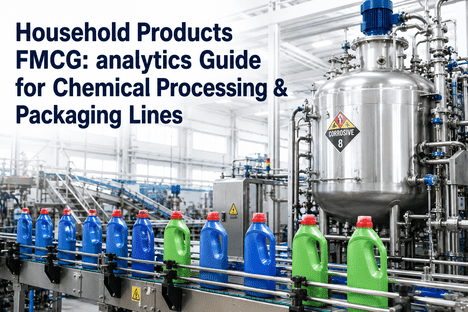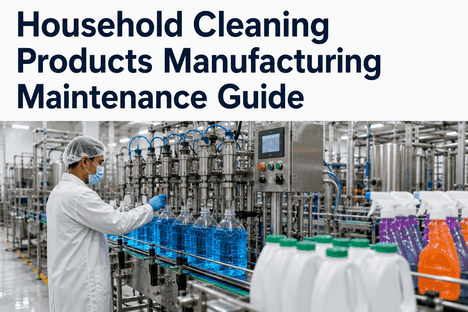
Household cleaning products manufacturing operates at the intersection of chemical process safety, high-speed consumer goods production, and stringent regulatory compliance. From liquid detergents and surface cleaners to disinfectants and bathroom cleaners, the production environment involves corrosive raw materials, hazardous chemical handling, and precision filling operations where a single gram of overfill or underfill affects both regulatory compliance and profit margin. Traditional maintenance and quality approaches leave operators reacting to equipment failures and batch deviations rather than preventing them. iFactory AI delivers a purpose-built analytics platform for household cleaning products manufacturing unifying predictive maintenance, chemical process monitoring, filling line analytics, and hazardous material compliance into a single AI-powered solution that helps plant managers and operators reduce downtime, minimize chemical waste, protect worker safety, and maintain regulatory compliance across every production line.
Is Your Cleaning Products Plant Running on Real-Time Predictive Intelligence?
iFactory AI delivers continuous health monitoring for chemical handling equipment, filling lines, packaging systems, and safety-critical assets giving operations leadership full visibility before conditions require regulatory action or cause production stoppages.
The Reliability, Safety, and Compliance Stakes in Cleaning Products Manufacturing
A household cleaning products plant operating at capacity with multiple filling lines generates significant daily revenue, but the margin structure in consumer packaged goods is tight. An unplanned line stoppage on a high-speed liquid detergent filling line does not just cost that day's production. It triggers cleaning validation, potential batch segregation, quality re-testing, and return-to-service procedures that can extend hours to days depending on the product classification and chemical residue involved. The financial exposure of a single unplanned stoppage on a major filling line routinely exceeds $50,000 when lost production, chemical waste, labor overtime, and expedited material costs are combined.
The gap is analytical intelligence: the ability to correlate signals across chemical batching, filling, labeling, and packaging systems — detecting developing anomalies before they reach alarm threshold, and surfacing actionable information to operations and maintenance teams faster than the current manual review cycle allows. This is precisely the gap that AI-driven predictive analytics addresses for household cleaning products manufacturing.
Where Predictive Analytics Applies Across the Cleaning Products Plant Asset Hierarchy
Cleaning products plant assets span chemical processing, filling, packaging, and facility infrastructure. Hazardous-material-handling systems — those involving corrosive chemicals, volatile organic compounds, or high-temperature processing — operate under OSHA PSM and EPA RMP requirements that define how they are monitored, tested, and maintained. Balance-of-plant packaging and material handling equipment operates under standard CPG manufacturing practices. AI predictive analytics applies across both categories, but the specific monitoring strategy, alert threshold logic, and corrective action integration differ meaningfully by equipment classification.
What iFactory's Predictive Analytics Platform Delivers Across the Cleaning Products Asset Portfolio
The table below maps iFactory's four core analytics capabilities against the specific cleaning products plant loss categories they address with the mechanism of detection and the documented outcome range at deployed facilities. The savings ranges reflect actual variation across deployments rather than single-point estimates, because the magnitude of each driver varies by plant vintage, product type, current maintenance program maturity, and operating history.
| Analytics Capability | Primary Asset Category | Detection Mechanism | Loss Category Addressed | Documented Outcome |
|---|---|---|---|---|
| Equipment Health Monitoring | Pumps, Mixers, Fillers, Compressors | Vibration signature, current draw, thermal pattern anomaly vs. AI-established equipment baseline | Unplanned line stoppages, filling line downtime, chemical process interruptions | 55–70% reduction in unplanned maintenance events |
| Chemical Process Analytics | Reactors, Batch Tanks, Feed Systems | Temperature profile deviation, viscosity trend anomaly, pH drift pattern recognition | Off-spec batches, chemical waste, rework cost, raw material overuse | 10–18 day advance warning vs. alarm-threshold detection |
| Filling Line Intelligence | Filling Nozzles, Weight Sensors, Cappers | Fill weight drift detection, nozzle wear pattern, capping torque trending, seal integrity scoring | Overfill loss, underfill compliance risk, false rejects, consumer complaint avoidance | 35–50% reduction in give-away loss on high-speed filling lines |
| Safety & Compliance Monitoring | Chemical storage, Ventilation, Scrubbers | Leak detection sensor trending, ventilation airflow modeling, scrubber efficiency scoring | OSHA PSM compliance gaps, EPA RMP reporting, worker exposure risk, near-miss events | 40–55% reduction in safety incidents from predictive risk scoring |
| Packaging Line Optimization | Labelers, Case Packers, Palletizers | Cycle time variation, jam prediction, changeover optimization, vision system calibration trending | Packaging line OEE loss, material waste, changeover downtime, quality reject rate | 8–14% improvement in packaging line OEE at AI-optimized plants |
Time-Based Maintenance vs. AI Predictive Monitoring — The Performance Gap
The dominant maintenance model at most household cleaning products plants remains time-based: preventive maintenance executed at fixed calendar intervals or run-hour schedules, and condition monitoring driven by alarm setpoints that flag anomalies only after they have already developed to a measurable threshold. This model was designed for an era before continuous data analytics was feasible. It is systematically blind to developing anomalies that evolve between maintenance intervals — which, for many chemical processing and filling assets, can be weeks or months.
- PM tasks executed at fixed calendar intervals regardless of actual equipment condition
- Developing anomalies between PM windows go undetected until alarm threshold is reached
- Vibration and temperature data collected manually on weekly or monthly schedules — trend development invisible in real time
- Maintenance scope driven by manufacturer recommendations rather than actual component condition
- Chemical waste and overfill detected during quality checks — already lost before action is taken
- Corrective work orders generated reactively after failure — root cause often unclear
- Continuous equipment health scoring from AI models trained on plant-specific operating history and failure data
- Developing anomalies flagged 10–18 days before they reach alarm-threshold levels
- Vibration, temperature, fill weight, and chemical process data analyzed in real time across all assets simultaneously
- Maintenance scope optimized from actual component condition data — unnecessary PM tasks identified and deferred
- Fill weight drift detected in real time — adjustments made before product enters off-spec range
- Corrective work orders generated with root cause pre-populated from AI anomaly classification
A Structured Path to AI Predictive Analytics at Your Cleaning Products Facility
Deploying AI predictive analytics at a household cleaning products plant does not require replacing existing control systems, modifying chemical processing equipment, or interrupting production. iFactory's integration architecture connects to existing plant historians, SCADA systems, and PLC networks through read-only data interfaces — no write access to process control systems at any stage. The deployment sequence below reflects the structured approach used at CPG facilities with regulatory documentation requirements and change management processes appropriate to chemical manufacturing environments.
Phase 1 — Data Integration and Baseline Establishment (Weeks 1–6)
iFactory connects to existing plant historian (OSIsoft PI, Aveva, or equivalent) and SCADA systems through read-only API interfaces — with no modification to chemical processing control systems or existing automation infrastructure. Sensor data from initial priority asset categories (typically chemical feed pumps, filling lines, and batch mixers) streams to iFactory's AI engine, and 60–90 days of historical data is used to establish individual equipment baselines. Book a Demo to review your plant-specific integration architecture.
Phase 2 — Priority Asset Monitoring and Alert Validation (Weeks 7–16)
AI health monitoring goes live for the initial asset set, with all alerts reviewed by plant engineering and reliability teams before any corrective work order is generated. This validation period serves two purposes: it calibrates alert sensitivity to plant-specific operating conditions, and it builds engineering team familiarity with AI anomaly classifications before the system is relied upon for maintenance planning decisions.
Phase 3 — Full Plant Coverage and Work Order Integration (Weeks 17–32)
Monitoring scope expands to cover the full asset portfolio including packaging systems, utility equipment, and facility infrastructure. iFactory integrates with the plant's existing CMMS or EAM system — generating work order drafts with anomaly classification, severity scoring, and recommended corrective actions.
Phase 4 — OEE Optimization and KPI Benchmarking (Week 32 onward)
With 9–12 months of plant-specific operational data accumulated, iFactory's analytics models are sufficiently trained to support OEE optimization and production planning. The platform generates condition-based maintenance recommendations ranked by impact on line throughput — identifying which PM tasks directly affect OEE and which can be deferred based on actual component condition. Monthly KPI benchmark reports compare AI-optimized outcomes against pre-deployment baselines, building the audit trail for management reporting and continuous improvement programs.
See iFactory's Cleaning Products Analytics Platform — Live.
iFactory integrates equipment health monitoring, chemical process analytics, filling line intelligence, and safety compliance monitoring into a single platform built for the operational complexity of household cleaning products manufacturing.
How iFactory Supports Regulatory Compliance and Reporting Requirements
Regulatory compliance in household cleaning products manufacturing is not optional — it is the operating constraint within which all production decisions are made. AI predictive analytics at a chemical processing facility must not only deliver operational value but must also be compatible with OSHA PSM, EPA RMP, and applicable state regulations. iFactory's platform is architected specifically to operate within these compliance frameworks.
OSHA PSM Compliance Support
- Continuous mechanical integrity monitoring for process safety equipment without interrupting production
- AI anomaly detection flags process deviations before they reach PSM-reportable thresholds
- Automated documentation of equipment condition trends for PSM audit preparation
- Management of change documentation support with AI-generated baseline comparisons
EPA RMP and EPCRA Support
- Real-time monitoring of hazardous chemical storage and process parameters for RMP compliance
- Leak detection and release prevention through continuous sensor health trending
- Tier II reporting data aggregation with audit-ready documentation from monitored systems
- Worst-case release scenario modeling support with AI-validated equipment condition data
Quality & Consumer Safety Reporting
- Automated fill weight and label accuracy data extraction for regulatory and retail compliance
- Consumer complaint trend analysis with causal factor pre-population for CAP entries
- Lot traceability data integration from AI-monitored production lines
- Third-party certification audit support with continuous compliance documentation
Expert Perspective: What Changes When AI Monitoring Is Running Continuously on the Cleaning Products Plant Floor
The most significant operational shift that AI predictive analytics brings to a household cleaning products plant is not the technology itself — it is the change in how operations and engineering teams relate to equipment health information. In a time-based maintenance model, equipment health is known at discrete points in time: when the last PM was performed, and when the next one is due. Between those points, the equipment's actual condition is, in a meaningful sense, unknown. AI monitoring collapses that uncertainty window to near zero.
What predictive analytics changes most fundamentally is the posture of the plant engineering organization. In a time-based program, you are always somewhat reactive — you discover conditions during PM execution, you enter them in your CMMS, and you manage the downstream consequences. With continuous AI monitoring, you are in a genuinely anticipatory mode. The system flags a developing bearing anomaly on a chemical feed pump twelve days before it would have shown up as a vibration alarm. Your engineering team evaluates it, characterizes it, schedules corrective maintenance during the next planned changeover window. The pump never causes a line stoppage. That event — the one that didn't happen — never shows up in your OEE numbers. It never requires an OSHA recordable entry. It never triggers a customer complaint. The value of the non-event is invisible in the metrics, but it is absolutely real.
The other dimension that surprised plant leadership at the facilities where I have observed these deployments is the chemical waste reduction impact. When you catch fill weight drift in real time rather than during the next quality check, you are correcting the offset before thousands of units are produced outside spec. At one facility, AI-driven fill weight monitoring reduced give-away on a high-speed liquid detergent line by 4.2% — which at that line's throughput translated to over $180,000 in annual raw material savings. That is a seven-figure return from the filling line intelligence alone — before counting any of the maintenance cost avoidance from predictive catches on the chemical processing side.
How iFactory Connects to Your Cleaning Products Plant's Existing Data Infrastructure
iFactory's connection to cleaning products plant data infrastructure is architecturally simple: the platform reads from existing data sources without modifying them. No changes to chemical processing control systems, no new instrumentation required, and no interference with existing plant production or safety systems.
The full integration from historian connection to live AI health monitoring goes live in 6–8 weeks for the initial priority asset set. No plant modification process, no safety review, no impact on existing production or control room functions. Book a Demo to walk through your plant's specific data architecture with iFactory's CPG integration team.
The Case for AI Predictive Analytics in Household Cleaning Products Manufacturing Is Both Operational and Strategic
The operational case for AI predictive analytics at household cleaning products plants is straightforward: continuous equipment health monitoring catches developing anomalies 10–18 days before they reach alarm-threshold levels, reducing unplanned maintenance events by 55–70% and enabling condition-based maintenance planning that consistently delivers better OEE with lower chemical waste and fewer quality incidents. The strategic case is equally compelling — in a regulatory environment where OSHA PSM compliance is under increasing scrutiny, EPA RMP requirements continue to tighten, and consumer brand loyalty depends on consistent product quality, the ability to demonstrate a proactive, AI-supported safety and quality posture is a meaningful competitive differentiator.
iFactory AI's predictive analytics platform is deployable without modifying existing chemical processing control systems, without safety system access, and within the regulatory framework applicable to CPG manufacturing software. The path from historian connection to live anomaly detection is 6–8 weeks. The path to full plant coverage and OEE optimization is 9–12 months. The documented savings from a single avoided line stoppage or a 4% reduction in fill weight give-away exceed total platform investment. to build a plant-specific deployment plan and begin the path to AI-supported reliability performance at your cleaning products facility.
Deploy AI Predictive Intelligence Across Your Cleaning Products Plant's Asset Portfolio
iFactory AI delivers continuous health monitoring for chemical processing equipment, filling lines, packaging systems, and safety-critical assets — in one platform built for the regulatory and operational complexity of household cleaning products manufacturing.
Household Cleaning Products Manufacturing Analytics — Frequently Asked Questions
Does AI predictive analytics require access to chemical processing control systems or modification of existing automation infrastructure?
No. iFactory's platform connects exclusively to the plant's existing historian or SCADA system through read-only API interfaces — there is no write access to chemical processing control systems at any stage of deployment, and no modification to existing automation infrastructure is required. The platform is deployed with appropriate documentation confirming that no change to process safety systems or control logic occurs. Book a Demo to review your plant's specific integration architecture with iFactory's CPG engineering team.
How does AI predictive analytics interact with the plant's existing CMMS or work order system?
iFactory integrates with your existing CMMS or EAM system to generate work order drafts automatically when an AI anomaly alert is validated by plant engineering. The draft work order includes the anomaly classification, severity scoring, recommended corrective actions, and relevant process data history. Engineering retains full authority to modify, accept, or reject the AI-generated characterization before formal work order creation. This integration eliminates the manual step between AI alert and work order generation without reducing engineering oversight of the maintenance process.
What types of anomalies can AI predictive analytics detect that time-based maintenance misses in cleaning products plants?
The most significant class of anomalies that time-based maintenance misses are those developing between PM intervals — particularly gradual degradation patterns that evolve over weeks or months before reaching alarm-threshold visibility. Examples at cleaning products plants include slow bearing wear on chemical feed pumps (detectable from vibration signature changes 10–14 days before alarm setpoint), developing seal leakage on filling nozzles (detectable from drip frequency trending before visible leakage), and gradual fill weight sensor drift (detectable from statistical process control analysis before quality check fails).
How does iFactory's platform support fill weight optimization without replacing existing quality control processes?
iFactory's filling line intelligence generates real-time fill weight drift detection as an advisory input to the existing quality control process — it does not replace QC checks, it enhances them. The platform identifies developing drift patterns from statistical analysis of fill weight data, flagging potential issues before they reach QC rejection thresholds. The QC team retains full authority over final disposition decisions; the AI recommendation identifies which filling heads are showing early signs of drift and which adjustments are likely to restore target fill weight with minimal interruption.
What is the minimum data infrastructure required to deploy iFactory at a cleaning products plant?
A functioning plant historian or SCADA data repository (OSIsoft PI, Aveva System Platform, Rockwell FactoryTalk, or equivalent) with adequate sensor coverage on the target asset categories is the primary prerequisite. iFactory performs a data quality assessment during the pre-deployment phase to identify which asset categories have sufficient sensor density for AI health modeling and which may benefit from targeted instrumentation additions. Most operating cleaning products plants with modern automation infrastructure have adequate data coverage for initial priority asset deployment without requiring new field instrumentation. Plants with older or fragmented data systems can be accommodated through iFactory's integration engineering team during the pre-deployment assessment. Talk to an Expert for a free data infrastructure assessment.
What ongoing costs should we budget for AI analytics at our cleaning products facility?
Annual costs typically include model retraining every 3–6 months ($8K–12K) and cloud or edge infrastructure ($6K–10K). No hidden per-alert or per-sensor fees. For a detailed cost projection tailored to your specific line count, asset categories, and integration requirements, Talk to an Expert on iFactory's CPG team.