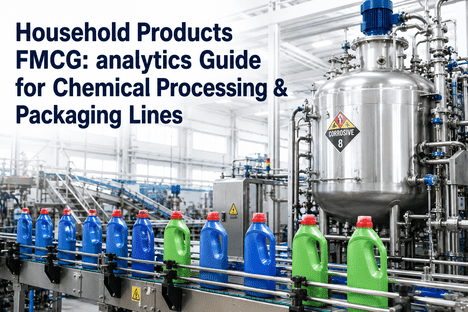
Household product FMCG manufacturing — detergents, surface cleaners, laundry liquids, dishwashing formulations, fabric softeners, and air fresheners — depends on precise chemical processing across mixing, blending, filling, and packaging operations. Production lines handle aggressive chemical formulations that accelerate equipment corrosion, cause seal degradation, and create chemical compatibility risks that lead to unplanned downtime, quality deviations, and safety incidents. IATF 16949, ISO 22716 (Cosmetics GMP), and ISO 9001 certification standards demand documented evidence of equipment condition monitoring, chemical handling procedures, batch traceability, and preventive maintenance execution across every processing stage. For plant executives and production managers managing asset reliability and audit readiness across multiple FMCG lines, iFactory's AI-powered analytics platform transforms maintenance and compliance data into actionable intelligence — automating chemical safety checklists, scheduling PM based on actual equipment condition and chemical exposure, and generating the digital compliance records that auditors require without manual data compilation. Book a Demo to see how iFactory delivers audit-ready analytics for household product chemical processing and packaging lines.
Household product formulations contain surfactants, enzymes, bleaching agents, acids, alkalis, and solvents that create an aggressive chemical environment for processing equipment. Stainless steel vessels experience pitting and crevice corrosion from chloride-containing formulations. Pump seals, gaskets, and hoses degrade from continuous chemical exposure — caustic soda in liquid detergents attacks elastomer seals, while acidic descalers accelerate wear on valve seats. Filling nozzles clog from formulation crystallization, and packaging film sealers lose calibration from adhesive buildup. Traditional time-based preventive maintenance schedules cannot account for these variable degradation rates — equipment fails between PM intervals, causing unplanned line stoppages that cost FMCG producers an average of $12,000 to $28,000 per hour of downtime on high-speed filling lines. Book a Demo to discuss how iFactory's condition-based analytics optimizes PM for your chemical processing lines.
The iFactory analytics platform combines AI-driven condition monitoring, automated chemical safety checklists, predictive PM scheduling, and digital compliance record generation into a unified architecture purpose-built for household product FMCG production environments. The platform ingests equipment sensor data, chemical batch records, maintenance history, and inspection logs — applying machine learning models that detect early-stage equipment degradation, optimize PM intervals based on actual chemical exposure and operating conditions, and generate audit-ready documentation without manual effort. Book a Demo to explore the full platform capabilities for your FMCG lines.
The chemical safety checklist module digitizes and automates the inspection protocols required for safe chemical processing in household product manufacturing. The platform generates daily, weekly, and monthly checklists that guide operators through equipment inspections — vessel wall integrity checks for corrosion pitting, seal and gasket condition verification, hose assembly inspection for swelling or cracking, filling nozzle cleanliness assessment, and packaging film sealer calibration verification. Each checklist item is linked to the specific equipment asset, the chemical formulation being processed, and the applicable ISO 22716 or ISO 9001 clause. Inspection results are recorded in real time via mobile devices or workstation terminals — completed checklists generate timestamped, tamper-evident digital records that serve as audit evidence. When an inspection identifies a condition exceeding acceptable limits, the platform automatically creates a corrective work order and alerts the maintenance team, enabling containment before the condition escalates to a failure or quality deviation.
The predictive PM scheduling engine replaces fixed-interval maintenance with condition-based scheduling that adapts to actual equipment degradation and chemical exposure. The model ingests historical maintenance records, sensor data (vibration, temperature, pressure, flow rate), chemical batch logs (formulation type, pH, temperature during processing), and inspection results to calculate the optimal maintenance interval for each asset. Equipment processing aggressive acidic formulations receives more frequent seal inspections and vessel wall thickness measurements. Filling nozzles handling crystallization-prone formulations trigger cleaning cycles based on cumulative throughput rather than calendar days. Packaging sealers processing adhesive-backed labels receive temperature calibration checks at intervals determined by actual calibration drift trends. The platform automatically adjusts PM schedules as operating conditions change — a production line switching from neutral-pH laundry detergent to alkaline surface cleaner triggers an automatic PM interval recalculation for all downstream equipment. The result is a 35% to 50% reduction in unplanned downtime and a 25% to 40% extension of mean time between failures across chemical processing and packaging assets.
The compliance documentation module automatically compiles the equipment inspection records, chemical safety checklists, PM execution logs, corrective work order histories, and batch traceability reports required for ISO 22716, IATF 16949, and ISO 9001 audits. Each record is mapped to the specific clause and requirement in the applicable standard — an auditor request for evidence of equipment cleaning verification under ISO 22716 Clause 8 (Production) is answered with the completed cleaning checklists, operator sign-offs, and cleaning validation records for the audit period. The platform generates audit packages in standard formats without requiring quality engineers to spend weeks compiling evidence. Corrective action requests (CARs) are tracked through closure, with the full investigation, root cause analysis, and verification records maintained in the digital audit trail. The platform also tracks chemical compatibility documentation — material safety data sheets (MSDS), chemical resistance charts for gasket and seal materials, and formulation change notifications — ensuring that every chemical introduced into production has documented compatibility verification before first use.
The deployment of iFactory's analytics platform across household product FMCG chemical processing and packaging lines has produced measurable improvements in both equipment reliability and compliance posture. The following comparison reflects documented results from facilities transitioning from time-based PM and manual inspection tracking to AI-driven condition monitoring and automated compliance documentation. Book a Demo to schedule an analytics assessment for your FMCG production lines.
Audit readiness is not a preparation activity confined to the weeks before a registrar visit — it is the output of an asset management and compliance system that operates with complete visibility, automated documentation, and condition-based maintenance execution every day. Traditional time-based PM programs and manual inspection checklists cannot deliver that level of readiness because they are inherently limited — by fixed intervals that ignore actual equipment condition, by inspection completion rates that rarely exceed 65%, by documentation that is compiled days or weeks after the event, and by the absence of chemical compatibility intelligence that links formulation changes to equipment degradation risks. iFactory's analytics platform eliminates those constraints. Every chemical safety checklist completed at 98% or higher adherence. Every PM interval optimized for actual chemical exposure and equipment condition. Every compliance record generated automatically and mapped to audit clauses. Every corrective action tracked through closure with full traceability. For plant executives and engineering leaders accountable for line reliability, compliance status, and production throughput, iFactory AI analytics is not an incremental improvement to an existing PM program — it is a replacement of the maintenance and compliance paradigm with a continuous, data-driven, and audit-ready asset management system. Book a Demo to start the analytics assessment for your household product FMCG lines and discover how quickly your operation can achieve continuous audit readiness.