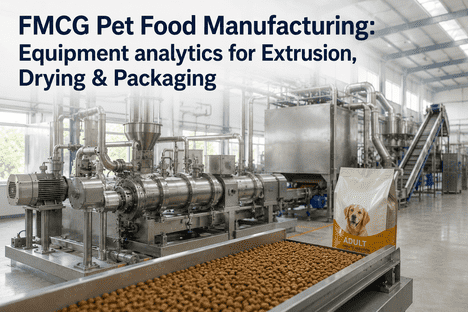
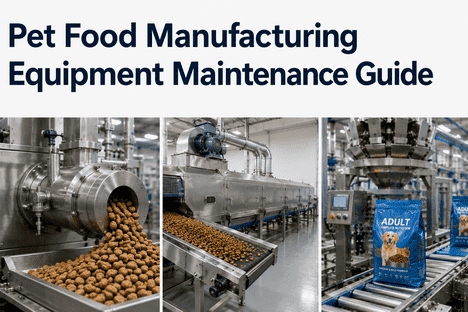
FMCG Pet Food Manufacturing: Equipment analytics for Extrusion, Drying & Packaging
By Seren on June 13, 2026
Pet food is the fastest-growing FMCG segment globally — a $130B+ industry expanding at 6.1% CAGR driven by humanisation of pets, premiumisation of diets, and the inexorable rise of global pet ownership with 94 million U.S. households now owning at least one pet. Behind every bag of kibble, pouch of wet food, or container of treats is a production facility running some of the most mechanically demanding equipment in food manufacturing: high-pressure extruders processing starchy, abrasive dough at 150–180°C with moisture injection rates of 300–600 kg/h, multi-zone conveyor dryers cycling continuously for 20+ hours per batch with precisely controlled temperature and humidity profiles, coating drums applying hot fat and liquid palatant layers at 60–90°C with atomisation accuracy requirements of ±2%, and high-speed vertical form-fill-seal packaging lines running at 200+ units per minute with nitrogen flush and seal integrity validation. A single unplanned extruder failure costs a mid-size pet food facility an average of $47,000 per incident in lost production, emergency parts procurement, product hold and disposal, and overtime labour. Yet 61% of pet food plants still rely on reactive maintenance as their primary strategy for extrusion and drying equipment. iFactory AI's Equipment Templates and PM Scheduling platform provides pet food maintenance and production teams with asset-specific preventive maintenance programmes, real-time equipment analytics, and prescriptive scheduling purpose-built for the unique mechanical and hygiene demands of extrusion, drying, coating, and packaging lines. Book a Demo to see how your pet food facility can reduce unplanned downtime, extend equipment life, and improve overall equipment effectiveness across your production lines.
Pet Food Manufacturing · FMCG · 2026
Equipment Analytics for Extrusion, Drying, Coating & Packaging Lines
End-to-end equipment analytics framework covering high-pressure extrusion systems, multi-zone conveyor dryers, precision coating drums, and high-speed automated packaging lines — purpose-built for pet food production facilities operating at FMCG throughput levels.
Asset-specific PM templates for extruders, dryers & packaging
Real-time OEE & equipment health dashboards
Screw, barrel & die wear monitoring analytics
Food safety & hygiene compliance integration
Why Pet Food Equipment Maintenance Is More Demanding Than Standard Food Manufacturing
Pet food production combines the mechanical intensity of industrial processing with the hygiene requirements of food manufacturing and the formulation complexity of nutritional science. The maintenance challenge is not simply that equipment breaks down — it is that the production parameters that make pet food production efficient (high temperature, high pressure, high abrasion, high moisture) are exactly the conditions that accelerate component wear and create contamination risks. Understanding these differences is the foundation of a PM programme that actually protects production. The four specific domains that distinguish pet food equipment maintenance from standard FMCG food manufacturing are interrelated and demand coordinated analytics across mechanical, electrical, and hygiene dimensions.
01
Extreme Thermal & Mechanical Stress
Standard food manufacturing processes typically operate at 60–120°C. Pet food extrusion runs at 150–180°C with barrel pressures of 40–80 bar. Screw speeds of 300–600 RPM generate continuous high-shear conditions. The combination of high temperature, high pressure, and abrasive ingredients (bone meal, corn, rice hulls) accelerates screw, barrel, and die wear by 3–5x compared to human food extrusion. Knife blade wear at the die face requires replacement every 200–400 production hours depending on formulation abrasiveness.
3–5x faster wear vs. human food extrusion
02
Hygiene & Pathogen Control Pressure
Pet food carries unique pathogen risks including Salmonella and E. coli that have been linked to multistate outbreaks and product recalls. Extrusion cooking provides a kill step (moisture, temperature, time), but post-extrusion contamination on dryers, coating drums, conveyors, and packaging equipment is a constant risk. Equipment analytics must track CIP cycle effectiveness, condensate management in dryers, and lubrication system integrity to prevent contamination. Dryers are the highest-risk zone — warm, moist environments where Salmonella can proliferate if hygiene protocols fail.
Salmonella risk highest on dryers & coating drums
03
Formulation-Driven Wear Variability
Unlike standard FMCG products with stable recipes, pet food manufacturers run dozens of formulations per line — puppy, adult, senior, grain-free, high-protein, limited-ingredient, wet, dry, semi-moist. Each formulation has different abrasive characteristics, fat content, moisture absorption, and thermal behaviour. A high-meat formulation accelerates screw wear; a high-grain formulation accelerates barrel wear; a high-fat formulation creates coating drum cleaning challenges. Equipment analytics must correlate wear rates and failure patterns with specific formulations to optimise PM intervals.
10–30+ formulations per line, each with distinct wear profile
04
Continuous Operation & Changeover Pressure
Pet food lines run 24/7 with 4–8 hour changeover windows between formulations. Extruders operate continuously for 3–5 weeks between scheduled maintenance shutdowns. Dryers run 20+ hour batch cycles with no interruption. Packaging lines run at 200+ ppm with 15–30 minute changeover targets. The pressure to maintain throughput while switching between products with different kibble shapes, sizes, and densities creates mechanical stress on forming dies, cut knives, sealing jaws, and volumetric fillers.
$47K average cost per unplanned extruder failure
Core Equipment Analytics Framework for Pet Food Production Lines
A comprehensive equipment analytics programme for pet food manufacturing spans four primary equipment classes — extrusion, drying, coating, and packaging — each with distinct failure modes, critical parameters, and maintenance strategies. The five-pillar framework below integrates mechanical condition monitoring, process parameter analytics, hygiene compliance tracking, and maintenance execution data into a unified equipment intelligence platform. Pet food plants that deploy integrated analytics across all five pillars achieve OEE improvements of 12–22% within the first 12 months.
P1
Extrusion System Analytics
Continuous monitoring of screw speed, motor amp draw, barrel zone temperatures (6–10 zones), pressure at die face, and torque. Predictive wear models for screws, barrels, inserts, and die plates based on cumulative throughput and formulation abrasiveness index. Knife blade wear tracking with change prediction. Condition-based lubrication of main drive bearings and gearbox.
Screw/Barrel wear · Motor load · Die pressure
P2
Dryer Performance Analytics
Multi-zone temperature and humidity monitoring with airflow balancing analytics. Belt tracking and tension monitoring to prevent edge damage and product spillage. Exhaust humidity sensor calibration and replacement scheduling. Condensate management system monitoring for hygiene risk detection. Burner/heat exchanger efficiency analytics with fuel consumption correlation.
Zone temps · Airflow · Humidity · Fuel efficiency
P3
Coating System Condition Monitoring
Fat and palatant delivery system analytics — pump pressure, flow rate accuracy, atomisation air pressure, nozzle condition. Drum rotation speed monitoring with variable-speed drive analytics. Coating weight uniformity tracking for quality assurance. Spray nozzle wear detection through pressure and pattern analysis. CIP system effectiveness monitoring for fat residue removal.
Fat flow accuracy · Nozzle wear · Drum speed
P4
Packaging Line Analytics
Form-fill-seal machine condition monitoring — drawdown tension, sealing jaw temperature and pressure, registration mark accuracy. Weigher and filler calibration drift detection. Gas flush system integrity for modified atmosphere packaging. Conveyor and accumulation table motor current analysis. Changeover time tracking for continuous improvement. Seal integrity test results trending for quality assurance.
Seal quality · Fill accuracy · OEE · Changeover time
P5
Cross-Line Hygiene & Compliance Analytics
Integrated cleaning schedule management across all equipment classes. CIP cycle parameter trending with cleaning effectiveness correlation. Environmental monitoring data (airborne dust, condensate, surface swabs) linked to production equipment. Allergen changeover verification tracking. Recall readiness dashboard with batch-equipment correlation for rapid traceability. Audit-ready documentation repository.
The table below maps each major pet food equipment category against its operational parameters, critical failure modes, typical maintenance intervals, and key analytics integration points. Understanding these differences is essential for building equipment-specific PM programmes that protect production without introducing unnecessary maintenance cost.
Seal integrity trend · Fill weight accuracy · OEE by SKU · Changeover duration · Waste percentage
Is your pet food plant's PM programme keeping pace with your production demands? Book a Demo to see how iFactory's Equipment Templates provide pre-built PM schedules for extruders, dryers, coating systems, and packaging lines — ready to deploy in your facility.
Self-Assessment — Does Your Pet Food Plant Have the Right Equipment Analytics?
Honest assessment of current equipment analytics capability is the prerequisite for improvement. The following seven criteria, derived from industry benchmarks across pet food extrusion, drying, coating, and packaging operations, provide a structured framework for scoring your facility's equipment analytics maturity. Each criterion is scored on a 1–5 scale corresponding to analytics maturity levels from reactive to prescriptive.
01
Extruder wear monitoring
Ask honestly:
"How do you track screw, barrel, and die wear on your extrusion lines, and when do you decide to replace them?"
Score 1: Replace only on failure · Score 3: Fixed-interval replacement based on calendar · Score 5: Predictive wear model based on cumulative throughput, formulation abrasiveness index, and motor amp/torque trend analysis with automated replacement alerting at optimal economic wear point.
02
Dryer belt & burner condition tracking
Ask honestly:
"Do you have real-time visibility into dryer belt tension, burner efficiency, and zone temperature uniformity?"
Score 1: Visual inspection only · Score 3: Periodic temperature logging with manual review · Score 5: Continuous monitoring of all dryer parameters with automated alerts for belt tracking deviation, burner efficiency drop, and zone temperature drift correlated with moisture content of finished kibble.
03
Coating system precision
Ask honestly:
"How do you verify that fat and palatant application is uniform and within specification for every batch?"
Score 1: No measurement — trust the recipe · Score 3: Periodic grab samples with lab analysis · Score 5: Real-time flow monitoring with automated spray nozzle wear detection, coating weight trending per SKU, and closed-loop adjustment capability for pump speed and atomisation pressure.
04
Packaging line OEE visibility
Ask honestly:
"Can you see real-time OEE for each packaging line, broken down by availability, performance, and quality?"
Score 1: Manual production reporting · Score 3: Automated line speed monitoring with downtime logging · Score 5: Real-time OEE dashboards per line and SKU with automated downtime root cause classification, changeover time tracking, and seal integrity trend analysis.
05
Hygiene & contamination risk monitoring
Ask honestly:
"How do you correlate equipment condition with hygiene risk, particularly on dryers and coating drums?"
Score 1: Swab results reviewed after production · Score 3: Scheduled hygiene audits with corrective actions · Score 5: Continuous condensate management monitoring, CIP cycle parameter trending with cleaning effectiveness correlation, and environmental monitoring data linked to specific production equipment and batches.
06
PM schedule optimisation
Ask honestly:
"Are your preventive maintenance intervals fixed by calendar, or do they adapt to actual equipment condition and production load?"
Score 1: No formal PM programme · Score 3: Fixed-interval PMs per manufacturer recommendations · Score 5: Risk-based PM scheduling where intervals are dynamically adjusted based on equipment condition monitoring data, formulation wear impact, cumulative throughput, and production schedule — eliminating both unnecessary maintenance and overdue tasks.
07
Changeover & formulation transition analytics
Ask honestly:
"How do you track changeover time and correlate equipment condition with formulation transitions?"
Score 1: Changeovers not tracked systematically · Score 3: Changeover times logged manually · Score 5: Automated changeover duration tracking per SKU pair, with analytics correlating equipment wear rates to specific formulations and providing recommendations for optimal production sequencing to minimise wear impact.
Three Implementation Pathways for Pet Food Equipment Analytics
Pet food manufacturing facilities at different analytics maturity levels require different implementation approaches. The right pathway depends on current sensor coverage, CMMS adoption, production line configuration, and organisational readiness. Each pathway preserves existing investment in extrusion lines, dryers, coating systems, and packaging equipment while adding the analytics layer that converts machine data into actionable maintenance and production intelligence.
Path A
Equipment Analytics Foundation
6–10 weeks
Deploy pre-built equipment templates for extruders, dryers, coating drums, and packaging lines. Establish PM schedules with task lists, spare parts, and labour requirements per equipment class. Create equipment hierarchy with failure mode history. Deploy shift logbook for operator condition reporting. Best fit for pet food plants with limited digital maintenance systems or manual PM management.
Connect existing PLC and sensor data from extruder drives, dryer zones, coating drum controllers, and packaging machine servos into a unified equipment analytics platform. Deploy predictive wear models for extruder screws and barrels. Real-time OEE dashboards per production line. Automated alerting for parameter deviations correlated with product quality data.
Best fit
Digital CMMS in place · PLC data available · some sensor infrastructure · PM compliance 50–75% · need to reduce unplanned downtime
Wk 1–4 PLC/sensor integration + data mapping
Wk 5–10 Predictive model training + dashboard development
Wk 11–14 Cutover + line-side display rollout + team training
Path C
Full Digital Transformation
16–24 weeks
End-to-end deployment covering all five equipment analytics pillars across multiple production lines and facilities. AI-driven predictive maintenance for extruders, dryers, coating systems, and packaging machines. Integrated hygiene and compliance analytics. Cross-line OEE benchmarking. Prescriptive scheduling that coordinates maintenance windows with production planning across the entire facility.
Best fit
Multi-line facilities · 200+ equipment assets · executive sponsorship · strategic mandate for Industry 4.0 transformation in pet food manufacturing
Wk 1–6 Line audit + sensor gap analysis + architecture
Wk 7–16 Parallel deployment across all equipment classes
Benchmark Your Pet Food Plant's Equipment Analytics Maturity
iFactory AI's FMCG practice runs a focused 2-week assessment against your specific extrusion, drying, coating, and packaging line configurations, current sensor coverage, CMMS adoption level, and production targets. You leave with a scored equipment analytics maturity assessment, a defended path recommendation, a 6–24 week deployment plan, and a downtime reduction projection grounded in your actual production data.
ROI — What Equipment Analytics Delivers for Pet Food Manufacturers
The business case for pet food equipment analytics rests on four measurable value drivers: unplanned downtime reduction, maintenance cost optimisation, quality and yield improvement, and changeover efficiency. Each driver delivers compounding returns as analytics maturity advances. Pet food facilities that implement integrated equipment analytics across extrusion, drying, coating, and packaging lines report 20–35% reduction in unplanned downtime, 15–25% reduction in maintenance spend, and 10–18% improvement in first-pass yield within the first 12–18 months of deployment.
20–35%
Unplanned Downtime Reduction
Predictive analytics for extruder screw wear, dryer belt tracking, coating pump condition, and packaging machine seal integrity eliminates the most common causes of unplanned line stops. At $47,000 per extruder failure, even a 30% reduction delivers $150K–$300K annual savings per line.
15–25%
Maintenance Spend Optimisation
Risk-based PM scheduling replaces fixed-interval approaches, reducing unnecessary screw replacements, bearing changes, and component overhauls while increasing reliability of critical assets. Condition-based lubrication alone reduces grease consumption by 30–50% on extruder and dryer bearings.
10–18%
First-Pass Yield Improvement
Real-time monitoring of extrusion zone temperatures, dryer moisture profiles, coating weight accuracy, and packaging seal integrity reduces rework and waste. Kibble moisture variance reduction of ±0.5% translates to significant throughput gains on continuous dryers.
15–30%
Changeover Time Reduction
Analytics-driven changeover tracking with formulation transition optimisation reduces average changeover time from 45–60 minutes to 30–40 minutes on extrusion and packaging lines. For facilities running 8–12 changeovers per day, this recovers 2–4 hours of production capacity daily.
Expert Perspective
"The pet food industry has a unique problem that most people don't see from the outside. Extruders in pet food plants run 24 hours a day, seven days a week — they are not like bakery ovens that can be cooled down and inspected every night. When an extruder screw breaks at 3 AM on a Saturday, the entire production line stops, the packing lines go idle, and by Monday morning you've lost $150,000 in production and the retailer is calling about their order. The frustrating part is that 90% of these failures are predictable. The screw wear profile follows a curve that can be monitored with amp draw trending and cumulative throughput tracking. The barrel wear accelerates at a rate that correlates with formulation abrasiveness. The knife blade dulling is visible in kibble shape variance. The data is already there — what's missing is the analytics layer that converts it into a maintenance decision. Pet food manufacturers that invest in this layer stop fixing broken extruders and start scheduling proactive interventions during planned changeover windows. That's the operational shift worth pursuing."
— iFactory AI FMCG Practice, 2026 industry insight
$47K
average extruder failure cost per incident
61%
of plants still on reactive maintenance
90%
of extruder failures are predictable with analytics
Conclusion: Equipment Analytics Is the Competitive Advantage in Pet Food Manufacturing
Pet food is the fastest-growing FMCG segment, and production capacity is the primary constraint on growth for most manufacturers. Equipment analytics transforms that constraint into a competitive advantage — not by running equipment harder, but by running it smarter with data-driven maintenance decisions that maximise uptime, extend asset life, and improve product quality consistency. The five pillars of extrusion system analytics, dryer performance monitoring, coating system condition tracking, packaging line intelligence, and cross-line hygiene compliance form an integrated equipment analytics framework that gives pet food maintenance and production teams a complete view of asset health, maintenance risk, and production readiness. iFactory AI's Equipment Templates and PM Scheduling platform provides the analytics layer that connects existing production data, sensor infrastructure, and maintenance systems into a unified equipment intelligence platform. Whether your facility needs foundational PM template deployment (Path A, 6–10 weeks), integrated condition monitoring (Path B, 10–14 weeks), or full digital transformation (Path C, 16–24 weeks), the platform preserves existing extrusion, drying, coating, and packaging equipment while adding the analytics and automation that eliminate unplanned downtime and reduce maintenance cost. The decision worth making in 2026 is not whether to invest in equipment analytics — it is which implementation pathway fits your facility's current maturity, production configuration, and growth objectives.
Run the Pet Food Equipment Analytics Assessment
iFactory AI's FMCG practice runs a structured 2-week assessment against your specific extrusion, drying, coating, and packaging line configurations, current sensor coverage, CMMS adoption level, and production targets. You leave with a scored maturity assessment, a defended path recommendation, a 6–24 week deployment plan, and a downtime reduction projection grounded in your actual production and maintenance data.
What is the most common cause of unplanned downtime in pet food extrusion lines?
The most common cause is screw and barrel wear leading to loss of pressure, reduced throughput, and eventual plugging or mechanical failure. Abrasive ingredients such as bone meal, corn, rice hulls, and mineral premixes accelerate wear at rates 3–5x higher than human food extrusion. The second most common cause is knife blade dulling at the die face — a worn knife produces inconsistent kibble size and shape, triggers quality alarms, and ultimately requires line stoppage for blade replacement. iFactory's predictive wear analytics tracks cumulative throughput against wear curves specific to each formulation group, enabling maintenance teams to schedule screw and knife replacement during planned changeover windows rather than emergency breakdowns.
How often should pet food dryer belts be replaced, and what are the warning signs of imminent failure?
Dryer belt life varies significantly by design and operating conditions. Woven wire mesh belts typically last 12–24 months in continuous pet food service; hinge-style modular plastic belts last 18–36 months. Warning signs of imminent failure include: belt tracking deviation requiring increasing adjustment frequency, edge damage or fraying, visible sagging between support rollers, increased drive motor amp draw indicating binding, and product spillage at belt transfer points. iFactory's analytics platform monitors belt tension through motor current trending and tracks cumulative production hours to provide predictive replacement alerts 4–6 weeks before expected failure, enabling planned weekend replacement rather than emergency mid-week stoppage.
What is the impact of formulation changes on coating drum maintenance requirements?
Formulation changes have a significant impact on coating drum maintenance. High-fat formulations (above 18–20% added fat) require more frequent spray nozzle cleaning due to fat oxidation residue. Formulations containing sticky palatants or humectants increase drum wall buildup and require more aggressive CIP cycles. High-sugar, high-moisture semi-moist formulations create the most challenging coating conditions with rapid residue accumulation. The key analytics insight is correlating coating system maintenance requirements with the specific formulation running — enabling maintenance teams to pre-position cleaning resources for high-impact changeovers and schedule nozzle inspection based on cumulative fat throughput rather than calendar days.
How does equipment analytics help with pet food food safety compliance and recall prevention?
Equipment analytics supports pet food safety compliance in five specific ways: (1) dryer condensate management monitoring prevents Salmonella proliferation in warm, moist environments; (2) CIP cycle parameter trending ensures cleaning effectiveness is consistent and documented for each equipment item; (3) environmental monitoring data linked to specific production batches enables rapid investigation of contamination events; (4) lubrication system condition tracking prevents lubricant leaks into product zones; (5) batch-to-equipment traceability enables precise scope definition during recall investigations — identifying exactly which product was produced on which equipment during which time window. The FDA's Food Safety Modernization Act (FSMA) Preventive Controls rules require pet food facilities to have documented hazard analysis and risk-based preventive controls. Equipment analytics provides the data infrastructure to demonstrate compliance.
What is the minimum investment required to start a pet food equipment analytics programme?
The minimum investment depends on current digital maturity. For a pet food plant with an existing CMMS and basic PLC data from extrusion and packaging lines, the Path A deployment (equipment templates + PM scheduling + shift logbook) typically starts at $25K–$50K for a single production line with 15–25 equipment assets. This includes pre-built equipment templates for extruders, dryers, coating drums, and packaging machines; PM schedule configuration; shift logbook deployment; and OEE dashboard setup. The typical payback period is 4–8 months based on unplanned downtime reduction alone. For plants without existing CMMS infrastructure, the initial investment also includes CMMS deployment, equipment hierarchy setup, and sensor gap analysis — typically $50K–$100K with 8–12 month payback.