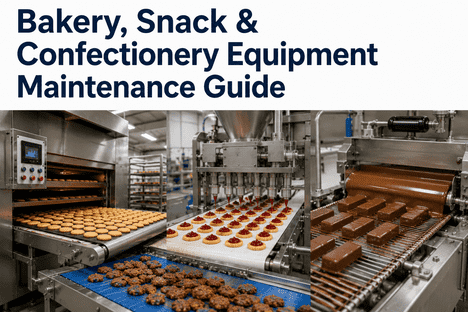
Snack food and confectionery manufacturing presents a unique analytics challenge: fryer oil degradation that affects both product quality and equipment life, extruder barrel temperature profiles that determine product texture and throughput, and high-speed packaging wrappers that must run at 300–800 ppm with zero downtime during peak production windows. These equipment classes fryers, extruders, and wrappers operate under conditions that render generic industrial analytics ineffective. Fryer oil oxidation accelerates bearing and seal wear at rates that vary with product turnover and oil type. Extruder screw and barrel wear changes the residence time distribution and torque profile unpredictably across production runs. Wrapper servo drives, film tensioners, and heat seal bars degrade through thermal and mechanical cycling patterns that do not match the fixed-interval maintenance schedules common in FMCG plants. iFactory AI's engine combines equipment-specific condition monitoring, shift logbook data, and production schedule integration to deliver maintenance predictions calibrated to the actual operating conditions of snack and confectionery lines. Book a Demo to see how iFactory transforms snack food equipment reliability.
Equipment-Specific Analytics for Snack and Confectionery Manufacturing
Fryer oil analytics, extruder barrel condition monitoring, and high-speed wrapper predictive maintenance — purpose-built for the operating conditions of snack food and confectionery production lines.
Why Snack Food and Confectionery Equipment Needs Specialised Analytics
Snack food and confectionery plants operate under production conditions that are structurally different from general FMCG manufacturing. Fryer lines run at 160–190°C oil temperature with continuous product throughput that cycles between potato chips, tortilla chips, extruded snacks, and seasonal products each with different oil absorption characteristics, fines generation rates, and residence times. Extruders process cereal-based doughs, protein-enriched snacks, and confectionery masses at barrel temperatures ranging from 60°C for forming extruders to 180°C for direct-expansion cooking extruders, with screw speeds of 200–600 RPM and die pressures up to 100 bar. High-speed wrappers on confectionery and snack packaging lines operate at 300–800 packs per minute with film tension, heat seal temperature, and servo register control tolerances measured in milliseconds and microns.
Generic time-based preventive maintenance cannot account for the variability that defines snack food production. A fryer that runs 16 hours of potato chips at high throughput will degrade its oil and stress its bearings differently than a fryer running 8 hours of tortilla chips at reduced speed. An extruder barrel that processes high-fat product formulations will experience different wear patterns than one processing low-fat formulations. A wrapper that runs 600 ppm for a holiday-season promotion will accumulate more servo drive stress cycles than one running 350 ppm for a standard production day. iFactory's Preventive analytics Scheduling engine captures these variations by fusing continuous sensor data with production schedule information from the MES, enabling maintenance predictions that are specific to each line, each product, and each shift.
Three Equipment Classes That Drive Snack Food Reliability
iFactory's preventive analytics deployment for snack food and confectionery manufacturing focuses on three equipment classes that collectively account for 70–85% of unplanned downtime in snack and confectionery plants. Each class requires distinct sensor strategies, AI model architectures, and maintenance scheduling logic.
Fryer Systems — Oil & Mechanical Analytics
Continuous oil quality monitoring via dielectric constant and total polar material trending. Bearing housing temperature and vibration on fryer conveyor drives, oil recirculation pumps, and exhaust fan systems. Predictive models distinguish oil degradation from mechanical wear, scheduling oil changes and bearing replacements on condition rather than calendar.
Extruder Barrel & Screw Analytics
Barrel zone temperature deviation monitoring, motor torque trending, screw speed variation analysis, and die head pressure pattern recognition. AI models detect screw flight wear, barrel liner degradation, and die blockage 2–4 weeks before quality deviations or throughput loss occur.
High-Speed Wrapper & Packaging Analytics
Servo drive current signature analysis for film feed, crimp jaw, and cut-off drives. Heat seal temperature trending and deviation detection. Film tension sensor analysis for web break prediction. Bearing and cam follower vibration on wrapper machine frames operating at 300–800 ppm.
Conveyor & Secondary Packaging
Bucket elevator bearing monitoring, case packer servo drive analysis, palletiser drive train vibration. Secondary packaging equipment that must keep pace with primary wrapper output to avoid line stoppages and accumulation table overflows.
Deep Dive Fryer Oil and Mechanical Analytics for Snack Lines
Fryer systems in snack food manufacturing operate at the intersection of food quality and equipment reliability — a space where traditional condition monitoring is rarely deployed because the primary failure indicators are oil-related rather than mechanical. However, oil degradation is the leading indicator of downstream mechanical failure in fryer systems. As fryer oil reaches the end of its useful life — defined by total polar material (TPM) exceeding 25% or dielectric constant deviation beyond the oil supplier's specification — the oil's viscosity increases, heat transfer efficiency drops, and the oil oxidation byproducts accelerate seal degradation, bearing wear, and carbon deposit formation on heating surfaces. A fryer that continues operating beyond the oil change threshold will experience accelerated mechanical degradation that manifests as conveyor drive bearing failures, oil recirculation pump seal leaks, and exhaust fan imbalance from accumulated grease deposits.
iFactory's fryer analytics platform integrates two data streams that are typically managed separately in snack plants: oil quality measurements (dielectric constant, TPM trend, oil top-up volume) and mechanical condition data (bearing housing temperature, conveyor drive vibration, pump motor current). The AI model correlates oil degradation rate with mechanical stress accumulation, providing 1–3 week advance warning of the conditions that lead to mechanical failure. When the model detects oil degradation accelerating toward the change threshold, it generates a preventive maintenance work order for oil change scheduling — typically reducing oil-related mechanical failures by 60–70% while optimising oil change intervals to extend useful oil life by 15–25% compared to calendar-based change schedules.
| Fryer Component | Monitoring Parameter | Sensor Type | Failure Mode Detected | Prediction Lead Time |
|---|---|---|---|---|
| Fryer Oil | Dielectric constant, TPM, top-up frequency | Inline oil sensor + flow meter | Oil degradation accelerating seal wear | 1–3 weeks |
| Conveyor Drive Bearings | Bearing housing temperature, casing vibration | Wireless temp + triaxial accel | Grease degradation, bearing spalling | 2–5 weeks |
| Oil Recirculation Pump | Motor current, pump casing vibration, discharge pressure | MCSA clamp + accel + pressure transmitter | Mechanical seal wear, impeller erosion | 2–4 weeks |
| Exhaust Fan | Fan bearing vibration, motor current, stack temperature | Triaxial accel + temp RTD + MCSA | Grease deposit imbalance, bearing wear | 3–6 weeks |
| Heating System | Oil temperature profile, burner flame signal, heat flux | Thermocouple array + PLC integration | Carbon deposit formation, burner degradation | 2–4 weeks |
Deep Dive — Extruder Barrel and Screw Analytics
Extruders in snack food and confectionery plants operate as the primary transformation equipment — converting raw ingredients into shaped, textured, and cooked product through controlled application of heat, pressure, and shear. The extruder barrel and screw assembly is subject to wear mechanisms that are specific to the product formulation being processed: hard particle abrasion from corn and rice grits, corrosion from acidic dough formulations, and thermal fatigue from the rapid temperature cycling between production runs and cleaning cycles. Screw flight wear of 0.5–1.5 mm is sufficient to change the residence time distribution, reduce specific mechanical energy (SME) input, and alter product texture, expansion ratio, and density often triggering quality rejections before the maintenance team is aware that wear has occurred.
iFactory's extruder analytics platform monitors barrel zone temperature deviation from setpoint as the primary indicator of process stability, combined with motor torque trending (which correlates with screw flight condition and dough viscosity) and die head pressure pattern analysis (which detects partial blockage or wear in the die assembly). The AI model is trained on product-specific baselines — a corn-based expanded snack at 12% moisture produces a different torque profile than a wheat-based formed snack at 18% moisture — and detects deviations from the expected profile for each product in the production schedule. When screw wear reaches the threshold that produces a measurable torque reduction at constant throughput, the system generates a preventive work order for screw inspection and replacement planning, typically providing 3–5 weeks of lead time before product quality is affected.
±1.5°C
Temperature deviation threshold per zone — deviations beyond this range detected 2–4 weeks before quality impact.
0.8 mm
Flight wear threshold detectable via torque profile change — 3–5 weeks before product texture deviation.
±3%
Die head pressure deviation from baseline — indicating partial blockage or wear progression.
±5%
Specific mechanical energy deviation threshold — signal of formulation, moisture, or screw condition change.
Deep Dive — High-Speed Wrapper Predictive Maintenance
High-speed wrappers on snack food and confectionery packaging lines operate at speeds that leave no margin for unplanned stops. A wrapper running 600 ppm that experiences a 30-minute unplanned stop for a servo drive fault or heat seal bar failure will lose 18,000 packs of production — at a direct cost of $3,000–$8,000 in lost output depending on product margin. When the wrapper stop causes upstream accumulation table overflow or downstream case packer starvation, the effective production loss can be 2–3x the wrapper downtime alone. The mechanical systems that fail most frequently on high-speed wrappers are the film feed servo drives (current signature degradation from bearing and coupling wear), crimp jaw cam followers and bearings (wear from continuous cycling at 300–800 cycles per minute), heat seal temperature controllers (drift from thermocouple degradation and relay wear), and film tension control systems (load cell drift and dancer arm bearing wear).
iFactory's wrapper analytics platform deploys wireless accelerometers on wrapper frame locations that transmit bearing and cam follower vibration at 15-minute intervals, servo drive current signature monitoring through non-invasive clamp-on current transformers, and heat seal temperature trending through direct RTD measurement. The AI model learns each wrapper's vibration and current baseline at each operating speed a wrapper running flow wrap at 600 ppm produces a different signature than one running stick pack at 350 ppm and detects deviations that indicate incipient bearing wear, cam follower degradation, or servo coupling fatigue. When a wrapper bearing shows envelope spectrum fault frequency elevation trending toward the alert threshold, the system generates a preventive work order that schedules bearing replacement during the next planned product changeover typically providing 2–4 weeks of lead time before the bearing would cause a production-stopping failure.
Deploy Preventive Analytics Across Your Snack and Confectionery Lines
iFactory's Preventive analytics Scheduling engine monitors fryer oil condition, extruder barrel wear, and high-speed wrapper health alongside your production schedule — delivering maintenance predictions calibrated to each line, each product, and each shift.
Implementation Approach for Snack Food Plant Deployment
iFactory's phased deployment model for snack food and confectionery plants begins with a 7-day equipment audit and sensor deployment on the highest-impact lines typically those running the highest-volume SKUs or operating with the most frequent unplanned downtime. The audit identifies which fryer lines, extruders, and wrappers have existing PLC data that can be integrated (temperature zones, motor currents, production speeds) and which require wireless sensor additions for the mechanical condition parameters that PLC data alone cannot provide.
Week 1 — Equipment Audit & Baseline Calibration
Audit existing PLC, SCADA, and MES data availability for each fryer, extruder, and wrapper line. Deploy wireless vibration and temperature sensors on target equipment. Begin 7-day baseline data collection across all operating conditions — different products, speeds, and ambient temperatures.
Weeks 2–3 — AI Model Training & Shadow Mode
Train product-specific AI models for each extruder and fryer line. Speed-specific models for each wrapper type. Shadow mode predictions validated against operator shift log entries and maintenance records. Model precision target: 85%+ before live alerting.
Week 4 — Live Alerting & Shift Logbook Integration
Activate live condition-based work order generation. Deploy iFactory Shift Logbook for operator defect reporting, oil quality measurements, and maintenance intervention documentation. Preventive analytics Scheduling engine begins correlating production schedule with equipment health.
Week 5+ — Fleet Expansion & Continuous Optimisation
Expand from pilot lines to full snack food plant coverage. Quarterly model retraining incorporating operator feedback from Shift Logbook and work order closure data. False positive rate optimisation targeting less than 0.5 per line-week.
iFactory Feature: Preventive analytics Scheduling
is the core maintenance orchestration module within iFactory's FMCG analytics platform. Unlike traditional CMMS systems that schedule work orders on fixed calendar intervals, Preventive analytics Scheduling generates condition-based work orders that are dynamically adjusted to each line's actual operating conditions, production schedule, and spare parts availability. The module fuses three data streams equipment condition data from continuous sensors and shift logbook entries, production schedule data from the MES, and spare parts inventory levels from the ERP to recommend the optimal maintenance intervention window for each asset. When a fryer bearing or wrapper servo drive reaches the preventive intervention threshold, the system evaluates the production schedule for the next 14 days, identifies the changeover or planned downtime window that minimises production impact, and generates a work order timed to that window. Book a Demo to see how Preventive analytics Scheduling transforms snack food equipment reliability.
Equipment Condition
Continuous sensor data — vibration, temperature, current — plus Shift Logbook operator entries and oil quality measurements.
Production Schedule
MES integration providing product changeover windows, planned downtime, seasonal production variations, and shift patterns.
Spare Parts Inventory
ERP integration for real-time parts availability — ensures work orders are generated when required spares are in stock.
Optimised Work Orders
Condition-based work orders scheduled to the production changeover window that minimises line downtime and maximises parts availability.
Industry Perspective on Snack Food Equipment Analytics
The snack food and confectionery industry has a structural maintenance problem that generic PdM solutions do not address. A potato chip fryer, a direct-expansion corn extruder, and a high-speed chocolate wrapper have almost no equipment failure modes in common — yet most preventive maintenance programs treat them with the same calendar-based PM template. What makes iFactory's approach different is that the analytics engine is built to recognise that a fryer's primary degradation indicator is oil quality, not vibration; that an extruder's screw wear signature is visible in motor torque before it appears in product quality data; and that a wrapper running at 600 ppm needs a different bearing monitoring strategy than one running at 300 ppm. The Preventive analytics Scheduling module was designed specifically for this operating reality — it does not try to force all FMCG equipment into a single condition monitoring framework.
Snack Food and Confectionery Analytics Common Questions
What sensors does iFactory install on fryer lines and extruders?
Fryer lines receive wireless triaxial accelerometers on conveyor drive and recirculation pump bearing housings, inline oil quality sensors for dielectric constant and TPM trending, and thermocouple probes for oil temperature profile monitoring. Extruders receive wireless temperature sensors on each barrel zone, clamp-on current transformers for motor current signature analysis, and pressure transmitters on the die head. All sensors are IP67-rated for washdown environments with food-grade approval for incidental food contact. Typical installation time is 45–60 minutes per asset with no modification to existing equipment required.
How does Preventive analytics Scheduling handle different product recipes and changeovers?
The Preventive analytics Scheduling engine is integrated with the plant's MES to receive the production schedule, including product recipes, changeover times, and planned downtime windows. AI models are trained on product-specific baselines — a corn-based expanded snack extruder profile differs from a wheat-based formed snack profile, and the model automatically selects the correct baseline when the production schedule is loaded. When an asset approaches the preventive intervention threshold, the scheduling engine evaluates the production schedule for the next 14 days and recommends the changeover or planned downtime window that minimises production impact. The work order is generated only when the intervention window aligns with available spare parts in inventory.
Can iFactory integrate with my existing CMMS and MES systems?
Yes. iFactory connects to CMMS platforms including SAP EAM, IBM Maximo, Oracle EAM, and Infor EAM through REST API for bidirectional work order and asset data synchronisation. MES integration covers Siemens Opcenter, Rockwell FactoryTalk, ABB Ability, and custom MES platforms through OPC-UA and SQL database connectivity. The Shift Logbook provides a mobile-optimised operator interface that runs on existing plant floor tablets and smartphones — no additional hardware required. Typical CMMS integration timeline is 4–6 days, MES integration timeline is 5–8 days.
What is the typical ROI for a snack food plant deployment?
For a snack food plant with 3–5 fryer lines, 2–4 extruders, and 8–12 high-speed wrappers, the total Year 1 investment ranges from $95,000 to $175,000 including wireless sensors, platform subscription, CMMS/MES integration, and engineering support. Typical Year 1 savings range from $420,000 to $780,000, driven by reduced unplanned downtime (60–75% reduction on monitored equipment), extended oil change intervals (15–25%), reduced wrapper spare parts consumption (30–50%), and eliminated emergency repair premiums. Payback is typically achieved within 3–5 months of deployment completion. Book a Demo for a personalised ROI projection based on your plant's equipment inventory and downtime history.
How does iFactory handle washdown environments and food safety requirements?
All iFactory sensors deployed in snack food and confectionery plants are rated IP67 minimum for washdown resistance, with food-grade stainless steel housings and FDA-compliant mounting adhesives for applications where drilling is not permitted. Wireless sensors communicate via encrypted LoRaWAN mesh network that operates reliably through stainless steel equipment, concrete walls, and washdown spray. No sensor wiring or conduit is required — installation is completed during scheduled production time without requiring electrical permits or shutdowns. The entire sensor-to-cloud data path is protected with TLS 1.2 encryption, and sensor data is stored in SOC 2-compliant cloud infrastructure with geo-redundant backup.
Deploy Preventive analytics Scheduling Across Your Snack Food Lines
Equipment-specific analytics for fryer systems, extruder barrels, and high-speed wrappers — integrated with your production schedule and delivered through iFactory's Preventive analytics Scheduling engine and Shift Logbook platform.