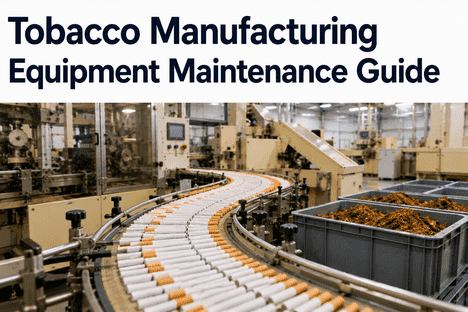
Tobacco Manufacturing Equipment analytics Guide

By Seren on June 4, 2026

tobacco-manufacturing-equipment-analytics-url.png_optimized_300

Tobacco manufacturing lines face relentless pressure to maximise uptime, reduce material waste, and maintain stringent quality standards across every production stage from primary processing and cigarette making to filter tipping, packing, and cartoning. High-speed cigarette makers running at 16 000+ cigarettes per minute, filter tippers, hinge-lid packers, cartoners, and plant-wide HVAC climate control systems all contribute to a complex, interdependent production environment where a single equipment failure can cascade into hours of line stoppage costing $12 000–18 000 per hour in lost output. iFactory's predictive maintenance and OEE analytics platform is purpose-built for tobacco manufacturing ingesting vibration, temperature, pressure, acoustic, and humidity sensor data from every critical asset, processing it through AI models trained on decades of tobacco line operating data, and delivering actionable failure predictions 10–14 days in advance. Book a Demo to see how iFactory helps tobacco manufacturers reduce unplanned downtime by up to 45% and improve OEE by 18–22%.

Predictive Maintenance · Tobacco 2026
Tobacco Manufacturing Equipment Analytics — Predictive Maintenance & OEE Platform

Cigarette maker drum & cutting head prediction · Filter tipper attachment monitoring · Packer seal bar & transfer fault detection · Cartoner & bundler cycle analysis · HVAC climate control optimisation · All unified in iFactory's tobacco reliability platform.

01
45%
Unplanned downtime reduction on monitored tobacco line equipment
02
22%
OEE improvement across maker, tipper, and packer assets
03
10–14 d
Advance warning on drum bearing, cutting head, and seal bar failures
04
30%
Lower maintenance spend through condition-based intervention

Condition Monitoring for Tobacco Manufacturing Equipment

Tobacco processing and packaging lines operate under demanding conditions — high-speed rotating assemblies, sticky tobacco dust accumulation, elevated temperatures, and tight humidity tolerances that directly affect product weight, fill, and taste consistency. Traditional run-to-failure or fixed-interval maintenance approaches cannot address the variable wear patterns caused by different tobacco blends, operator techniques, and production schedules. iFactory's tobacco equipment analytics platform combines IIoT sensors, edge computing, and machine learning to deliver comprehensive condition monitoring across the entire production line from primary conditioning cylinders and cutting machines through secondary making, tipping, packing, and cartoning to final palletising.

Each monitored asset — maker drum shafts, cutting knife assemblies, suction band drives, filter plug transfer drums, combiner wheels, packer seal bars, carton tuckers, and HVAC air handling units — is equipped with industrial-grade vibration, temperature, pressure, acoustic, and humidity sensors. Data streams to iFactory's edge gateways where AI models trained on historical failure patterns detect early-stage degradation signatures. Maintainers receive alerts with root-cause recommendations and recommended intervention windows, enabling precision maintenance during planned changeovers rather than emergency shutdowns that disrupt production schedules and compromise quality. Book a Demo to learn how iFactory's real-time condition monitoring protects your tobacco production throughput.

Tobacco Equipment — Where Predictive Maintenance Boosts Production Efficiency
10–14 d
Cigarette Makers
Drum·cutting head·suction band·tobacco density
Maker PdM
7–10 d
Filter Tippers
Plug transfer·rolling stage·combiner wheel
Tipper PdM
7–10 d
Packing Machines
Seal bar·film tension·carton erector·transfer
Packer PdM
5–7 d
Cartoners & Bundlers
Glue nozzle·case erector·cycle timing·jam
Cartoner PdM
Continuous
HVAC & Climate
Humidity·temp·airflow·energy optimisation
Climate PdM

The True Cost of Reactive Maintenance in Tobacco Manufacturing

01
Maker Drum & Cutting Head Failure Prediction
High-speed cigarette maker drum bearings and cutting knife assemblies operate under continuous mechanical stress at speeds exceeding 16 000 cpm. A seized drum bearing or dull cutting knife can stop an entire production line for 4–6 hours, with each hour of unplanned downtime costing $12 000–18 000 in lost production, material waste, and emergency repair logistics. iFactory monitors drum vibration harmonics, cutting knife temperature rise rate, and suction band pressure differentials to predict degradation 10–14 days before failure. The Shift Logbook captures operator-reported anomalies — unusual noise, loose ends, hard packs — alongside sensor data for richer model training. Book a Demo to see iFactory's maker prediction models in production.
10–14 day lead time70–80% accuracyMaker downtime reduction
02
Packer Seal Bar & Transfer Turret Degradation
Hinge-lid packers and soft-pack machines rely on precisely timed seal bars, transfer turrets, and carton tuckers operating in synchronised sequence. Seal-bar temperature drift, timing misalignment, or film-tension variation causes jammed packs, wrinkled film wrap, and rejected cartons that require 2–3 hours of troubleshooting per event. These packing-line issues reduce OEE by 8–12% on typical tobacco packaging lines. iFactory monitors seal-bar temperature profiles, transfer turret timing signatures, and film-tension sensor data to detect drift before it produces defective packs, enabling correction during planned changeovers rather than emergency interventions.
Seal bar temp profileTransfer timing drift8–12% OEE recovery
03
Filter Attachment Defects & Climate Control Drift
Filter tipper misalignment produces loose or crooked filter attachments that jam downstream packers and trigger customer quality complaints. Simultaneously, humidity swings in tobacco processing areas — conditioning chambers, cutting rooms, maker halls — cause weight variation, poor cut uniformity, and inconsistent tobacco filling density that increases reclaim rates and degrades product consistency. iFactory applies ensemble ML models that separate signal from noise in filter tipper acoustic data and correlate HVAC sensor streams with production quality metrics. The platform's continuous learning loop improves prediction precision as more operating and quality data accumulates.
Acoustic emission analysisHumidity correlationContinuous learning loop

How iFactory Turns Tobacco Line Telemetry Into Predictive Intelligence

iFactory is the AI software intelligence layer — not a sensor manufacturer or hardware vendor. The platform integrates with existing tobacco line telemetry from PLCs (Siemens, Rockwell, Mitsubishi, Beckhoff), SCADA systems, MES platforms, ERP solutions (SAP, Oracle), vibration sensors, temperature probes, acoustic sensors, humidity transmitters, and IoT gateways already deployed across your production facility. The Shift Logbook captures operator shift reports, defect tags, and maintenance notes alongside the sensor stream, creating a unified data fabric for predictive model training across every maker, tipper, packer, cartoner, and HVAC asset in your tobacco plant. Book a Demo to explore iFactory's pre-built tobacco equipment templates and deployment roadmap.

Asset Class
Telemetry Sources
iFactory Prediction Output
Efficiency Impact
Cigarette Makers
Vibration·temp·pressure·acoustic
Drum & cutting head failure·RUL·quality drift
$12–18K prevented per failure
Filter Tippers
Acoustic·pressure·position·torque
Plug transfer defect·misalignment risk
Fewer packer jams from filter defects
Packing Machines
Temp·tension·timing·torque
Seal bar drift·transfer fault·jam prediction
8–12% OEE recovery on packing lines
HVAC & Climate
Humidity·temp·airflow·energy
Climate drift·energy optimisation·compliance
20% energy saving·quality stability

Predictive Maintenance Use Cases for Tobacco Manufacturing Efficiency

Cigarette Makers
Maker Drum, Cutting Head & Suction Band Prediction
Continuous

iFactory ingests vibration, temperature, pressure, and acoustic data from each cigarette maker in the line. ML models trained on historical failure patterns predict drum bearing degradation, cutting knife wear, and suction band fatigue 10–14 days in advance with confidence scoring and recommended intervention windows. The Shift Logbook captures operator quality observations — loose ends, hard packs, tobacco density variation — alongside sensor data for continuous model improvement. Planners schedule bearing replacements and knife changes during format changeovers, eliminating emergency maker stoppages.

Lead Time10–14 days
Accuracy70–80%
Book a Demo
Packing Machines
Packer Changeover & Seal Bar Optimisation
Continuous

Hinge-lid and soft-pack packers lose significant production time to changeover delays and seal-bar-related rejects. iFactory monitors seal-bar temperature rise profiles, carton-tucker timing, and film-tension sensor data to optimise changeover procedures and predict seal-bar degradation before it produces defective packs. Smart changeover assistants guide operators through format-switch procedures based on real-time sensor feedback, reducing changeover time by 35% and eliminating trial-and-error adjustments. Alerts route to the maintenance shift in the Shift Logbook with root-cause analysis and recommended corrections.

Improvement35% faster changeovers
DetectionSeal bar·timing·tension
Talk to an Expert
Filter Tippers
Filter Quality & Attachment Analytics
Continuous

Filter tipper misalignment and plug deformation produce loose filter attachments that jam downstream packers and trigger quality complaints. iFactory applies acoustic emission analysis on filter plug transfer drums, rolling stages, and combiner wheels to detect plug deformation, misalignment, and glue-starved joints before they produce defective cigarettes. The platform's continuous learning loop improves prediction precision as more operating data accumulates, with the Shift Logbook capturing operator-reported filter quality observations alongside sensor data for richer model training.

ModelEnsemble ML·continuous learning
DataSensor + operator shift log
Talk to an Expert
HVAC & Climate
Climate Control Energy & Compliance Optimisation
Continuous

Tobacco conditioning, cutting, and making processes require precise humidity (±0.5% RH) and temperature control to maintain product quality and consistency. iFactory monitors HVAC system performance — airflow, chiller efficiency, humidifier output, filter condition — and correlates energy consumption with production throughput and quality metrics. The platform detects climate drift before it affects product quality, optimises HVAC set-points for energy efficiency, and generates compliance reports for quality audits. Predicted maintenance events for HVAC assets align with planned production stops, eliminating climate-related quality excursions.

ParametersHumidity·temp·airflow·energy
OutputClimate alert·energy savings·compliance

What iFactory Delivers for Tobacco Manufacturing Operational Efficiency

45%
Reduction in unplanned downtime on monitored tobacco equipment
AI-driven prediction vs reactive maintenance response
22%
OEE improvement across maker, tipper, packer, and cartoner assets
Planned intervention replaces emergency response
30%
Lower maintenance spend through condition-based intervention
Reduced spare parts·overtime·emergency logistics
3.5%
Quality yield improvement from real-time parameter monitoring
Fewer loose ends·pack rejects·filter defects·reclaim

FAQ

iFactory is the AI software intelligence layer — not a sensor manufacturer or hardware vendor. The platform integrates with vibration sensors, temperature probes, acoustic sensors, humidity transmitters, PLCs, SCADA (Siemens, Rockwell, Wonderware), ERP (SAP, Oracle), and IoT gateways already deployed on your tobacco production equipment. Your site selects the sensor and telemetry hardware; iFactory turns the data into predictive intelligence, maintenance alerts, shift-ready work orders, and OEE dashboards purpose-built for tobacco manufacturing.
Model tuning typically requires 6–12 months of operation on a specific tobacco line configuration to eliminate false positives, tune threshold parameters, and build maintenance team confidence. The platform's continuous learning loop improves precision over time as more failure and operating data accumulates. iFactory recommends starting with one equipment type and one failure mode — such as maker drum bearing prediction — proving value before expanding across the entire production line fleet.
Yes. iFactory connects to SAP, Oracle, JDE, Microsoft Dynamics, and major CMMS platforms commonly used in tobacco manufacturing. The Shift Logbook captures operator defect reports, shift handover notes, and maintenance actions alongside sensor-generated predictions. Every prediction event, sensor reading, and maintenance action is recorded with full traceability for audit, compliance, and continuous model improvement. Book a Demo to review iFactory's integration roadmap for your specific plant systems.
Initial deployment covering 8–12 high-speed lines (makers, tippers, packers) typically takes 8–12 weeks from sensor installation to go-live, depending on data availability and equipment integration scope. The platform requires 6–12 months of historical equipment data to establish baseline health thresholds and train initial models. If data is available in your existing historian or SCADA database, initial models can be trained in under four weeks. iFactory deploys on-premise or via secure cloud with pre-built tobacco equipment templates covering Hauni, Decouflé, Sasib, G.D, Focke, and Molins machines.
All sensors and edge gateway hardware are enclosed in IP67-rated, corrosion-resistant housings designed for the dusty, humid conditions typical of tobacco production facilities. Sensor mounting solutions are engineered to prevent tobacco dust accumulation on sensing surfaces. Edge gateways include conformal-coated electronics and operate reliably at ambient temperatures from 0 °C to 60 °C. iFactory's platform has been deployed in tobacco plants across multiple continents and is tested for long-term reliability in demanding FMCG production environments.
Deploy iFactory for Tobacco Manufacturing Predictive Maintenance

AI-powered predictive maintenance platform connecting cigarette makers, filter tippers, packing machines, cartoners, and HVAC climate control systems into one unified intelligence layer — with ML-based failure prediction, Shift Logbook integration, CMMS workflow automation, and line-wide OEE analytics. Pre-built tobacco equipment templates deploy in weeks, not months.
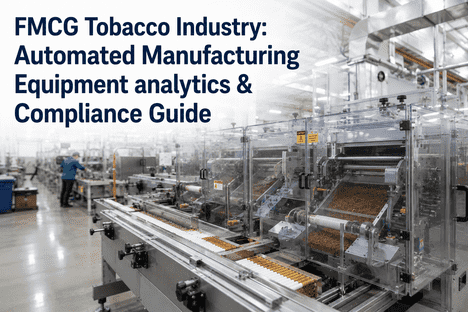

Cigarette Makers PdM Filter Tipper Monitoring Packer Health Analytics Cartoner Optimisation HVAC Climate Control

Share This Story, Choose Your Platform!