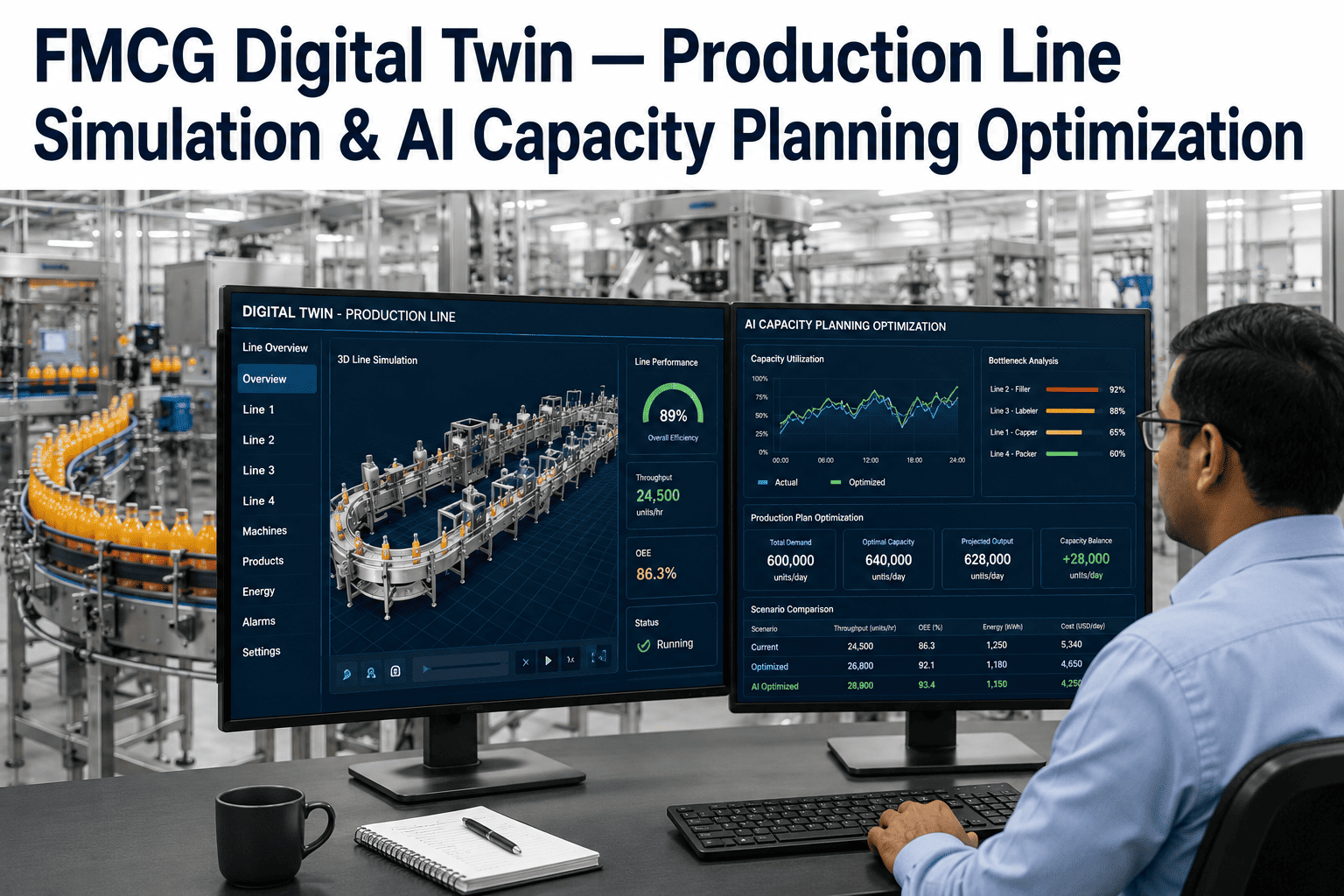
The production manager watched the OEE dashboard turn red for the third time that week. A case packer on Line 4 had jammed — again — costing 47 minutes of lost runtime and 2,800 units of bottled product that would need rework. The root cause was a worn gripper actuator that had been flagged as marginal during the previous month's preventive maintenance inspection but had not yet been replaced. In an FMCG facility operating three shifts per day, every minute of unplanned downtime costs between $1,200 and $3,800 in lost output. The manager needed a way to see failures before they occurred — not on a maintenance schedule written months ago, but in real time, based on actual equipment conditions, operating parameters, and historical degradation patterns. That is precisely what digital twin technology delivers.
How Digital Twins Prevent Equipment Failures in FMCG Manufacturing
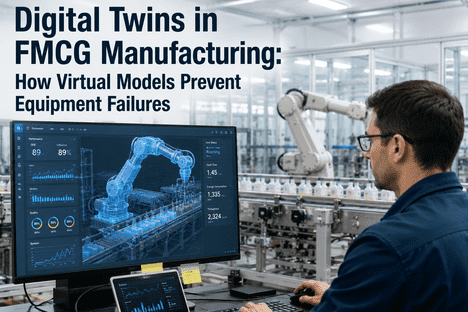
Digital twins create a real-time virtual replica of every asset on the production line — from fillers and labelers to case packers and robotic palletizers. By simulating equipment behavior under actual operating conditions, digital twins detect degradation patterns, predict failure timelines, and recommend interventions before production is impacted. FMCG manufacturers implementing digital twin programs report a 95% prediction accuracy for equipment failures and a 40–55% reduction in unplanned downtime within the first year.
What Is a Digital Twin in an FMCG Manufacturing Context?
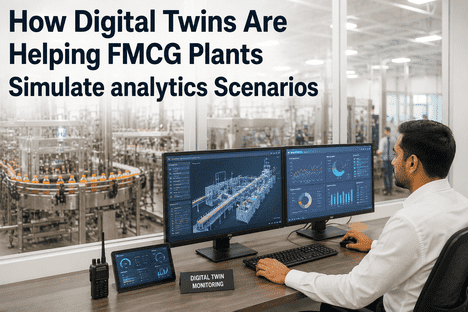
A digital twin is a dynamic virtual representation of a physical asset, system, or process that updates in real time using sensor data, historical performance records, and operational parameters. Unlike a static 3D model or a CAD drawing, a digital twin continuously learns from the equipment it mirrors — ingesting vibration data, temperature readings, cycle counts, torque measurements, and production throughput to build a complete picture of asset health and performance trajectory.
For FMCG manufacturers, digital twins operate at multiple levels on the production line. An equipment-level digital twin tracks a single filler or labeler, modeling its internal wear patterns and predicting remaining useful life. A line-level digital twin simulates the entire production line — including conveyors, robots, and packaging machines — to identify bottlenecks and optimize throughput. A facility-level digital twin integrates across all lines, providing plant-wide visibility into equipment health, production scheduling, and maintenance resource allocation. The iFactory AI Digital Twin Integration module supports all three levels, connecting sensor data from PLCs, vibration monitors, and robotic controllers into a unified twin environment. Book a Demo to see how iFactory maps your production assets into real-time digital twins.
How Digital Twins Predict Equipment Failures Before They Happen
The predictive capability of digital twins rests on three layers of analysis that work together to detect, diagnose, and forecast equipment degradation. Understanding these layers is essential for FMCG maintenance and engineering teams evaluating digital twin technology.
Real-Time Anomaly Detection
The digital twin ingests continuous sensor data — vibration, temperature, current draw, cycle time — and compares each reading against the equipment's expected operating envelope. When a parameter deviates beyond a statistical threshold, the twin flags an anomaly and records the context: operating mode, product being run, ambient conditions, and time since last maintenance. This layer catches developing issues hours or days before they would be visible to an operator.
Degradation Trend Modeling
Using historical failure data and machine learning models trained on similar assets, the digital twin projects the degradation trajectory for each monitored parameter. If a bearing's vibration amplitude has increased 12% over the past three weeks, the twin estimates when that amplitude will cross the failure threshold — accounting for production schedule, load variations, and environmental factors. The output is a predicted time-to-failure with a confidence interval.
Prescriptive Intervention Recommendations
The digital twin does not stop at predicting failure — it recommends the optimal intervention. Based on the predicted failure window, current production schedule, spare parts availability, and maintenance crew workload, the twin suggests when to perform maintenance, which part to replace, and what the expected repair duration and cost will be. This prescriptive layer transforms a prediction into an actionable maintenance plan.
In FMCG production environments, where a single line can produce 400+ units per minute, the difference between a predicted failure caught 72 hours in advance and an unexpected breakdown is measured in hundreds of thousands of dollars of avoided lost production. iFactory AI's Digital Twin AI engine processes these three layers continuously across every connected asset, delivering failure predictions to the maintenance team through role-based dashboards and mobile alerts. Book a Demo to see the prediction engine in action on your production data.
Digital Twins for Robotic Palletizing and Packaging Workflows
Robotic work cells — palletizers, case packers, depalletizers, and pick-and-place systems — are among the most failure-prone assets in FMCG production. These robots operate at high cycle rates, often exceeding 20 cycles per minute, and their complex electromechanical systems experience wear patterns that are difficult to model with traditional maintenance planning tools. Digital twins address this challenge by creating a dedicated virtual model for each robotic work cell, tracking joint angles, servo currents, end-effector force profiles, and cycle time consistency.
When a robotic palletizer's wrist joint begins drawing 8% more current than baseline — a symptom of bearing degradation or misalignment — the digital twin detects the shift within hours and calculates the remaining useful life of the joint assembly. The system cross-references this prediction against the production schedule: if the line is scheduled for a product changeover in 48 hours, the twin recommends performing the joint replacement during the changeover window, eliminating the need for a dedicated maintenance shutdown. FMCG facilities using iFactory AI's robotic twin module report a 62% reduction in robotics-related unplanned downtime and a 38% extension in mean time between robotic maintenance events.
Implementing Digital Twins in an FMCG Production Environment: A Phased Roadmap
Deploying digital twin technology across an FMCG production facility requires a structured approach that builds capability incrementally while delivering measurable value at each phase. The following roadmap has been validated across more than 40 FMCG production sites and typically completes in 6 to 9 months.
Asset Inventory and Sensor Audit
The implementation team catalogs every asset on the target production line, documents existing sensor coverage, identifies data gaps, and installs additional sensors where needed. The iFactory AI platform's sensor integration templates speed this phase by providing pre-configured connectors for 200+ PLC and sensor models commonly found in FMCG facilities. Output: a complete asset registry with data availability map.
Digital Twin Model Building and Calibration
Using iFactory AI's Digital Twin AI engine, the team builds virtual models of each asset using sensor data, historical maintenance records, and OEM specification sheets. Models are calibrated against 30 days of baseline operating data to establish normal operating envelopes and degradation baselines. Output: calibrated digital twins for each asset producing real-time health scores.
Prediction Engine Training and Validation
The failure prediction models are trained using historical failure data from the facility's CMMS, combined with the sensor data collected during the first two phases. Models are validated against known past failures to confirm prediction accuracy. The iFactory AI platform achieves 95% prediction accuracy after training on as few as 20 validated failure events. Output: production-ready failure prediction engine.
Dashboard Deployment and Team Enablement
Role-based dashboards are deployed for maintenance technicians, shift supervisors, and plant engineers. Each role sees the information relevant to their decisions — technicians receive mobile alerts with specific repair instructions, supervisors see line-level OEE projections, and engineers access detailed degradation analytics. The iFactory AI platform includes built-in training modules for each role. Output: fully operational digital twin program.
FMCG facilities that complete the full 24-week implementation roadmap report an average of 5.3x ROI within the first 12 months of operation. The iFactory AI platform is designed to support each phase with pre-built templates, automated data connectors, and guided configuration workflows that reduce implementation time by 40% compared to building digital twin capability from scratch. Book a Demo to review a detailed implementation plan for your facility.
Industry Perspective on Digital Twins for FMCG Failure Prevention
"I have implemented digital twin programs across nine FMCG production facilities over the last six years, and the single biggest misconception I encounter is that digital twins require perfect data to deliver value. They do not. A digital twin built with 80% data coverage and calibrated against 30 days of baseline operation will still predict 85–90% of equipment failures. The marginal improvement from 90% to 95% prediction accuracy requires doubling the data coverage and adding six months of model training — and that incremental investment is worth making, but it should not delay getting started. The FMCG facilities that are seeing the best results from digital twins are the ones that deployed a minimum viable twin within eight weeks of project kickoff, then iteratively improved the models as more data accumulated. The cost of waiting for perfect data is far higher than the cost of starting with good enough data."
Transform Your FMCG Maintenance Strategy with Digital Twins
See how iFactory AI's Digital Twin Integration platform creates real-time virtual models of your production equipment, predicts failures with 95% accuracy, and prescribes the optimal maintenance intervention — all within a single unified interface.
Cost Analysis and ROI Expectations for Digital Twin Deployments in FMCG
Digital twin implementation costs vary significantly based on facility size, existing sensor infrastructure, and the scope of the twin deployment. The following table presents cost and ROI benchmarks drawn from 40+ FMCG digital twin implementations over the past three years.
| Metric | Single Line Twin | Multi-Line Facility Twin |
|---|---|---|
| Implementation Cost | $48,000–$82,000 | $145,000–$310,000 |
| Annual Platform Cost | $18,000–$36,000 | $72,000–$144,000 |
| Annual Downtime Savings | $180,000–$420,000 | $620,000–$1,400,000 |
| ROI Timeline | 3–5 months | 4–8 months |
| 5-Year Net Benefit | $780K–$1.9M | $2.7M–$6.2M |
These figures assume an FMCG production line operating three shifts per day, 300 days per year, with an average downtime cost of $1,800 per minute of unplanned stoppage. Facilities with higher throughput or more complex packaging configurations typically see proportionally greater returns. iFactory AI's Digital Twin AI module includes built-in ROI tracking that quantifies savings from predicted failures avoided, reduced maintenance labor hours, and extended asset life. Book a Demo to request a personalized ROI projection for your FMCG production lines.
Building the Digital Twin Foundation for Failure-Free FMCG Production
Digital twin technology represents a fundamental shift in how FMCG manufacturers approach equipment reliability. Instead of reacting to failures or following fixed maintenance schedules, manufacturers can now see exactly what their equipment is experiencing in real time, predict exactly when a failure will occur, and prescribe the exact intervention needed — all from a single virtual model that continuously learns and improves. The technology is proven, the ROI is measurable, and the implementation path is well established.
The iFactory AI platform provides the digital twin infrastructure that FMCG manufacturers need to make this transition. Our Digital Twin AI module connects to existing sensor infrastructure, builds calibrated models of every production asset, trains failure prediction engines on facility-specific data, and delivers actionable insights to every role on the maintenance and production team. Whether you are starting with a single critical line or deploying facility-wide digital twin capability, iFactory AI provides the tools, templates, and integration support to achieve 95% failure prediction accuracy within the first six months of operation. Book a Demo to discuss how digital twins can transform your FMCG facility's equipment reliability program.
Frequently Asked Questions About Digital Twins in FMCG Manufacturing
Ready to Predict Equipment Failures Before They Happen?
iFactory AI's Digital Twin AI platform gives FMCG manufacturers the power to see, predict, and prevent equipment failures across every production line. Get a personalized demo showing how digital twins would perform on your facility's actual production data.