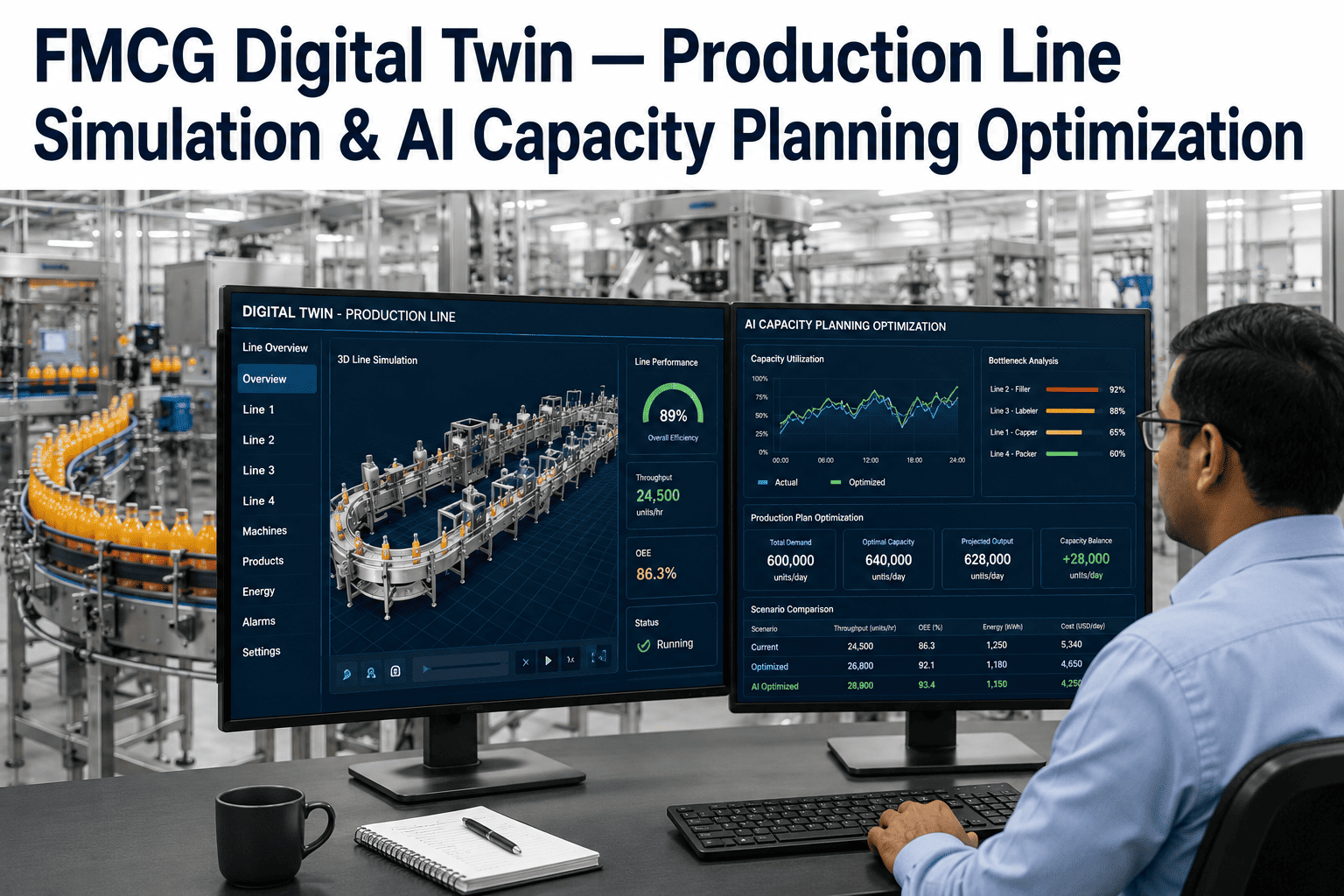
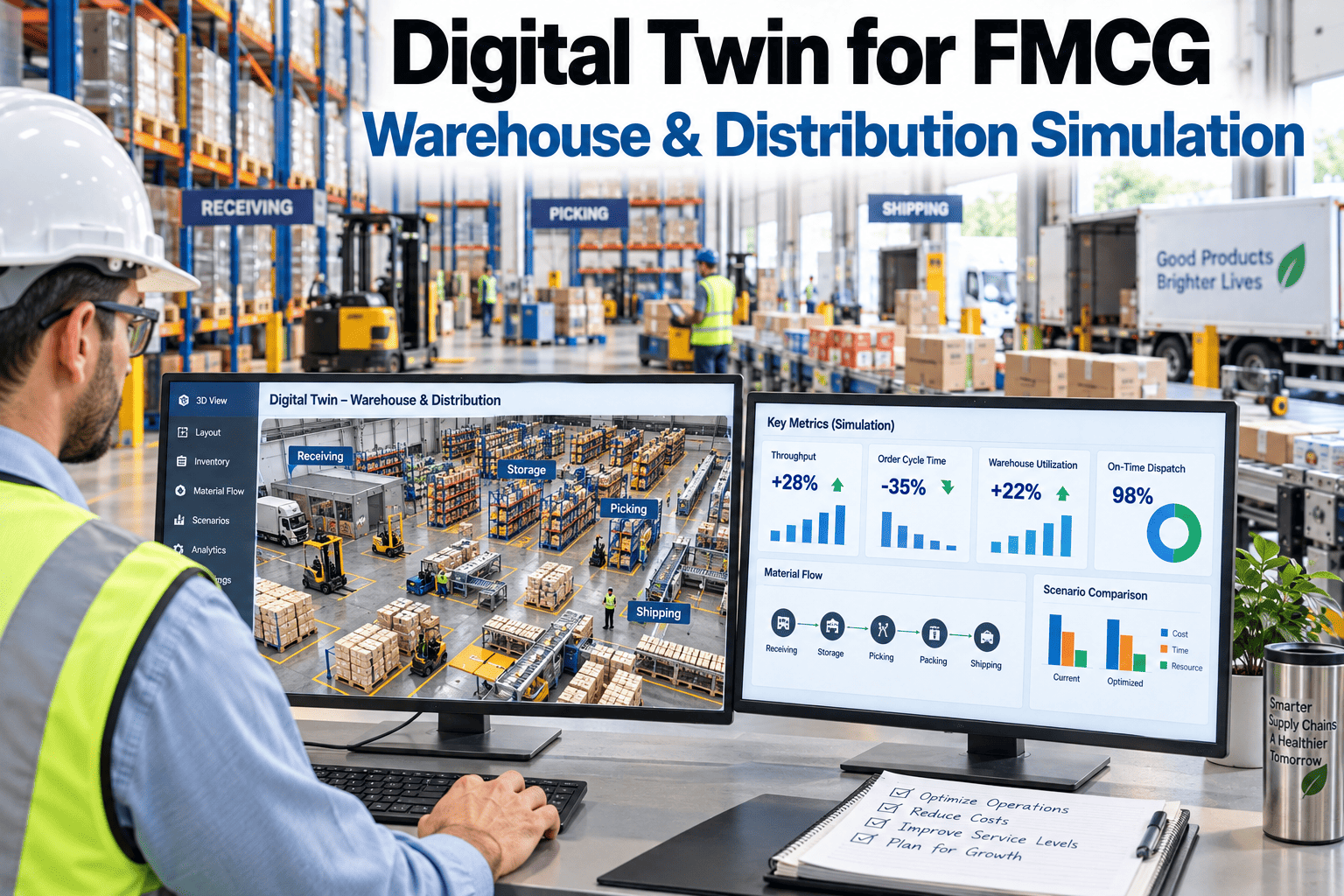
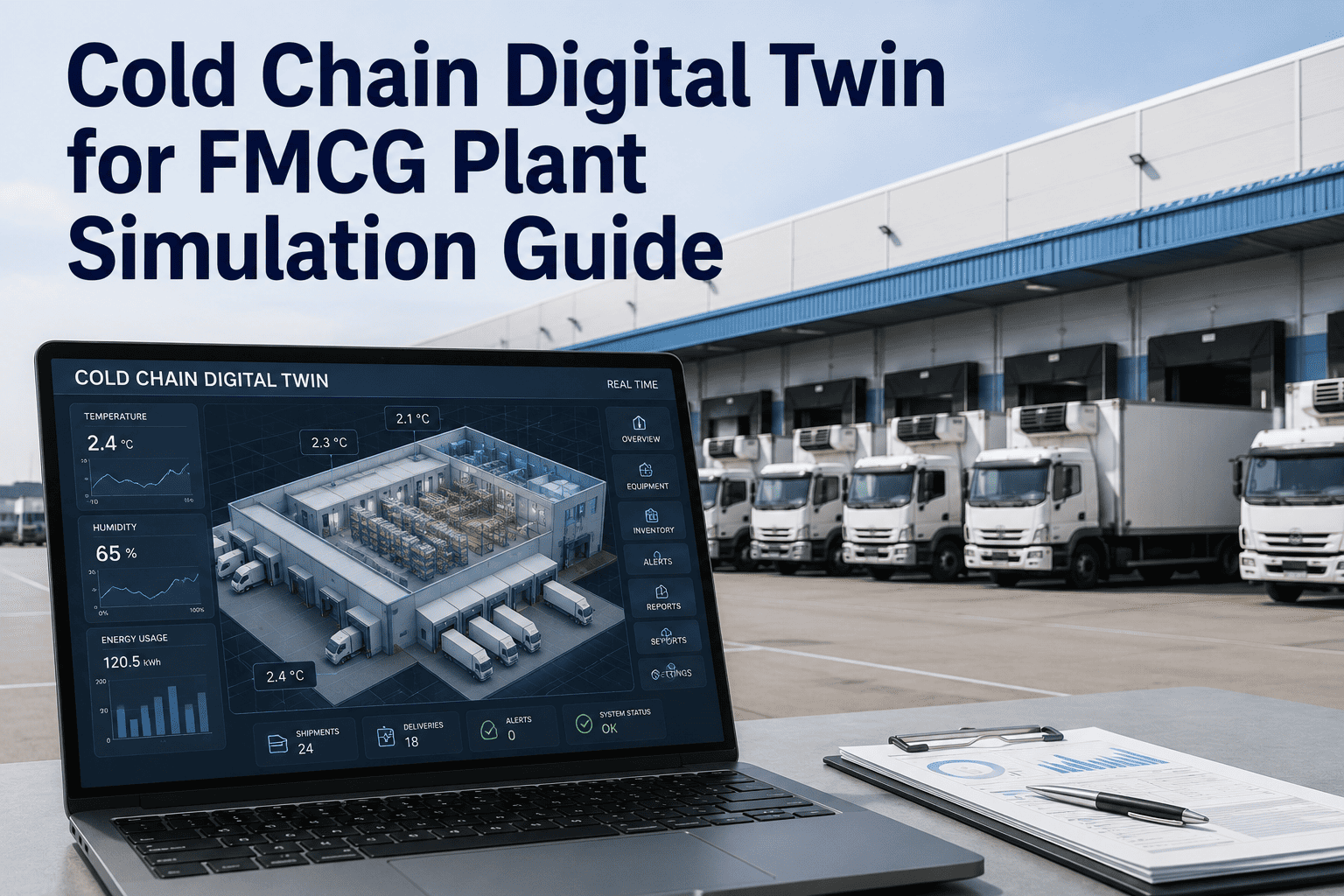
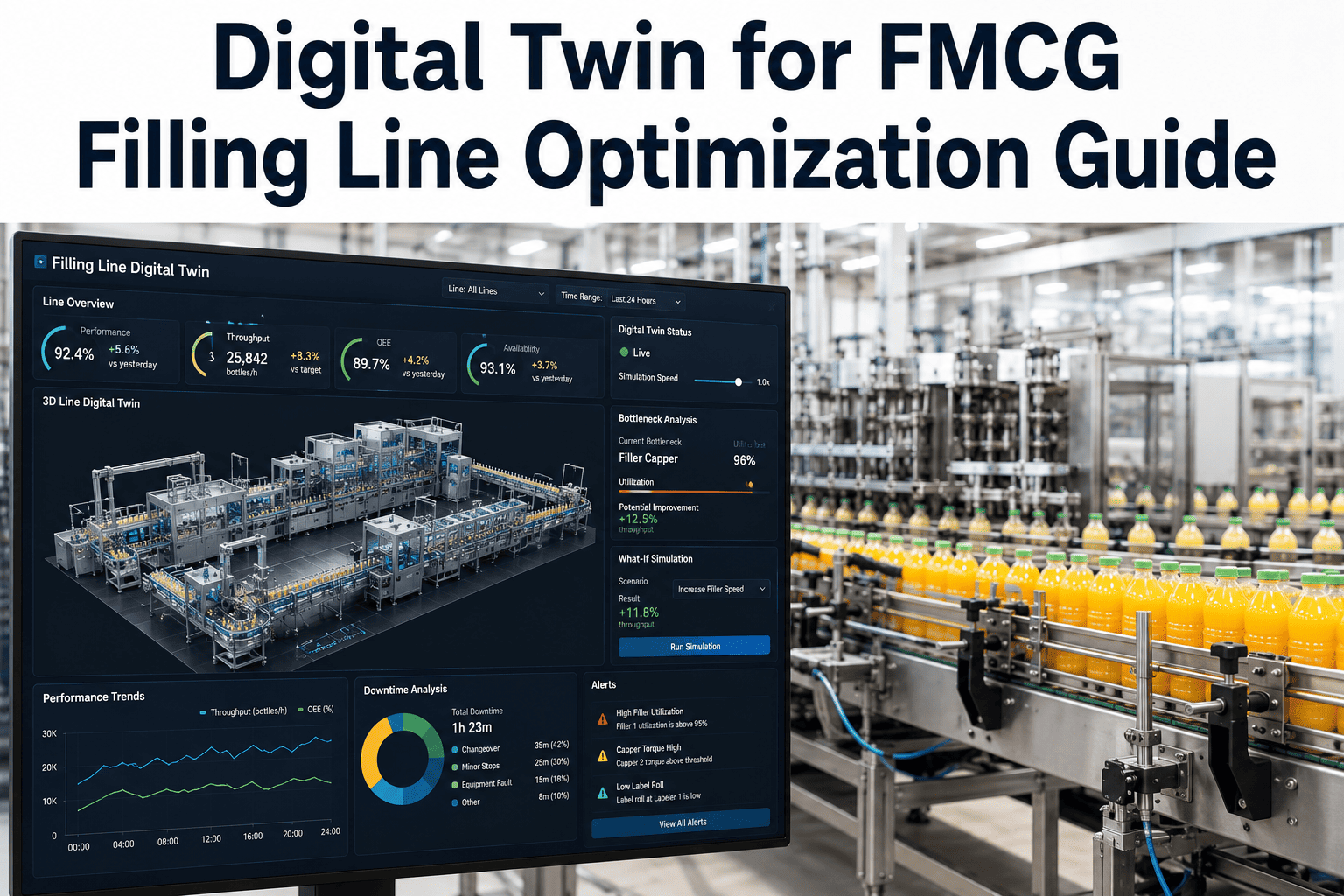
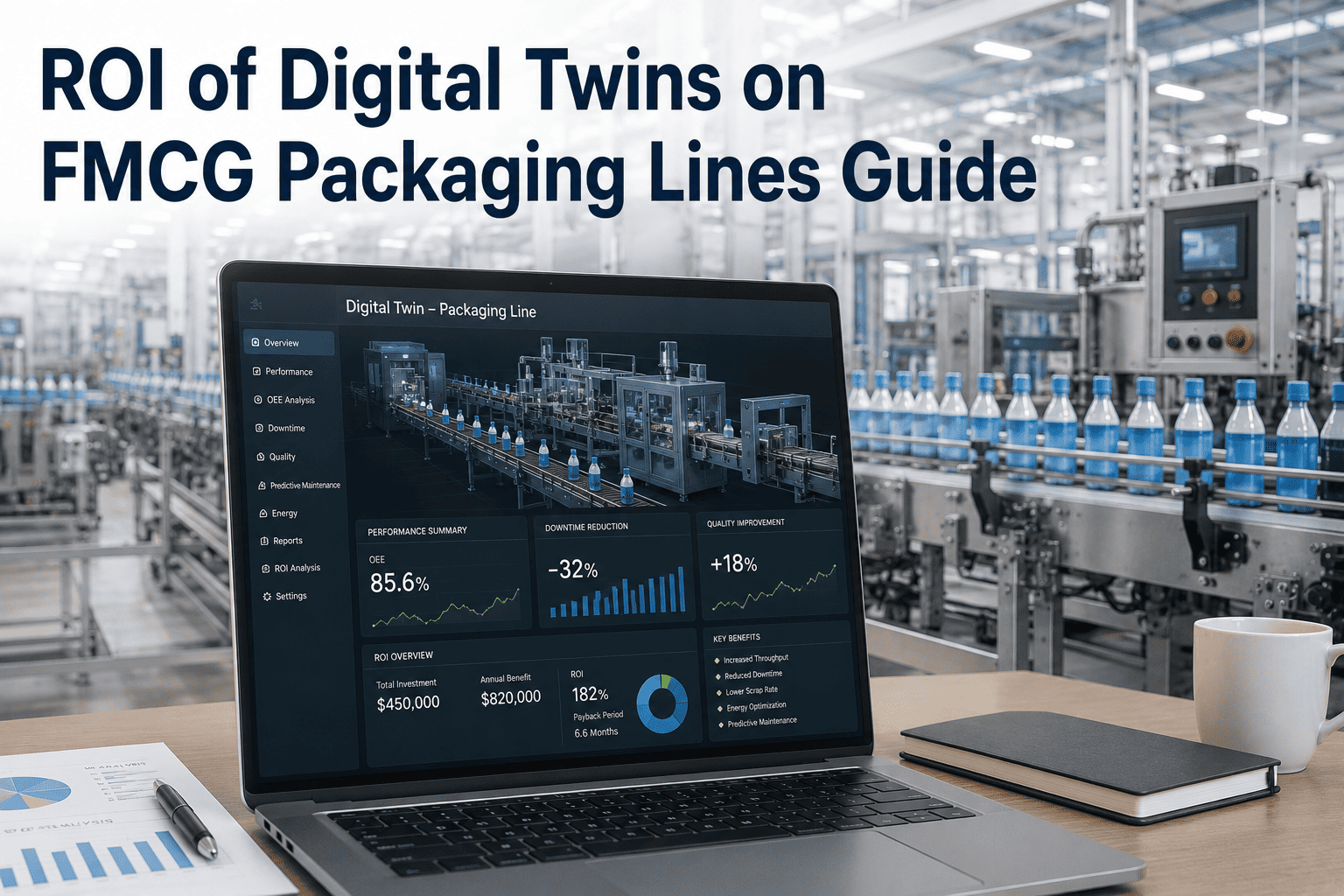
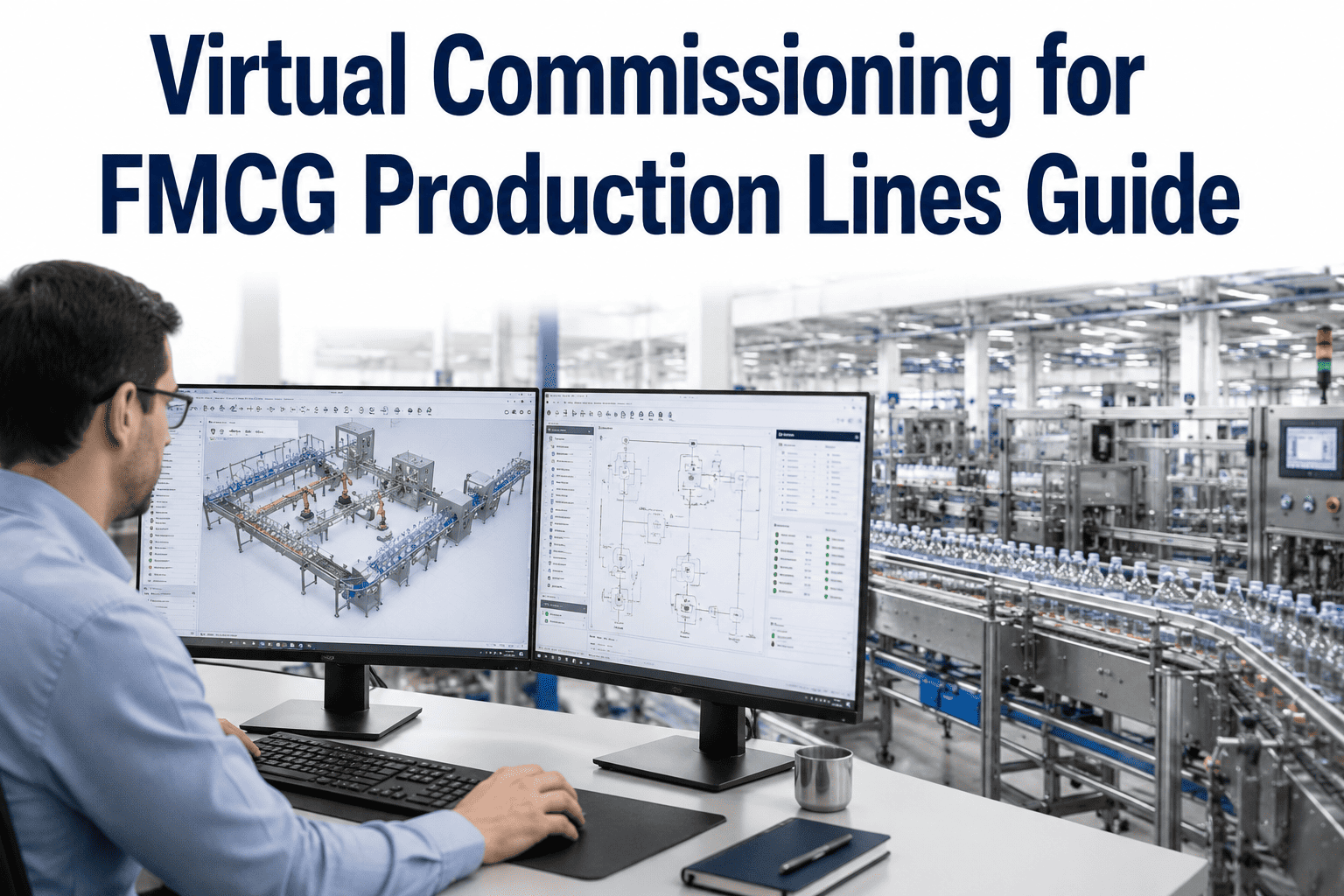
Changing a changeover sequence on a live FMCG line is an expensive way to find out it was a bad idea. A new SKU rotation, a revised staffing model, or a faster changeover target usually cannot be tested safely on the actual line, because a failed experiment means lost production, wasted materials, and a shift supervisor who has to explain the downtime. Most plants end up choosing the safe, familiar sequence over the better one simply because there was never a low-risk way to try the alternative first. A digital twin removes that constraint by letting the plant test the change virtually before it ever touches the floor, which is exactly what ifactory support helps FMCG operations teams set up.
iFactory Digital Twin Platform
Test the Change Before You Bet a Shift On It
A virtual model of your production line that mirrors real changeover times, staffing constraints, and SKU sequencing, so scenario testing happens on a screen instead of on the floor.
Why FMCG Lines Are Especially Hard to Optimize by Trial and Error
A line running one automotive component for eight hours has few variables to manage. An FMCG line running fifteen SKU variants in a single shift, each with its own changeover time, packaging requirement, and staffing need, has dozens of variables interacting at once. Shifting one changeover sequence can ripple into staffing gaps two hours later, or create a bottleneck at a downstream packing station that was never the intended target of the change. Testing that ripple effect on the real line means absorbing the cost of getting it wrong. Testing it in a digital twin means the ripple effect shows up on a screen first, where it costs nothing to be wrong.
On the Physical Line
A new changeover sequence risks real downtime if it fails
Staffing changes are tested with real people and real shifts
A bad SKU rotation shows up as lost throughput at month-end
Only one scenario can be tried at a time, once per shift at most
In the Digital Twin
The same sequence is tested in minutes with zero production risk
Staffing models are simulated against historical shift patterns
A bad SKU rotation is caught before it is ever scheduled
Dozens of scenarios can be compared side by side in one sitting
See It on Your Own Line
Bring Your SKU Mix and Let's Build a Test Scenario Together
We will walk through how a digital twin of your specific line would model a changeover or staffing scenario you are currently unsure about.
What Actually Gets Modeled in an FMCG Digital Twin
A useful digital twin is not a generic 3D animation of a factory, it is a data-driven model built from the actual cycle times, changeover durations, and constraint points of a specific line. The model is only as good as the data feeding it, which is why the build process starts with pulling real historical performance rather than theoretical machine specifications.
SKU Scheduling
Test different SKU sequencing orders to find the rotation that minimizes total changeover time across a full shift, not just for a single swap.
Changeover Sequencing
Model where changeover steps can run in parallel versus where they are genuinely sequential, often revealing time savings nobody had considered.
Staffing Models
Simulate different crew sizes and station assignments against actual demand patterns before committing to a schedule change.
Bottleneck Location
Identify which station becomes the constraint under a proposed change, since the bottleneck often moves once one part of the line speeds up.
From Line Data to a Tested Scenario
Building and using a digital twin is a repeatable cycle, not a one-time modeling exercise. Each scenario tested feeds back into a sharper model for the next question the plant needs answered.
The Simulation Cycle
1
Pull Historical Line Data
Real cycle times, changeover durations, and downtime patterns are pulled from existing MES and SCADA history to ground the model in reality.
2
Build the Virtual Line
Stations, constraints, and dependencies are mapped into a model that behaves the way the physical line actually behaves under load.
3
Define the Scenario
A specific question gets tested — a new SKU rotation, a staffing change, a faster changeover target — against the model.
4
Compare Outcomes
Throughput, changeover time, and staffing utilization are compared across scenarios side by side before any decision is made.
5
Deploy the Winning Scenario
The tested sequence moves to the physical line with confidence, and the outcome feeds back into the model to sharpen the next simulation.
Typical Outcomes Reported After Simulation-Led Changes
Not sure which scenario would move the needle most on your line? Send us your current changeover data and we will suggest where to start.
Frequently Asked Questions
How accurate is a digital twin compared to what actually happens on the line?
Accuracy depends entirely on the quality of the historical data used to build the model, which is why the process starts with pulling real cycle times and changeover durations rather than theoretical specifications from equipment manuals. Most plants find the model tracks closely with real outcomes once it has been validated against a few known scenarios, and accuracy improves further as more real results feed back into it.
Talk to our team about the validation process for your specific line.
Do we need a fully digitized line before we can build a digital twin?
No, a twin can be built from existing MES, SCADA, or even manually logged historical data, though richer real-time data does improve the model over time. Many plants start with a twin built from historical records and layer in live data feeds later as their digital infrastructure matures.
Book a walkthrough to see what your current data would support.
How long does it take to build a working digital twin of one production line?
A pilot model of a single line, built from existing historical data, typically takes a few weeks from initial data pull to a validated, usable simulation. Building a twin of an entire plant with multiple interconnected lines takes longer, which is why most engagements start with one line before expanding.
Reach out to our team for a timeline based on your specific line complexity.
Can the digital twin test staffing scenarios, or only equipment and scheduling changes?
Yes, staffing is one of the most commonly tested variables, since crew size and station assignment decisions carry real cost and are otherwise difficult to test without disrupting an actual shift. The model incorporates historical labor patterns alongside equipment constraints so a staffing scenario reflects realistic operating conditions, not just theoretical capacity.
Book a scoping call to discuss a staffing scenario specific to your plant.
What happens if a tested scenario performs differently once it is actually deployed?
That gap is exactly what gets fed back into the model to sharpen it for the next simulation, since no digital twin will match reality perfectly on the first pass. The value is not that the twin is always exactly right, it is that testing in the twin is dramatically cheaper and safer than testing on the physical line, and each deployment makes the next prediction more reliable.
Contact our team to understand how model refinement works over time.
Stop Guessing on the Floor.
Build a Digital Twin of Your Line and Test Before You Commit
Bring a changeover or staffing question you have been unsure about. We will show you how it would model out before you ever schedule the change.