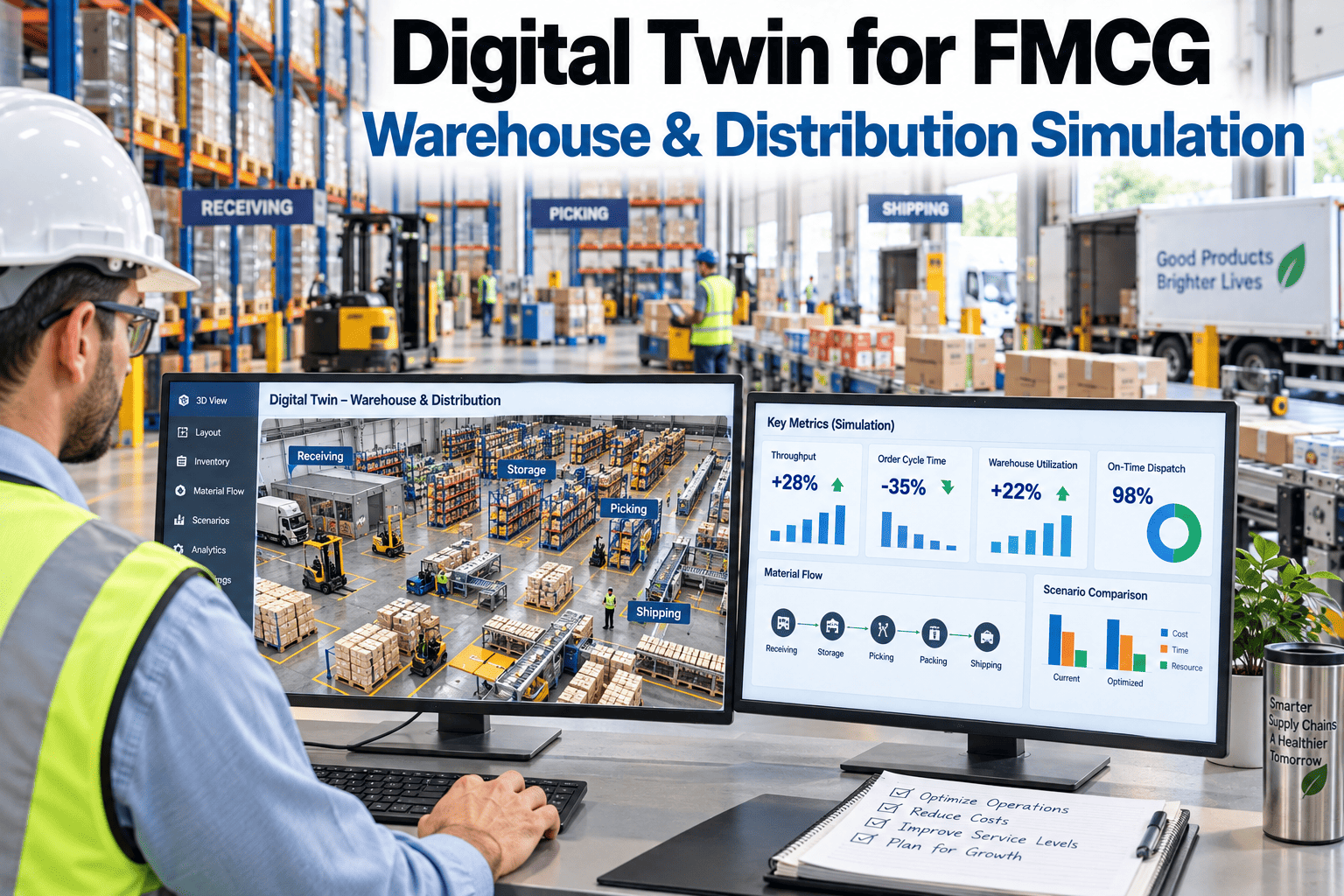
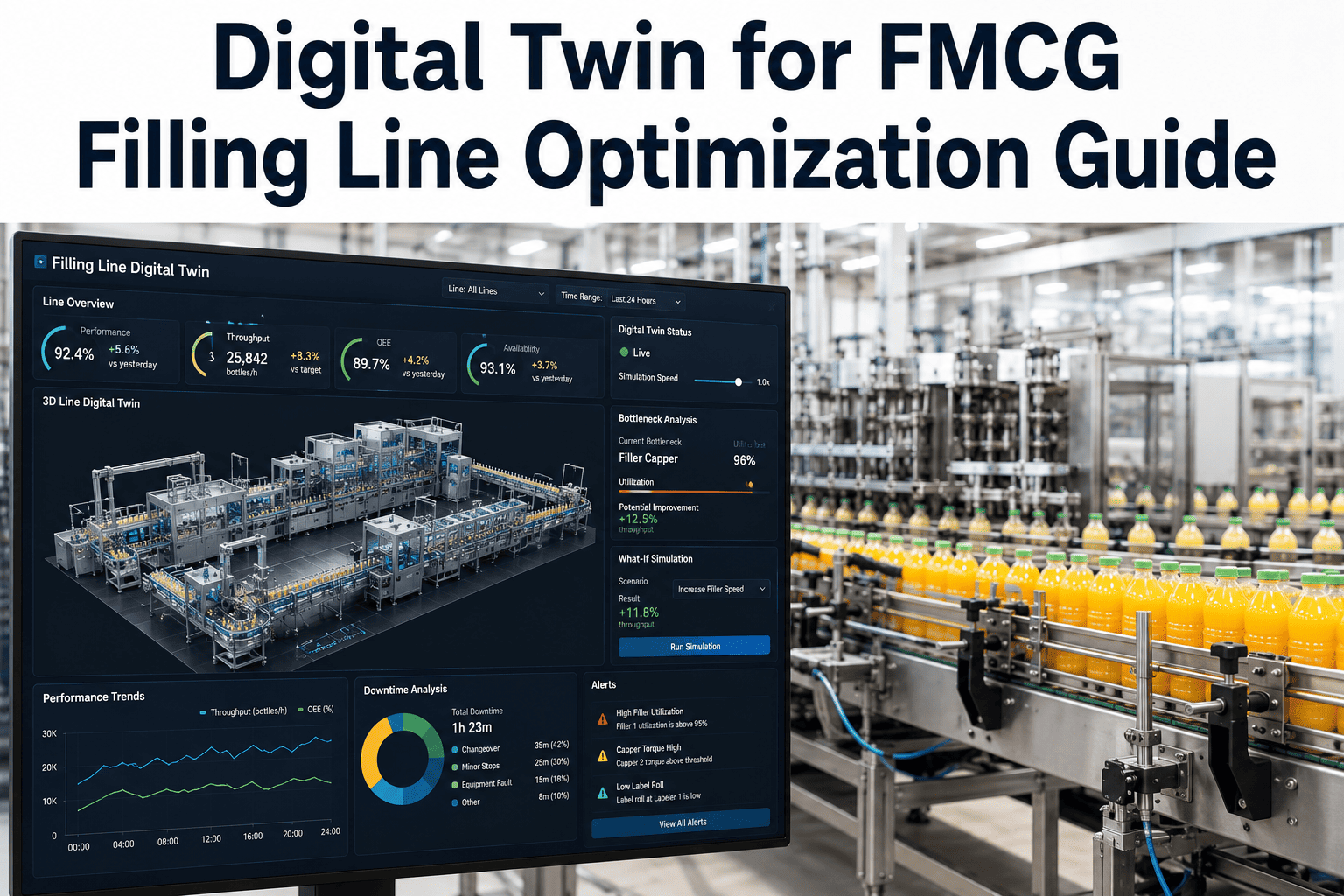
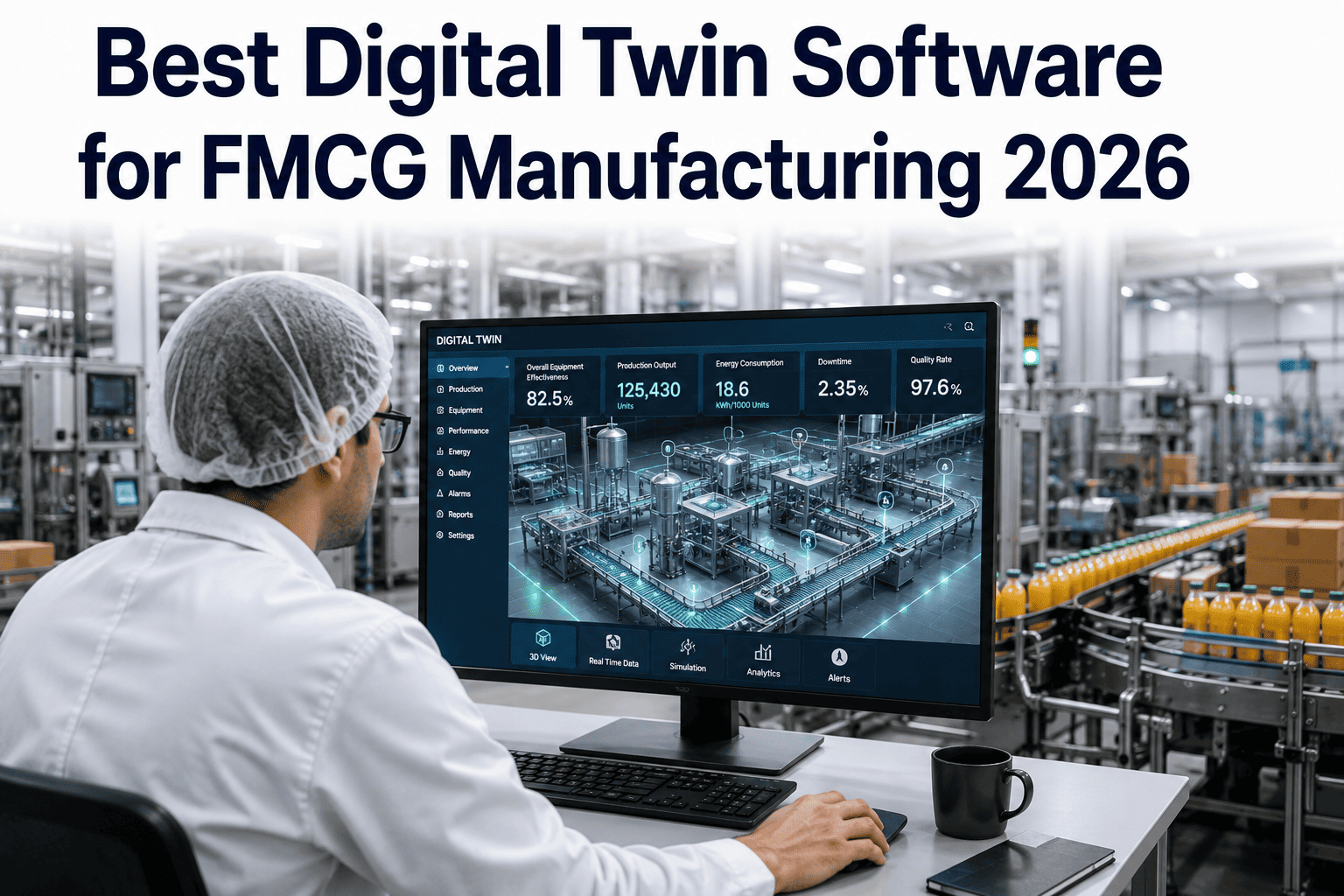
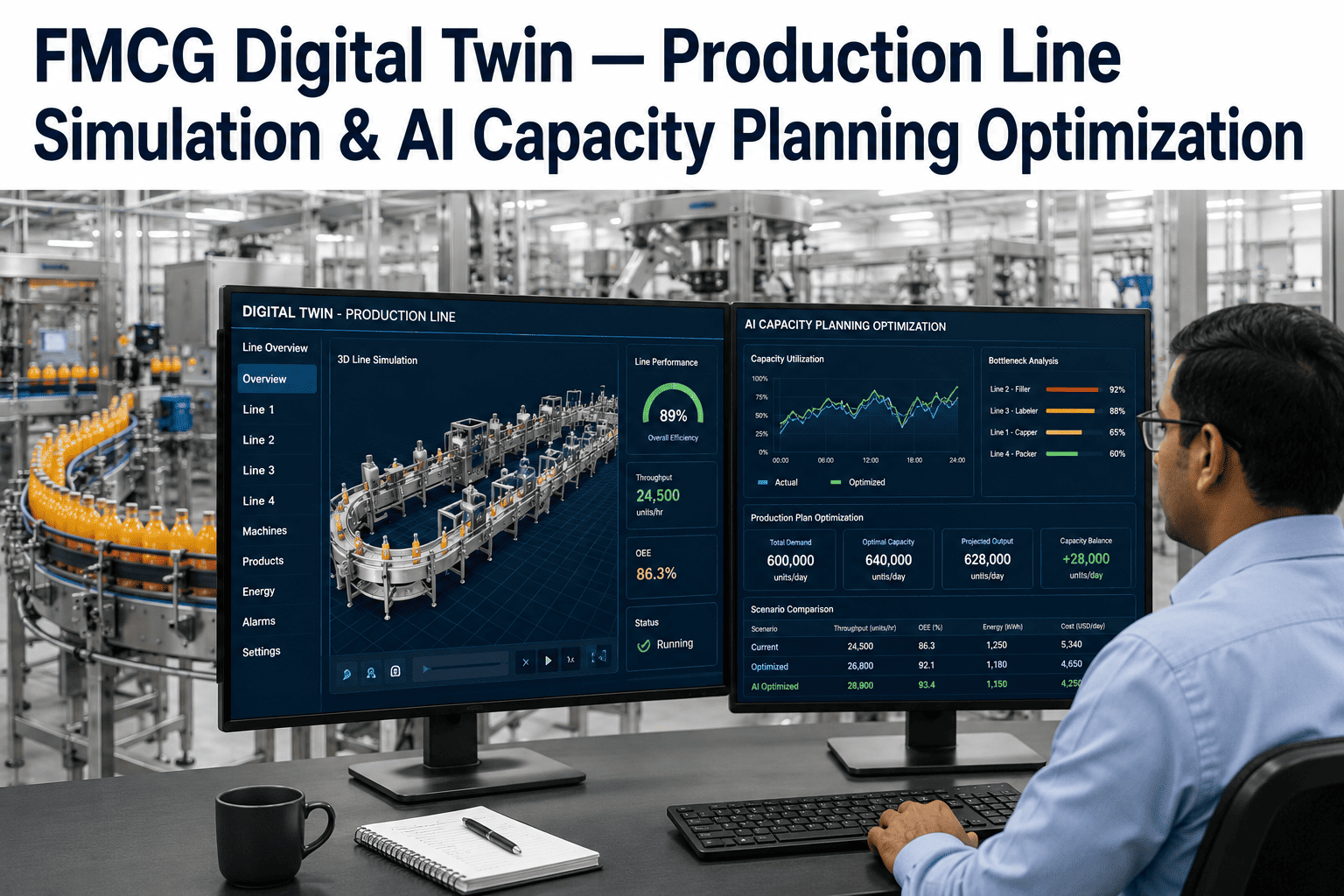
Adding a second forklift fleet, moving the pick line, or reconfiguring dock doors are all decisions warehouse leaders used to have to make on instinct and a spreadsheet, then live with for a year before finding out if the math was right. A digital twin removes that gamble by modeling the exact flow of pallets, pickers, and dock traffic through a virtual copy of your facility, so a layout change gets tested in software days before a single rack gets physically moved. This is the core of how iFactory approaches warehouse and distribution center planning for FMCG operators.
DIGITAL TWIN — WAREHOUSE & DISTRIBUTION
Digital Twin for FMCG Warehouse & Distribution Simulation
Model flow, pick path, and dock scheduling in a virtual copy of your facility before committing capital or headcount to a real-world layout change.
Storage
Racking & Slotting
The Cost of Testing a Layout Change in the Real Warehouse
Every physical warehouse change carries a hidden testing cost that rarely shows up on the capital request: the weeks of disrupted throughput, the picker retraining, and the very real possibility that the change makes flow worse rather than better. Because that trial happens live, with real orders and real customers waiting on them, most warehouse leaders are forced to be conservative — sticking with a known-suboptimal layout rather than risking a change that might not pay off. A digital twin removes that risk by moving the experimentation into a virtual model where a failed test costs nothing but a few hours of simulation time.
What a Warehouse Digital Twin Actually Simulates
A useful warehouse twin is not a static 3D model — it is a dynamic simulation that moves virtual pallets, orders, and pickers through the facility using your actual order profile, SKU velocity, and staffing patterns. Each zone of the facility gets modeled with the specific variables that matter to its own operation, which is what makes the resulting simulation predictive rather than decorative.
RECEIVING
Dock Door Scheduling
Models inbound truck arrival patterns against available dock doors and labor, testing whether adding or reassigning doors reduces truck wait times and detention costs.
STORAGE
Slotting & Rack Layout
Simulates travel distance and retrieval time under different slotting strategies, testing whether relocating high-velocity SKUs closer to pack stations reduces pick time.
PICKING
Pick Path Optimization
Runs your actual order mix through alternative pick path logic and staffing levels, projecting picks-per-hour and labor cost before any change to the live floor.
SHIPPING
Outbound Dock Flow
Tests staging area capacity and outbound dock assignment against shipping volume peaks, identifying bottlenecks before a seasonal volume spike hits the real floor.
Simulation Testing vs Real-World Trial — The Cost Comparison
The financial case for a digital twin becomes clearest when the cost and risk of testing a change virtually is placed side by side with testing the same change live in the facility. The gap is not just about dollars — it is about how many alternatives can realistically be evaluated before committing.
| Factor | Real-World Trial | Digital Twin Simulation |
|---|
| Cost of testing one layout option | Labor disruption, retraining, lost throughput | Compute time only, no physical disruption |
| Number of alternatives realistically testable | Usually one, due to cost and risk | Dozens of variations run in parallel |
| Time to result | Weeks to months of live observation | Hours to days per simulation run |
| Risk if the change underperforms | Real orders delayed, real cost incurred | None — model is discarded and refined |
| Confidence before capital commitment | Based on judgment and limited pilot data | Based on simulated throughput across your actual volumes |
Build a Virtual Model of Your Own Facility
iFactory builds a digital twin of your actual warehouse layout, order profile, and staffing pattern, so your next layout decision is tested in software before it touches the real floor.
From Model to Decision — How a Twin Project Runs
Building a warehouse digital twin is a defined, sequential project rather than an open-ended technology initiative. The stages below reflect the typical path from an empty model to a layout decision leadership can act on with confidence.
1
Facility Data Capture
Layout dimensions, rack configuration, dock counts, and current order and staffing data are collected to ground the model in your actual operation.
2
Baseline Model Validation
The twin is run against current operations first, and its output is checked against real throughput numbers to confirm the model reflects reality accurately.
3
Scenario Testing
Proposed layout, staffing, or process changes are run through the validated model, with each scenario's projected throughput and labor impact compared side by side.
4
Decision & Implementation
Leadership selects the scenario with the strongest projected outcome, and the twin continues to serve as a reference model for future changes.
A Distribution Center Director on Testing Before Building
"
We had been debating a full re-slotting of our highest-velocity SKUs for almost two years, because everyone had an opinion about whether it would actually help and nobody wanted to be responsible for a six-week disruption if it didn't. Building the digital twin took about five weeks, most of it spent capturing accurate data on our current layout and order patterns. Once the model was validated against our real throughput numbers, we ran fourteen different slotting scenarios in about three days, something that would have been completely impossible to test live. The scenario we picked showed an 18% projected reduction in average pick travel distance, and when we implemented it for real, the actual result came in close enough to the simulation that we now trust the twin for every layout decision we make. The two years of debate before that could have been avoided entirely if we had built the model on day one instead of arguing from opinion.
— Distribution Center Director, Regional FMCG Distributor · Manages 3 Distribution Facilities
What Changes Once You Can Simulate Before You Build
Once a validated digital twin exists, the way a warehouse team approaches every subsequent decision shifts, because testing an idea stops being expensive and risky and becomes routine. The outcomes below are the ones twin-enabled teams consistently report.
✓
Layout and slotting changes get tested against dozens of alternatives instead of committed to on a single best guess.
✓
Capital requests for new equipment or automation are backed by simulated throughput projections rather than vendor estimates alone.
✓
Seasonal peak planning identifies dock and staffing bottlenecks weeks before volume actually arrives.
✓
New facility design decisions are validated against a virtual model before construction begins, reducing costly retrofits.
Frequently Asked Questions
How long does it take to build a digital twin of an existing warehouse?
For a typical single-facility warehouse, building and validating an initial digital twin usually takes four to six weeks, most of which is spent capturing accurate layout dimensions, rack configurations, and historical order and staffing data. Facilities with more complex automation, multiple building sections, or less organized existing data on order patterns can take somewhat longer during the data capture phase. Once the baseline model is validated against your actual throughput, subsequent scenario testing typically takes just days per scenario rather than weeks.
How accurate are digital twin simulation results compared to what actually happens?
Accuracy depends heavily on how well the baseline model is validated against real operational data before scenario testing begins — a twin validated against your actual throughput numbers, order profile, and staffing patterns typically produces projections that align closely with real-world results once implemented. Simulations are directional planning tools rather than exact guarantees, since real-world variables like unexpected equipment downtime or labor absences introduce variation that a model cannot fully predict. The value is in comparing scenarios against each other reliably, which the model does very well, rather than promising an exact future number.
Can a digital twin model a facility that doesn't exist yet?
Yes, and this is one of the most valuable applications for FMCG operators planning a new distribution center or a major facility expansion. Using projected order volumes, proposed layout designs, and planned staffing levels, a twin can test multiple facility design options before construction begins, helping avoid costly layout mistakes that would otherwise only surface after the building is already operational. The absence of real historical data means these models rely more heavily on projected assumptions, so validating those assumptions carefully is an important part of the process.
Does building a digital twin require replacing our existing warehouse management system?
No — a digital twin is typically built as a simulation layer that draws on data from your existing warehouse management and order systems rather than replacing them. The twin consumes historical and live data to build and validate its model, and its output is used to inform decisions that get implemented through your existing systems and processes. This makes it possible to start building a twin without a disruptive system migration as a prerequisite.
What's a realistic first use case for a warehouse digital twin?
A focused first project — such as testing an upcoming slotting change, evaluating a proposed dock door reconfiguration, or planning staffing for a known seasonal peak — tends to be a stronger starting point than attempting to model an entire facility's every process simultaneously. A narrower first use case builds internal confidence in the model's accuracy and demonstrates value quickly, creating the foundation to expand the twin's scope to additional zones and use cases afterward. To scope a first digital twin project for your facility,
book a demo with our team.
Test Your Next Layout Change Before You Build It
A validated digital twin turns warehouse layout decisions from a costly live experiment into a fast, low-risk simulation exercise. iFactory builds and validates a model of your actual facility so every future change is tested first.