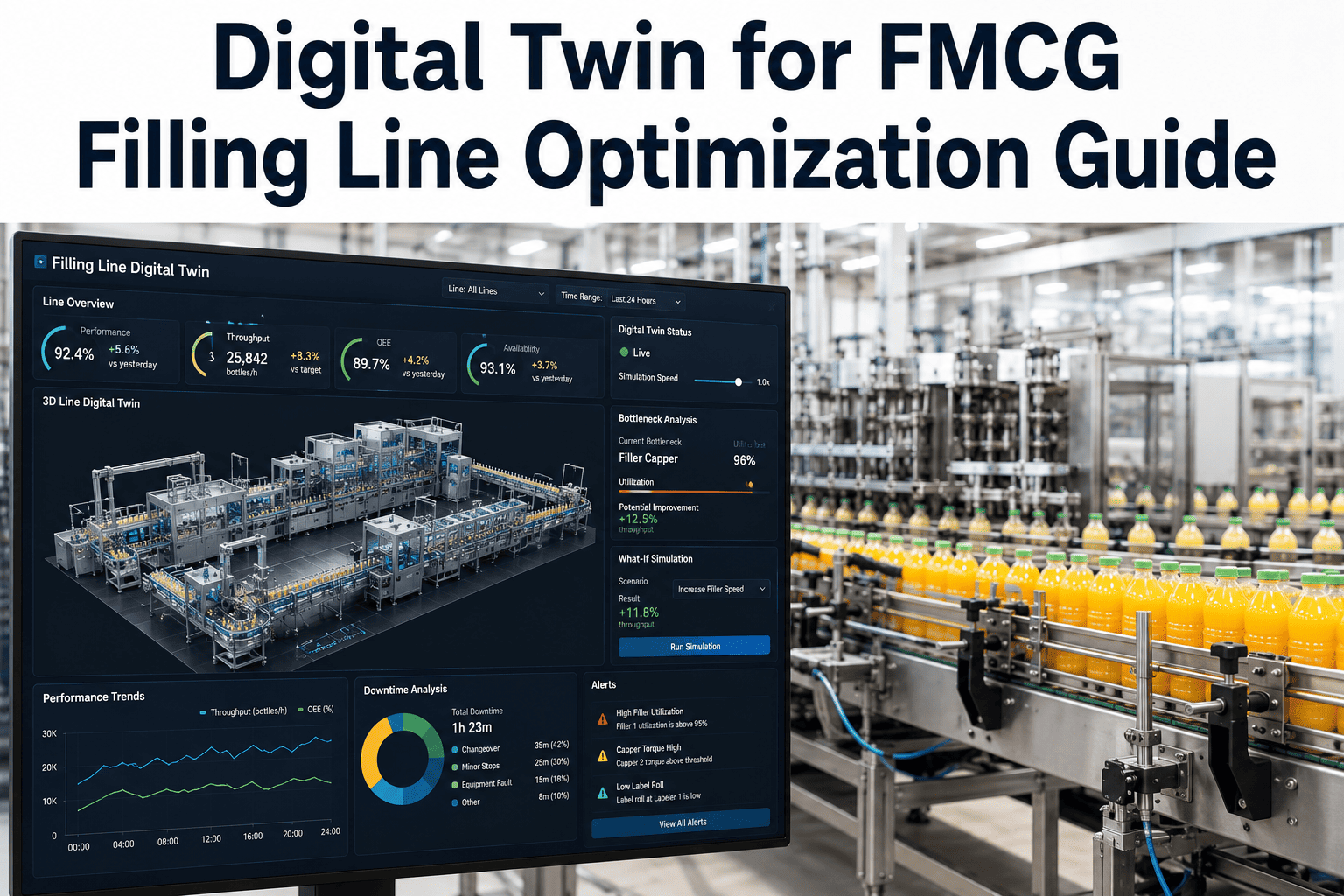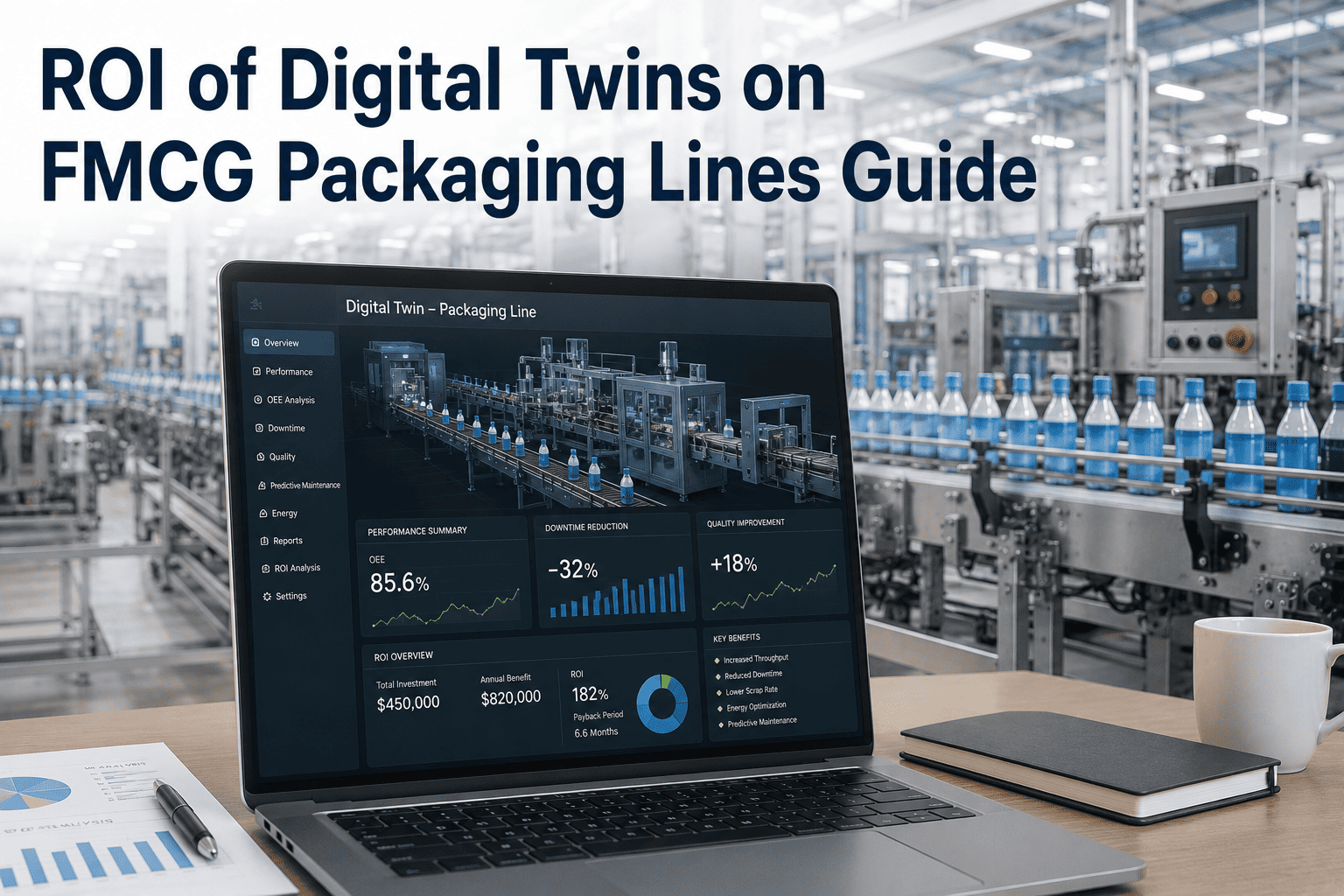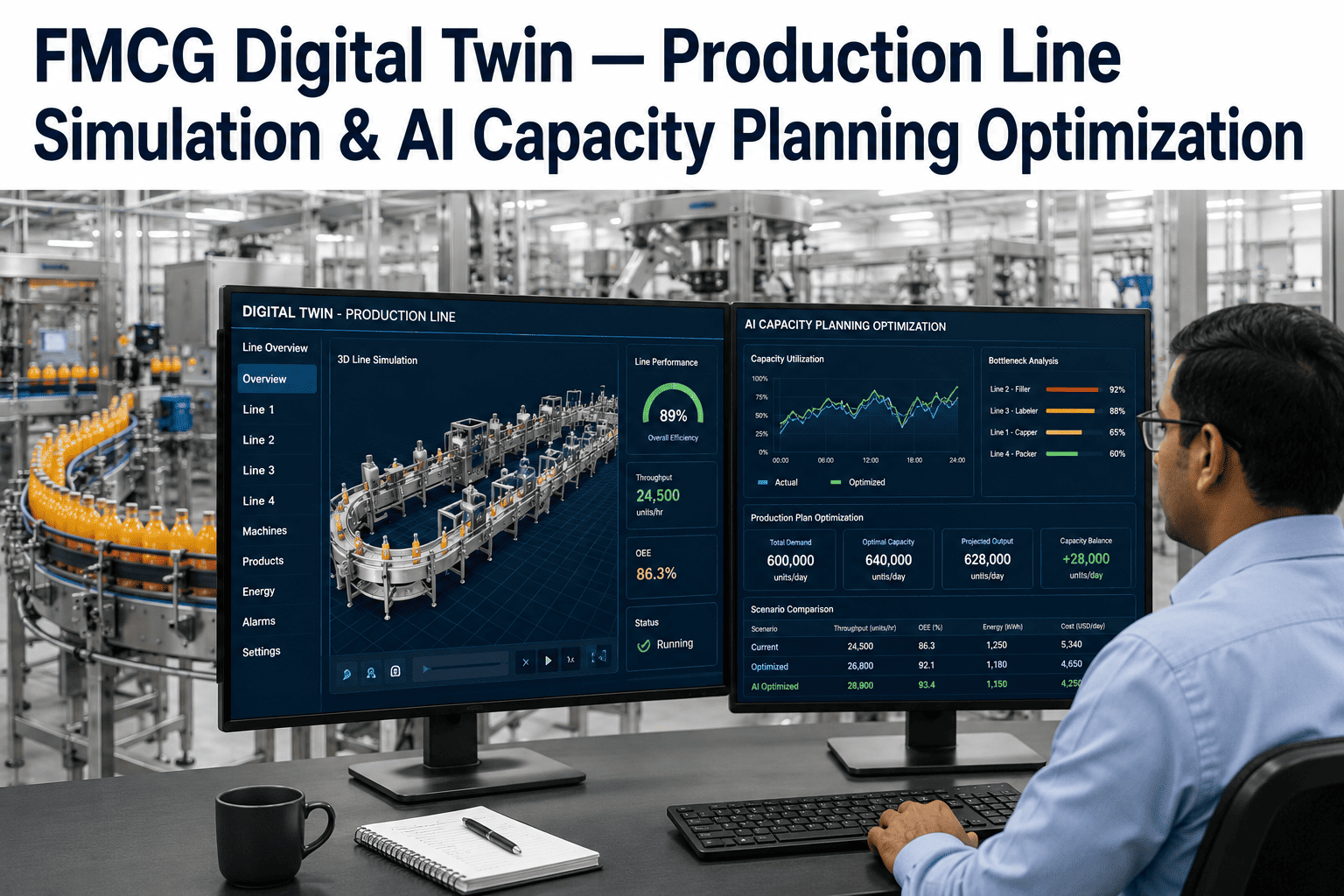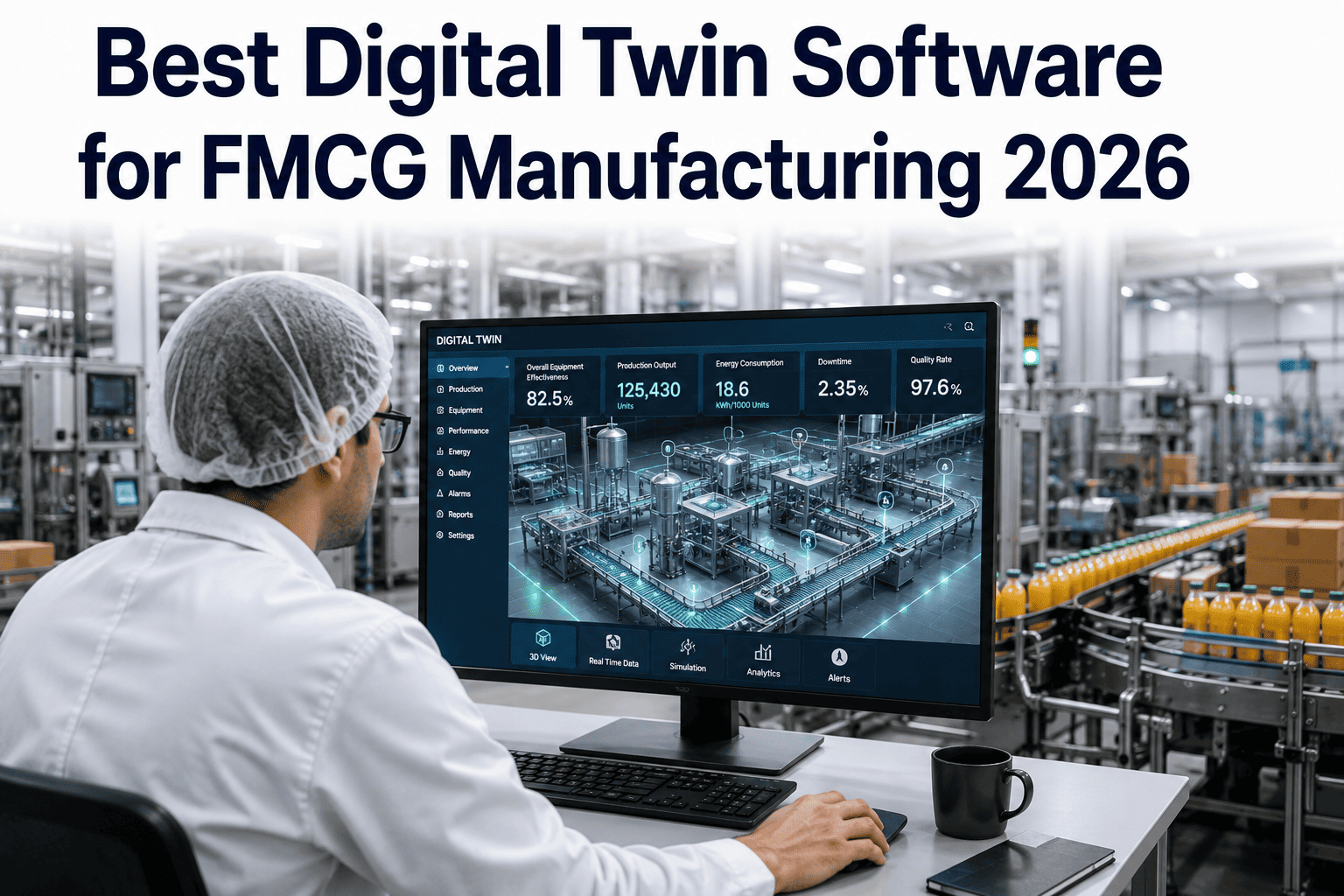
Most FMCG plants buy simulation software the same way they buy any other plant system, by comparing feature lists and price sheets, and most of them regret it within a year. Digital twin platforms differ enormously in what they can actually validate before a line goes live, and a tool that renders a beautiful 3D model but can't simulate real cycle-time interactions leaves you exactly where you started: guessing until the equipment arrives. Gartner has projected that by the end of 2026, roughly 70 percent of industrial manufacturers will be running at least one digital twin in production, up sharply from a small minority just a few years earlier, which means the buying decision plant leaders make this year is no longer optional homework, it is the difference between a smooth line startup and a six-week scramble.
Every Digital Twin Platform Claims To Simulate Your Line — Very Few Actually Can
A real comparison isn't about which tool has the nicest interface. It's about which one can model your specific packaging, filling, and palletizing constraints accurately enough to trust before you spend capital on the physical change.
The Feature List Looks The Same On Every Vendor Site — The Underlying Physics Doesn't
Nearly every digital twin vendor markets 3D visualization, real-time data connectivity, and simulation capability, and on paper the checklists are nearly identical. The gap only becomes visible once you ask a harder question: does the model account for servo interaction, changeover sequencing, and mechanical tolerance stack-up, or does it just move geometry around on screen without any physics behind the motion? FMCG lines are unusually unforgiving of that gap because packaging and filling equipment run at high cycle rates with tight timing dependencies between stations, so a twin that only handles static layout planning will miss exactly the problems that cause real commissioning delays: cycle-time bottlenecks, spatial conflicts at handoff points, and safety-zone overlaps that only appear when everything is running together at speed.
The practical filter, then, is not "does it have simulation," it's "does it simulate the specific failure modes that have caused problems on your lines before." A vendor demo built around a generic conveyor system tells you very little about how the tool will behave when you feed it your actual filler-to-capper handoff timing.
Six Criteria That Actually Predict Whether A Twin Will Save You Commissioning Time
Physics-Based Motion, Not Just Animation
The model needs real kinematic and dynamic behavior, so servo timing, acceleration limits, and mechanical interference show up in simulation exactly as they would on the floor.
Live Data Connectivity
A twin that can pull real PLC, SCADA, and sensor data keeps the virtual model synchronized with actual equipment state rather than drifting into a purely theoretical exercise.
Changeover And Format Simulation
FMCG lines switch formats constantly, so the platform needs to model changeover sequences and validate timing across every SKU variant, not just one nominal run state.
Safety Zone And Interlock Validation
Robotic cells and guarding logic should be testable virtually, catching zone overlaps and interlock conflicts before a safety review flags them on the actual floor.
Integration With Existing Control Systems
The tool should connect to the PLC and controller brands already installed on your lines rather than requiring a parallel, disconnected control environment.
A Path From Pilot To Plant-Wide Rollout
What works cleanly on one pilot line needs a realistic path to scale across a full facility without rebuilding the model architecture from zero each time.
Stop Comparing Feature Lists — See Your Own Line Simulated
The only comparison that matters is how a platform handles your actual equipment and constraints. iFactory builds a working model of your line so you can see the difference between marketing claims and real simulation accuracy before you commit.
How The Major Capability Categories Typically Stack Up Across Platform Types
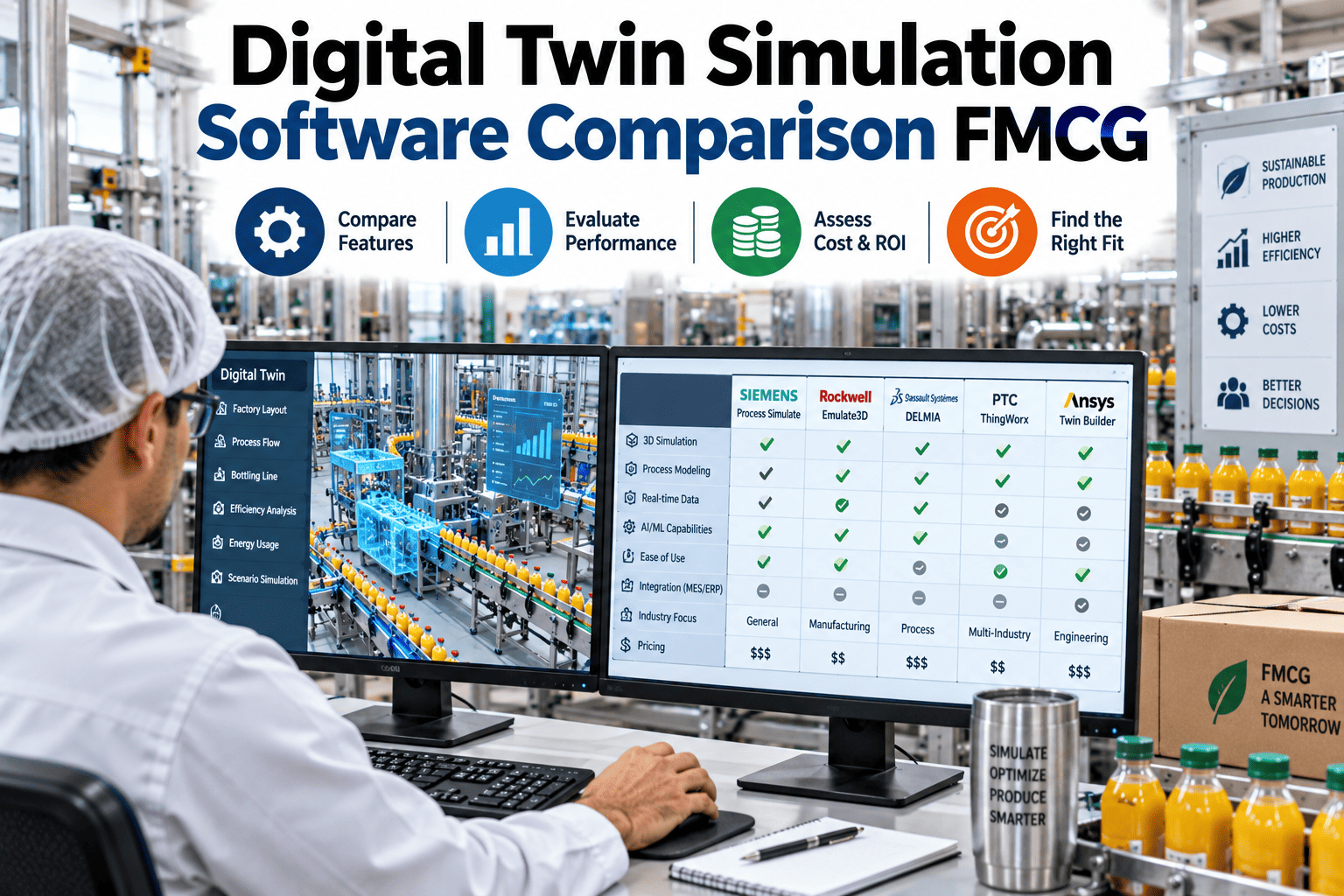
The table below reflects general patterns observed across digital twin platform categories in FMCG deployments, useful as a starting scorecard rather than a specific vendor ranking, since actual capability varies by release and configuration.
| Capability | Basic Visualization Tools | Simulation-Grade Platforms |
|---|---|---|
| Physics-based motion | Limited or none | Full kinematic and dynamic modeling |
| Changeover simulation | Rarely supported | Multi-format validation built in |
| Live PLC data sync | Static or one-way | Bidirectional real-time sync |
| Safety zone testing | Manual review only | Automated interlock validation |
| Scale to plant-wide | Rebuild required | Modular architecture reused |
The Kind Of Problems A Simulation-Grade Twin Should Catch Before Installation
The clearest way to judge a platform is by the specific problems it prevents rather than the features it lists. A filler running at a different cycle rate than its downstream capper produces a bottleneck that a physics-based model exposes immediately, long before conveyors and guarding are physically installed. A robotic palletizer arm swept through its full reach envelope in simulation reveals a spatial conflict with an adjacent structural column that a static layout drawing would never catch, because a drawing shows position, not motion. Changeover sequences run virtually across every SKU your line handles surface timing mismatches that only appear on specific format combinations, the kind of edge case that otherwise gets discovered during a live changeover trial with the whole shift standing around waiting.
None of these are hypothetical scenarios, they are the categories of finding that show up repeatedly across commissioning projects, and they are precisely what separates a genuinely useful digital twin from an expensive 3D walkthrough.
A Practical Selection Sequence For FMCG Plant And Engineering Teams
Define The Specific Failure Modes You Need Modeled
List the actual problems that have caused commissioning delays or changeover issues before, and use those as the evaluation criteria rather than a generic feature checklist.
Request A Model Of Your Own Equipment, Not A Demo Line
Insist on seeing your actual filler, capper, or palletizer modeled, since generic demo content tells you nothing about accuracy on your specific mechanical configuration.
Test Integration Against Your Existing Controls
Confirm the platform connects cleanly to the PLC and SCADA systems already on your floor before assuming a smooth rollout.
Pilot On One Line Before Committing Plant-Wide
A single-line pilot with a defined commissioning-time or downtime-reduction target gives you real evidence before a larger capital commitment.
Why FMCG Adoption Of Digital Twins Is Accelerating Faster Than Other Sectors
FMCG manufacturing runs shorter product cycles, more frequent format changes, and tighter margins than many other industrial sectors, which makes the cost of a delayed or disrupted line change disproportionately painful compared to slower-moving industries. That pressure is a meaningful part of why adoption in this sector has moved quickly: the same simulation capability that saves a few weeks of commissioning time on one project pays for itself again on the next format change, and the one after that, compounding in a way that a single large capital project in a more stable production environment simply doesn't. Plant leaders evaluating platforms in 2026 are increasingly weighing this recurring value against upfront license cost, rather than treating a digital twin as a one-time project tool.
Common Questions From FMCG Teams Evaluating Digital Twin Platforms
See What A Simulation-Grade Twin Looks Like On Your Own Line
iFactory models your actual equipment, not a generic demo, so you can evaluate commissioning-time savings and changeover accuracy before you commit budget. Book a demo and bring your hardest changeover scenario.