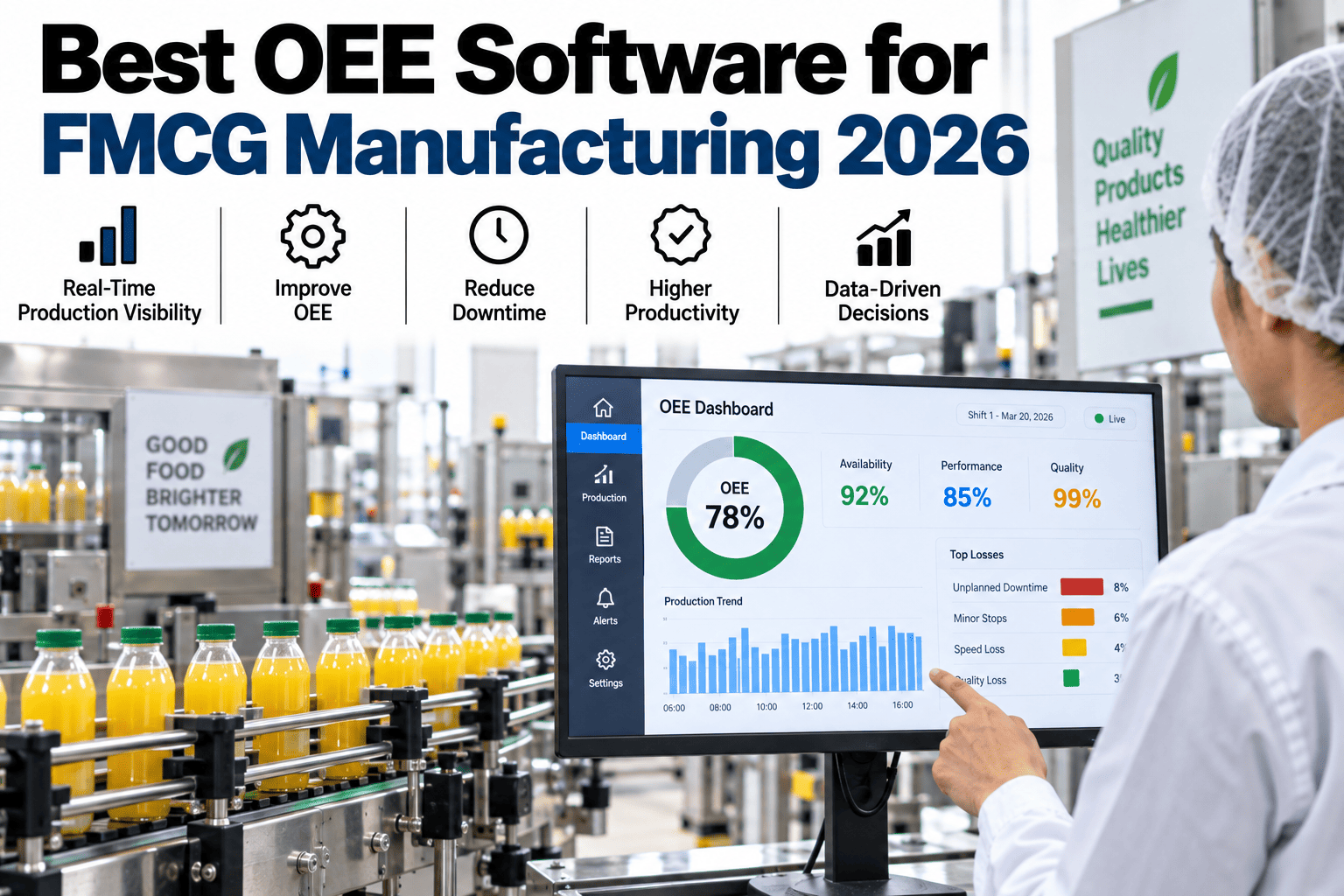
FMCG production lines lose more capacity to short stops, minor quality holds, and small speed deviations than to the dramatic breakdowns that get noticed automatically, and most OEE software on the market was built for discrete manufacturing, not the high-speed, high-SKU-count reality of a food, beverage, or personal care line. Choosing the wrong platform means chasing a downtime number that never quite matches what the floor actually experiences. Teams evaluating options can Book a Demo to see how iFactory's OEE platform is purpose-built for FMCG line speeds and loss patterns.
Why FMCG OEE Requirements Differ From General Manufacturing
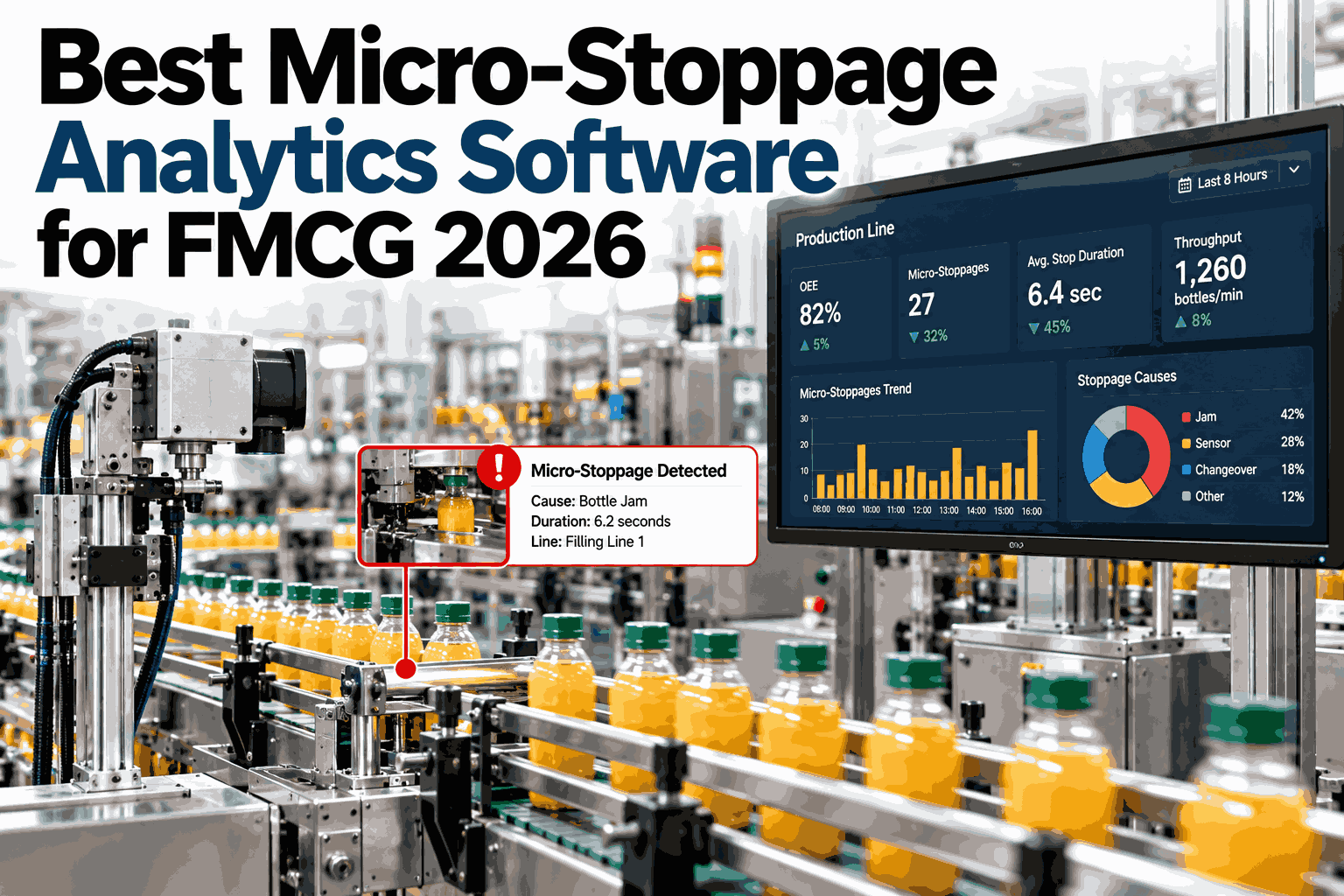
A generic OEE tool built for slower, lower-SKU discrete manufacturing tends to struggle in an FMCG environment for a specific reason — FMCG lines run at speeds where a stoppage lasting only a few seconds can still represent meaningful lost output, and a single shift might involve dozens of changeovers between SKUs as production switches between package sizes, flavors, or formulations. A platform that only captures stops longer than a minute, or that treats changeover time as a fixed constant rather than something to actively reduce, misses a large share of the loss that actually determines an FMCG plant's real capacity.
Evaluation Criteria That Actually Separate Platforms
Most OEE software vendors will claim to track availability, performance, and quality — the three standard OEE components — so a feature checklist alone rarely distinguishes platforms in a meaningful way. The differences that matter show up in the details: how granular the data capture actually is, how automatically it happens versus relying on manual operator entry, and how well the resulting numbers hold up against what the floor genuinely experiences during a shift.
| Evaluation Area | Weak Platform Signal | Strong Platform Signal |
|---|---|---|
| Stop capture granularity | Only stops over one minute logged automatically | Sub-minute stoppages captured without manual entry |
| Changeover analysis | Changeover treated as a single fixed downtime code | Changeover broken down by transition type and duration trend |
| Data collection method | Relies heavily on operator manual entry | Automated capture from line sensors and PLC data |
| Quality loss linkage | Quality holds tracked in a separate disconnected system | Quality loss integrated directly into the OEE calculation |
Deployment Considerations for High-SKU, High-Speed Lines
Beyond feature comparison, deployment reality matters just as much for FMCG plants specifically. A platform that requires extensive manual configuration for every SKU and every changeover type becomes a maintenance burden on a line that runs dozens of SKUs, while one designed with FMCG-scale SKU counts and rapid changeover cycles in mind handles this complexity with far less ongoing administrative overhead. Integration with existing PLC and SCADA infrastructure also matters more on FMCG lines, where retrofitting extensive new sensor hardware onto an already tightly packed, high-speed line is often impractical.
SKU Configuration Overhead
Platforms requiring manual setup per SKU or changeover type create growing administrative burden as portfolio complexity increases.
Existing Infrastructure Compatibility
Ability to pull data from existing PLC and SCADA systems avoids costly hardware retrofits on already space-constrained lines.
Multi-Line, Multi-Plant Rollout
Consistent OEE definitions and calculation logic across plants, so leadership can compare performance on an apples-to-apples basis.
Frequently Asked Questions: Best OEE Software for FMCG Manufacturing
What OEE stop-duration threshold is appropriate for a typical FMCG line?
Many FMCG lines benefit from capturing stops as short as a few seconds, since at typical line speeds even brief interruptions accumulate into meaningful lost output over a shift, but the exact threshold worth tracking depends on the specific line's speed and the granularity a plant's improvement process can realistically act on. Setting the threshold too coarse hides real loss, while setting it impractically fine can generate more data than a team can meaningfully review. Teams can Book a Demo to calibrate an appropriate threshold for a specific line.
How long does a typical OEE software implementation take on an existing FMCG line?
Implementation timelines vary based on existing infrastructure and how many lines are included in the initial rollout, but a platform that can integrate with existing PLC and SCADA data rather than requiring new hardware generally implements faster than one requiring a full sensor retrofit, often the difference between a matter of weeks versus several months for a comparable scope.
Should OEE targets be the same across every line in a multi-line FMCG plant?
Uniform targets across lines with genuinely different speeds, product complexity, and changeover frequency tend to produce misleading comparisons, since a line running a single high-volume SKU will naturally post a higher OEE than one running frequent changeovers across many SKUs even with equally strong operational performance. Setting line-specific targets that account for these structural differences gives a fairer basis for comparison and improvement tracking.
Can OEE software help reduce changeover time, or does it only measure it?
A platform that breaks changeover down by transition type and tracks duration trends over time does more than just measure it — it surfaces which specific changeover types are taking longer than they should, giving teams a concrete target for standardized work improvement rather than a single blended changeover average that hides where the actual opportunity lies.
How does OEE software handle lines that run multiple product formats on the same equipment?
Platforms designed for FMCG complexity typically calculate OEE separately by product format or SKU family run on a given line, since a single blended OEE figure across very different formats can obscure whether a performance issue is tied to a specific product configuration rather than the line as a whole. This format-level breakdown is especially useful for lines that alternate frequently between package sizes or product variants. Contact iFactory Support for guidance on configuring format-level OEE tracking.