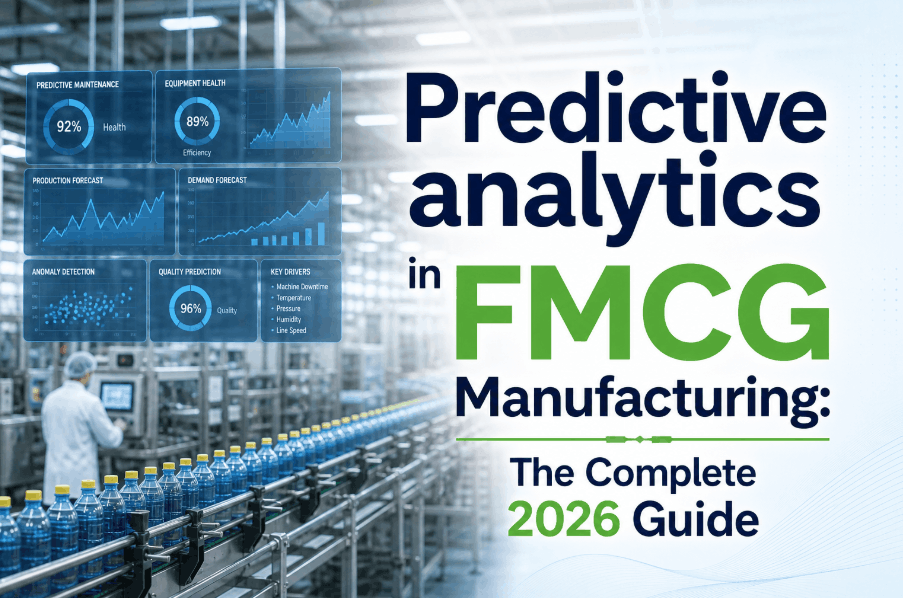
Predictive analytics in FMCG manufacturing has moved from an experimental capability to a competitive necessity. In 2026, consumer goods plants operating without AI-driven equipment monitoring are absorbing unplanned downtime costs that AI-equipped competitors have already eliminated. This guide breaks down exactly how predictive analytics works on the FMCG plant floor — from IoT sensor infrastructure and robotic inspection systems to real ROI benchmarks and a practical implementation roadmap for Operations and Reliability Directors ready to close the gap.
What Is Predictive Analytics in FMCG Manufacturing?
Predictive analytics in FMCG manufacturing is the application of machine learning models, IoT sensor streams, and historical failure data to forecast equipment degradation before it causes unplanned downtime. Unlike traditional preventive maintenance — which schedules interventions based on calendar time or production cycles — predictive analytics operates on actual condition data. Vibration signatures, temperature anomalies, current draw patterns, and acoustic emissions are continuously analyzed against trained failure models to generate alerts when a machine crosses into an abnormal operating envelope.
For consumer goods manufacturers, the operational impact is direct: lines that would have stopped for hours or days due to bearing failure, pump cavitation, or conveyor misalignment are instead serviced during planned windows — before the failure occurs. Book a demo to see how iFactory's predictive analytics module integrates with your existing FMCG line equipment.
The 2026 FMCG manufacturing environment makes this capability urgent. Margin compression, SKU proliferation, and retailer service level agreements leave no tolerance for unplanned stoppages. Plants that have deployed AI-driven analytics consistently report 40–60% reductions in unplanned downtime and OEE improvements of 8–15 percentage points within 12 months of full deployment.
Why FMCG Plants Are Uniquely Vulnerable to Unplanned Downtime
Consumer goods manufacturing operates under conditions that amplify the cost of every unplanned stoppage. High-speed packaging lines, continuous processing equipment, and climate-sensitive product streams mean that a single bearing failure on a filling line can halt an entire production block — not just the machine itself. Downstream buffer limitations in FMCG plants mean failures propagate rapidly across interconnected systems.
The equipment profile of a typical FMCG plant — motors, pumps, compressors, conveyors, heat exchangers, and packaging machinery — is well-suited to condition-based monitoring. These asset classes have established failure signatures that machine learning models can detect with high accuracy when trained on sufficient sensor history. The gap for most plants is not the availability of the technology; it is the operational infrastructure to connect sensor data to AI models and close the loop with maintenance teams in real time.
IoT Sensors: The Foundation of FMCG Predictive Analytics
Effective predictive analytics in FMCG manufacturing begins with a robust IoT sensor layer. The quality, density, and placement of sensors directly determines the accuracy and lead time of failure predictions. For FMCG plants deploying or upgrading condition monitoring infrastructure in 2026, the following sensor categories deliver the highest diagnostic value.
Vibration Sensors (Accelerometers)
The primary diagnostic tool for rotating equipment. Vibration analysis detects imbalance, misalignment, bearing wear, gear mesh faults, and looseness with high sensitivity. Wireless MEMS accelerometers mounted directly on bearing housings stream real-time FFT data to edge processors and cloud analytics platforms, enabling sub-millisecond fault detection in high-speed FMCG packaging and filling equipment.
Thermal Imaging and Temperature Sensors
Infrared thermography and contact temperature sensors identify electrical faults, overloaded motors, heat exchanger fouling, and lubrication degradation well before mechanical failure. In FMCG plants with continuous cooking, pasteurization, or chilling processes, thermal monitoring also ensures product safety compliance alongside equipment reliability goals. Book a demo to see how iFactory integrates thermal data into its FMCG predictive analytics dashboard.
Current and Power Quality Monitoring
Motor current signature analysis (MCSA) detects rotor bar faults, winding degradation, and mechanical overloading through harmonic analysis of current draw patterns. Power quality monitoring captures voltage sags, harmonic distortion, and imbalanced phases that accelerate motor and drive failures across FMCG production lines.
Ultrasonic Sensors
Airborne and contact ultrasound detects compressed air leaks, valve seat degradation, bearing lubrication faults, and partial electrical discharge. In FMCG plants where compressed air represents 15–25% of total energy consumption, ultrasonic leak detection alone delivers measurable ROI independent of downtime reduction.
Process and Flow Sensors
Pressure, flow rate, and level sensors on pumping systems, heat transfer circuits, and fluid handling infrastructure provide operational context that improves AI model accuracy. Deviations from normal operating curves — reduced pump head, increased differential pressure, declining flow efficiency — are early indicators of impeller wear, seal degradation, or fouling that vibration sensors alone may not detect until later failure stages.
Robotic and AMR-Based Equipment Inspection in FMCG Plants
A critical evolution in FMCG predictive monitoring is the deployment of Autonomous Mobile Robots (AMRs) for scheduled and on-demand equipment inspection. While fixed IoT sensors excel at continuous monitoring of accessible, stationary assets, AMRs extend condition monitoring to equipment in constrained, hazardous, or difficult-to-reach locations — filling the coverage gaps that static sensor networks leave behind.
In FMCG manufacturing environments, AMR inspection platforms are typically equipped with thermal cameras, ultrasonic sensors, gas detectors, and visual inspection modules. They execute programmed inspection routes during changeovers or low-production windows, uploading sensor readings directly to the plant's predictive analytics platform for AI analysis. Book a demo to see how iFactory's IoT monitoring platform integrates AMR inspection data alongside fixed sensor streams.
Thermal and Vibration Scanning of Inaccessible Assets
AMRs equipped with non-contact thermal and vibration sensors inspect motors, drives, and junction boxes located in confined spaces, elevated positions, or hazardous zones where fixed sensor installation is impractical. Inspection data is time-stamped and geolocated, creating auditable equipment health records for each inspection pass.
Visual Defect Detection with AI Image Analysis
High-resolution cameras mounted on AMR platforms capture equipment surface conditions — oil leaks, belt wear, coupling misalignment, corrosion, and insulation damage — that automated visual AI systems classify and trend over sequential inspection cycles, enabling degradation rate modeling unavailable through sensor data alone.
Gas and Environmental Monitoring
In FMCG plants handling volatile organic compounds, refrigerants, or cleaning chemicals, AMRs provide mobile gas detection coverage that supplements fixed-point gas sensors. Real-time leak detection integrated with predictive analytics platforms triggers maintenance dispatch before environmental or safety thresholds are breached.
Inspection Data Integration with Predictive Models
AMR inspection datasets feed directly into the same AI analytics models that process fixed sensor data — creating a unified equipment health record that combines continuous monitoring signals with periodic physical inspection findings. This fusion approach significantly improves fault classification accuracy and reduces false positive alert rates.
AI and Machine Learning Models Driving FMCG Predictive Analytics
The predictive power of an FMCG analytics platform depends entirely on the quality and architecture of its underlying machine learning models. Understanding which model types are applied to which failure modes helps Operations Directors evaluate platform capabilities and set realistic performance expectations during procurement and deployment.
| Model Type | Primary Application | Data Input | Typical Lead Time Before Failure |
|---|---|---|---|
| Anomaly Detection (Isolation Forest, Autoencoders) | Baseline deviation alerts for motors, pumps, conveyors | Vibration, current, temperature | 2–8 weeks |
| Remaining Useful Life (RUL) Regression | Bearing and gear degradation tracking | Vibration FFT, temperature trend | 1–6 weeks |
| Classification Models (Random Forest, XGBoost) | Fault type identification and root cause categorization | Multi-sensor fusion data | Days to weeks |
| Time-Series Forecasting (LSTM, Transformer) | Operational parameter drift and process degradation | Process sensor streams, historian data | 1–4 weeks |
| Computer Vision (CNN-based) | Visual defect detection via AMR and fixed cameras | Camera images, AMR inspection frames | Inspection-dependent |
The most effective FMCG predictive analytics platforms do not rely on a single model type. They deploy model ensembles that combine anomaly detection for early-warning breadth with fault classification models for alert specificity — reducing both missed failures and false positive alerts that erode maintenance team trust in AI recommendations. Book a demo to explore iFactory's multi-model analytics architecture for FMCG equipment types.
OEE Improvement Through Predictive Analytics: What the Data Shows
Overall Equipment Effectiveness is the primary performance metric through which FMCG plants quantify the return on predictive analytics investment. OEE improvement from predictive analytics manifests across all three OEE components — Availability, Performance, and Quality — though the most direct and largest gains come through Availability improvements driven by unplanned downtime elimination.
Industry benchmarks from FMCG plants with mature predictive analytics deployments (18+ months post-implementation) consistently show: Availability improvements of 6–14 percentage points from elimination of unplanned stoppages; Performance improvements of 2–5 percentage points from early identification of speed-degrading mechanical conditions; Quality improvements of 1–3 percentage points from process stability gains as equipment operates within tighter condition tolerances. Combined OEE gains of 8–18 percentage points represent $2M–$12M in annual recovered production value for a mid-size FMCG plant operating at $50M–$200M annual revenue, depending on line count and baseline OEE.
The FMCG plants capturing the highest OEE returns from predictive analytics share three operational characteristics: they have integrated their analytics platform with CMMS/EAP systems to automate work order generation from AI alerts; they have structured their maintenance team around condition-based intervention rather than calendar-based rounds; and they review model performance weekly, retraining on new failure events to continuously improve prediction accuracy over time.
Common FMCG Predictive Analytics Implementation Failures — and How to Avoid Them
Despite clear ROI evidence, a significant proportion of FMCG predictive analytics deployments underperform against initial projections. Understanding the most common failure patterns allows Operations and Reliability Directors to structure implementations that avoid the pitfalls that derail peer programs.
FMCG Predictive Analytics Implementation Roadmap: Five Phases to Full Deployment
For Reliability and Operations Directors building the business case and implementation plan for predictive analytics in their FMCG plant, the following five-phase roadmap reflects best practices from successful deployments across food, beverage, personal care, and household products manufacturing environments.
Critical Asset Register and Failure Mode Analysis
Document every asset with significant downtime impact potential. For each asset, identify dominant failure modes, current detection method, average time between failures, and average repair duration. This failure mode register becomes the prioritization input for sensor deployment and model training. Output: ranked asset criticality register with failure mode profiles and monitoring gap documentation.
IoT Sensor Infrastructure Deployment
Deploy IoT condition monitoring sensors on Tier 1 and Tier 2 critical assets. Establish edge computing nodes for local data processing and configure secure data transmission to the analytics platform. Commission wireless sensor networks and validate data quality against known machine operating states before activating AI models. Output: validated sensor network with confirmed data quality for all monitored assets.
AI Model Training and Baseline Establishment
Train anomaly detection models on 4–12 weeks of normal operating data per asset class. Configure failure classification models using historical maintenance records and failure data. Establish alert thresholds with input from maintenance technicians familiar with each asset type. Conduct controlled alert simulation to validate detection accuracy before production go-live. Output: calibrated AI model set with validated detection thresholds per asset class.
CMMS Integration and Workflow Redesign
Integrate the predictive analytics platform with your CMMS to automate work order generation from confirmed AI alerts. Redesign maintenance scheduling to incorporate condition-based intervention windows alongside remaining PM tasks. Train maintenance and reliability teams on alert interpretation, escalation procedures, and feedback processes for model improvement. Output: live CMMS integration with automated alert-to-work order workflow and trained maintenance team.
Performance Review, Model Retraining, and Coverage Expansion
Review AI model performance monthly for the first six months — tracking true positive rate, false positive rate, and average alert lead time against actual failure events. Retrain models on confirmed failure data to continuously improve accuracy. Expand sensor coverage to Tier 3 assets based on ROI data from the initial deployment. Output: continuously improving predictive analytics program with documented OEE and downtime impact metrics.
Predictive Analytics vs. Preventive Maintenance: The FMCG Cost Comparison
One of the most persistent barriers to predictive analytics adoption in FMCG manufacturing is the perceived cost comparison against established preventive maintenance programs. The true cost picture, when fully accounted, consistently favors predictive analytics — but the comparison requires including all cost categories that preventive programs typically obscure.
Preventive maintenance programs in FMCG plants average 30–40% unnecessary maintenance interventions — components replaced before failure that had significant remaining useful life. Each unnecessary replacement carries parts cost, labor cost, and production interruption cost. Predictive analytics eliminates this category of waste almost entirely by deferring intervention to the point of demonstrated need. Book a demo to model the ROI of transitioning your FMCG plant's maintenance strategy to AI-driven predictive analytics.
The total cost of ownership comparison also shifts when FMCG plants account for secondary failure costs — the damage a failing bearing or pump causes to adjacent components before it is detected and repaired. Predictive analytics' 2–8 week advance warning window consistently reduces secondary damage rates by 60–80%, compressing repair costs significantly relative to reactive and scheduled-based approaches.
Frequently Asked Questions: Predictive Analytics in FMCG Manufacturing
What FMCG equipment types benefit most from predictive analytics?
Rotating equipment — motors, pumps, compressors, fans, and gearboxes — delivers the highest predictive analytics ROI in FMCG plants due to well-established vibration failure signatures. Packaging machinery, filling lines, conveyors, and heat exchangers are also high-value targets. Assets with long repair lead times or single-point-of-failure production roles should be prioritized for initial sensor deployment.
How long does predictive analytics take to deliver measurable downtime reduction in FMCG?
Most FMCG plants see measurable unplanned downtime reduction within 3–6 months of go-live, with full OEE impact typically visible at 9–12 months as AI models mature on plant-specific failure data. Plants with good historical maintenance records achieve faster model accuracy because failure signatures can be validated against confirmed past events rather than accumulated prospectively.
Can predictive analytics integrate with existing FMCG ERP and CMMS systems?
Modern predictive analytics platforms for FMCG manufacturing support API-based integration with all major CMMS platforms (SAP PM, Maximo, Infor EAM, eMaint) and ERP systems. Integration enables automated work order generation from AI alerts, parts pre-ordering triggered by degradation forecasts, and OEE data consolidation across production and maintenance systems.
Is predictive analytics viable for small and mid-size FMCG manufacturers?
Yes. Cloud-based predictive analytics platforms have reduced deployment costs significantly, making the technology accessible to mid-size FMCG plants operating 2–10 production lines. SaaS pricing models eliminate the need for on-premise AI infrastructure. Wireless IoT sensors reduce installation costs further by eliminating cable runs. Payback periods for mid-size FMCG deployments typically range from 12–24 months depending on asset criticality and baseline downtime rates.