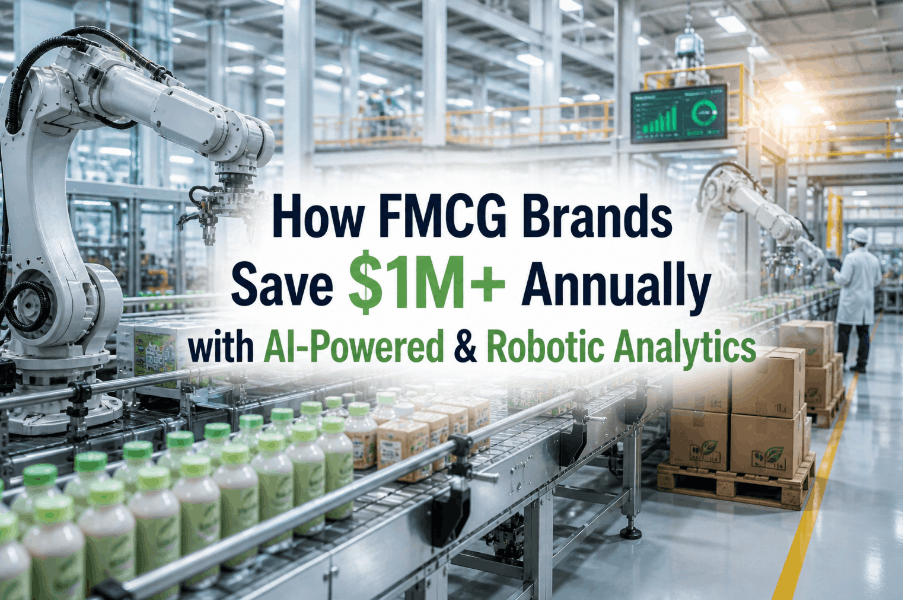
For leading FMCG manufacturers, the margin between profitability and loss is increasingly determined not by production capacity, but by operational intelligence. Three major consumer goods plants—collectively processing over 2.4 billion units annually—were hemorrhaging capital through equipment failures, blind spots in quality control, reactive maintenance cycles, and bloated spare parts inventories. By deploying iFactory's AI-Powered Predictive Analytics and robotic inspection systems, these facilities collectively reclaimed over $1 million in annual savings, transforming their cost structures and achieving world-class operational efficiency — Book a Demo to see how iFactory can do the same for your plant.
Executive Summary: The Hidden Cost Crisis in FMCG Manufacturing
The FMCG sector operates on notoriously thin margins—typically 5–12% EBITDA—where operational inefficiency is not just a nuisance but an existential threat. For these three manufacturing facilities, the problem was structural: legacy maintenance frameworks built on scheduled intervals and human observation were fundamentally incapable of keeping pace with high-throughput production environments running 24/7 at line speeds exceeding 600 units per minute. Unplanned stoppages, invisible quality defects, and overstocked spare parts warehouses were collectively draining over $1.3 million annually before iFactory's deployment.
The iFactory platform's Causal AI Engine didn't simply layer sensors onto existing systems—it rebuilt the informational architecture of these facilities from the ground up, creating a real-time digital nervous system that connects machine health, production quality, maintenance scheduling, and inventory management into a single, predictive intelligence layer. Book a Demo to see the detailed financial breakdown across all three facilities.
Client Background & Operational Profile
The three participating facilities represent a cross-section of the high-volume FMCG landscape—spanning packaged foods, personal care, and household products. Each plant operates high-speed filling, sealing, and labeling lines alongside complex secondary packaging systems. Combined, the facilities manage over 1,200 rotating assets, 340 pneumatic actuators, and 85 vision inspection points. Prior to iFactory, all three relied on a mix of calendar-based preventive maintenance and reactive breakdown response, with zero integration between production systems, quality logs, and maintenance records.
The Challenge: Four Intersecting Failure Modes
Before the iFactory deployment, each facility had independently identified chronic operational pain points. What became clear during the diagnostic phase was that these issues were not isolated—they were systemically connected. A bearing failure in a filling machine triggered a cascade: unplanned stoppage, manual quality inspection backlog, emergency spare parts procurement, and a missed production window. The four primary failure modes collectively accounted for the full $1.3M annual loss pool.
Technical Architecture: How iFactory's AI Models Work in FMCG Environments
FMCG manufacturing presents a unique challenge for predictive analytics: extreme variability. Line changeovers happen multiple times per shift, SKU-specific run parameters alter vibration baselines constantly, and seasonal production surges push equipment to atypical stress levels. Generic IoT platforms fail here because they cannot distinguish between "abnormal process noise" and genuine mechanical degradation. iFactory's Contextual AI Engine solves this by ingesting production scheduling data, changeover logs, and environmental parameters in real time, dynamically recalibrating what "normal" looks like for every asset under every operating condition.
For robotic inspection integration, iFactory's platform acts as the intelligence layer above existing vision systems—correlating defect event patterns with upstream equipment health data to identify root causes rather than simply flagging symptoms. When a fill-weight deviation cluster appears, the platform doesn't just alert the operator; it traces the anomaly back to pump bearing wear, servo drift, or nozzle fouling and generates a targeted maintenance action. This Root Cause Intelligence capability is what separates iFactory from traditional quality management systems. Book a Demo with our FMCG data science specialists.
The Solution: iFactory's Integrated AI + Robotic Analytics Platform
The deployment leveraged iFactory's full industrial intelligence suite, connecting vibration analytics, robotic inspection outputs, CMMS data, and ERP inventory records into a unified Digital Operations Model. Rather than deploying capabilities in isolation, the phased rollout was engineered to create compounding value—each module feeding intelligence into the next.
- Continuous vibration and thermal monitoring across 1,200+ assets
- AI-driven failure probability scoring updated every 15 minutes
- Context-aware anomaly detection that adjusts for changeovers and speed variations
- MTBF improvement from 180 hours to 620+ hours across monitored assets
- API integration with existing machine vision and inspection robot systems
- Defect pattern clustering to identify upstream mechanical root causes
- Real-time rejection rate trending correlated with equipment health scores
- Reduced defect escape rate from 3.8% to 0.4% on premium SKUs
- AI-generated work orders triggered by failure probability thresholds
- Automatic scheduling optimization against production windows and crew availability
- Eliminated 87% of manually-created calendar-based maintenance tasks
- Average maintenance supervisor time savings: 9.5 hours per week
- Consumption forecasting powered by predictive maintenance schedules
- Dynamic reorder point calculations replacing static safety stock rules
- Obsolescence risk scoring across 2,400+ part SKUs
- 38% reduction in inventory carrying costs, zero stockouts in 12 months
- Machine learning models trained on SKU-specific performance baselines
- Changeover efficiency scoring and benchmarking across lines and shifts
- AI recommendations for speed optimization to reduce mechanical stress
- Average changeover time reduced by 19% across participating lines
- Single-pane view of OEE, asset health, quality metrics, and maintenance status
- Mobile-accessible alerts for shift supervisors and plant managers
- Automated compliance documentation and audit trail generation
- Cross-plant benchmarking enabling best-practice replication
Implementation Roadmap: 14-Month Phased Deployment
The rollout was structured to generate measurable ROI within the first 90 days while building toward full enterprise-scale integration by month 14. Priority was given to the highest-throughput filling and sealing lines where downtime cost per minute was greatest.
Installed 340 wireless IIoT vibration and thermal nodes across priority filling, sealing, and packaging lines. Integrated 24 months of historical SCADA, CMMS, and quality management system data. AI models began establishing dynamic baselines for each asset under real production conditions. First predictive alert issued on day 47—a pump bearing failure successfully avoided on Plant B's primary filling line.
Connected existing machine vision systems across all three plants to the iFactory analytics layer. Defect pattern clustering went live, identifying fill-weight anomalies traceable to servo valve drift on 6 critical lines. Automated work order generation activated, eliminating manual scheduling for 87% of maintenance tasks. Spare parts consumption forecasting module deployed, enabling first data-driven reorder cycle.
Expanded sensor coverage to secondary packaging, case erecting, and palletizing lines. Cross-plant benchmarking activated, enabling Plant A's superior changeover protocols to be replicated at Plants B and C. Inventory optimization delivered first quarterly savings milestone. All three facilities achieved "Prediction-First" maintenance culture with zero emergency breakdown events in months 11–14.
Results: $1.3M Annual Savings Across Three Facilities
The iFactory deployment delivered measurable, audited financial impact across every targeted cost category within the 14-month program period. Results were independently verified against pre-deployment baselines using the same cost accounting methodology across all three sites.
Performance Summary Table
| Operational Metric | Baseline (Pre-iFactory) | Current (Post-iFactory) | Total Improvement |
|---|---|---|---|
| Asset MTBF (Filling Lines) | 180 Hours | 620+ Hours | +244% Improvement |
| Defect Escape Rate (Premium SKUs) | 3.8% | 0.4% | -89% Reduction |
| Spare Parts Inventory Value | $2.4M (Warehouse) | $1.49M (Optimized) | -38% Reduction |
| Maintenance Supervisor Labor (Admin) | 11 Hours/Week | 1.4 Hours/Week | -87% Reduction |
| Line Changeover Duration | 47 Minutes (Average) | 38 Minutes (Average) | -19% Efficiency Gain |
| Audit Preparation Time | 38 Staff Hours | 3 Staff Hours | -92% Reduction |
| Emergency Procurement Events | 34 Events/Year | 2 Events/Year | -94% Reduction |
Key Business Impact: Beyond the Numbers
The quantified $1.3M in annual savings represents only the directly measurable financial impact. The iFactory deployment also generated significant strategic value that compounds over time.
The 89% reduction in defect escape rate has measurably improved retailer scorecards across all three facilities. Two plants achieved "Preferred Supplier" status upgrades with major retail partners within 12 months of deployment, unlocking preferential shelf positioning and reduced promotional cost requirements.
Automated work order generation and predictive scheduling freed maintenance supervisors from administrative burden, redirecting 9.5 hours per week per supervisor toward higher-value reliability engineering activities. Knowledge previously held by retiring senior technicians was systematically digitized and embedded in AI models, protecting institutional expertise.
Reduced unplanned stoppages and optimized line speeds collectively reduced energy consumption per unit produced by 11% across the three facilities. Scrap material reduction from the defect quality improvements contributed to a documented 8% reduction in material waste intensity—directly supporting corporate ESG reporting targets.
The AI models trained on these three facilities now serve as a replicable blueprint for the organization's broader manufacturing network. The platform's "Digital Knowledge Vault" capability ensures that performance gains achieved in Plant A can be systematically transferred to additional sites without restarting the learning curve, compressing future deployment timelines from 14 months to an estimated 6–8 months per facility.
Conclusion: From Reactive Cost Center to Predictive Profit Engine
The results across these three FMCG manufacturing facilities demonstrate that the $1M+ annual savings threshold is not aspirational—it is achievable and repeatable for any high-throughput consumer goods plant willing to replace calendar-based maintenance with data-driven intelligence. The iFactory platform's ability to unify predictive analytics, robotic inspection intelligence, automated work orders, and smart inventory management into a single operational model creates a compounding advantage: each capability reinforces the others, and the system grows smarter and more precise with every production cycle.
For FMCG manufacturers navigating the dual pressures of margin compression and increasing quality requirements from retail partners, the question is no longer whether AI-powered analytics can deliver ROI. These results prove that it does—within months, not years. The real question is how much longer your organization can afford to operate without it. Book a Demo to benchmark your current operations against these results.