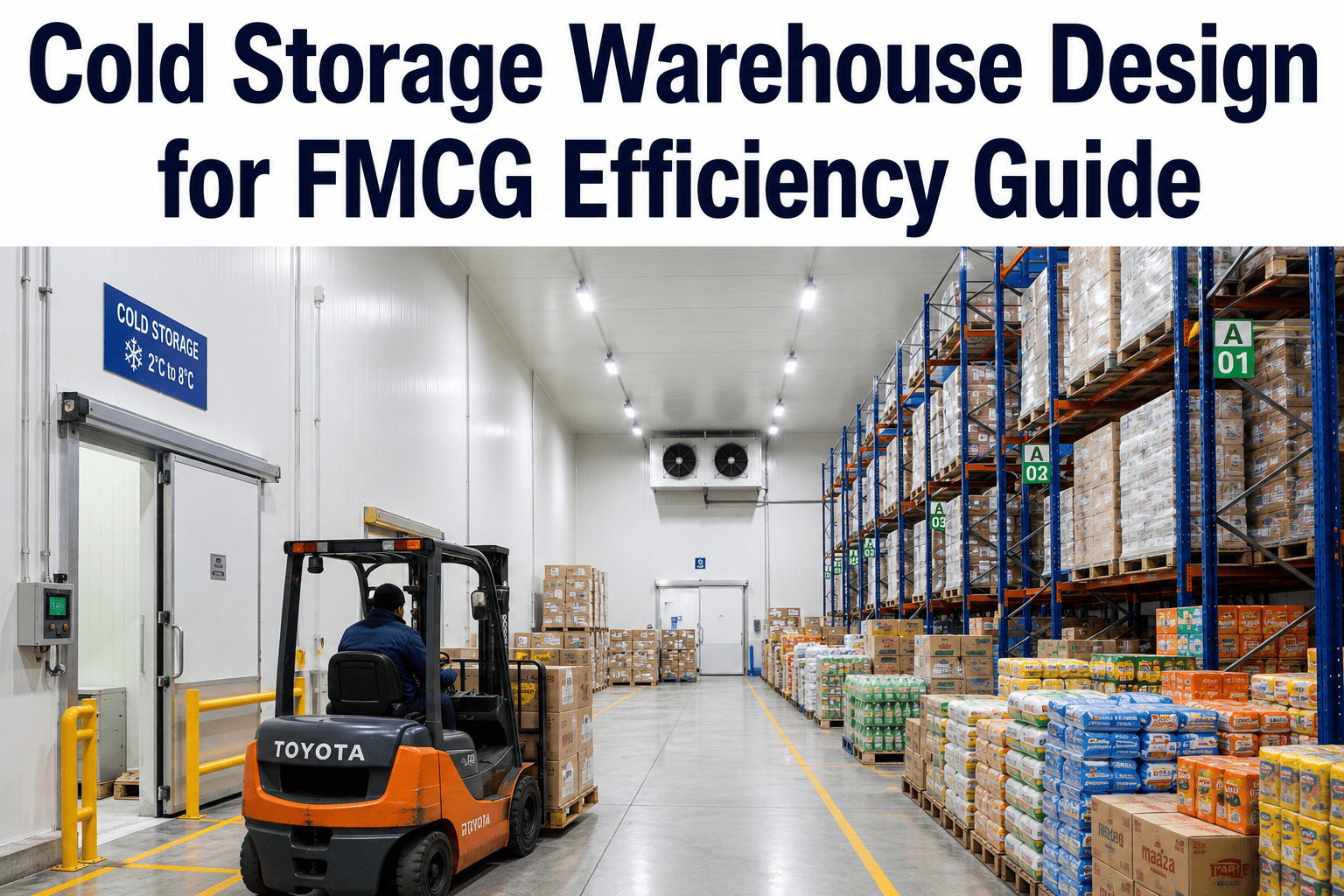
A cold storage warehouse spends most of its energy budget fighting the same battle over and over: warm outside air pushing its way in every time a dock door opens, forklift traffic hauling heat in through the door with it, and refrigeration equipment working overtime to pull that heat back out before it reaches product stacked near the entrance. Most of that fight is decided long before the facility opens, in decisions about dock design, air curtains, temperature zoning, and rack layout that either work with the physics of cold air or constantly fight against it. Retrofitting a badly designed facility later is possible but expensive, while getting the layout right at the design stage is close to free by comparison. See how these design principles apply to your own facility footprint at ifactory support.
Cold Storage Design
The Warehouse Layout Decisions That Determine Your Energy Bill for a Decade
Dock design, air curtain placement, temperature zoning, and rack layout choices that cut energy consumption while keeping product exactly where it needs to be in the temperature range it needs.
The Dock Door: Where Most of the Energy Loss Actually Happens
A single dock door left open during a loading cycle can exchange more conditioned air with the outside than the rest of the facility loses in an entire day of normal operation, which makes dock design the single highest-leverage decision in a cold storage layout. The physics are straightforward: cold air is denser than warm air and sinks, so an open dock door creates a natural exchange where warm outside air flows in near the top of the opening while cold conditioned air spills out near the bottom, regardless of how well-sealed the rest of the building envelope is.
Vestibule Dock Design
A sealed intermediate space between the outside door and the cold storage door reduces direct air exchange to a single, smaller opening at a time.
Air Curtain Placement
A properly sized air curtain across the dock opening creates a barrier of moving air that resists the natural exchange, but only if sized correctly for the opening height and width.
Dock Leveler Sealing
Inflatable or foam dock seals that conform tightly around the trailer body close the gap between the trailer and the building during loading.
Sizing an Air Curtain Correctly
An undersized air curtain is close to useless, since it fails to generate enough velocity to actually resist the pressure differential across a large dock opening, while an oversized one wastes energy running a fan far larger than the opening requires. Sizing depends on the actual opening dimensions, the temperature differential between the cold storage side and the outside, and the frequency and duration of door-open events at that specific dock. A facility running high-frequency, short-duration door cycles has different air curtain requirements than one running fewer, longer cycles, even if both facilities have identical opening sizes.
Air Curtain Sizing Reference by Dock Opening
Temperature Zoning: Not Every Product Needs the Coldest Room
A common and costly design mistake is building a single facility to the coldest temperature requirement across the whole product mix, which means chilled dairy sitting at four degrees ends up stored in a room built and refrigerated for frozen goods at minus eighteen, simply because it shares a building with frozen inventory. Proper zoning separates the facility into distinct temperature bands, each refrigerated only as aggressively as its own product mix requires, with buffer zones between bands to reduce the load on any single zone's equipment from adjacent temperature differentials.
Frozen Zone
Minus eighteen degrees or colder, isolated with its own dedicated refrigeration and minimal door traffic.
Chilled Zone
Zero to four degrees for dairy, deli, and similar categories, separated from frozen to avoid unnecessary overcooling.
Cool Ambient Zone
Ten to fifteen degrees for temperature-sensitive but non-refrigerated categories like some beverages and confectionery.
Buffer / Staging Zone
An intermediate temperature space between zones and the dock, reducing the differential any single zone has to fight.
Not Sure If Your Current Layout Is Fighting Itself?
Bring your facility floor plan and product mix to the call. We will walk through where zoning and dock design changes would cut energy load.
Rack Layout: Airflow Matters as Much as Storage Density
It is tempting to maximize storage density by packing racking as tightly as possible, but refrigeration equipment depends on airflow to actually maintain consistent temperature throughout a room, and racking that blocks that airflow creates warm pockets even in a room where the overall average temperature reads correctly. Racking laid out with clear aisles aligned to the room's air circulation pattern, adequate clearance from cooling units, and consistent spacing between pallets maintains far more even temperature distribution than the same total storage capacity packed without regard to airflow.
1
Map Airflow Before Placing Racks
Identify where cooling units push air and where it returns before finalizing rack aisle orientation.
2
Keep Clearance Around Cooling Units
Stacking product too close to evaporator units restricts airflow and creates localized warm or cold spots.
3
Align Aisles With the Circulation Pattern
Aisles running parallel to the primary air movement direction maintain more even temperature than perpendicular layouts.
4
Place Fastest-Moving SKUs Nearest the Dock
Reduces the distance and time product spends in transit through varying temperature zones within the facility.
Energy Efficiency by Design Choice
Energy Reduction From Proper Vestibule Dock Design
Relative to a direct-opening dock with no intermediate sealed space
Energy Reduction From Correct Temperature Zoning
Relative to storing all products at the coldest required temperature
Temperature Consistency From Airflow-Aware Rack Layout
Relative to a layout optimized purely for storage density
Four Design Mistakes That Get Baked In Permanently
Building One Temperature for the Whole Facility
Refrigerating the entire building to the coldest product's requirement wastes significant energy on everything else stored there.
Undersizing Air Curtains to Save Upfront Cost
A cheaper, undersized unit fails to resist air exchange and ends up costing more in ongoing energy loss than the upfront savings.
Racking Too Close to Cooling Units
Maximizing storage density at the expense of airflow clearance creates inconsistent temperature that undermines monitoring data.
No Buffer Zone Between the Dock and Cold Storage
A direct transition from ambient loading area to cold storage maximizes the temperature differential the refrigeration system fights constantly.
Wondering how much energy your current facility layout is losing to avoidable design gaps? Talk to our team for a walkthrough.
Frequently Asked Questions
Is it worth retrofitting air curtains into an existing facility rather than waiting for a new build?
Retrofitting air curtains is one of the more cost-effective upgrades available to an existing cold storage facility, since it addresses the single largest source of energy loss without requiring structural changes to the building itself. The payback period is typically measured in months rather than years for high-traffic dock doors.
Talk to our team about evaluating this for your specific docks.
How many temperature zones does a typical FMCG cold storage facility actually need?
Most facilities handling a mixed FMCG product line benefit from three to four zones: frozen, chilled, cool ambient, and a buffer or staging area, though the exact number depends heavily on the specific product mix and how distinct the temperature requirements are across categories. Fewer zones simplify operations but sacrifice some energy efficiency; more zones improve efficiency but add operational complexity.
Does rack layout really affect temperature that much if the room's overall reading looks fine?
Yes, a single sensor reading the room average can look completely normal while pockets near poorly placed racking sit several degrees off from that average, especially near cooling units with restricted airflow. This is exactly why zone-level and multi-point sensor coverage matters alongside good rack layout, since a single average reading can mask real localized problems.
What's the difference between a vestibule dock and a standard dock seal?
A dock seal closes the gap around a trailer during active loading, while a vestibule creates an entirely separate intermediate space with its own door between the outside and the cold storage area, reducing air exchange even when a trailer is not present or during the moments a trailer is backing in. The two are complementary rather than substitutes, and higher-traffic docks often benefit from both.
Book a scoping call to see which combination fits your facility.
Should fastest-moving SKUs always be placed closest to the dock?
In most cases yes, since it reduces both labor time and the cumulative time product spends being moved through varying temperature conditions within the facility, but this needs to be balanced against maintaining clear airflow paths and not creating congestion near the dock that slows down loading itself.
Stop Fighting Your Own Building Layout.
Get a Design Review Built Around Your Product Mix
Bring your facility floor plan and product categories to the call. We will walk through dock, zoning, and rack layout changes that would cut your energy load.
Zoned
Temperature bands, not one setting
Sealed
Dock openings with proper sizing
Airflow-Aware
Rack layout, not just dense
Lower
Sustained energy cost