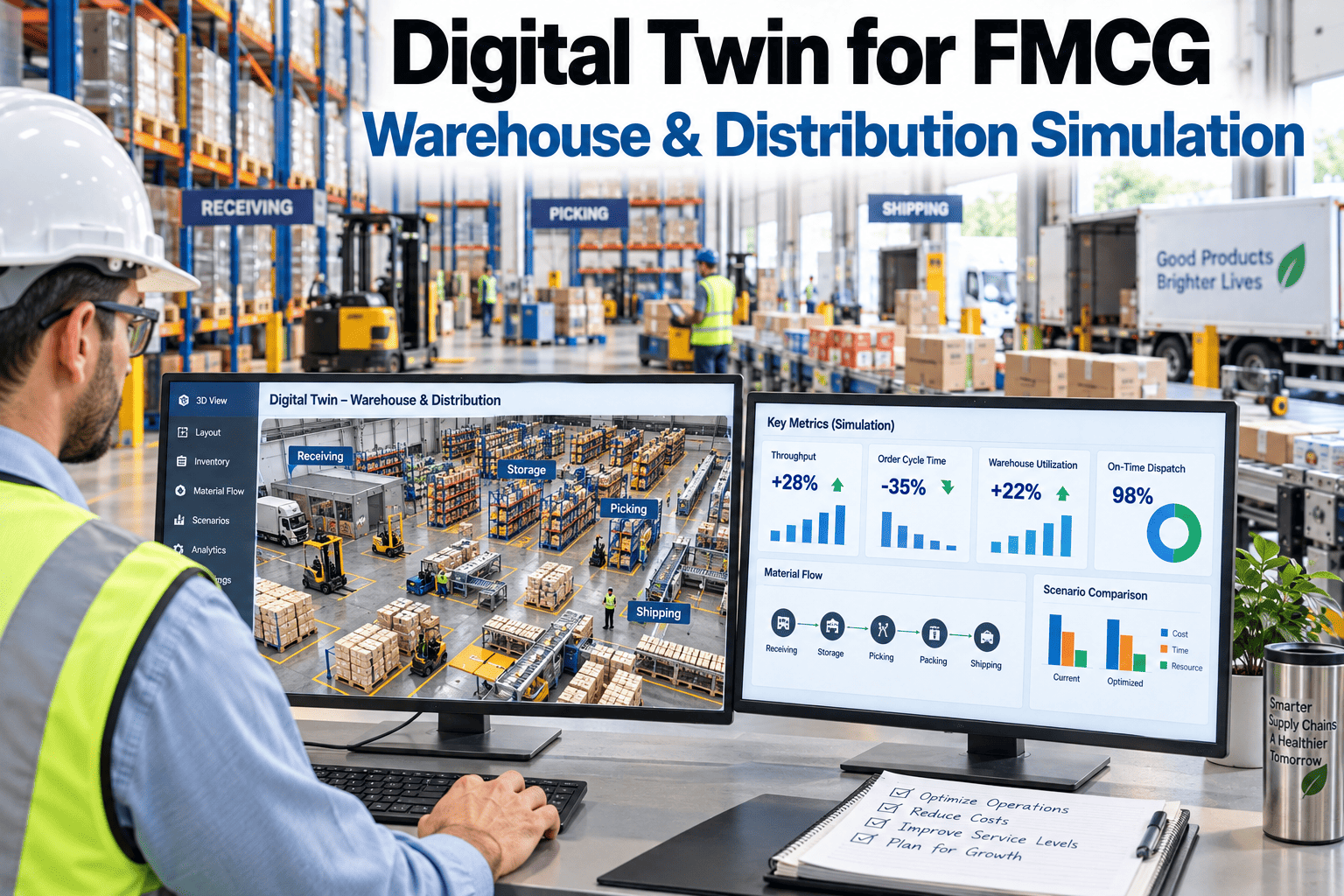
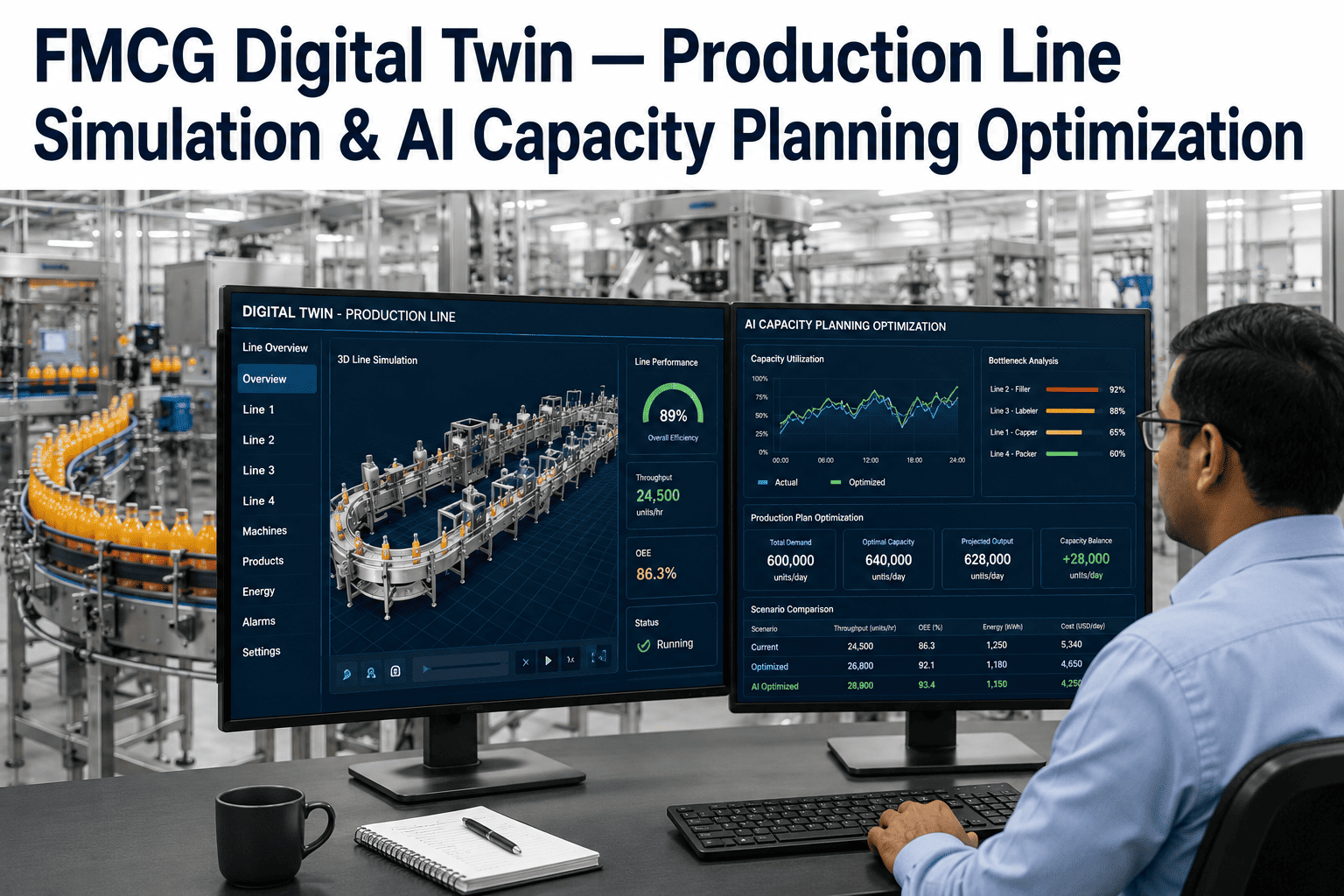
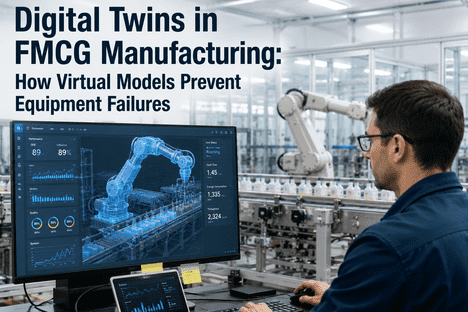
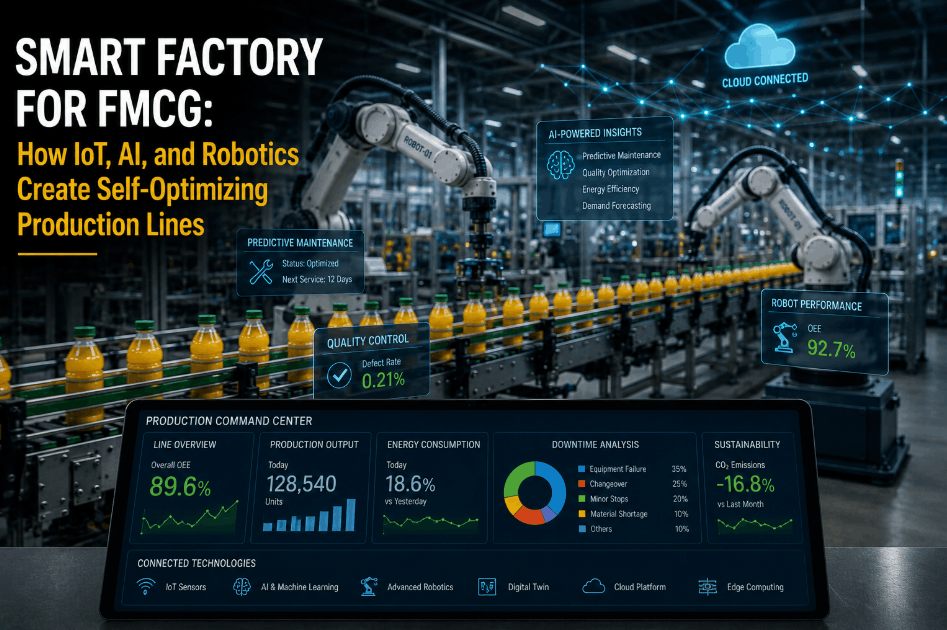
Before a single conveyor belt is adjusted, before a new filling sequence is tested, before a production changeover is executed — what if your factory could run the entire scenario first in a perfect virtual replica and show you exactly what would happen? That is the operational reality that digital twin technology is delivering to FMCG manufacturers in 2026. A digital twin is a continuously updated, physics-accurate virtual model of your production environment — synchronized with live sensor data and capable of simulating future states, stress-testing process changes, and predicting outcomes before any physical intervention occurs.
Digital Twin Technology for FMCG Production Optimization
Simulate every process change, production scenario, and equipment decision in a virtual factory — before it costs you time, material, or output on the real floor.
What Makes a Digital Twin Different From a Simulation
Traditional simulations are static — they model a scenario once, based on assumptions. A digital twin is live. It continuously ingests real-time data from sensors, PLCs, and production systems on your actual factory floor and updates its virtual model accordingly. Every machine state, temperature reading, throughput measurement, and quality flag in the physical factory is mirrored in the twin within milliseconds.
This live synchronization is what unlocks the technology's core value for FMCG: you can run predictive scenarios against a model that reflects today's exact operational state, not a static baseline captured months ago. When you ask "what happens if I increase line speed by 12% on the afternoon shift," the digital twin answers using current machine wear status, current ambient conditions, and current product specifications. Sign up for iFactory to explore digital twin integration for your FMCG production environment.
Five Ways FMCG Manufacturers Use Digital Twins Right Now
The value of digital twin technology in FMCG is not theoretical — leading manufacturers across food, beverage, personal care, and household products are deploying it across five distinct operational domains.
Production Line Speed Optimization
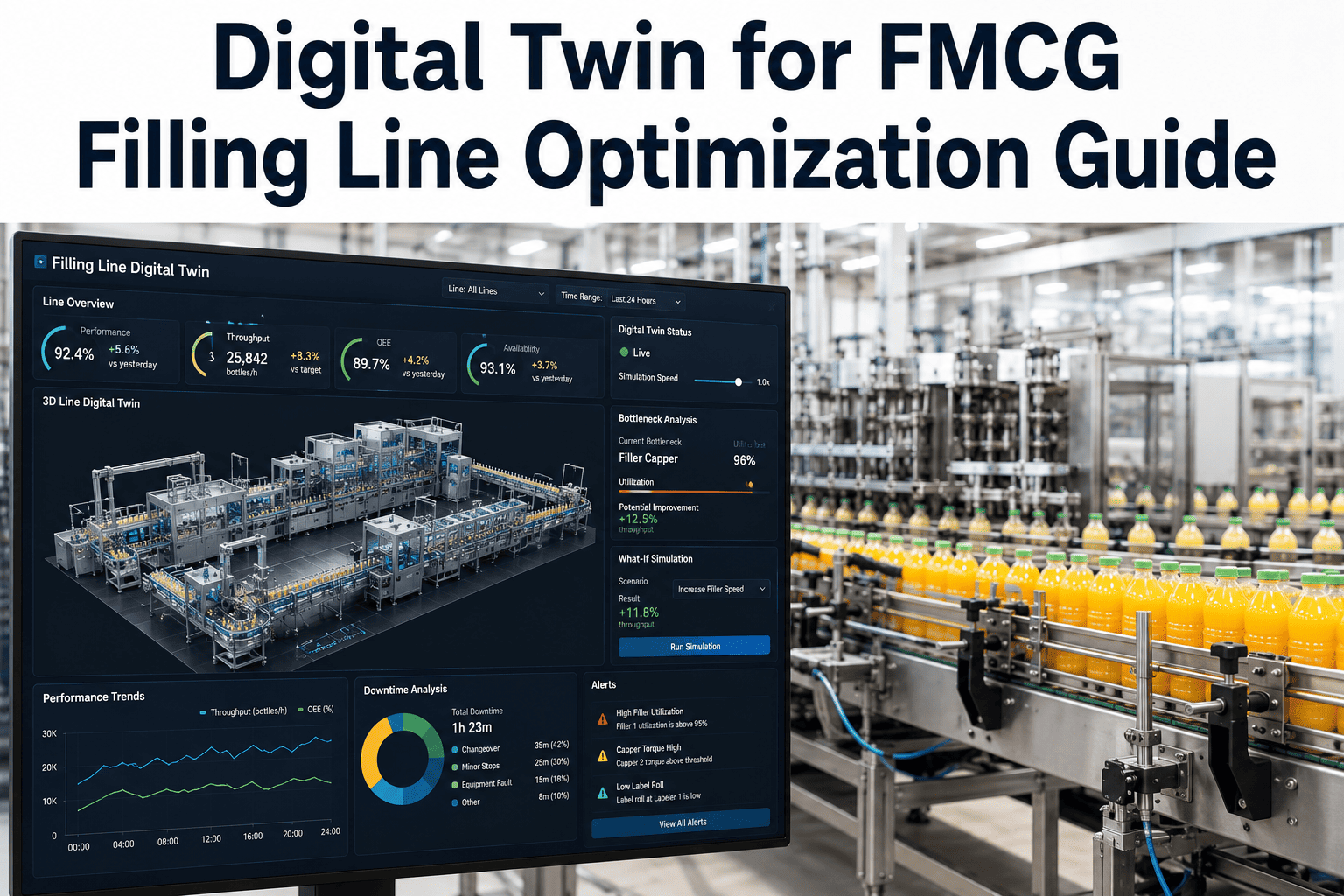
FMCG lines frequently operate below theoretical maximum throughput because plant managers lack confidence in how machines will respond to speed increases. Digital twins allow engineers to simulate line acceleration scenarios in the virtual environment, identifying the exact speed ceiling beyond which downstream equipment becomes the bottleneck. Plants using this approach consistently discover they can unlock 8–15% additional throughput without any capital investment — simply by redistributing existing capacity intelligently. Book a demo with iFactory to see production line simulation in action.
Changeover Time Reduction
Product changeovers in FMCG — switching a filling line from one SKU to another — can consume 45 to 120 minutes of production time. Digital twins simulate the full changeover sequence, identifying where parallel activities are possible and where sequence reordering reduces total elapsed time. Manufacturers regularly achieve 25–40% changeover time reductions through twin-optimized scheduling.
Predictive Quality Control
Quality defects in FMCG often have compound causes — a combination of temperature drift, ingredient viscosity variation, and line speed that individually fall within tolerance but together produce an out-of-spec product. Digital twins model these compound interactions and predict quality outcomes before the batch completes, enabling intervention while correction is still possible.
Maintenance Window Planning
Scheduling planned maintenance in FMCG requires balancing equipment health against production demand. Digital twins simulate the cost of deferring maintenance — additional wear, failure probability increase, downstream quality risk — against the cost of taking the line down. This gives maintenance planners a quantified basis for scheduling decisions rather than relying on fixed calendar intervals. Sign up for iFactory to connect your maintenance scheduling to digital twin insights.
New Product Introduction Testing
Introducing a new SKU or formulation to an existing production line carries significant risk — incompatible viscosities, unexpected filling behavior, labeling machine conflicts. Digital twins run the new product specification through a virtual line before any physical trial, identifying compatibility issues that would otherwise only surface during costly physical production runs.
Simulate Before You Execute — With iFactory Digital Twin Intelligence
iFactory connects your FMCG production data to a digital twin layer that lets you test every process change, speed adjustment, and maintenance decision in a virtual environment before committing on the physical floor.
From filling line optimization and changeover simulation to predictive quality control and NPI testing — iFactory's digital twin capabilities give FMCG operations teams the confidence to make faster, smarter production decisions with measurable impact on throughput, waste, and OEE.
Implementing Digital Twins in FMCG: A Practical Phased Approach
Digital twin implementation in FMCG does not require replacing existing infrastructure. The most successful deployments follow a disciplined phased approach that delivers measurable value at each stage before expanding scope.
Data Foundation and Sensor Mapping
Identify the 3–5 highest-value assets or production lines for the pilot. Map existing sensor data, PLC outputs, and manual measurement points. Establish data pipelines that feed real-time operational data into the twin platform. This phase typically takes 4–8 weeks and establishes the live synchronization layer that makes everything else possible.
Model Validation and Calibration
The virtual model is calibrated against known historical scenarios — past changeovers, speed adjustments, maintenance events — to verify that the twin's predictions match what actually occurred. Calibration typically continues for 6–10 weeks until the model achieves sufficient predictive fidelity for production decisions. Book a demo to see how iFactory handles twin calibration for FMCG-specific equipment.
Scenario Testing and Decision Support
With a validated twin operational, the production team begins using it for active decision support — simulating upcoming changeovers, testing scheduled maintenance timing, evaluating line configuration options. This phase generates the ROI data that typically justifies expanding the program to additional production lines and facilities.
Plant-Wide Expansion and Continuous Optimization
Successful pilots expand to cover the full production environment. At full deployment, digital twins enable continuous production optimization — the system constantly runs background simulations to identify improvement opportunities and surfaces recommendations to production planners and maintenance teams automatically. Sign up for iFactory to start your digital twin pilot with guided implementation support.
Common Implementation Challenges and How to Overcome Them
Many FMCG facilities have equipment with inconsistent or low-frequency sensor coverage. The most effective approach is to prioritize digital twin deployment on newer, well-instrumented assets first — building program credibility while planning sensor upgrades for legacy equipment in parallel.
Overly complex digital twin models that try to capture every variable in the production environment often result in systems that are too slow to provide actionable insights and too difficult for production teams to interpret. The best implementations start with focused models covering the variables that drive 80% of production variance, not attempting to model everything simultaneously.
Digital twins deliver the most value when they exchange data bidirectionally with existing Manufacturing Execution Systems and maintenance platforms. iFactory's integration architecture supports standard protocols for connecting twin outputs directly to maintenance scheduling, work order creation, and production planning workflows.
Production teams understandably hesitate to change physical operations based on virtual model recommendations. This trust is built progressively — starting with low-stakes decisions where the twin's predictions can be easily verified, and expanding to higher-stakes decisions as track record accumulates. Transparent confidence scoring on twin recommendations accelerates this trust-building process.
Start Optimizing Your FMCG Production With Digital Twin Technology
iFactory gives FMCG production teams a live digital twin connected to your existing sensor infrastructure — no rip-and-replace, no months-long implementation before value is delivered.
Run production scenarios virtually before committing on the floor. Reduce changeover time, eliminate NPI surprises, optimize line speeds, and make maintenance decisions with quantified confidence. Your production data is already generating insights — iFactory's digital twin layer makes sure you're acting on them.
Frequently Asked Questions
What exactly is a digital twin in FMCG manufacturing
A digital twin in FMCG manufacturing is a continuously updated virtual model of a production line, facility, or individual piece of equipment that mirrors the real-time state of its physical counterpart through live sensor data. Unlike static simulations, digital twins remain synchronized with actual operating conditions — machine wear levels, current product specifications, ambient conditions — allowing manufacturers to run predictive scenarios against a model that reflects today's reality, not a historical baseline.
How does a digital twin reduce waste in FMCG production
Digital twins reduce waste through two primary mechanisms. First, they enable virtual testing of process changes — speed adjustments, formulation modifications, changeover sequences — identifying combinations that produce out-of-spec products before any physical material is consumed. Second, they predict quality deviations in real time during production, enabling early intervention before entire batches are compromised. FMCG manufacturers typically report 25–35% reductions in production waste within 12 months of full digital twin deployment.
Can digital twins work with our existing legacy FMCG equipment
Yes, with some planning. Digital twins do not require equipment to have built-in digital connectivity. Retrofit sensors — vibration sensors, thermal cameras, flow meters, and environmental monitors — can be added to legacy machines and connected to the twin platform. The model is built from observed physical behavior rather than native machine data. The key limitation with legacy equipment is sensor coverage density; the more parameters that can be measured, the higher the model's predictive fidelity. iFactory's implementation team works with clients to identify the minimal sensor set that delivers meaningful twin accuracy on each specific equipment type.
How long does it take to implement a digital twin for an FMCG production line
A focused digital twin covering a single critical production line typically reaches operational status within 12–16 weeks: 4–6 weeks for data infrastructure and sensor mapping, 6–10 weeks for model calibration and validation. Time to value can be shorter for facilities with existing dense sensor coverage and modern equipment. Full plant-wide deployment timelines vary considerably based on facility complexity, but most FMCG manufacturers have their highest-priority lines live within one quarter of project start.
What is the difference between a digital twin and an MES in FMCG
A Manufacturing Execution System manages and records what is happening on the production floor in real time — tracking orders, recording outputs, logging quality results, and managing production schedules. A digital twin complements this by simulating what could happen under different scenarios. The two systems work best together: the MES provides real operational data that feeds the twin's model, and the twin's recommendations inform scheduling, maintenance, and process decisions managed through the MES. iFactory integrates both capabilities within a unified platform.
What ROI can FMCG manufacturers realistically expect from digital twin deployment
ROI varies by facility complexity and initial operational maturity, but industry data from 2024–2025 deployments shows consistent value across several areas: OEE improvements of 15–25%, changeover time reductions of 25–40%, material waste reductions of 20–30%, and meaningful reductions in unplanned downtime through predictive maintenance integration. Most FMCG manufacturers reach positive ROI within 12–18 months. The strongest returns typically come from facilities with high changeover frequency, complex multi-SKU product mixes, and significant historical variation in product quality outcomes.