How to Reduce Changeover Time on FMCG Production Lines with SMED and Robotics
By Seren on June 16, 2026
Every time an FMCG production line stops for a changeover, the clock starts counting lost output at the full line rate. A 45-minute changeover on a line running at 400 packs per minute costs 18,000 packs of lost production. If that line runs three SKUs per shift with two changeovers, the daily loss is 36,000 packs — over 13 million packs per year per line. The prevailing assumption in most FMCG plants is that changeover time is a fixed cost of doing business with multiple SKUs: you accept the downtime because the alternative is dedicating a line to each product. But the plants that have applied SMED methodology and collaborative robotics have demonstrated that changeover time is not fixed. It is a process parameter that can be engineered, measured, and reduced. A systematic SMED program combined with cobot-assisted changeover tasks routinely cuts changeover time by 50 percent or more — turning a 45-minute changeover into a 20-minute event, recovering those 18,000 packs per changeover, and making smaller batch sizes economically viable without sacrificing OEE.
SMED · Cobot Changeover · Real-Time Tracking · Loss Analysis
FMCG Plants That Cut Changeover Time by 50% Do Not Work Faster During Changeovers. They Use SMED to Eliminate Internal Steps and Cobots to Automate the Repetitive Ones — While iFactory Tracks Every Second.
iFactory's Changeover & Setup Time Tracking module gives FMCG production teams real-time visibility into every changeover step, SMED-based workflow automation, cobot integration for repetitive tasks, and OEE loss analytics that quantify the impact of every minute saved.
Average changeover time reduction achieved by FMCG plants implementing SMED methodology with cobot-assisted tasks — documented across packaging, filling, and labelling line changeovers in food, beverage, and personal care manufacturing
30%
Additional OEE improvement potential when changeover time data is integrated into real-time production dashboards and loss tree analysis — every minute saved on changeover is a direct gain in overall equipment effectiveness
70%
Of changeover tasks in typical FMCG packaging lines are classified as external setup — tasks that can be performed while the machine is still running. SMED systematically converts them, drastically reducing machine downtime
3x
Faster cobot-assisted tool changes compared to manual changeover on FMCG filling and capping machines — collaborative robots handle repetitive pick-place-adjust tasks while operators focus on setup verification and quality checks
Why Changeover Time Is the Leverage Point for FMCG Production Agility
Changeover time is the single most impactful variable for production agility in FMCG because it directly determines the minimum economic batch size. When a changeover takes 45 minutes, the production planner needs to run batches large enough that the changeover downtime is a small fraction of total run time. This drives long production runs, high finished goods inventory, slow response to demand shifts, and frequent end-of-life waste when products are discontinued or reformulated. When changeover time drops to 20 minutes, the planner can halve the batch size while maintaining the same OEE. This means faster response to promotions, shorter lead times for retailers, less working capital tied up in finished goods, and lower scrap from expired short-shelf-life products.
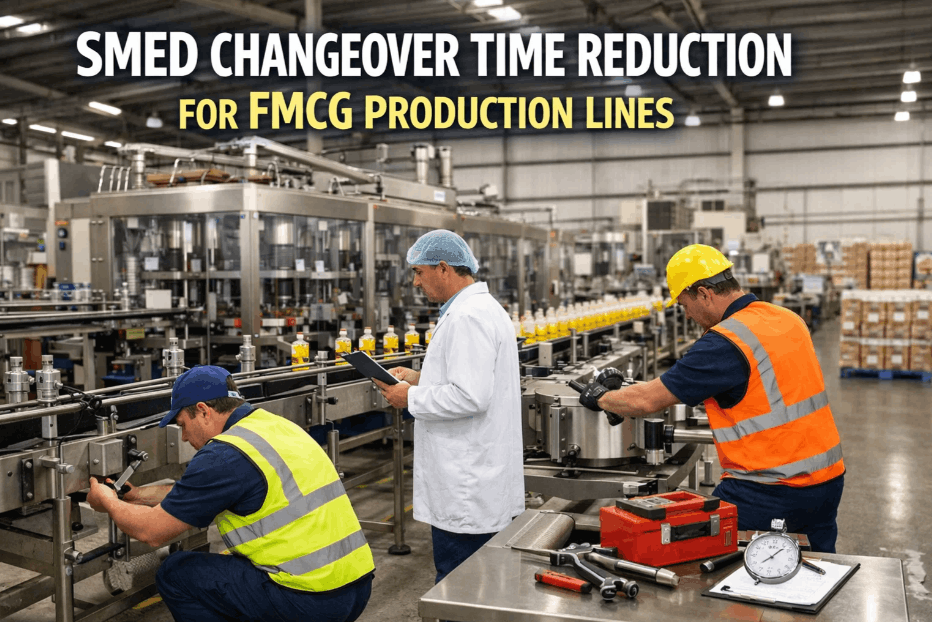
The SMED methodology developed by Shigeo Shingo provides the structured approach to achieving this reduction. It classifies every changeover task as either internal — work that can only be performed while the machine is stopped — or external — work that can be performed while the machine is still running. The core of SMED is converting internal tasks to external tasks, then streamlining the remaining internal tasks through parallelization, standardized tooling, quick-release mechanisms, and automation. Collaborative robots amplify this by handling the repetitive, physically demanding external tasks — fetching tooling, pre-positioning change parts, cleaning surfaces — while operators focus on the skilled tasks that require judgment and verification.
The SMED Framework for FMCG Changeover Reduction
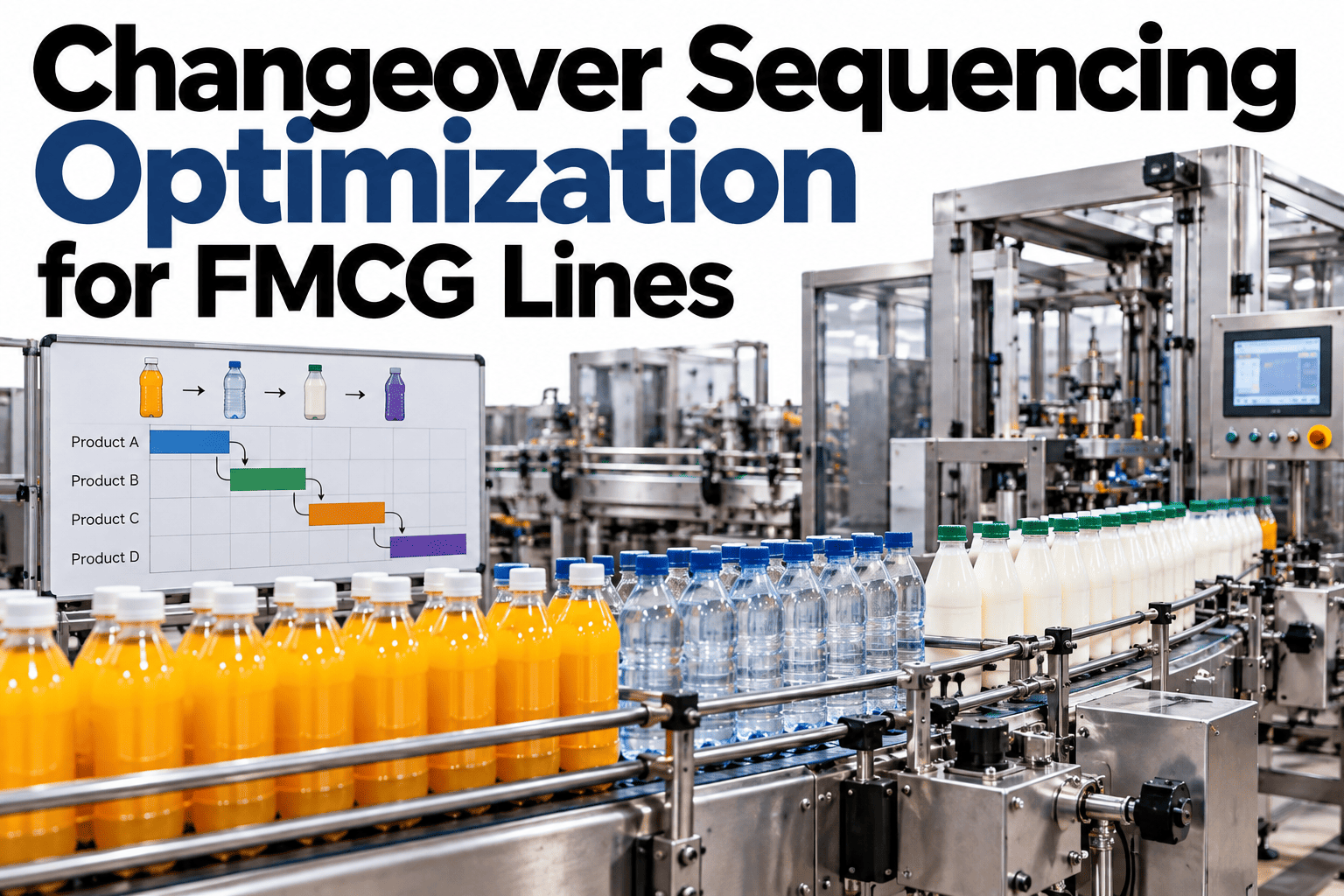
Applying SMED to an FMCG production line follows a structured sequence of analysis and improvement. The process begins with observation, documentation, and classification of every step in the current changeover — then systematically attacking each category of waste. The following table shows the three stages of SMED implementation and how each stage contributes to measurable changeover time reduction on an FMCG packaging or processing line.
The Three Stages of SMED Implementation on FMCG Lines
01
Stage 1 — Separate Internal and External Setup
Every changeover task is observed, timed, and classified as internal or external. The team documents each step and identifies which tasks are actually being performed while the machine is stopped that could be done while it is still running. Common examples in FMCG: fetching change parts from the storeroom, cleaning equipment, pre-heating or pre-cooling, preparing packaging materials, and staging tools. The immediate time saving from this separation alone is typically 20-30 percent — simply by moving external tasks out of the machine stop period.
Key action: Use iFactory Changeover Tracking to record and classify each step in real time, building a data-driven baseline for every SKU changeover.
02
Stage 2 — Convert Internal Tasks to External
Each internal task is analysed to determine whether it can be redesigned as an external task. This is where engineering improvements have maximum impact: quick-release clamps replace bolted connections, standardized guide rails replace custom adjustments, colour-coded and pre-set tooling eliminates measurement steps, and cobots are deployed to handle tasks that can be automated. The conversion stage typically reduces the remaining internal time by another 30-40 percent. For example, a filling line that requires 12 change parts for a format switch can have all 12 pre-staged by a cobot while the line is running — turning 8 minutes of internal retrieval time into zero.
Key action: Programme cobot paths for change part staging, tool pre-positioning, and surface cleaning. Use iFactory to track conversion progress.
03
Stage 3 — Streamline All Remaining Internal Tasks
The remaining internal tasks — those that genuinely require the machine to be stopped — are streamlined through parallel operations, standardized procedures, visual work instructions, and lighting-directed setup verification. Two operators working in parallel on different sections of the line can reduce the internal time by up to 50 percent compared to sequential work. Standardized quick-change tooling, colour-coded change parts, and pre-calibrated adjustment points eliminate the time spent measuring, checking, and re-checking. Cobots handle parallel tasks such as applying new labels to the label magazine while the operator changes the filling nozzles.
Key action: Deploy iFactory SMED checklists and digital work instructions to ensure every operator follows the standardized sequence every time.
04
Sustain — Measure Every Changeover, Analyse Every Loss
The SMED stages above deliver the initial reduction, but sustaining and improving it requires continuous measurement. Every changeover is tracked in iFactory's Changeover Tracking module — start time, end time, each step duration, operator identification, SKU pair, and any issues encountered. The data feeds OEE analytics and loss tree analysis so the production manager sees exactly how much time is lost to changeover on each line, each shift, and each SKU combination. When a changeover takes longer than the target, the system flags the deviation, and the team investigates the root cause — a missing change part, a cobot path deviation, an operator who needs additional training, or a procedure that needs updating.
Key action: Set changeover time targets for every SKU pair in iFactory. Monitor actual vs target in real time. Investigate every outlier.
How Collaborative Robots Accelerate SMED on FMCG Lines
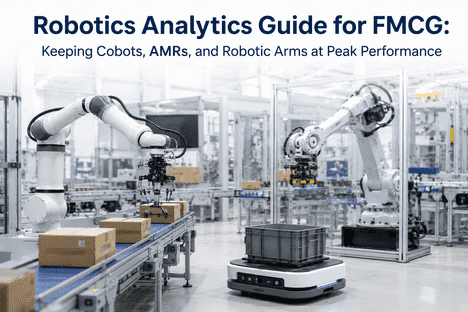
Collaborative robots bring a specific capability to SMED implementation that manual processes cannot match: consistent execution of repetitive external tasks at the same speed every time, without fatigue, distraction, or variation between operators. On an FMCG packaging line, a cobot can be programmed to retrieve the next SKU's change parts from the tool crib while the line is still running the current SKU, position them on a dedicated cart at the changeover point, clean the relevant machine surfaces with a programmed motion path, and return to the home position — all during the final two minutes of the current production run. When the machine stops, the operator finds every change part already staged, every tool positioned, and every surface cleaned. The internal changeover work starts immediately, without the 7 to 10 minutes of running around that typifies a manual changeover.
The cobot does not replace the operator's role in the changeover. It handles the physical, repetitive, low-judgment tasks so the operator's skill and experience are applied where they create the most value: verifying that change parts are correctly installed, performing first-off quality checks, adjusting parameters on the HMI, and releasing the line for production. The operator remains the decision-maker and the quality gate. The cobot is the hands that fetch, clean, and position while the operator's brain focuses on setup verification and process control.
Manual Changeover vs Cobot-Assisted Changeover — The Operator's Experience Compared on FMCG Filling Lines
Manual Changeover
Operator spends the first 8-12 minutes of changeover walking to the tool crib, locating change parts, and transporting them to the line — machine is stopped and waiting during this time.
Cleaning and surface preparation takes 5-8 minutes of internal time. Operator rushes through it to get the line running again.
Change part installation and adjustment is sequential — operator works on each station one at a time. Total internal time 25-35 minutes.
First-off quality check happens after the line is running. If settings are wrong, the line starts producing waste immediately.
Changeover time varies significantly between operators and shifts. Best operator at 28 minutes, slowest at 52 minutes on the same SKU pair.
With Cobot-Assisted SMED
Cobot retrieves and stages all change parts during the last 3 minutes of production. Machine stops with everything ready at the line. Zero internal time for part retrieval.
Cobot performs programmed cleaning passes during machine stop while operator begins change part installation. Cleaning time reduced to 2-3 minutes, running in parallel with other tasks.
Operator and cobot work in parallel. Cobot handles label magazine reload while operator changes filling nozzles. Internal time 12-18 minutes.
First-off verification performed using iFactory Changeover checklist and AI Vision Camera before line restart. Settings confirmed before production begins.
Consistent changeover time within 3-minute variation regardless of operator. Standardized process driven by cobot program and digital work instructions.
"
Before we implemented SMED with the cobot, our changeover on the main beverage filling line was 38 minutes on a good shift. The cobot now pre-stages every change part and handles the cleaning cycle while the operator starts the mechanical changeover. Our average is 16 minutes across all three shifts. The biggest surprise was not the time saving itself — it was the consistency. Every changeover now takes between 15 and 18 minutes regardless of which operator is running the line. That predictability lets us schedule smaller batches and respond to promotion orders in 24 hours instead of 72.
— Production Manager, Major FMCG Beverage Manufacturer — 12 Filling Lines, 40+ SKUs, 3 Production Shifts
SMED Analytics · Cobot Integration · Changeover Tracking · OEE Loss Tree
Every Minute of Changeover Time You Eliminate Is a Direct Gain in OEE and Production Capacity. The FMCG Lines That Win Are the Ones That Measure Every Second, Automate Every Repetitive Task, and Standardise Every Procedure. Book a Demo to See iFactory Changeover Tracking on Your Line.
iFactory's Changeover & Setup Time Tracking module gives FMCG teams real-time changeover measurement, SMED workflow automation, cobot integration for changeover tasks, and OEE analytics that quantify every improvement in terms of recovered production capacity.
Step-by-Step Implementation: Launching a SMED + Robotics Changeover Reduction Program
Implementing SMED with robotics on an FMCG line follows a defined methodology that any production team can execute. The key is to start with data, not assumptions — measure the current state before making changes, and let the data identify the highest-impact opportunities.
Step 01
Baseline Every Changeover for 2 Weeks
Use iFactory Changeover Tracking to record every changeover across all shifts for two weeks. Capture start time, end time, SKU pair, operator, and any delays or issues. Export the data and analyse the variation — between operators, between shifts, between SKU pairs. The baseline reveals the current average, the best demonstrated practice, and the specific SKU pairs with the longest changeover times. Without this baseline, every improvement target is a guess.
Output: Current changeover time by SKU pair, operator, and shift. Best demonstrated practice identified.
Step 02
Video Record and Classify Every Step
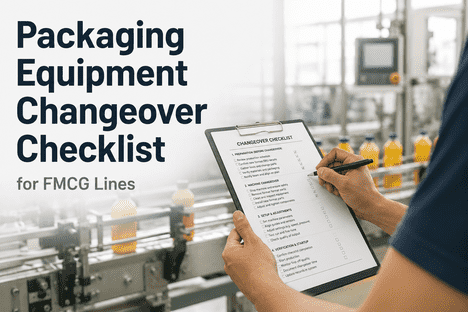
Record the changeover process for the three highest-time SKU pairs on video. Play back with the changeover team and classify every task as internal or external. Use iFactory's Smart Document Management to store the video and the classified task list. The team identifies which external tasks are currently being performed during machine downtime and estimates the potential time saving from converting them. This is where the 20-30 percent quick-win reduction comes from.
Output: Classified task list with internal/external designation. Quick-win opportunities identified with estimated time savings.
Step 03
Redesign Tools and Procedures for Quick Change
Implement quick-release clamps, colour-coded change parts, pre-set guide rails, and standardized tooling. Move change part storage closer to the line. Create visual work instructions for every SKU pair showing exactly which change parts are needed and their positions. For each internal task, ask the team: can we do this before the machine stops? Can we do it in parallel with other tasks? Can a cobot do it? This redesign phase targets the 30-40 percent conversion reduction.
Output: Redesigned changeover procedure with externalised tasks. Quick-change tooling and work instructions deployed.
Step 04
Deploy Cobot for External and Parallel Tasks
Program the cobot for the specific external tasks identified in Stage 2: change part retrieval and staging, surface cleaning, label magazine reloading, tool pre-positioning. Start with one cobot on one high-volume line to validate the approach before scaling. Integrate the cobot's task completion signal into iFactory's Changeover Tracking so the system knows when external tasks are complete and the internal changeover clock starts. This phase delivers the parallelization gains that push total changeover time below 20 minutes.
Output: Cobot programmed for changeover tasks. Integration with iFactory Changeover Tracking active. Pilot line running.
Step 05
Standardise, Measure, Improve Continuously
Document the new standard changeover procedure in iFactory Shift Logbook and Smart Document Management. Set changeover time targets for every SKU pair in the system. Every changeover is tracked automatically — any deviation from the target triggers an investigation. The production manager reviews changeover performance weekly using iFactory OEE Analytics, looking at changeover loss as a percentage of total available time. The team runs a monthly SMED kaizen event to identify the next 5 percent improvement. Continuous improvement becomes a data-driven process, not a motivational program.
Output: Standardised changeover procedure. Real-time tracking in place. Monthly improvement process active.
Step 06
Scale Across Lines and SKU Families
Once the pilot line demonstrates consistent 50 percent+ reduction, expand the SMED + robotics approach to additional lines. Each line follows the same five-step process — baseline, classify, redesign, deploy cobot, standardise. SKU families are grouped by changeover similarity, and standard procedures are created for each family rather than each individual SKU. iFactory's analytics track aggregate changeover performance across all lines, and the plant-level OEE dashboard shows the total production capacity recovered from changeover reduction.
The iFactory Changeover Tracking Platform — What the Production Team Sees
iFactory's Changeover & Setup Time Tracking module is purpose-built for production teams running SMED programs. The platform gives every stakeholder — the operator on the line, the production supervisor, the plant manager — a view of changeover performance that matches their decision-making horizon. The operator sees the real-time changeover timer and step-by-step checklist on the line-side tablet. The supervisor sees a live dashboard of all changeovers in progress with actual vs target duration. The plant manager sees weekly and monthly changeover loss trends by line, SKU family, and shift.
The platform integrates directly with OEE analytics, so every minute of changeover time is automatically classified as a planned loss in the OEE calculation. When changeover time drops from 45 minutes to 20 minutes, the OEE dashboard shows the improvement in real time — not as a separate report, but as an integral part of the line's overall equipment effectiveness. This direct link between changeover reduction and OEE performance is what sustains management commitment to the SMED program: every improvement is visible in the metric that the plant leadership team watches daily.
Conclusion
Changeover time reduction in FMCG is not a one-time improvement project. It is a competitive capability that separates plants that can respond to market demand with short production runs and low inventory from plants that are locked into long runs because their changeover times make small batches uneconomical. SMED provides the methodology — the systematic classification, conversion, and streamlining of every changeover task. Collaborative robots provide the amplification — handling the repetitive, physical tasks so operators can focus on setup verification and quality assurance. iFactory Changeover Tracking provides the measurement and accountability — recording every changeover, quantifying every improvement, and integrating every gain into OEE analytics.
The evidence from FMCG production environments in 2025 and 2026 is conclusive: plants that implement SMED with cobot assistance achieve 50 percent or greater reduction in changeover time. The 50 percent figure is not aspirational — it is the average result documented across packaging, filling, and labelling line changeovers in food, beverage, and personal care manufacturing. The plants achieving these results share one characteristic: they measure every changeover, classify every step, and use data to drive every improvement decision.
iFactory's Changeover & Setup Time Tracking module is designed for FMCG production teams who need to reduce changeover time, improve OEE, and increase production agility. Book a Demo to see how the platform integrates with your existing lines and cobot deployments, or talk to an expert about a free changeover assessment and SMED readiness audit for your FMCG production facility.
Frequently Asked Questions
A typical SMED + robotics implementation on a single FMCG line follows a 10-12 week timeline. Weeks 1-2 are baseline measurement and video analysis. Weeks 3-4 are task classification and quick-win implementation — moving external tasks out of machine downtime and deploying quick-change tooling. Weeks 5-7 are cobot programming, safety validation, and integration testing. Weeks 8-10 are pilot operation with real production changeovers, fine-tuning the procedure and cobot paths. Week 10-12 are standardisation, documentation, and handover to the production team. The initial 20-30 percent reduction from Stage 1 externalisation is typically visible within the first 4 weeks. The full 50 percent+ reduction including cobot deployment is achieved within the 12-week window. Contact our team to see a sample implementation timeline for your specific line configuration.
The highest-impact cobot tasks for FMCG changeover reduction are external tasks that can be performed while the machine is still running: retrieving and staging change parts from the tool crib, pre-positioning tools and fixtures at the changeover point, cleaning machine surfaces with a programmed motion path, reloading label magazines, and removing finished product from the outfeed area. Once the machine is stopped, cobots are most effective for parallel tasks such as cleaning one section while the operator works on another, applying new labels to the applicator, and assisting with heavy lifting during change part installation. The key design principle is that the cobot handles the repetitive, predictable, physically demanding tasks while the operator handles the skilled tasks that require visual inspection, judgment, and adjustment. Talk to an expert about a cobot task analysis for your specific FMCG line types.
iFactory Changeover Tracking integrates through multiple pathways depending on the existing automation infrastructure. For lines with PLC controls, the module reads machine state signals — running, stopped, idle — to automatically detect changeover start and end events. For lines with MES or ERP integration via SAP, Oracle, or Microsoft Dynamics, the module reads production order data to identify the SKU pair for each changeover and cross-reference planned vs actual changeover duration. For manual lines, operators use a line-side tablet or mobile device with a barcode scanner to log changeover start and end, with the system automatically calculating duration and classifying the loss in OEE analytics. The cobot's task completion signals can be integrated through OPC UA or Modbus TCP protocols, allowing the system to track external task completion status and internal changeover timing automatically. Talk to an expert about your specific integration requirements.
Collaborative robots are designed for safe human-robot collaboration without safety fencing, and operator training focuses on three areas: safety awareness (understanding the cobot's operating envelope, emergency stop procedures, and collaborative workspace boundaries), task coordination (knowing when the cobot is performing its programmed tasks and what the operator should be doing in parallel), and basic exception handling (clearing a jammed gripper, resetting the cobot after a fault, calling for support). Typical operator training is 4-8 hours including hands-on practice on the actual line. The cobot programming itself is handled by automation engineers or integrators — operators are not expected to programme or modify cobot paths. The SMED methodology and changeover procedure training is separate and typically takes one shift of hands-on practice with the new procedure. Book a Demo to see the training materials and operator interface for a cobot-assisted changeover on an FMCG line.
A 50% Changeover Time Reduction Is Not a Target. It Is the Natural Result of a Systematic SMED Program Where Every Task Is Classified, Every Repetitive Step Is Automated by the Cobot, and Every Second Is Tracked in Real Time. Get a Free Changeover Assessment for Your FMCG Line.
iFactory's Changeover & Setup Time Tracking module for FMCG production — real-time changeover measurement by SKU pair, SMED workflow automation with digital checklists, cobot integration for changeover task parallelization, and OEE analytics that quantify every minute of improvement in terms of recovered production capacity.