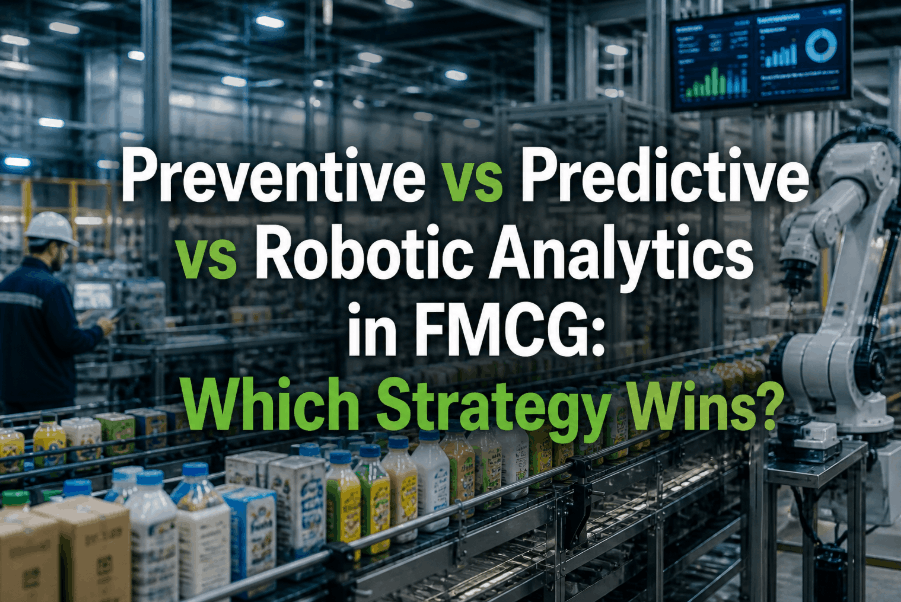
Predictive analytics for FMCG manufacturing has matured from a pilot-stage experiment into a core operational capability that prevents equipment failures 7 to 14 days before they happen. By combining IoT sensors, vibration analysis, motor current signatures, and machine learning models trained on years of failure pattern data, modern predictive analytics platforms now deliver advance failure warnings with enough lead time to schedule maintenance during planned downtime — eliminating the 24–72 hour unplanned outages that historically defined FMCG plant maintenance. Plants that book a demo with iFactory typically achieve a 50–70% reduction in unplanned downtime within the first year of deployment.
Predict Equipment Failures 14 Days Before They Disrupt Production
iFactory's predictive analytics platform combines IoT sensor data, vibration analytics, and AI failure models to give FMCG plants the early warning that ends unplanned downtime.
Why Predictive Analytics Has Replaced Reactive Maintenance in FMCG
The economics of reactive maintenance in FMCG manufacturing have become untenable. A single hour of unplanned downtime on a high-speed packaging line costs between $10,000 and $50,000 — and the average mid-sized FMCG plant absorbs 80–150 unplanned downtime hours per year. Predictive analytics for FMCG transforms this cost profile by surfacing the early degradation signals — vibration shifts, temperature drift, motor current anomalies — that precede every mechanical failure by days or weeks. Sensor-based analytics platforms now identify these patterns automatically, with no requirement for in-house data science teams. Manufacturers that book a demo with iFactory discover that the majority of their historical breakdowns showed clear predictive signatures 7 to 14 days in advance — signatures that simply weren't being captured before deployment.
Vibration Analysis
The most reliable predictive signal for rotating equipment. Bearing wear, misalignment, imbalance, and looseness all produce distinct vibration signatures detectable weeks before audible or thermal symptoms emerge.
Motor Current Signature
Electrical current waveform analysis exposes load anomalies, broken rotor bars, and bearing faults — without requiring physical sensor access to the motor or driven equipment.
Thermal Drift
Gradual temperature increases on bearings, gearboxes, and electrical contacts signal lubrication breakdown, friction increase, and connection degradation before failure cascade begins.
AI Pattern Recognition
Machine learning models correlate multiple sensor streams against historical failure libraries — surfacing complex multi-variable failure patterns invisible to single-signal threshold monitoring.
The Predictive Analytics Workflow: From Sensor Signal to Maintenance Action
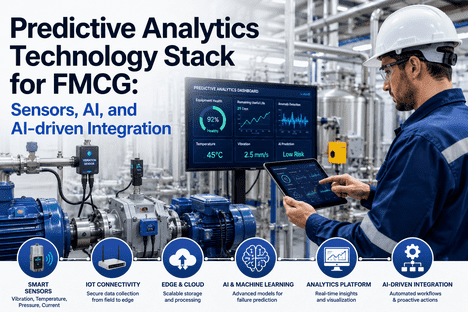
Effective predictive analytics for FMCG plants follows a four-stage workflow that turns raw sensor data into prioritized maintenance actions. The discipline that separates high-performing predictive programs from failed pilots is the integration between each stage — sensor data that isn't routed into pattern recognition, or alerts that aren't routed into work order generation, creates analytical capability without operational impact. Engineers who book a demo with iFactory walk through the live workflow from sensor capture to scheduled work order on the maintenance system.
Sensor Capture
IoT vibration, current, temperature, and pressure sensors stream continuous condition data from every critical asset to the analytics platform.
Pattern Detection
AI models compare live signals against historical failure libraries, identifying degradation patterns before threshold-based alarms would fire.
Failure Forecast
Detected patterns generate a remaining-useful-life estimate — typically 7 to 14 days for FMCG rotating equipment — with confidence scoring.
Planned Action
Work orders are generated, parts pre-ordered, and maintenance scheduled into planned downtime — eliminating the unplanned outage entirely.
The Five Highest-Value Predictive Analytics Use Cases in FMCG Plants
Not every asset on an FMCG line is a worthwhile predictive analytics target. The highest-value use cases concentrate around assets where unplanned failure stops the entire line, parts have long lead times, or the failure mode is well-characterized by sensor-detectable signatures. The five use cases below consistently deliver the fastest ROI in FMCG predictive analytics deployments.
Bearing Failure Prediction on Conveyor Drives
Conveyor drive bearings produce highly distinctive vibration signatures as raceway, rolling element, and cage faults progress. Predictive analytics typically identifies bearing degradation 14–21 days before catastrophic failure — converting a 4-hour emergency replacement into a 30-minute planned swap.
Pump Cavitation and Seal Wear
Process pumps in liquid FMCG operations show cavitation, impeller wear, and mechanical seal degradation through pressure pulsation and vibration spectra. Early detection prevents both line stoppage and product loss from seal failures.
Compressor Health Monitoring
Plant air compressors and refrigeration compressors signal valve faults, bearing wear, and lubrication issues through current waveform shifts and discharge temperature drift — well before efficiency loss or catastrophic shutdown.
Gearbox Wear Detection
High-torque gearboxes on packaging and processing lines exhibit gear mesh frequency anomalies as tooth wear, lubrication breakdown, and bearing damage progress. Lead time from first detection to failure typically exceeds 30 days for gearboxes.
Motor Health and Insulation Degradation
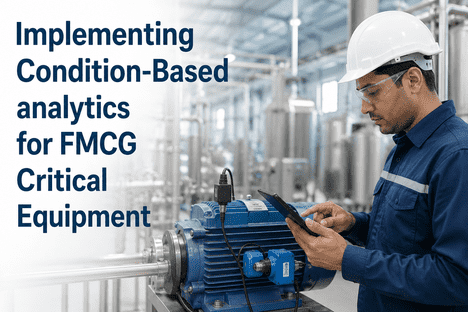
Three-phase induction motors driving FMCG lines reveal broken rotor bars, stator winding faults, and bearing damage through motor current signature analysis — a non-intrusive diagnostic that requires no physical access to the motor.
Reactive vs Preventive vs Predictive: Why FMCG Plants Are Moving to Prediction
The maintenance maturity curve in FMCG manufacturing has three clearly differentiated stages, each with measurably different cost, downtime, and reliability profiles. Understanding where your plant currently sits — and the gap to predictive maturity — is the foundation of a credible business case for predictive analytics deployment. Plants that book a demo with iFactory typically receive a maturity assessment against this exact framework as part of the deployment scoping.
| Dimension | Reactive Maintenance | Preventive Maintenance | Predictive Analytics |
|---|---|---|---|
| Trigger | Equipment failure | Calendar or runtime interval | Actual condition signal |
| Downtime Profile | 24–72 hours unplanned | Mostly planned; occasional unplanned failures between intervals | Planned downtime only; failure prevented |
| Parts Strategy | Emergency sourcing; premium freight | Inventory carried for scheduled intervals | Just-in-time ordering; 7–14 day lead time available |
| Maintenance Labor | Overtime, weekend call-outs, firefighting | Scheduled team during planned windows | Optimized scheduling; reduced overtime |
| Equipment Life | Shortened by failure damage | Often shortened by unnecessary intervention | Extended; only intervene when condition warrants |
| Total Maintenance Cost | Baseline (highest) | 15–25% reduction vs reactive | 40–60% reduction vs reactive |
See Predictive Failure Warnings on Your Own Equipment
iFactory's deployment team installs IoT sensors, calibrates failure models, and delivers the first predictive warnings within the first quarter.
How to Deploy Predictive Analytics on an Existing FMCG Line
A predictive analytics deployment on a live FMCG production line does not require shutting down operations or replacing existing equipment. The standard rollout follows a sensor-first, model-second sequence — installing wireless or wired condition sensors on the highest-value assets during planned maintenance windows, then layering AI models on top of the resulting data streams. Teams that book a demo with iFactory get a customized deployment plan based on asset criticality, sensor accessibility, and existing maintenance system integration.
Asset Criticality Map
Rank every rotating asset by line impact, replacement cost, and historical failure rate. Identify the 20% of assets generating 80% of downtime cost — the first sensor deployment targets.
Sensor Installation
Wireless vibration, current, and temperature sensors installed during scheduled stops. No production interruption; no permanent rewiring of existing equipment.
Model Calibration
Baseline signatures captured per asset; AI models tuned against historical failure data and operating profile. False positive rate driven below 5%.
First Predictions
Live failure forecasts flow into maintenance systems. Predictive work orders begin replacing reactive call-outs within the first quarter of deployment.
Predictive Analytics for FMCG: Frequently Asked Questions
How accurate are predictive analytics failure forecasts for FMCG equipment?
Modern predictive analytics platforms achieve 85–95% forecast accuracy on well-characterized failure modes — bearings, motors, pumps, gearboxes. Forecast accuracy improves continuously as more failure data is captured and fed into the model retraining pipeline.
How much lead time do predictive warnings typically provide?
Rotating equipment failures in FMCG environments typically produce 7 to 14 days of advance warning — enough lead time to source parts, schedule labor, and plan the intervention into existing maintenance windows. Gearboxes and large motors often produce 30+ days of warning.
Do we need a data science team to operate predictive analytics?
No. Modern predictive analytics platforms ship with pre-trained failure models for standard FMCG equipment classes. Deployment, calibration, and model maintenance are handled by the platform provider — your maintenance team consumes alerts and acts on work orders.
Which assets should we instrument first?
Start with rotating assets whose failure stops the entire production line — conveyor drives at line bottlenecks, primary process pumps, plant air compressors, and refrigeration compressors. These typically deliver 80% of the available ROI from the first 20% of installed sensors.
What unplanned downtime reduction can we realistically expect?
FMCG plants completing a full predictive analytics deployment typically reduce unplanned downtime by 50–70% within 12 months. Maintenance cost falls by 25–40%, and equipment life is extended through condition-based rather than calendar-based intervention.
Ready to End Unplanned Downtime With Predictive Analytics?
iFactory's predictive analytics platform combines IoT sensors, AI failure models, and maintenance system integration to give FMCG plants the 7–14 day early warning that ends emergency breakdowns.

-in-fmcg-a-step-by-step-guide-to-eliminating-recurring-failures.png)