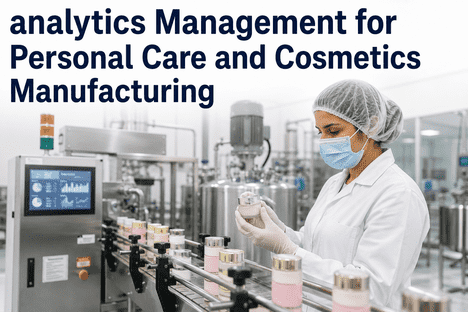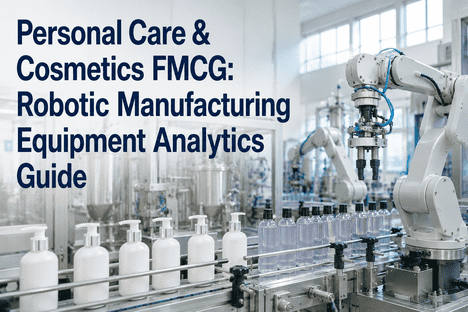
Personal care and cosmetics FMCG manufacturing has undergone a fundamental transformation over the past decade, with robotic mixing vessels, automated filling lines, high-speed labeling robots, and intelligent packaging systems now forming the operational backbone of modern beauty product production facilities. For maintenance and reliability managers at cosmetics manufacturing plants producing everything from skincare creams and lotions to color cosmetics, fragrances, and hair care products, the margin between uninterrupted GMP-compliant production and costly batch rejections, line stoppages, or regulatory deviations is measured in microns of fill accuracy, fractions of a degree in mixing temperature control, and milliseconds of robotic pick-and-place precision. iFactory AI's Robotics and Manufacturing Analytics platform provides cosmetics production teams with a unified predictive intelligence layer that anticipates equipment degradation before it compromises batch quality, optimizes cleaning and changeover schedules between product runs, and correlates robotic performance data with downstream quality outcomes to achieve target OEE with zero GMP deviations. Book a Demo to see the platform configured for your cosmetics facility's robotic equipment fleet, product portfolio, and quality compliance requirements.
Achieve Precision Robotic Manufacturing Analytics Across Your Cosmetics Production Line with AI-Driven Intelligence
iFactory's Robotics AI and Manufacturing Analytics platform combines real-time robotic equipment monitoring, predictive maintenance for filling and packaging machines, GMP compliance tracking, and cleanroom environmental analytics in a single solution purpose-built for personal care and cosmetics FMCG production environments.
Robotic Equipment Reliability — The Critical Variable in Cosmetics FMCG Production and Profitability
Robotic equipment reliability is the single most important operational parameter in any modern personal care and cosmetics FMCG manufacturing facility, directly affecting production throughput, batch quality consistency, GMP compliance status, and overall equipment effectiveness. For maintenance and reliability managers, the challenge is maintaining robotic mixing vessels, automated filling machines, labeling robots, and packaging systems at peak performance while minimizing unplanned downtime, which at $15,000 to $40,000 per hour in lost production for a mid-size cosmetics line represents one of the largest operational risks in FMCG manufacturing. A typical cosmetics plant producing 50 million units annually across skincare, hair care, and color cosmetics categories spends $3 million to $8 million per year on robotic equipment maintenance and replacement parts alone, meaning every percentage point of OEE improvement translates directly to bottom-line savings and increased production capacity.
The physics of robotic equipment reliability in cosmetics manufacturing is governed by the interaction between mechanical wear patterns, process parameters, cleaning and sanitation cycles, and environmental conditions, with each factor influencing equipment degradation in ways that make calendar-based preventive maintenance inadequate for modern high-speed production lines. As robotic filling machines cycle through 120 to 200 containers per minute, servo-driven labeling robots apply wraps at speeds exceeding 300 labels per minute, and robotic cartoning and case-packing systems handle thousands of units per hour, component wear accelerates non-linearly with speed, product viscosity, and environmental exposure. iFactory's Robotics AI analytics model ingests real-time vibration, temperature, current draw, cycle time, and position accuracy data from every robotic asset on the production floor, predicting equipment degradation trajectories and recommending interventions before failures occur that would compromise batch integrity or GMP compliance.
AI-Driven Analytics Strategy Across the Cosmetics Robotic Production Line
Effective robotic equipment analytics requires coordinated monitoring across every asset group in the cosmetics production line, from bulk ingredient handling robotic systems and mixing vessel automation to high-speed filling carousels, labeling robots, cartoning systems, and final case-packing robots. Each asset category exhibits distinct failure modes, degradation patterns, and performance characteristics that must be analyzed within the context of the specific product type, batch size, and GMP cleanliness classification. iFactory's Manufacturing Analytics platform integrates sensor data from all robotic and automated equipment into a unified predictive model that optimizes maintenance scheduling, changeover timing, and cleaning validation across the full production line rather than treating each robotic asset as an isolated maintenance entity.
Robotic Mixing Vessel Analytics and Process Control
Robotic mixing vessels are the heart of cosmetics manufacturing, where emulsification, homogenization, and blending of raw materials into finished product bases occurs under precisely controlled temperature, shear, and vacuum conditions. Modern cosmetic mixing systems use robotic impeller positioning, automated ingredient dosing, and in-process viscosity monitoring that generate thousands of data points per batch. The primary failure modes include agitator seal degradation leading to contamination risk, temperature jacket fouling affecting heat transfer uniformity, vacuum system leakage compromising deaeration efficiency, and homogenizer wear that alters droplet size distribution in emulsion products. iFactory's analytics platform monitors vessel performance parameters against baseline profiles for each product SKU, predicting seal wear rates, detecting fouling accumulation before it affects batch uniformity, and optimizing cleaning-in-place (CIP) cycles between product changeovers.
- Real-time impeller torque and mixing power monitoring to detect viscosity deviations and equipment degradation before batch quality is affected
- Seal wear prediction using trend analysis of vibration signatures, temperature gradients, and vacuum hold test results across production cycles
- CIP cycle optimization that correlates cleaning effectiveness with sensor data, reducing cleaning time by 20–35% while maintaining GMP compliance
- Product-specific mixing profile baselines that enable automated batch release decisions based on real-time process parameter conformance
Automated Filling Machine Performance and Precision Analytics
High-speed automated filling machines for cosmetics products — including piston fillers for viscous creams and lotions, peristaltic pump fillers for serums and liquid products, and auger fillers for powder-based cosmetics — operate at speeds from 60 to 200 containers per minute with fill weight tolerances typically required at ±0.1 to ±0.5 grams depending on product type and regulatory jurisdiction. Fill accuracy deviations cause both product giveaway (excess fill) and regulatory compliance risk (underfill), with a typical 0.2 gram average overfill across 50 million annual units representing $200,000 to $500,000 in annual product giveaway depending on formulation cost. iFactory's filling machine analytics module monitors fill weight trends, nozzle wear patterns, pump calibration drift, and container positioning accuracy to predict when calibration intervention is needed and optimize fill parameters for each product and container format combination.
- Fill weight trend analysis with SPC-based alarms that detect pump drift, nozzle wear, or viscosity changes before they produce out-of-specification fills
- Predictive nozzle and gasket replacement scheduling based on cumulative fill cycles, product abrasiveness, and fill weight deviation trends
- Container positioning and indexing accuracy monitoring to detect conveyor wear, starwheel timing drift, or robotic pick-and-place degradation
- Closed-loop fill parameter adjustment that correlates downstream checkweigher data with upstream filler settings for real-time accuracy optimization
Robotic Labeling and Decorating System Analytics
Robotic labeling systems in cosmetics manufacturing apply pressure-sensitive labels, shrink sleeves, roll-fed labels, or direct print decoration to containers at speeds exceeding 300 units per minute, with label placement accuracy requirements typically within ±0.3 to ±0.5 millimeters for premium cosmetic packaging. Label misalignment, wrinkling, skew, or missing labels are among the most common packaging defects in cosmetics production, causing both aesthetic rejection and regulatory non-compliance for ingredient labeling requirements. iFactory's labeling robot analytics module monitors label placement accuracy through vision system feedback, applicator pad wear through cycle count and placement trend analysis, and label web tension control through servo motor current and encoder position data to predict maintenance needs and optimize labeling parameters for each container shape, label material, and adhesive combination.
- Label placement accuracy trending using downstream vision inspection feedback correlated with applicator cycle count and pad condition
- Servo-driven applicator wear prediction based on position deviation trends, acceleration profiles, and cumulative labeling cycles
- Label web tension monitoring to detect reel brake wear, dancer roller bearing degradation, or web track misalignment before they cause label skew or wrinkling
- Container shape and label format changeover optimization using historical setup data to recommend optimal applicator parameters for each configuration
Robotic Cartoning, Case-Packing, and Palletizing Analytics
Downstream robotic packaging systems — including carton erection and closing robots, case-packing robots, and palletizing robots — handle the final stages of cosmetics production at rates that must match or exceed the filling line output to avoid bottlenecking. These systems are subject to high cyclic loads, rapid acceleration and deceleration, and exposure to packaging material dust and debris that accelerate mechanical wear. Common failure modes include gripper jaw wear affecting carton handling reliability, wrist joint backlash accumulation causing position drift, vacuum cup degradation reducing pick reliability, and conveyor synchronization drift that causes product accumulation or starvation at robotic work cells. iFactory's packaging robot analytics module tracks joint temperatures, motor currents, cycle times, and position accuracy against baseline profiles to predict component degradation before it causes production stoppages or package quality defects.
- Robot joint health monitoring using vibration analysis, temperature trending, and position accuracy measurement to detect bearing and gearbox wear progression
- End-of-arm tooling (EOAT) wear prediction based on cycle count, grip force trends, and pick success rate degradation for gripper and vacuum cup replacement scheduling
- Conveyor synchronization monitoring to detect encoder drift, belt tension loss, or drive system wear that causes product flow disruption at robotic work cells
- Overall robotic packaging cell OEE tracking with automated root cause analysis for downtime events categorized by failure mode and severity
Cleanroom Environmental and GMP Compliance Analytics
Cosmetics manufacturing facilities operating under GMP regulations must maintain controlled environmental conditions including ISO Class 5 to Class 8 cleanroom classifications, temperature and humidity control, differential pressurization between zones, and comprehensive environmental monitoring programs. Robotic equipment operating in these environments must meet stringent cleanliness and contamination control requirements, with equipment design, material selection, lubrication, and maintenance procedures all governed by GMP guidelines. iFactory's GMP compliance and cleanroom analytics module integrates environmental sensor data, equipment cleanliness validation records, personnel movement tracking, and HVAC system performance data into a unified compliance dashboard that provides real-time visibility into cleanroom conditions and automated GMP deviation detection and documentation.
- Real-time cleanroom classification monitoring with automated ISO class verification and deviation alarms for particulate counts, pressure differentials, and HEPA filter integrity
- Equipment cleanliness tracking with automated cleaning validation scheduling based on production volume, product type, and elapsed time since last validated cleaning
- GMP deviation detection and automated documentation that captures all relevant process, equipment, and environmental data for compliance reporting
- Trend analysis of environmental monitoring data to predict HVAC filter loading, cleanroom garment life, and sanitization cycle effectiveness for proactive intervention
Cleaning Validation and Changeover Optimization Analytics
Cleaning validation between product changeovers is one of the most time-consuming and quality-critical operations in cosmetics manufacturing, with typical changeover times ranging from 2 to 8 hours depending on product type, equipment complexity, and cleaning validation requirements. For facilities producing multiple SKUs across different product categories — transitioning from skincare to hair care to color cosmetics — inadequate cleaning between changeovers can cause cross-contamination that results in batch rejection, customer complaints, and regulatory action. iFactory's cleaning analytics module uses sensor data from the cleaning process — including flow rate, temperature, conductivity, and turbidity measurements from CIP systems — combined with historical product residue data to optimize cleaning cycles, predict cleaning validation outcomes, and reduce changeover time while maintaining GMP compliance.
Product Residue Risk Assessment and Cleaning Requirement Prediction
The cleaning requirement between product changeovers depends on the residue characteristics of the previous product, the sensitivity of the next product to cross-contamination, and the equipment contact surface materials and geometry. High-viscosity products, pigmented formulations, and products containing active ingredients require more intensive cleaning than simple water-based formulations produced in sequence. iFactory's residue risk assessment model analyzes product formulation data, equipment contact surface characteristics, and historical cleaning validation results to predict the minimum effective cleaning cycle for each product-to-product transition, reducing unnecessary cleaning time while ensuring complete residue removal.
CIP Cycle Optimization with Real-Time Cleanliness Monitoring
Conventional CIP cycles operate on fixed time and temperature programs that do not account for actual soil load, residue solubility, or cleaning effectiveness during each specific cycle. iFactory's CIP optimization module monitors real-time cleaning parameters — including return water conductivity, turbidity, temperature, and flow rate — to determine the optimal endpoint for each cleaning phase, terminating rinse and wash cycles as soon as cleanliness targets are achieved rather than running fixed-duration programs. This analytics-driven approach typically reduces total CIP cycle time by 20 to 35 percent while maintaining or improving cleaning validation pass rates.
Automated Cleaning Validation Documentation and Batch Release
GMP regulations require documented evidence of cleaning effectiveness before each production campaign, including visual inspection records, rinse water analysis results, swab test data, and equipment cleanliness certifications. Manual compilation of cleaning validation documentation is time-consuming and error-prone, often delaying batch release by 30 to 90 minutes while documentation is assembled and reviewed. iFactory's automated cleaning validation module generates complete cleaning documentation packages from sensor and system data immediately upon cycle completion, enabling automated batch release decisions for validated cleaning cycles and alerting quality assurance personnel only when deviations or non-standard cleaning events require manual review.
Changeover Performance Analytics and Continuous Improvement
SMED (Single-Minute Exchange of Die) methodologies applied to cosmetics production changeovers require detailed time and motion data to identify and eliminate non-value-added changeover activities. iFactory's changeover analytics module tracks every phase of the changeover process — from last-good-product completion through cleaning, equipment reconfiguration, line clearance verification, and first-good-product approval — providing detailed time analysis, bottleneck identification, and trend reporting that enables continuous reduction in changeover time and variability. Facilities using iFactory's changeover analytics typically achieve 15 to 25 percent reduction in average changeover time within the first six months of deployment.
Real-Time Batch Integrity Monitoring and Quality Analytics
AI-powered quality analytics systems using in-line NIR, rheology, and vision sensors enable real-time batch integrity monitoring during cosmetics production, detecting viscosity deviations, color variations, particle size distribution shifts, and container defects as they occur rather than through end-of-batch laboratory testing. iFactory's quality analytics platform integrates in-line sensor data with robotic equipment performance parameters to correlate equipment condition with product quality outcomes, enabling proactive quality interventions that prevent batch rejection and reduce laboratory testing requirements. Real-time quality dashboards provide production managers with immediate visibility into batch status, quality trends, and equipment-related quality risk factors across all active production lines.
Our cosmetics manufacturing facility in New Jersey produces approximately 65 million units annually across skincare, hair care, and color cosmetics categories, serving major prestige and masstige brands for the North American retail market. The facility operates 14 robotic mixing vessels, 22 high-speed filling lines with robotic container handling, 18 robotic labeling systems, and 8 robotic cartoning and case-packing cells, running 24 hours per day with 4 to 8 product changeovers per shift depending on the season and promotional calendar. Before deploying iFactory's Robotics AI and Manufacturing Analytics platform, our overall robotic equipment OEE averaged 78 percent, with unplanned downtime events accounting for 12 percent of total available production time at an average cost of approximately $22,000 per hour in lost output.
The AI analytics platform reduced our unplanned robotic equipment downtime by 44 percent within the first four months of deployment, increasing overall OEE from 78 percent to 88 percent and recovering approximately 720 hours of additional production capacity annually. The cleaning validation analytics module reduced average changeover time by 28 percent across our top 20 product transitions, recovering an additional 180 hours of production time per year while actually improving our cleaning validation pass rate from 97.2 percent to 99.1 percent. The combined capacity recovery of approximately 900 hours per year represents additional production value of $6.5 million annually at our current product mix and margin structure. We are now standardizing the iFactory platform across our two additional manufacturing sites as part of a company-wide Industry 4.0 initiative.
Deploy AI-Powered Robotics Analytics Across Your Personal Care and Cosmetics Manufacturing Line
From robotic mixing vessel monitoring and automated filling machine analytics to labeling robot performance tracking, packaging system optimization, and cleanroom GMP compliance — iFactory's Manufacturing Analytics platform delivers the complete robotic equipment intelligence stack in one unified solution built for cosmetics FMCG production environments.
Implementation Roadmap and Measurable Impact for Cosmetics Manufacturing
Implementing AI-driven robotics and manufacturing analytics across a cosmetics production facility is a structured process that typically spans 10 to 16 weeks from initial equipment data integration to full production-line deployment. The implementation follows a phased approach designed to build operator and maintenance team confidence in the analytics platform's predictions while maintaining uninterrupted GMP-compliant production. iFactory's deployment team works alongside the facility's engineering, maintenance, and quality assurance groups to integrate data streams from existing robotic controllers, sensors, vision systems, and CMMS/EAM platforms, configure the AI models for the specific equipment fleet and product portfolio, and train operators and maintenance technicians on the platform's recommendation interface and analytics capabilities.
- Calendar-based preventive maintenance without regard to actual equipment condition, utilization, or degradation rate
- Reactive maintenance response to robotic equipment failures after they cause line stoppages and batch interruptions
- Manual cleaning validation documentation with 30–90 minute batch release delays for documentation compilation and review
- Standalone robotic controllers and CMMS platforms with limited cross-system data integration or analytics capability
- Fixed-duration CIP cycles that do not adapt to actual soil load, product residue characteristics, or cleaning effectiveness
- End-of-batch quality testing with delayed feedback that prevents real-time quality intervention during production
- Condition-based predictive maintenance using real-time sensor data and AI degradation models for every robotic asset
- Proactive intervention alerts delivered 2–14 days before predicted failure, enabling planned maintenance during scheduled downtime
- Automated cleaning validation documentation with real-time batch release decisions, eliminating documentation-related delays
- Unified analytics platform integrating robotic controllers, environmental sensors, vision systems, CMMS, and quality data
- Adaptive CIP cycle control that optimizes cleaning time based on real-time residue monitoring, reducing cycle time by 20–35%
- In-line quality analytics with real-time deviation detection and automated intervention for proactive batch quality assurance
- Continuous learning models that improve prediction accuracy over time based on equipment performance and maintenance outcome data
Optimize Robotic Equipment Performance, Reduce Unplanned Downtime, and Ensure GMP Compliance Across Your Cosmetics Production Line
iFactory tracks every robotic asset from mixing vessels to case-packing cells, predicts equipment degradation before it affects production, and optimizes maintenance, cleaning, and changeover operations in real time — giving cosmetics manufacturing teams the analytics intelligence they need to achieve world-class OEE and GMP compliance simultaneously.
Cosmetics Robotic Manufacturing Analytics — Frequently Asked Questions
What types of robotic equipment in cosmetics manufacturing can iFactory's analytics platform monitor?
iFactory's Robotics AI and Manufacturing Analytics platform monitors virtually any robotic or automated equipment used in cosmetics FMCG production, including robotic mixing vessels and homogenizers, automated piston and peristaltic filling machines, robotic labeling and sleeving systems, carton erection and closing robots, case-packing and palletizing robots, automated guided vehicles (AGVs) for material handling, and robotic inspection and vision systems. The platform connects to robotic controllers from all major manufacturers including ABB, Fanuc, KUKA, Yaskawa, Universal Robots, Epson, and Stäubli through standard industrial communication protocols including OPC-UA, Modbus TCP, EtherNet/IP, and Profinet, enabling unified analytics across mixed-vendor robotic fleets without requiring proprietary hardware or controller modifications.
How does the platform integrate with existing CMMS, MES, and quality systems in a GMP-regulated cosmetics facility?
iFactory's platform integrates with existing enterprise systems through REST APIs, database connectors, and file-based data exchange, supporting integration with leading CMMS platforms (SAP PM, IBM Maximo, Infor EAM, Maintenance Connection), MES systems, quality management systems (QMS), laboratory information management systems (LIMS), and environmental monitoring systems. The platform operates in full compliance with 21 CFR Part 11 requirements for electronic records and signatures, providing audit trail documentation, data integrity controls, and validated integration interfaces suitable for GMP-regulated cosmetics manufacturing environments. Typical system integration and data mapping requires 2 to 3 weeks of configuration work and can proceed in parallel with equipment data integration for accelerated deployment timelines.
What is the expected ROI timeline for deploying robotic manufacturing analytics in a cosmetics facility?
Cosmetics manufacturing facilities deploying iFactory's Robotics AI and Manufacturing Analytics platform typically achieve full investment recovery within 8 to 16 months, driven primarily by unplanned downtime reduction, productivity improvement from reduced changeover time, and product giveaway reduction from optimized fill weight control. For a mid-size cosmetics facility producing 50 million units annually with a robotic equipment fleet value of $15 million to $30 million, the combined value of downtime reduction (typically $1 million to $3 million annually), changeover time savings ($300,000 to $800,000 annually), and fill weight optimization ($200,000 to $500,000 annually) generates total annual value of $1.5 million to $4.3 million. Additional ROI contributors include extended robotic equipment life through condition-based maintenance, reduced spare parts inventory through predictive failure notification, improved batch release velocity through automated cleaning validation, and reduced quality deviation investigation costs through root cause analytics. Book a Demo to discuss a deployment timeline and ROI projection for your specific cosmetics manufacturing facility.
How does the platform handle GMP compliance requirements specific to cosmetics manufacturing?
iFactory's platform is designed specifically for GMP-regulated manufacturing environments with features including automated audit trail documentation for all equipment and process data changes, electronic signature support meeting 21 CFR Part 11 requirements, role-based access control with granular permission management, data integrity controls including input validation and tamper-evident audit logging, automated GMP deviation detection and documentation with root cause analysis, and validated data exchange interfaces for integration with GMP-compliant enterprise systems. The platform supports cosmetics GMP guidelines including ISO 22716 (Cosmetics GMP) and FDA cosmetic GMP requirements, providing configurable compliance templates and reporting that align with each facility's specific regulatory framework and quality management system.
What operator and maintenance team training is required for deploying analytics-based robotic equipment management?
iFactory provides a comprehensive training program tailored to cosmetics manufacturing teams, including classroom sessions covering analytics platform fundamentals and dashboard navigation, hands-on equipment-specific training for maintenance technicians covering sensor data interpretation and predictive alert response procedures, operator training for real-time production dashboards and quality notification workflows, and administrator training for system configuration and user management. Most production and maintenance team members become proficient with daily platform use within 3 to 5 training sessions. The platform is designed for user acceptance from day one, with role-specific dashboards that present actionable information relevant to each user's responsibilities, confidence indicators for predictive alerts, and transparent model reasoning that helps teams understand the basis for analytics recommendations while maintaining human authority over all maintenance and production decisions.