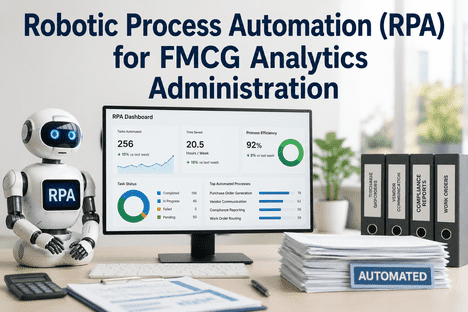
FMCG analytics administration purchase order generation, vendor communication, compliance reporting, and work order routing consumes 15–20 hours per analyst per week in repetitive, rule-based tasks that add no analytical value. Robotic Process Automation (RPA) eliminates this overhead by deploying software bots that execute admin workflows at machine speed with zero data entry errors, freeing the analytics team to focus on demand forecasting, category management, trade promotion optimization, and the strategic analysis that drives FMCG competitive advantage. iFactory AI's engine combines a no-code RPA bot builder, pre-built ERP and procurement system connectors, a centralized dispatch dashboard with SLA monitoring, and audit-grade logging purpose-built for the administration-heavy reality of FMCG analytics functions. Book a Demo to see how leading FMCG brands reclaim 20+ hours per week by automating analytics administration.
The Admin Burden in FMCG Analytics
Every purchase order, vendor email, compliance checklist, and work order consumes analyst time that should be spent on insights. Across a typical FMCG analytics team supporting procurement, supply chain, and trade finance functions, these administrative tasks total 60–80 hours per month the equivalent of one full-time analyst doing data entry instead of data science. The cost is not just labour; it is the opportunity cost of delayed demand signals, slow category response times, and trade spend that goes unoptimized because the analytics team is buried in paperwork.
RPA flips this equation. Bots handle the repeatable, rules-based steps logging into ERP systems, extracting data from supplier portals, formatting compliance reports, routing work orders through approval chains while analysts focus on exception handling, pattern recognition, and the strategic recommendations that actually move revenue and margin. iFactory's automation layer connects directly to your existing SAP, Oracle, Microsoft Dynamics, and major FMCG procurement platforms through pre-built connectors that require no API development.
The table below maps the four highest-volume admin workflows in FMCG analytics to their automation potential, time impact, and the iFactory module that delivers each capability.
Automation Use Cases Before and After RPA
RPA transforms four high-volume, low-judgment admin workflows that slow down every FMCG analytics function. The before-and-after comparison demonstrates the operational shift when bots take over the repetitive work.
- Analyst manually creates 50+ POs per week in ERP copy-paste from demand forecast spreadsheets
- Vendor emails drafted, sent, and tracked individually no automation of confirmations or reminders
- Compliance reports assembled by logging into 5–6 systems and copy-pasting data into PowerPoint
- Work orders routed through 4 approval hops via email chain lost emails cause 2–3 day delays
- PO discrepancies caught at month-end reconciliation 3–4 weeks after the error occurred
- Analyst overtime averages 8–10 hours per week during peak compliance reporting cycles
- POs generated in batch from analytics demand signals — validated and submitted to ERP automatically
- Vendor communications sent automatically with PO attachments, delivery updates, and invoice reminders
- Compliance reports compiled and distributed on schedule — data pulled from all source systems automatically
- Work orders routed and tracked in a single dispatch dashboard — SLA monitoring with escalation triggers
- PO discrepancies flagged in real time — automated matching against PO, goods receipt, and invoice
- Zero overtime during compliance cycles — bots run 24/7, reports delivered before deadlines
Key Automation Capabilities
iFactory's RPA engine is purpose-built for FMCG analytics admin, combining a no-code bot designer, pre-built ERP and procurement connectors, a centralized dispatch console, and enterprise-grade audit logging into a single platform. Each capability targets a specific admin bottleneck that steals analyst hours.
Implementation Journey — From Zero to Automated in Six Weeks
iFactory's phased deployment model gets your FMCG analytics team from current-state manual admin to bot-automated workflows in under six weeks, with measurable time savings and error reduction at every stage.
We automated 80% of our analytics administration in five weeks using iFactory's RPA engine. Our team went from spending 18 hours per week on POs and compliance reports to delivering three new strategic category projects per quarter. The ROI was immediate — we effectively gained a full-time analyst without a new hire, and our data accuracy improved from 92% to 99.7%.
iFactory Feature: Automated Workflows & Dispatch
The Automated Workflows & Dispatch module is the core RPA capability within iFactory's FMCG analytics platform. It combines a no-code bot builder, pre-built ERP and procurement system connectors, a centralized dispatch dashboard with real-time SLA monitoring, and audit-grade logging into a single interface. The module is designed specifically for the administration-heavy reality of FMCG analytics — where analysts are pulled between strategic analysis and operational paperwork. Book a Demo to see how it unifies your analytics admin automation into one dashboard.
| Capability | What It Automates | Time Saved / Week | Error Reduction |
|---|---|---|---|
| PO Generation | Batch-create purchase orders from analytics demand signals and inventory reorder points | 5 hours | 100% (eliminates manual entry errors) |
| Vendor Communications | Auto-send PO confirmations, delivery updates, invoice reminders, and discrepancy alerts | 3 hours | 90% (eliminates missed vendor follow-ups) |
| Compliance Reporting | Auto-compile and distribute compliance reports from 6+ source systems on schedule | 6 hours | 95% (eliminates copy-paste errors) |
| Work Order Dispatch | Route work orders with SLA monitoring, escalation triggers, and completion verification | 4 hours | 100% (eliminates lost email requests) |
| Exception Handling | Flag edge cases for analyst review with full context and resolution recommendations | 2 hours | 85% (reduces manual triage errors) |
Frequently Asked Questions
iFactory's Automated Workflows & Dispatch module is a native, no-code RPA engine that requires no additional RPA licensing. It also integrates with UiPath and Automation Anywhere if your enterprise already uses those platforms. The iFactory connector library covers SAP, Oracle, Microsoft Dynamics, and all major FMCG ERP and procurement systems — typically connected in under 2 hours per system with no API development required.
Most FMCG analytics teams deploy their first bot in under two weeks. The full automation roadmap covering PO generation, vendor communications, compliance reporting, and work order dispatch typically completes within six weeks using iFactory's phased deployment model. Pre-built templates for each workflow accelerate the process significantly — bot configuration for a standard PO generation workflow takes approximately 4 hours.
No. RPA eliminates the repetitive admin work that prevents analysts from doing high-value analysis — it does not replace the analytical thinking, business context, and strategic judgment that drive FMCG category performance. Teams that adopt RPA consistently report higher job satisfaction, more strategic project work, and improved retention. Analysts gain time for the demand forecasting, trade promotion optimization, and revenue growth management work they were hired to do.
Every bot workflow includes an intelligent exception-handling queue. When a bot encounters a scenario it cannot resolve — a vendor rejects a PO, a compliance field is missing, a work order exceeds approval threshold — it routes the item to an analyst with full context including the original data, the error condition, and recommended resolution actions. The analyst handles the exception, and the bot resumes the remaining workflow autonomously. This human-in-the-loop design ensures accuracy while maintaining automation efficiency.