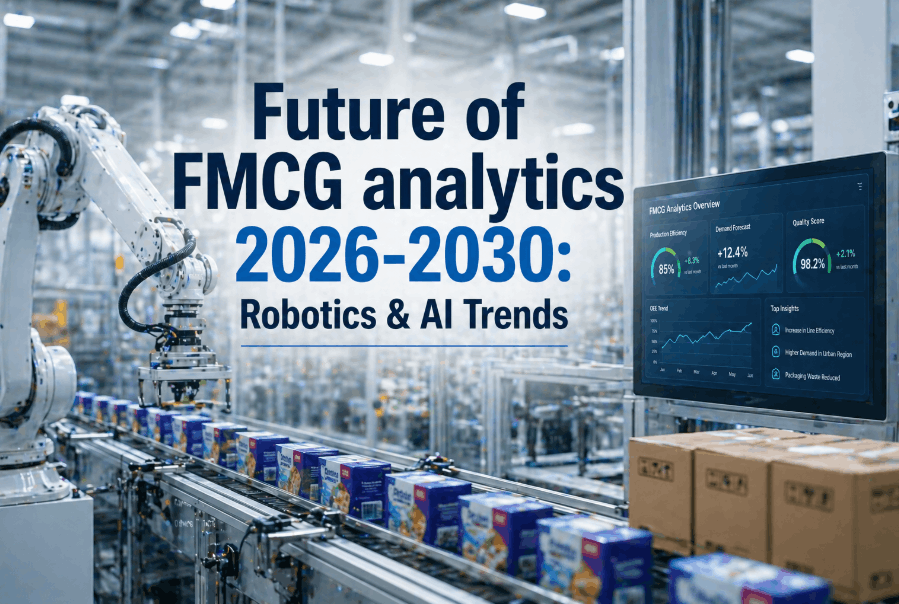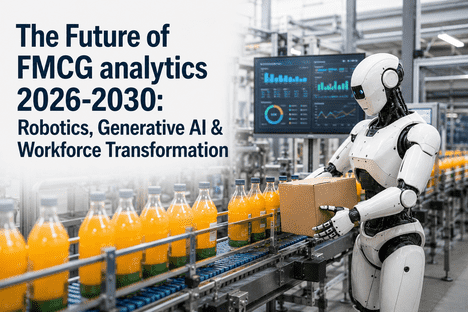
The next five years will reshape FMCG analytics more profoundly than the previous twenty. By 2030, the typical fast-moving consumer goods plant will operate with a generative AI analytics copilot that translates natural language queries into multivariate root-cause analyses in real time, autonomous analytics robots that rove production floors collecting and interpreting data without human intervention, and humanoid factory assistants that collaborate with operators on line changeovers, quality inspections, and predictive maintenance interventions. The workforce itself will be transformed — not replaced, but augmented — as analytics literacy becomes a baseline competency for every role from shift supervisor to plant manager. The FMCG companies that prepare for this transition now will operate at cost structures and efficiency levels their competitors will not reach until the 2030s.
The Generative AI Analytics Copilot: Your Plant's New Digital Twin
The most immediate shift in FMCG analytics between now and 2027 is the transition from dashboards that require humans to interpret data to generative AI copilots that interpret data for humans. Today, when a line manager wants to understand why OEE dropped on Pack Line 4 between 2 AM and 4 AM, they open a dashboard, navigate to the OEE widget, check the availability, performance, and quality components, drill into the downtime log, cross-reference shift records, and synthesise the answer themselves. That process takes a skilled analyst fifteen to thirty minutes. A generative AI analytics copilot does it in seconds — accepting a natural language query, traversing the plant's full data graph (OEE, downtime, quality, energy, throughput, maintenance history), and returning a natural language explanation with supporting visualisations and recommended actions.
iFactory's AI Platform embeds this copilot capability directly into every analytics surface — production monitoring, quality control, maintenance, energy, and OEE dashboards. The copilot understands FMCG-specific context: changeover waste patterns, cleaning validation windows, shelf-life-driven production scheduling, and the interaction between line speed and quality events on high-volume packaging lines. When a plant manager asks "what happened between midnight and 4 AM on Pack Line 4," the copilot does not just return a chart — it returns a diagnosis: fifteen-minute unscheduled downtime spike at 2:17 AM linked to a film roll splice failure on the flow-wrapper, which generated a thirty-unit seal-quality reject cascade before the operator intervened. The diagnosis is generated from the same data the manager would have navigated manually. The difference is time: seconds versus minutes. And in a high-volume FMCG plant, minutes of delayed diagnosis can mean thousands of units of in-process waste.
Autonomous Analytics Robots: From Data Collection to Decision
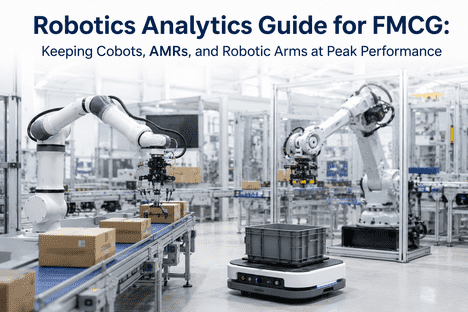
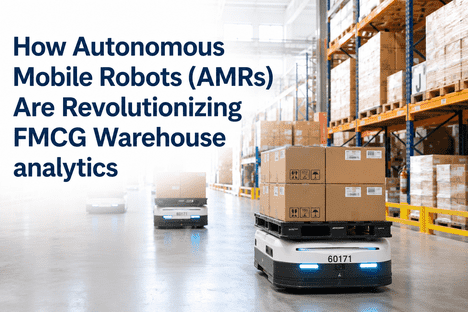
The autonomous analytics robot represents the second major wave of FMCG analytics transformation. By 2028, mobile robots equipped with thermal cameras, vibration sensors, acoustic monitoring arrays, and AI vision systems will rove production floors continuously — collecting data that today requires dedicated instrument technicians, scheduled patrol rounds, and manual data logging. These robots do not replace the existing sensor infrastructure. They extend it to areas where fixed sensors are impractical: packaging lines that are reconfigured weekly, warehouse zones with variable layouts, and quality hold areas where temporary monitoring conditions are needed.
iFactory's Robotics AI module integrates data from autonomous mobile analytics platforms directly into the plant's analytics pipeline. A robot that detects an abnormal thermal pattern on a packaging line's heat-seal bar during its 2 AM patrol cycle does not simply log the temperature — it correlates the thermal reading against the line's historical seal-quality data, checks the current batch's seal integrity test results, and generates a predictive quality alert if the combination of temperature, product formulation, and line speed matches a known failure mode. The robot becomes an analytics node, not just a data collection device. Its outputs flow into the same OEE, quality, and maintenance dashboards that human analysts use, extending the plant's analytics coverage to areas and times that human patrols cannot sustain continuously.
Humanoid Factory Assistants: The Workforce Multiplier
The most transformative development in the 2028–2030 timeframe is the introduction of humanoid factory assistants — general-purpose robots with bipedal mobility, dexterous manipulation, and embedded AI that allows them to perform tasks that today require human presence. Unlike fixed automation, humanoid assistants can navigate the same physical environment as operators: climbing line-access platforms, opening cabinet doors, manipulating changeover tooling, and working alongside humans on tasks that cannot be fully automated within current technology economics.
The analytics implication is significant. Every humanoid assistant is also a data-collection node — continuously measuring line-side conditions, operator interaction patterns, tooling wear states, and process parameters that traditional sensors do not capture. iFactory's Digital Twin AI integrates humanoid sensor streams into the plant's digital twin, creating a level of operational visibility that no combination of fixed sensors alone can achieve. When a humanoid assistant performs a line changeover guided by its AI vision system, every torque value, alignment measurement, and cycle time is recorded in the analytics platform — building a changeover performance dataset that identifies which operator-assistant teams achieve the fastest and most consistent changeovers, and which process steps introduce the most variability.
We deployed the generative AI analytics copilot across three beverage plants in Q2 2026. Within sixty days, our line managers were diagnosing OEE events in under sixty seconds that previously required a fifteen-minute dashboard review or a call to the plant analyst. The copilot caught a seal-quality drift pattern on a PET bottling line that our static dashboard had been missing for six weeks — the line was trending toward a defect threshold that no one saw because no one was looking at the right combination of variables. The copilot found it, surfaced it, and recommended the temperature adjustment that eliminated it. That single catch paid for the entire deployment across all three plants.
— Director of Manufacturing Analytics, Multinational Beverage FMCG Company, 3 Plants, 12 Production LinesSustainability-Driven Operations: Analytics Meets ESG
By 2028, sustainability analytics will no longer be a separate reporting function — it will be embedded in every operational decision the plant makes. The driver is not regulation alone, though expanding carbon reporting requirements across Europe, North America, and Asia-Pacific are accelerating the timeline. The real driver is the recognition that sustainability metrics and operational efficiency metrics converge at the same point: less energy per unit produced, less water per unit, less waste per unit. The analytics platform that optimises for OEE and the one that optimises for carbon intensity are the same platform, drawing from the same data, making the same trade-offs visible.
iFactory's Energy Monitoring module already provides real-time energy consumption tracking per line, per product SKU, and per production hour — forming the foundation for the carbon accounting layer. The 2027 roadmap adds automated carbon intensity calculation per unit produced, with Scope 1 and Scope 2 tracking built into the production analytics pipeline. By 2029, the platform will ingest supplier emissions data for Scope 3 reporting, creating a fully automated ESG reporting framework that generates regulatory submissions directly from operational data without manual compilation. The FMCG plants that have this infrastructure in place before the regulatory deadlines will report at a fraction of the administrative cost of plants that assemble ESG data through manual spreadsheets and quarterly data pulls.
Preparing Your FMCG Workforce for 2030
The workforce transformation implied by these technology shifts is the dimension that FMCG manufacturers underestimate most consistently. The analytics tools of 2030 — generative AI copilots, autonomous robots, humanoid assistants — do not require every operator to become a data scientist. They do require every operator to become comfortable interacting with AI-generated insights, validating machine-generated recommendations against their own experience, and escalating when the copilot's diagnosis does not match the floor-level reality they observe. This is a different skill set from current analytics competency models, which focus on dashboard navigation and report interpretation. The future skill is judgement: knowing when the AI is right, when it is wrong, and when the answer lies somewhere in between.
iFactory's Team Management module supports this evolution through personalised competency tracking and skill-gap analysis. As the plant's analytics capabilities mature, the platform maps each operator's interaction patterns with the copilot, the quality of their overrides, and their improvement trajectory — building an analytics competency profile that identifies which operators are ready for advanced roles and which need additional training. The workforce plan for 2030 is not built in 2029. It is built now, with the analytics infrastructure that develops operator capability alongside the technology.