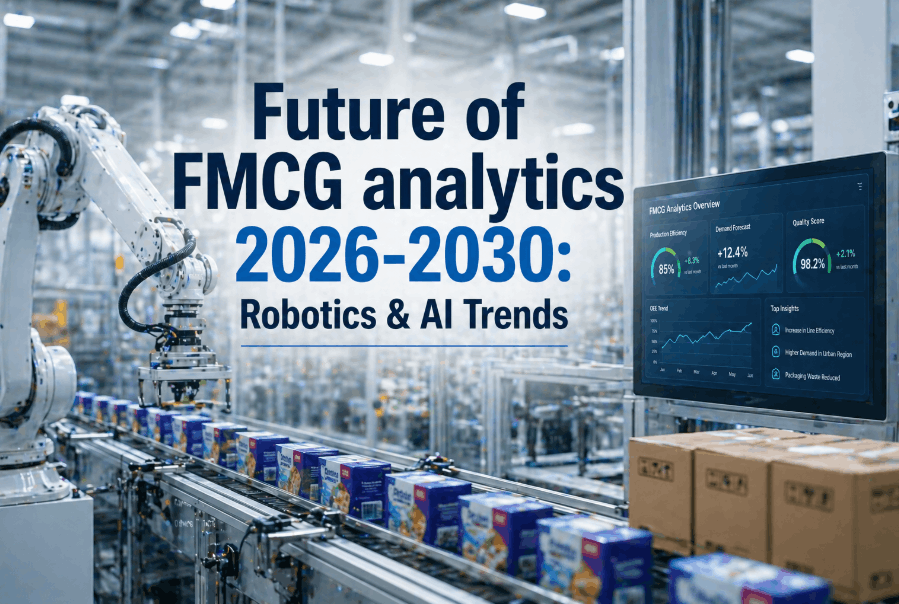
The future of FMCG analytics is actively reshaping food and consumer goods manufacturing right now — agentic AI, autonomous robots, digital twins, and generative AI are converging into unified platforms that eliminate the gap between operational data and real-time action. Companies that delay aligning their analytics strategy with these trends risk compounding competitive disadvantage through 2030. Operations leaders ready to explore next-generation FMCG analytics can Book a Demo to see how AI-powered platforms are already delivering 2030-ready capabilities today.
Future-Proof Your FMCG Operations with AI-Powered Analytics
iFactory's next-generation analytics platform delivers agentic AI monitoring, predictive quality control, digital twin simulation, and autonomous workflow orchestration — built specifically for food and consumer goods manufacturers navigating 2026–2030 transformation.
Why FMCG Analytics Is Entering a Fundamental Transformation Phase Through 2030
The FMCG analytics shift from 2026 to 2030 is not incremental — it is a structural move from descriptive dashboards to prescriptive, autonomous systems that act without human intervention. Three forces drive this: large language model maturity, collapsing sensor network costs, and agentic AI frameworks that orchestrate multi-step workflows autonomously. Manufacturers can Book a Demo to see how 2030-ready capabilities are already running in production environments today.
Agentic AI in FMCG Manufacturing: Beyond Dashboards to Autonomous Decision-Making
Agentic AI systems don't wait for human review — they monitor production continuously, detect anomalies in real time, and execute corrective actions through direct integration with MES, procurement, and logistics networks. In food manufacturing, agentic AI autonomously adjusts pasteurization parameters, reroutes ingredient supplies, and reschedules production runs — all within predefined safety boundaries without supervisor sign-off on routine decisions. Operations directors can Book a Demo to see live autonomous decision workflows running in food manufacturing environments.
Generative AI for FMCG Production Intelligence
Generative AI trained on food manufacturing data enables natural language querying — plant operators and quality managers ask complex questions in plain language and get synthesized, context-aware answers from live sensor data and batch records, with no data science intermediary required.
Digital Twin Simulation for Production Optimization
Digital twin platforms create virtual replicas of production lines and cold chains — enabling manufacturers to simulate recipe changes, capacity expansions, and equipment reconfigurations in a risk-free virtual environment before committing real production resources.
Autonomous Robotics with Embedded Analytics Intelligence
Next-generation FMCG robots embed analytics processing directly — enabling real-time quality inspection, dynamic production routing, and adaptive packaging that responds to upstream variation without centralized compute latency or manual programming updates.
Predictive Supply Chain Analytics with Multi-Tier Visibility
FMCG supply chain platforms will achieve full multi-tier supplier visibility — integrating ingredient quality data, logistics metrics, and retail POS demand signals into unified predictive models that eliminate reactive supply chain management for good.
Digital Twin Technology: The Future of FMCG Production Simulation
Digital twins — continuously updated virtual models synchronized with real-time sensor data — let food manufacturers test process improvements, ingredient substitutions, and capacity scenarios without production risk. By 2028, digital twin adoption is projected to exceed 60% of large-scale FMCG producers, with mid-market companies following as cloud-native architecture continues driving costs down.
Predictive Quality Analytics: Eliminating Defects Before They Occur
Predictive quality analytics identifies upstream process conditions and ingredient variability patterns that correlate with downstream defects — before defective product is ever produced. ML models trained on multi-year production data detect specific combinations of raw material deviation, process drift, and equipment degradation that precede quality failures by hours. For FDA, BRCGS, SQF, and FSSC 22000 compliance, AI-generated quality trend documentation delivers statistical evidence that manual inspection records cannot match at scale.
Computer Vision Quality Inspection Replacing Manual Grading
AI computer vision evaluates color, texture, dimensional tolerance, and surface integrity at line speeds that exceed human inspector capability — generating statistical quality records that regulatory and retail audit requirements demand at scale.
Hyper-Granular Demand Forecasting with Behavioral Analytics
Next-generation demand platforms integrate social sentiment, weather correlations, promotion response modeling, and demographic shifts — predicting SKU-level demand at individual store granularity 12–16 weeks out for true production capacity alignment.
AI-Optimized Energy Consumption and Sustainability Analytics
EU CSRD and SEC climate disclosure rules drive FMCG manufacturers toward AI energy analytics that monitor utility consumption at equipment granularity — identifying optimization opportunities and generating carbon accounting documentation for sustainability-focused retail customers.
Human-AI Collaboration Analytics Optimizing Workforce Performance
Workforce analytics platforms track operator decision latency, AI recommendation acceptance rates, and ergonomic risk patterns — optimizing the human factors that determine how effectively AI tools translate into measurable production performance gains.
Autonomous Robotics and the Future FMCG Factory Floor
The FMCG factory of 2030 will feature fleets of autonomous mobile robots, collaborative arms performing quality inspection alongside human workers, and AI orchestration coordinating task assignment in real time based on production priority analytics. Analytics-embedded robots that understand production context and quality requirements are adaptive assets that continuously improve their own performance contribution — not just expensive fixed-function machines.
FMCG Analytics Technology Comparison: Current State vs. 2030 Capabilities
The progression across every FMCG analytics dimension from 2026 to 2030 is substantial. Manufacturers who begin building toward these capabilities now will achieve compounding advantages that accelerated late-mover adoption programs cannot replicate.
| Analytics Capability | Current State — 2026 | Future State — 2030 | Competitive Impact |
|---|---|---|---|
| Production Intelligence | Real-time dashboards with human review | Agentic AI with autonomous decision execution | Eliminates decision latency across all operations |
| Quality Management | Statistical process control with alert thresholds | Predictive defect prevention with multi-variable AI | Prevents defects before production rather than after |
| Demand Forecasting | Historical sales-based SKU forecasting | Behavioral signal integration, 16-week granular projection | Aligns production with actual consumer demand signals |
| Supply Chain Visibility | Tier-1 supplier integration with manual escalation | Multi-tier real-time visibility, autonomous procurement | Eliminates supply disruption across the ingredient network |
| Maintenance Analytics | Condition monitoring with maintenance alerts | Digital twin failure simulation, autonomous scheduling | Reduces unplanned downtime to near-zero |
| Sustainability Reporting | Manual energy data aggregation for compliance | Automated carbon accounting with real-time scope 3 | Enables continuous sustainability optimization |
| Workforce Optimization | Shift scheduling and productivity tracking | Human-AI collaboration analytics, adaptive task orchestration | Maximizes human contribution alongside autonomous systems |
AI Adoption Rate by FMCG Analytics Capability: 2026 vs. Projected 2030
Adoption velocity across FMCG analytics capabilities is highly uneven — predictive maintenance and demand forecasting are leading early adoption, while agentic workflow automation and digital twin simulation are accelerating fast toward dominant deployment by 2030. Understanding where adoption pressure is highest helps manufacturers prioritize their roadmap investments.
Building the FMCG Analytics Infrastructure That Supports 2030 Capabilities Today
Manufacturers winning through 2030 are building their data infrastructure now — not waiting for full AI maturity. The right foundational investments create the conditions that advanced AI systems require to deliver their full performance potential. Manufacturers ready to assess their infrastructure against 2030 readiness benchmarks can Book a Demo to review iFactory's analytics maturity assessment and platform roadmap.
Unified Data Platform & Real-Time Sensor Integration
Consolidate sensor streams, quality system records, equipment metrics, and supply chain inputs into a single analytics-ready data layer — eliminating system fragmentation that limits AI model training quality and operational integration depth across the full production environment.
ML Model Development for Production-Specific Analytics
Generic AI models deliver limited FMCG value. Facility-specific training on product formulation complexity, regulatory constraints, and process engineering patterns produces the precision required for reliable autonomous decision support at production scale.
Workflow Orchestration & Autonomous Action Integration
Connect intelligence outputs to operational action — integrating AI recommendations with MES controls, procurement triggers, logistics scheduling, and quality hold workflows so decisions execute without manual intervention at each process step.
Generative AI in FMCG: Transforming How Manufacturers Interact with Operational Data
Generative AI eliminates the analytics expertise barrier — a shift supervisor can ask "why did yield drop on the pasteurization line last Tuesday?" and receive a synthesized answer drawn from equipment logs, ingredient records, and historical yield models, with no BI tool proficiency required. This democratizes analytics access across the full workforce, accelerating organizational learning at every operational level.
Regulatory Technology Analytics: FMCG Compliance Automation Through 2030
AI-powered RegTech automates documentation generation, deviation tracking, corrective action recording, and regulatory report compilation — eliminating the manual compliance burden that consumes substantial food safety team capacity. By 2030, leading manufacturers will maintain continuous compliance documentation across FDA, USDA, GFSI, and customer-specific requirements simultaneously, generating audit-ready packages on demand.
Ready to Align Your FMCG Analytics Strategy with 2030 Trends?
iFactory's AI-powered analytics platform delivers agentic intelligence, predictive quality modeling, digital twin simulation, and regulatory compliance automation — positioning food and consumer goods manufacturers for sustained competitive performance through 2030.
Frequently Asked Questions: Future of FMCG Analytics 2026–2030
What is agentic AI and how does it differ from conventional FMCG analytics?
Agentic AI autonomously perceives production environments, formulates decisions, and executes actions unlike conventional analytics that present insights for human review. It detects deviations, identifies root causes, adjusts process parameters, and documents corrective actions, all within predefined safety boundaries without supervisor approval.
How are digital twins used in food and beverage manufacturing analytics?
Digital twins create continuously synchronized virtual replicas of production lines and cold chains — letting quality teams simulate recipe changes, planners model capacity scenarios, and maintenance engineers predict equipment failure propagation before committing real production resources or risking operational disruption.
When will autonomous robotics become standard in FMCG manufacturing?
Analytics-embedded robotics already operate in leading FMCG facilities for palletizing and quality inspection. By 2027–2028, declining costs will bring collaborative robotics within reach of mid-market food manufacturers, with widespread adoption across packaging and production cells expected by 2029–2030.
How should FMCG manufacturers prioritize analytics investment for 2030 readiness?
The highest-return investments are infrastructure foundations: unified production data platforms, continuous sensor coverage, and digital documentation practices that replace paper records with structured data assets — the training material that advanced AI analytics systems require to perform reliably.
Will generative AI replace data science teams in FMCG manufacturing companies?
Generative AI democratizes analytics access but elevates not replaces expertise. Data scientists will shift from routine data extraction to model validation, AI governance, and strategic architecture decisions that generative AI interfaces cannot handle autonomously or with sufficient manufacturing-domain precision.
Start Your FMCG Analytics Transformation Today
See how iFactory's AI-driven analytics platform delivers agentic intelligence, predictive quality control, and regulatory compliance automation the foundation your food manufacturing operation needs to lead through 2026, 2028, and 2030.