Pharmaceutical FMCG GMP Compliant Equipment analytics for OTC Products
By Seren on June 13, 2026
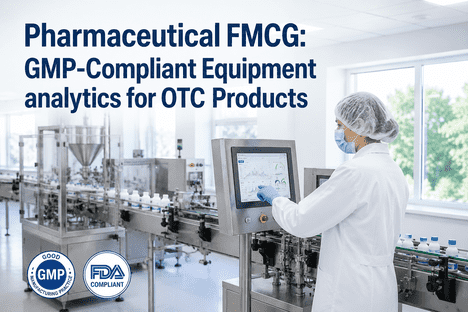
Over-the-counter pharmaceutical manufacturing operates at the intersection of high-speed FMCG production economics and strict GMP regulatory requirements mandated by FDA, EMA, WHO, and national pharmacopoeias. Unlike prescription drug manufacturing, OTC facilities must balance the throughput demands of fast-moving consumer goods with the full weight of 21 CFR Part 211 (Current Good Manufacturing Practice for Finished Pharmaceuticals), EU GMP Annex 1 (Manufacture of Sterile Medicinal Products for applicable products), ICH Q7 (GMP for Active Pharmaceutical Ingredients), and ISO 14644 cleanroom classification standards. The compliance burden is compounded by the diversity of OTC product forms — tablets, capsules, liquids, creams, ointments, inhalers, transdermal patches — each with distinct equipment configurations, critical process parameters, and contamination control strategies. Industry data indicates that 40–55% of FDA Form 483 observations and warning letters issued to OTC manufacturers cite equipment-related deficiencies: incomplete IQ/OQ/PQ protocols, inadequate cleaning validation, absent calibration records, and insufficient maintenance documentation. The cost of non-compliance extends beyond regulatory action — unplanned equipment downtime in pharmaceutical production averages $15,000–$30,000 per hour for OTC solid dosage forms and $30,000–$60,000 per hour for liquid/sterile products. iFactory AI's GMP Module and Validation Tracking platform provides pharmaceutical quality and engineering teams with a unified analytics layer that connects equipment qualification status, calibration schedules, cleaning validation protocols, maintenance work orders, and cleanroom monitoring data into a single compliance-ready system. Book a Demo to see how your OTC manufacturing facility can achieve and maintain GMP compliance while maximizing equipment reliability and production throughput.
GMP Compliance · OTC Manufacturing · 2026
GMP-Compliant Equipment Analytics for OTC Pharmaceutical Manufacturing
End-to-end analytics framework covering equipment qualification (IQ/OQ/PQ), cleanroom environmental monitoring, cleaning validation, calibration management, and preventive maintenance — purpose-built for OTC manufacturers operating under FDA, EMA, and WHO GMP regulations.
The Regulatory Landscape: GMP Requirements for OTC Equipment Analytics
OTC pharmaceutical manufacturing occupies a unique regulatory space. Products are not prescribed by a physician, yet they must meet the same GMP standards applied to prescription drugs under 21 CFR Part 211. The FDA's Compliance Program Guidance Manual for OTC products (CPGM 7356.008) specifically targets equipment qualification, cleaning validation, and laboratory controls during routine surveillance inspections. The four regulatory domains that drive equipment analytics requirements in OTC facilities are interconnected and demand coordinated data management across quality, engineering, and production functions.
01
Equipment Qualification (IQ/OQ/PQ)
21 CFR 211.63 requires that equipment be "of appropriate design, adequate size, and suitably located to facilitate operations for its intended use." IQ verifies proper installation per specifications. OQ demonstrates operation within defined limits across normal and worst-case conditions. PQ proves consistent performance with actual production materials. Each phase requires documented evidence with approved protocols, executed test scripts, and summary reports. Missing or incomplete IQ/OQ/PQ protocols are the most frequently cited equipment observation in FDA warning letters to OTC manufacturers.
Cited in 35%+ of OTC warning letters
02
Cleaning Validation
21 CFR 211.67 requires written procedures for cleaning equipment between batches and product changeovers. Cleaning validation must establish that residue limits for active ingredients, cleaning agents, and microbial contaminants are consistently met. OTC facilities running multiple products on shared equipment face the highest cleaning validation burden — each product pair requires a dedicated validation protocol. Analytical methods for residue detection (HPLC, TOC, UV-Vis) must be validated and their calibration status maintained. Equipment analytics must track cleaning status, hold times, and CIP/SIP cycle parameters.
15–30% of total validation effort
03
Calibration & Preventive Maintenance
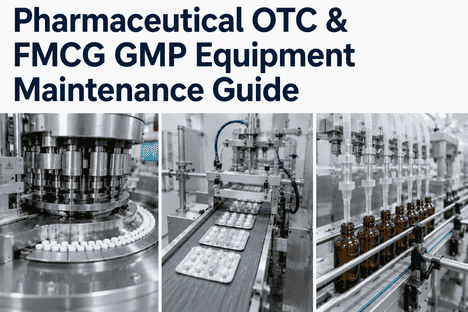
21 CFR 211.68 requires that automatic, mechanical, or electronic equipment be "routinely checked" and "calibrated according to a written program." Temperature sensors, pressure transmitters, flow meters, pH probes, balance scales, and spectrophotometers require documented calibration at defined intervals traceable to NIST standards. Preventive maintenance of pharmaceutical equipment — tablet presses, blister packing lines, liquid filling stations, homogenizers, autoclaves — must follow manufacturer specifications and be documented with work order history. Equipment analytics must correlate calibration and PM completion with batch release decisions.
Calibration overdue = batch rejection risk
04
Cleanroom & Environmental Monitoring
EU GMP Annex 1 and ISO 14644 classify cleanroom environments by particulate limits (Grade A/B/C/D for EU; Class 100/10,000/100,000 for US). OTC liquid and semi-solid manufacturing requires Grade C/D environments. Continuous monitoring of temperature, relative humidity, differential pressure, particle counts, and viable microbial levels generates terabytes of data annually. Equipment analytics must correlate environmental excursions with production batches, trigger deviation investigations, and demonstrate that product quality was not compromised. Real-time alerting and trend analysis separate proactive compliance from retrospective remediation.
50,000+ data points per cleanroom daily
Core Pillars of GMP-Compliant Equipment Analytics
A GMP-compliant equipment analytics program rests on five interconnected pillars that bridge quality assurance, engineering maintenance, production operations, and regulatory documentation. Each pillar generates data that must be captured, correlated, and reported in a format that satisfies inspector scrutiny during routine audits and for-cause investigations. OTC manufacturers that integrate these pillars into a unified analytics platform reduce audit preparation time by 60–80% and eliminate the data silos that produce conflicting compliance signals.
P1
Qualification Lifecycle Management
End-to-end tracking of equipment qualification from URS through FAT/SAT, IQ, OQ, PQ, and ongoing requalification. Digital protocol libraries with electronic signatures (21 CFR Part 11 compliant). Automated re-qualification scheduling based on risk classification, usage intensity, and regulatory requirements. Deviation tracking with CAPA linkage during qualification execution.
IQ/OQ/PQ · FAT/SAT · Re-qualification
P2
Calibration & Preventive Maintenance
Instrument and equipment calibration scheduling with automated alerts for approaching due dates. Calibration certificate storage with direct batch record linkage. PM program execution tracking with work order generation, parts reservation, and technician assignment. Equipment analytics dashboards showing calibration compliance %, PM on-time completion, and mean time between maintenance events.
NIST traceability · PM compliance · MTBM
P3
Cleaning Validation Analytics
Cleaning protocol execution tracking with residue limit verification. Hold time studies and dirty equipment hold time monitoring. CIP/SIP cycle parameter trending (flow rate, temperature, detergent concentration). Cleaning status dashboards showing equipment readiness for product changeover. Automated cleaning failure investigation workflow with root cause assignment.
Swab/Rinse samples · HPLC/TOC · Limits
P4
Cleanroom Environmental Monitoring
Real-time continuous monitoring of critical parameters: temperature, RH, differential pressure, particle counts (0.5µm and 5.0µm), viable air sampling, surface microbial counts. Automated alerting with configurable alert/action limits per EU GMP Annex 1. Environmental data trending with batch correlation. Deviation investigation workflow with root cause analysis and CAPA. Quarterly trend review reports per regulatory expectation.
ISO 14644 · EU GMP Annex 1 · Alert/Action
P5
Compliance Documentation & Reporting
Centralized documentation repository for validation protocols, calibration certificates, PM records, cleaning reports, and environmental data. Automated report generation for regulatory submissions and internal audits. Document version control with electronic signature workflow. Audit trail for all GMP-critical data changes. Inspection-readiness dashboards showing real-time compliance posture across all equipment and systems.
21 CFR Part 11 · Audit trail · ALCOA+
Equipment Qualification Lifecycle — From URS to Re-Qualification
The equipment qualification lifecycle for OTC pharmaceutical manufacturing spans the full asset journey from user requirement specification through decommissioning. Each phase produces documented evidence that inspectors examine for completeness, accuracy, and adherence to approved protocols. The table below maps the qualification lifecycle stages with their regulatory basis, key deliverables, and typical analytics integration points.
Operational limits testing, alarm verification, cycle development
Parameter limit dashboards
Insufficient worst-case testing
PQ
21 CFR 211.110
Process performance with production materials, 3 consecutive batches
Batch record correlation analytics
Insufficient batch replication
Ongoing
21 CFR 211.67/68
Calibration, PM, cleaning validation, change control
Real-time compliance dashboard
Re-qualification overdue tracking
Decommission
Company SOP
Equipment retirement protocol, data migration, archival
Asset lifecycle report
Incomplete data migration plan
Is your OTC facility's equipment qualification documentation inspection-ready? Book a Demo to see how iFactory's GMP Module automates protocol tracking, deviation management, and re-qualification scheduling across your entire equipment fleet.
Traditional OTC pharmaceutical manufacturers maintain validation documentation in binders, shared network drives, or document management systems that lack real-time analytics. The result: protocol approvals take 4–6 weeks, requalification due dates are tracked manually in spreadsheets, and inspection readiness requires weeks of preparation. Validation protocol analytics transforms this landscape by digitizing the full protocol lifecycle with measurable efficiency gains. The seven-point assessment framework below enables quality and engineering teams to evaluate their current validation documentation maturity and identify the highest-impact digitization opportunities.
01
Protocol creation & review cycle
Measure your baseline:
"How many days does it take from initial protocol draft to final approved version ready for execution?"
Paper-based: 30–45 days · Digital without analytics: 15–20 days · With iFactory GMP Module: 3–5 days. The difference is automated template population, parallel review workflows, and real-time comment resolution tracking.
02
Protocol execution tracking
Measure your baseline:
"Can you see real-time execution status of all active qualification protocols across your facility?"
Score 1: Paper execution with manual status tracking · Score 3: Digital execution with delayed status updates · Score 5: Real-time dashboards showing protocol progress, deviation counts, and pending approvals per equipment item.
03
Deviation & exception management
Measure your baseline:
"How are deviations during protocol execution captured, investigated, and resolved?"
Score 1: Handwritten deviations appended to protocol · Score 3: Digital deviation forms with email notification · Score 5: Automated deviation workflow with root cause analysis, CAPA generation, and impact assessment linked to protocol results.
04
Re-qualification scheduling
Measure your baseline:
"Are re-qualification dates tracked with automated alerts, or do they depend on manual review?"
Score 1: No re-qualification tracking · Score 3: Spreadsheet-based tracking with manual review · Score 5: Risk-based re-qualification scheduling with automated notifications, protocol generation, and compliance dashboard.
05
Change control linkage
Measure your baseline:
"Are equipment changes automatically assessed for re-qualification impact?"
Score 1: No change control process · Score 3: Change control with manual impact assessment · Score 5: Integrated change control with automated qualification impact analysis and re-qualification protocol generation.
06
Inspection readiness
Measure your baseline:
"How many days would it take to produce a complete equipment qualification package for an FDA investigator?"
Score 1: 5–10 days of document retrieval · Score 3: 1–2 days with digital repository · Score 5: Real-time dashboard showing qualification status, calibration compliance, and open deviations for every piece of equipment — accessible in minutes.
07
Data integrity compliance
Measure your baseline:
"Does your validation documentation system comply with 21 CFR Part 11 data integrity requirements?"
Score 1: Paper records with no audit trail · Score 3: Digital records without full Part 11 compliance · Score 5: Full ALCOA+ compliant system with electronic signatures, audit trail, data backup, user access controls, and system validation documentation.
Implementation Pathways — Building Your GMP Equipment Analytics Program
OTC pharmaceutical manufacturers at different stages of analytics maturity require different implementation approaches. The right pathway depends on current documentation practices, quality management system maturity, regulatory exposure, and organizational readiness for digital transformation. Each pathway preserves existing investment in QMS platforms, CMMS systems, and environmental monitoring hardware while adding the analytics and integration layer that converts fragmented compliance data into a unified inspection-ready picture.
Path A
Validation Documentation Digitization
6–8 weeks
Digitize existing IQ/OQ/PQ protocols, calibration records, and cleaning validation documentation into a unified GMP Module. Establish protocol templates with automated population. Deploy deviation management workflow with CAPA linkage. Configure re-qualification scheduling with automated alerts. Create inspection readiness dashboard. Best fit for organizations still managing validation documentation through paper binders or basic document repositories.
Best fit
Paper-based or basic digital documentation · manual deviation tracking · spreadsheet re-qualification scheduling · inspection preparation takes 5+ days
Wk 1–3 Protocol template library + data migration
Wk 4–5 Deviation workflow + CAPA configuration
Wk 6–8 Re-qualification scheduling + dashboard
Path B
Integrated Compliance Analytics Platform
10–14 weeks
Connect existing CMMS, environmental monitoring system, and quality management platform into a single compliance analytics layer. Correlate equipment qualification status with calibration records, PM completion, cleaning validation results, and environmental data. Deploy real-time compliance dashboards per equipment line and cleanroom zone. Automated batch release checking against equipment status. Best fit for organizations with digital systems operating in silos.
Best fit
Digital CMMS + QMS + EM systems in place · systems not integrated · data manually reconciled for audits · 2–3 day inspection preparation
Wk 1–4 System integration architecture + data mapping
Wk 5–9 Compliance analytics build + dashboard development
Wk 10–14 Validation + rollout + training
Path C
Full GMP Digital Transformation
16–20 weeks
End-to-end deployment covering all five pillars: qualification lifecycle management, calibration/PM integration, cleaning validation analytics, cleanroom environmental monitoring, and compliance documentation. iFactory AI's GMP Module serves as the unified compliance data platform. All equipment classes, cleanroom zones, and product families covered. Automated deviation investigation, CAPA management, and inspection readiness reporting. Best fit for greenfield facilities or organizations undertaking comprehensive QMS modernization.
Best fit
Greenfield facility · major QMS transformation · 500+ equipment items · multiple cleanroom zones · regulatory exposure across FDA, EMA, WHO
Wk 1–6 Equipment census + protocol inventory + system architecture
Wk 7–14 Parallel pillar deployment + integration
Wk 15–20 System validation + cutover + training
Transform Your OTC Facility's GMP Compliance Posture
iFactory AI's GMP Module and Validation Tracking platform runs a structured 2-week assessment against your specific equipment roster, cleanroom configuration, documentation practices, and regulatory exposure. You leave with a scored compliance analytics maturity assessment, a defended path recommendation, a 6–20 week deployment plan, and a compliance cost reduction projection grounded in your actual audit history and equipment data.
The Business Impact — What GMP-Compliant Equipment Analytics Delivers
The business case for GMP-compliant equipment analytics in OTC pharmaceutical manufacturing rests on four measurable value drivers: regulatory risk reduction, operational efficiency improvement, maintenance cost optimization, and product quality assurance. Each driver delivers compounding returns as analytics maturity advances. OTC manufacturers that implement integrated equipment analytics report 40–60% reduction in audit observations, 30–50% reduction in deviation investigation cycle time, and 15–25% reduction in maintenance spend through optimized calibration and PM scheduling.
40–60%
Reduction in Audit Observations
Integrated compliance analytics eliminates the documentation gaps and missing records that drive 483 observations. Real-time dashboards ensure every protocol, calibration certificate, and cleaning record is current and accessible before the inspector arrives. Typical investment: $75K–$200K. Payback: 6–12 months based on regulatory risk avoidance.
30–50%
Deviation Cycle Time Reduction
Automated deviation investigation workflows with standardized root cause analysis templates reduce average investigation time from 15–20 days to 5–8 days. CAPA generation and effectiveness check tracking ensure deviations are not only resolved but prevented from recurring.
15–25%
Maintenance Spend Optimization
Risk-based calibration and PM scheduling replaces fixed-interval approaches, eliminating unnecessary maintenance while ensuring critical instruments remain in compliance. Equipment analytics identify recurring failure patterns that drive design modification or replacement decisions.
$15K–$60K
Per Hour Unplanned Downtime Cost
Predictive equipment analytics integrated with GMP compliance data prevents unplanned downtime that costs OTC solid dose facilities $15K–$30K/hour and liquid/sterile facilities $30K–$60K/hour. Early warning indicators from vibration, temperature, and current draw monitoring trigger maintenance before failure occurs.
Expert Perspective
"The most persistent misconception in OTC pharmaceutical manufacturing is that GMP compliance and production efficiency are opposing objectives. They aren't. A tablet press that is properly qualified, calibrated, and maintained produces more compliant tablets per hour at lower cost than one that is neglected until an FDA inspection triggers a crash qualification program. The data proves it: OTC facilities with integrated equipment analytics platforms consistently achieve higher OEE scores than their paper-based counterparts while receiving fewer 483 observations. The cost of compliance is not a burden on production — it is the foundation of reliable production. The manufacturers who understand this invest in equipment analytics not because the regulator demands it, but because the business case is undeniable."
— iFactory AI Pharmaceutical Practice, 2026 industry insight
60–80%
reduction in audit preparation time
50%+
fewer equipment-related 483 observations
Zero rip
of existing CMMS, QMS, or EM systems required
Conclusion: GMP-Compliant Analytics Is the Foundation of OTC Manufacturing Excellence
OTC pharmaceutical manufacturing operates at the convergence of regulatory rigor and production velocity. GMP-compliant equipment analytics is not a documentation burden — it is the operational framework that enables both compliance and throughput. The five pillars of qualification lifecycle management, calibration and preventive maintenance, cleaning validation, cleanroom environmental monitoring, and compliance documentation form an integrated system where each component reinforces the others. iFactory AI's GMP Module and Validation Tracking platform provides the analytics layer that connects these pillars into a single, inspection-ready compliance data platform. Whether your facility needs foundational protocol digitization (Path A, 6–8 weeks), integrated compliance analytics (Path B, 10–14 weeks), or full GMP digital transformation (Path C, 16–20 weeks), the platform integrates with existing CMMS, QMS, and environmental monitoring systems while adding the analytics and automation that eliminate compliance gaps and reduce regulatory risk. The decision worth making in 2026 is not whether to digitize GMP compliance documentation — it is which implementation pathway fits your facility's current maturity, regulatory exposure, and operational priorities.
Assess Your OTC Facility's GMP Equipment Analytics Maturity
iFactory AI's pharmaceutical practice runs a structured 2-week assessment against your specific equipment roster, cleanroom zones, documentation practices, and regulatory exposure. You leave with a scored maturity assessment, a defended path recommendation, a 6–20 week deployment plan, and a compliance improvement projection grounded in your actual audit history and equipment data.
What is the difference between equipment qualification and equipment validation in pharmaceutical GMP?
Equipment qualification (IQ/OQ/PQ) is the documented process of verifying that a specific piece of equipment is properly installed, operates correctly, and performs consistently for its intended purpose. Equipment validation is the broader term that encompasses qualification plus all ongoing activities including calibration, preventive maintenance, cleaning validation, change control, and re-qualification. In practice, qualification is the initial demonstration of equipment fitness, while validation is the ongoing program that maintains that fitness throughout the equipment lifecycle. Both are required under 21 CFR Part 211 and are subject to FDA inspection scrutiny.
How often must pharmaceutical equipment be re-qualified under GMP regulations?
There is no fixed regulatory interval for re-qualification. The frequency is determined by a risk-based assessment that considers equipment criticality (direct product contact vs. indirect), complexity, failure history, manufacturer recommendations, and change history. Industry practice typically ranges from annual re-qualification for critical equipment (tablet presses, filling lines, autoclaves) to every 2–3 years for major equipment (blenders, granulators, coating pans) and every 3–5 years for minor equipment (conveyors, labelling machines, cartoners). Re-qualification is also triggered by significant equipment modifications, relocation, or major repairs. iFactory's GMP Module automates risk-based re-qualification scheduling with configurable rules per equipment class.
What are the most common equipment-related findings in FDA Form 483 observations for OTC manufacturers?
The five most frequently cited equipment-related observations in OTC manufacturing are: (1) incomplete or missing IQ/OQ/PQ protocols and reports; (2) inadequate cleaning validation procedures and incomplete residue testing documentation; (3) overdue calibration of critical instruments with continued batch release; (4) absent or incomplete preventive maintenance records; and (5) inadequate investigation of equipment-related deviations with missing CAPA. These five categories account for approximately 55–65% of all equipment-related 483 observations in OTC facilities. The root cause across all categories is the same: fragmented documentation systems that cannot produce a complete, current equipment qualification package on demand.
Can AI-driven equipment analytics replace traditional GMP documentation requirements?
No. AI-driven analytics cannot replace the regulatory requirement for documented evidence of equipment qualification, calibration, and maintenance. However, AI can transform how that documentation is generated, managed, and analyzed. iFactory's platform uses AI to automate protocol population from equipment specifications, flag deviation patterns requiring investigation, predict calibration drift before it exceeds limits, and correlate environmental monitoring data with batch quality outcomes. The documentation remains — but it is generated in real-time, analyzed for patterns, and presented in inspection-ready dashboards rather than assembled manually from binders and spreadsheets. The regulatory requirement for documented evidence is unchanged; the efficiency and accuracy of documentation management is transformed.
How does cleanroom environmental monitoring data integrate with equipment qualification records?
Cleanroom environmental monitoring data must be correlated with production batches to demonstrate that product quality was not compromised by environmental excursions. For GMP compliance, the integration requires: (1) time-stamped environmental data (particle counts, temperature, RH, differential pressure) linked to specific production batches running in specific cleanroom zones; (2) alert/action limit excursions automatically triggering deviation investigations with equipment impact assessment; (3) quarterly environmental monitoring trend reports that demonstrate ongoing cleanroom control; and (4) annual cleanroom re-qualification per ISO 14644 that includes particle count mapping and recovery testing. iFactory's platform provides batch-to-environment correlation analytics that eliminate the manual data reconciliation burden and ensure every batch release decision considers environmental data.