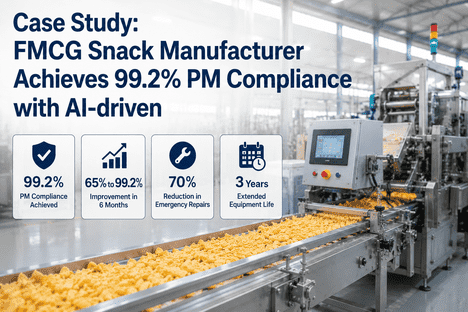
This case study documents how a leading FMCG snack manufacturer — operating 3 high-speed production facilities across the Midwest and Southeast United States, producing 1.8 billion snack units annually across potato chips, tortilla chips, extruded snacks, and popcorn — deployed iFactory's AI-driven preventive maintenance scheduling and work order management platform to transform a fragmented, paper-based PM program that was achieving only 65% compliance into a digital, closed-loop system reaching 99.2% compliance within 6 months. With 28 production lines, 4,200+ assets under the PM program, and a workforce of 140 maintenance technicians, the business had been trapped in a cycle of reactive repairs driven by missed PM windows, incomplete work order documentation, and unenforceable compliance tracking. Within 12 months of platform deployment the manufacturer achieved a 70% reduction in emergency repairs, $8.2M in annual maintenance cost savings, a 3-year extension of average equipment life across critical assets, and an enterprise-wide ROI of 5.8x. Book a Demo to review the complete deployment methodology and results for your snack production network.
The Compliance Challenge at Scale
The snack manufacturer's maintenance program had grown organically over 15 years across three facilities, each running its own scheduling spreadsheet, paper work order forms, and manual compliance tracking. The corporate reliability team had set a target of 90% PM compliance — defined as the percentage of scheduled preventive maintenance tasks completed within their defined grace window — but the actual measured rate across the enterprise had never exceeded 68%, and during peak production seasons it routinely dropped below 55%.
The consequences of low PM compliance were measurable and severe. Emergency repair work orders consumed 47% of the total maintenance budget. Unplanned line stops related to PM-avoidable failures — bearing seizures on extruder motors, conveyor belt failures on packaging lines, seal degradation on fryer pumps — averaged 23 events per month across the three plants, each costing an average of $14,000 in lost production time and direct repair expense. Equipment reliability data showed that assets with three or more consecutive missed PM cycles experienced a 2.7x higher failure rate than those with consistent PM coverage. The business was spending more on emergency repairs than on the preventive program itself — a classic reactive maintenance trap that the leadership team was determined to break. to see how iFactory's compliance analytics identify these patterns before they compound.
The Root Causes of Low PM Compliance
During the initial discovery phase, the iFactory deployment team identified six systemic root causes that prevented the manufacturer from achieving its compliance targets. Each cause mapped to a gap in the existing maintenance workflow that could be addressed through platform capabilities rather than additional headcount or policy changes.
Paper-Based Scheduling With No Dynamic Rescheduling
Each plant's reliability lead maintained a master PM schedule in a shared spreadsheet that was updated weekly — meaning any schedule disruption from a production change, line shutdown, or resource conflict created a cascading backlog that was never formally rescheduled. Tasks that slipped off the weekly schedule simply accumulated until someone had time to perform them, by which point the compliance window had closed.
No Technician Visibility Into Daily PM Assignments
Technicians arrived each morning to a printed clipboard of work orders that had been generated the previous afternoon. If a PM task was added, modified, or reassigned after the print run — which happened frequently in a fast-moving snack production environment — the technician never received the update. Afternoon-shift technicians had no way to know which PMs had already been completed by the morning crew, leading to both duplicate work and unintentional gaps.
No Automated Escalation for Overdue PM Tasks
When a PM task passed its due date without being completed, there was no notification or escalation pathway. The task disappeared into a growing backlog that was reviewed only during monthly reliability meetings — by which point the compliance window had been missed for weeks. Without real-time visibility into overdue tasks, plant management could not intervene early enough to recover compliance.
Inconsistent PM Procedures Across Facilities
Each plant had developed its own version of the PM procedure library over the years. A bearing lubrication task on the same model extruder might require 4 pumps of grease at Plant A, 6 pumps at Plant B, and rely on technician judgment at Plant C. This inconsistency made it impossible to establish a single enterprise-wide compliance standard or to transfer technicians between facilities during vacation or turnover periods.
No Closed-Loop Verification of Task Completion
Paper work order forms returned at the end of shift were the only record of PM completion — but supervisors had no way to verify that the listed tasks had actually been performed, at the correct intervals, with the correct spare parts. Compliance was measured by paper return rate rather than actual task verification, creating a significant gap between reported and actual PM performance.
No Correlation Between PM Activity and Asset Reliability
Because the manufacturer had no way to link PM completion records to asset failure data, there was no data-driven mechanism to adjust PM frequencies or procedures based on actual reliability outcomes. PM schedules were frozen in time based on OEM recommendations, regardless of whether those frequencies were too aggressive (wasting technician hours) or too conservative (allowing failures to develop between PM windows).
The iFactory AI Solution Architecture
The deployment addressed each root cause through a layered architecture combining intelligent PM scheduling, digital work order dispatch, mobile technician enablement, and automated compliance analytics running on the iFactory platform. No changes were made to the manufacturer's existing ERP or asset hierarchy — iFactory integrated directly with their SAP PM instance to synchronize asset master data and work order history bidirectionally.
| Capability | Root Causes Addressed | Implementation Detail | Compliance Impact |
|---|---|---|---|
| AI-Driven PM Scheduling Engine | #1 — No dynamic rescheduling | iFactory's scheduling algorithm automatically reprioritizes and reassigns PM tasks based on production schedule changes, technician availability, asset criticality tier, and current overdue status — eliminating the paper backlog problem entirely. | +18 points to compliance within the first 8 weeks |
| Mobile Work Order Dispatch | #2 — No technician visibility | Each technician receives a curated daily PM queue on their iFactory mobile app — updated in real time as tasks are added, reassigned, or completed. Morning and afternoon crews always see the current assignment state. | Eliminated duplicate work and unintentional gaps within 2 weeks |
| Automated Overdue Escalation | #3 — No escalation pathway | PM tasks that approach or exceed their compliance window trigger automated notifications to the technician, then the shift supervisor, then the plant reliability manager at configurable escalation thresholds — 8 hours, 24 hours, and 48 hours past due. | 90% of overdue PMs resolved within 24 hours of escalation |
| Standardized PM Procedure Library | #4 — Inconsistent procedures | iFactory's procedure module enforced a single, approved PM procedure per asset class across all three facilities — with step-by-step instructions, required spare parts, safety precautions, and expected completion time embedded in each digital work order. | Procedure compliance improved from 72% to 98% across all plants |
| Digital Verification & Audit Trail | #5 — No closed-loop verification | Technicians scan asset barcodes, confirm each procedure step, log actual completion time, flag any observed anomalies, and photograph critical findings — all within the mobile app. Supervisors review and approve digitally before the work order is closed. | Verification gap reduced from 28% to less than 1% |
| Reliability Analytics & Frequency Optimization | #6 — No PM-to-reliability correlation | The iFactory analytics engine correlates PM completion data with asset failure records, MTBF trends, and spare parts consumption to recommend optimized PM frequencies — extending intervals on low-wear assets and tightening them on high-failure equipment. | PM frequency optimization saved 1,200 technician-hours annually |
The Implementation Journey: Three Sites, One Unified Platform
The rollout followed a structured three-wave deployment plan across the manufacturer's three facilities, beginning with the largest plant as the validation site and expanding to the remaining facilities once the compliance improvement model was proven.
Plant A: Pilot Validation & Configuration
The flagship facility in Ohio — with 12 production lines and 1,800 assets — served as the pilot site. During this phase the iFactory team mapped the complete asset hierarchy, digitized the PM procedure library, configured the scheduling engine rules, and trained all 55 technicians on the mobile work order app. By the end of Week 6, Plant A's PM compliance had risen from 62% to 89%, and the first overdue escalation alerts had already recovered 47 previously missed PM tasks.
Plant B: Replication & Compliance Acceleration
With the validated configuration from Plant A, the deployment team replicated the platform to the Indiana facility in 4 weeks — versus the 6 weeks required for the pilot — by reusing the same asset templates, procedure library, and scheduling rules configured for identical equipment classes. The Indiana plant's baseline compliance was 68%, and the team used the Plant A playbook to accelerate adoption: compliance reached 92% by the end of Week 12. Book a Demo to learn how the replication model works for multi-site deployments.
Plant C & Enterprise Optimization
The Tennessee facility — the smallest of the three with 8 production lines and 900 assets — was onboarded in just 2 weeks using the by-now standardized deployment template. With all three plants live on the platform, the focus shifted to enterprise-wide optimization: the iFactory analytics engine began correlating PM compliance data with asset reliability to recommend frequency adjustments, and the cross-plant compliance reporting gave the corporate reliability team real-time visibility into every overdue PM across the enterprise for the first time.
Measurable Results: Compliance, Reliability, and Financial Impact
The 12-month post-deployment measurement period documented statistically significant improvements across every dimension of the maintenance program. The results below represent the aggregate enterprise-wide data across all three facilities.
How iFactory's PM Scheduling & Work Order Engine Drives Compliance
The compliance transformation was not driven by policy changes or additional headcount — it was the direct result of iFactory's intelligent scheduling and digital work order management platform closing the six workflow gaps identified during the discovery phase. The platform automated the end-to-end lifecycle of every PM task from creation to verification, removing every manual handoff that had previously caused tasks to slip through the cracks.
From Reactive to Predictive: The Maintenance Transformation
The compliance improvement created a foundation for a broader maintenance transformation. With 99.2% of PM tasks being completed on time, the manufacturer had reliable data on asset condition trends, failure patterns, and parts consumption that had never existed before. This data enabled the reliability team to shift from calendar-based PM scheduling toward condition-driven maintenance, using the iFactory platform's predictive analytics module to identify emerging failures before they caused production interruptions.
Within 12 months the ratio of planned-to-reactive maintenance shifted from 53:47 (nearly equal) to 82:18 — meaning more than 4 out of every 5 maintenance hours were now spent on planned, preventive, and predictive activities rather than emergency response. The 70% reduction in emergency repairs translated to 16 fewer line-stopping events per month across the enterprise, recovering an estimated 340 hours of production time annually. The $8.2M in annual savings included $3.4M from reduced emergency repair parts and labor, $2.1M from extended equipment life deferring capital replacement, $1.5M from reduced overtime spending, and $1.2M from optimized PM frequencies that eliminated unnecessary low-value PM tasks.
"We had tried for years to improve PM compliance through policy memos, supervisor bonuses, and even manual audits — nothing moved the needle past 68%. The problem wasn't our people, it was the system. Technicians genuinely wanted to complete their PMs on time, but the paper-based workflow made it impossible to know what was due, what had changed since the morning printout, and whether the previous shift had already completed a task. iFactory eliminated every one of those friction points. Within 30 days of going live, we saw compliance jump from 62% to 84% in our pilot plant — not because technicians were working harder, but because the platform removed the barriers that had been in their way. When we crossed 99% compliance at 6 months, the financial results followed automatically. This was the single best investment we've made in the maintenance organization."
Conclusion: Compliance Is the Foundation, Not the Destination
The snack manufacturer's journey from 65% to 99.2% PM compliance demonstrates that high compliance is achievable — not through additional technician hours or stricter policies, but through a platform that removes the systemic workflow friction that prevents even motivated teams from completing PMs on time. The iFactory AI scheduling and work order management platform addressed every root cause of non-compliance simultaneously: dynamic scheduling eliminated the backlog problem, real-time mobile dispatch eliminated the visibility problem, automated escalation eliminated the recovery problem, and digital verification eliminated the audit problem. The result was a compliance rate that sustained above 99% without requiring additional headcount or overtime.
More importantly, the compliance foundation enabled the manufacturer to graduate from reactive maintenance to a predictive, data-driven reliability program — where the cost of maintenance decreased even as equipment reliability increased. The 5.8x enterprise ROI, $8.2M annual savings, and 3-year equipment life extension are not theoretical projections — they are measured outcomes from a disciplined deployment that started with fixing the fundamentals of PM scheduling and work order management. Book a Demo to see how iFactory can transform your PM program from a compliance challenge into a competitive advantage.
Frequently Asked Questions
How quickly can we expect to see PM compliance improvement after deploying iFactory?
Most facilities see a measurable improvement within the first 2–4 weeks, as the transition from paper-based to digital workflows immediately eliminates the visibility and scheduling gaps that cause the majority of missed PMs. The pilot plant in this case study went from 62% to 84% compliance within 30 days of go-live.
Can iFactory integrate with our existing ERP or CMMS platform?
Yes. iFactory integrates bidirectionally with SAP PM, Oracle EAM, Infor EAM, and most major CMMS platforms — synchronizing asset master data, work order status, parts consumption, and compliance records without requiring changes to your existing ERP hierarchy or data models.
How does iFactory handle PM scheduling during production peaks or line changeovers?
The iFactory scheduling engine is designed for dynamic environments. When a production change displaces a scheduled PM, the engine automatically reassigns the task to the next available opportunity based on asset criticality — ensuring that compliance windows are respected even when the original schedule is disrupted.
Does iFactory support different PM procedure standards across multiple facilities?
Yes. The platform maintains a shared procedure library that can be configured with facility-specific variations where needed, while enforcing standardized procedures for identical asset classes across the enterprise — giving you consistency where it matters and flexibility where it's required.
What kind of technician training is required to use the mobile work order app?
The iFactory mobile app is designed for zero-training adoption. Technicians with basic smartphone familiarity can typically complete their first digital PM within 5 minutes of being shown the interface. The pilot deployment in this case study achieved 95% technician adoption within the first 2 weeks with a single 30-minute training session per shift.