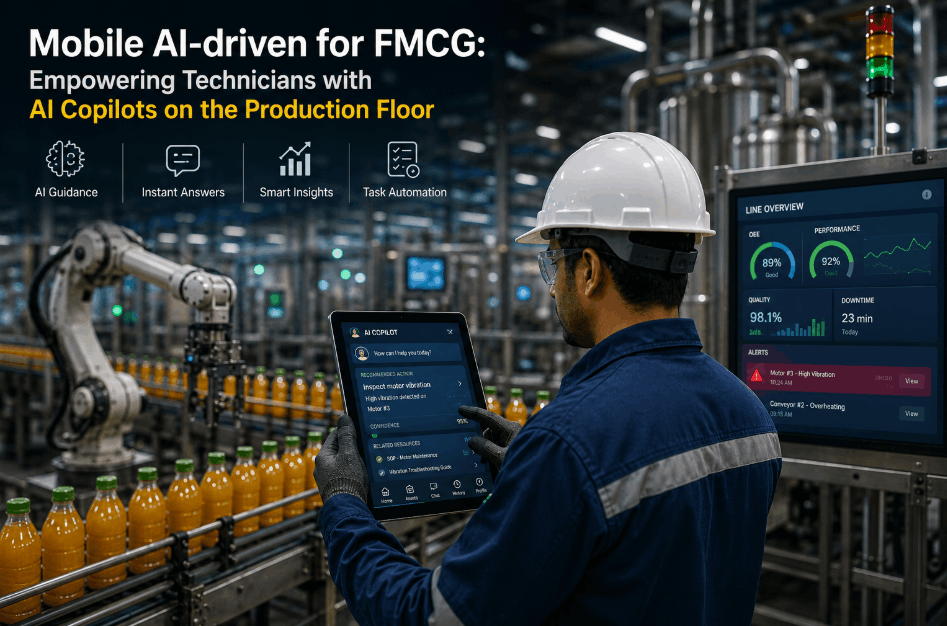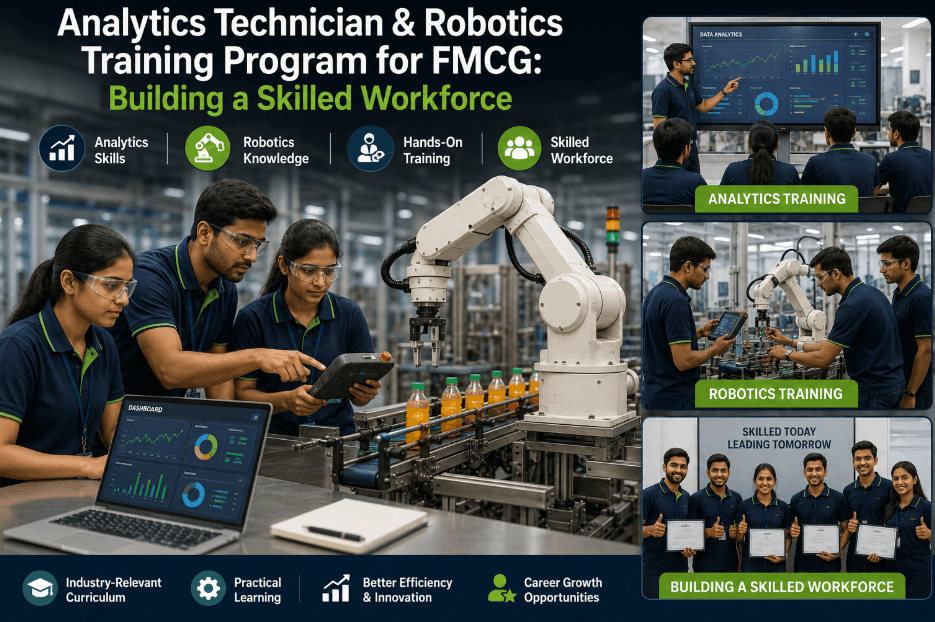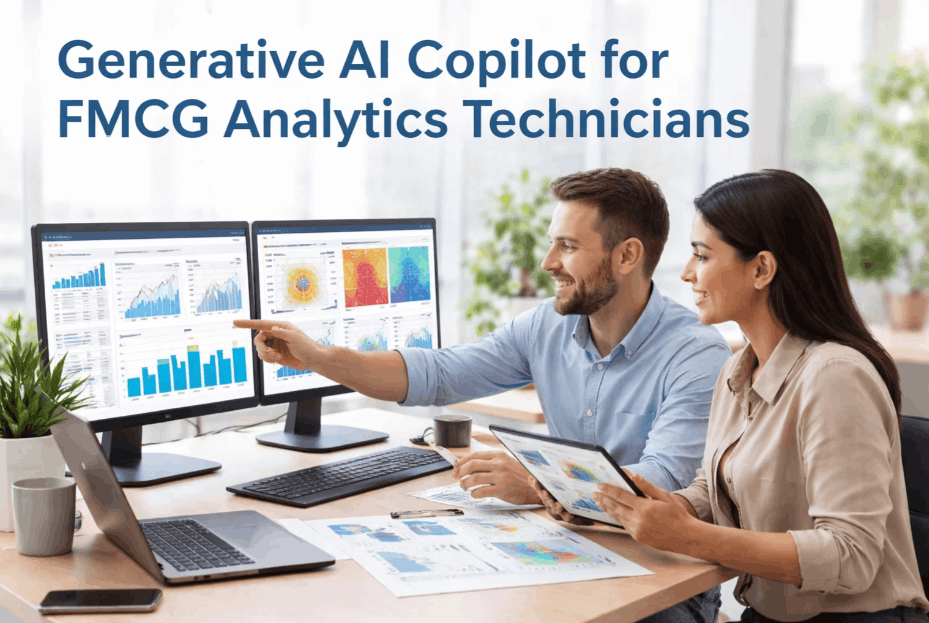
Generative AI is reshaping how FMCG Analytics technicians work — moving them away from manual SOP binders and reactive troubleshooting toward intelligent, conversational support available in real time on the plant floor. An AI copilot for FMCG Analytics doesn't just surface data; it interprets it, explains it in plain language, auto-generates work orders, and walks technicians through complex fault resolution without a supervisor in the loop. For food and beverage manufacturers running continuous high-speed lines, this shift from passive dashboards to active GenAI-powered guidance is the difference between a two-minute corrective action and a forty-minute production stoppage. Book a demo to see how iFactory's generative AI platform supports FMCG Analytics teams in real production environments.
Deploy a Generative AI Copilot for Your FMCG Analytics Team
iFactory's GenAI platform delivers natural language troubleshooting, automated SOP lookup, and intelligent work order creation — purpose-built for food and beverage plant technicians.
Why Traditional FMCG Analytics Tools Are Failing Plant Technicians
The modern FMCG production floor generates more real-time data than any technician can meaningfully process — vibration readings, OEE metrics, drive torque trends, temperature logs, and maintenance histories all accumulating simultaneously across dozens of assets. Legacy SCADA dashboards and CMMS platforms were built to store and display this data, not to reason about it. When a packaging line trips at 2:00 AM, the technician facing a fault code doesn't need a chart — they need an answer. The core problem in FMCG Analytics AI adoption is not a data shortage — it's a context shortage. Technicians spend an estimated 20–35% of their shift time searching for information: locating the right SOP revision, cross-referencing historical fault logs, or waiting for a maintenance engineer to return a call. Book a demo to understand how iFactory's AI copilot compresses that search time to near-zero.
What a Generative AI Copilot Does for FMCG Analytics Technicians
iFactory's FMCG AI Analytics assistant integrates directly with your sensor data, CMMS, and document management systems — turning raw operational data into actionable, conversational guidance that technicians can access instantly from any device on the plant floor.
AI Troubleshooting for FMCG: Real-World Technician Scenarios
The true value of a generative AI FMCG implementation is not in the technology — it is in the specific plant floor moments where AI-guided decision-making replaces costly delays. These are the scenarios where iFactory's AI copilot consistently delivers measurable impact across food and beverage production environments.
Scenario 1: Midnight Packaging Line Fault
Diverter jammed 3 times, same fault code. AI queried fault history, identified SKU changeover as root cause, and served the exact SOP pressure adjustment — without calling the on-call engineer.
Scenario 2: Pre-Shift Equipment Briefing
Asked the Analytics copilot food platform for Line 5 asset health before shift start. AI flagged two degrading components and generated a prioritized inspection list — no spreadsheet required.
Scenario 3: New Technician Onboarding
Faced a low vacuum alarm with no supervisor present. AI provided a full diagnostic sequence with safety steps for that specific machine model. Book a demo to see how ramp time shrinks dramatically.
Scenario 4: Root Cause Investigation
AI queried for all anomalies 72 hours before an unplanned stoppage — surfacing a correlated timeline of vibration spikes, load increases, and a missed PM that would have taken hours to reconstruct manually.
GenAI Copilot vs Traditional Analytics Support: Side-by-Side
For FMCG operations leaders evaluating investment in AI work order FMCG automation and GenAI-assisted maintenance, this comparison illustrates the operational performance gap between conventional Analytics support tools and an intelligent AI copilot platform.
| Capability | Manual / Legacy Tools | Standard PdM Platform | iFactory GenAI Copilot |
|---|---|---|---|
| Fault Diagnosis Speed | 20–60 min (manual lookup) | 10–20 min (dashboard review) | Under 2 min (conversational AI) |
| SOP Retrieval | Manual folder/search navigation | Linked documents only | Natural language query, instant result |
| Work Order Creation | Full manual data entry | Partially pre-filled templates | Auto-generated, technician confirms |
| Predictive Alert Context | None — raw threshold alarms | Basic trend charts | Narrative explanation with recommended action |
| Knowledge Retention | Dependent on individual technicians | Stored fault codes only | AI-accumulated institutional memory |
| New Technician Ramp Time | 3–6 months supervised | 4–8 weeks with system training | AI-guided from day one |
| Shift Handover Quality | Variable, paper-based | Digital log with manual input | AI-generated shift summary, auto-prioritized |
How iFactory's GenAI Food Manufacturing Platform Is Built
Deploying a GenAI food manufacturing copilot that actually works in a production environment requires more than wrapping a large language model around a CMMS. iFactory's AI architecture is purpose-built for the data complexity, safety requirements, and real-time response demands of FMCG Analytics operations.
Unified Data Ingestion Layer
Connects to PLC data via OPC-UA and Modbus, ingests SAP PM and Maximo CMMS records, and indexes SOPs, P&IDs, and regulatory filings — normalized into a single AI context model. No data warehouse migration needed.
Plant-Specific AI Fine-Tuning
The GenAI model is fine-tuned on FMCG failure physics, food safety protocols, and equipment fault libraries — then learns your plant's specific asset configurations and failure patterns over the first 4–6 weeks of deployment.
Retrieval-Augmented Generation (RAG)
Every AI response is grounded in your actual plant documents and live sensor data — not generic procedures. Responses cite specific SOP revisions and fault records, making outputs fully traceable and auditor-ready.
Continuous Learning Loop
Technician confirmations, overrides, and feedback feed back into the model — improving prediction accuracy and work order quality quarter over quarter. Book a demo to see the learning engine live.
Deploying an AI Analytics Copilot in FMCG: What to Expect
One of the most frequently raised concerns about implementing FMCG AI Analytics tools is operational disruption during rollout. iFactory's deployment methodology is designed specifically for 24/7 food and beverage manufacturing environments where stopping the line is not a viable implementation option.
Data Source Audit & Integration Mapping
iFactory engineers audit existing PLC connections, CMMS data structure, and document library organization. Integration points for OPC-UA, Modbus, and CMMS APIs are mapped without any production interruption.
Document Indexing & CMMS Connection
SOPs, maintenance manuals, P&IDs, and regulatory documents are ingested and indexed into the RAG engine. Live CMMS data connection is established, and sensor data streams go live into the AI context layer.
AI Baseline Learning & Copilot Activation
The AI model builds asset-specific baselines, learns plant nomenclature, and the conversational copilot interface goes live. Technicians begin using natural language queries during a supervised trial period with feedback capture active.
Full Operations & Continuous Model Improvement
Auto work order generation, AI-guided shift briefings, and predictive alert narratives go live permanently. Monthly model reviews with your Analytics team drive continuous accuracy improvement and expanding coverage to additional asset classes.
Generative AI for FMCG Analytics: Frequently Asked Questions
Your Plant Floor Technicians Deserve Better Than a Search Bar.
iFactory's generative AI copilot delivers real-time natural language troubleshooting, automated SOP lookup, and intelligent work order creation — purpose-built for FMCG Analytics teams running food and beverage production 24/7.