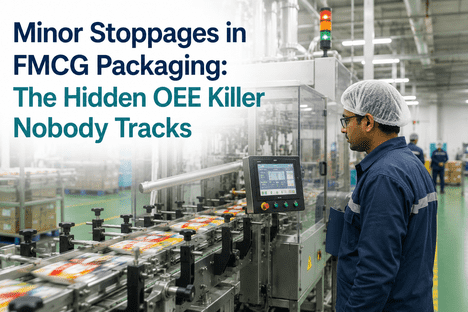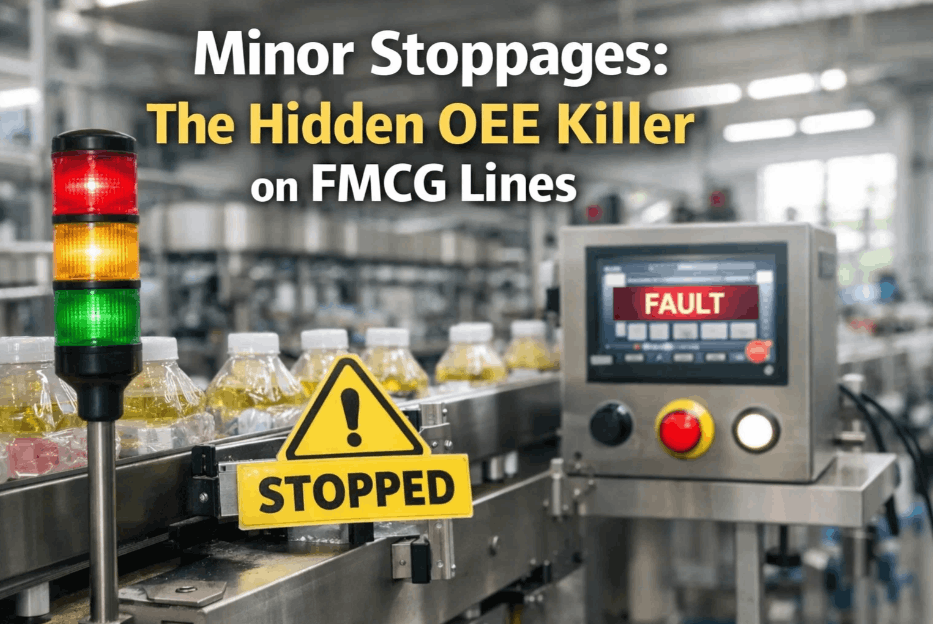
For FMCG plant managers operating high-speed packaging and filling lines, the most significant threat to Overall Equipment Effectiveness (OEE) isn't the catastrophic gearbox failure — it is the thousand tiny cuts of minor stoppages. These "micro-stops," typically lasting less than three minutes, are often ignored by traditional maintenance logging because they don't require external parts or formal work orders. However, on a line running at 600 bottles per minute, a 90-second jam every hour translates to 9,000 units of lost production by the end of a single shift. Identifying and eliminating these hidden losses requires a unified intelligence layer capable of millisecond-level telemetry. You can Book a demo or Consult our architects to see how AI-driven micro-stop detection can reclaim up to 15% of your lost capacity.
Is Your Packaging Line Bleeding OEE Through Micro-Stops?
Detect, categorize, and eliminate high-frequency minor stoppages using real-time sensor fusion and AI-driven root cause analysis.
Why Minor Stoppages Are the "Hidden Killers" of FMCG Profitability
The primary challenge with **minor stoppages in FMCG packaging** is visibility. Because operators can often clear these jams with a quick reset or manual adjustment, the frequency of the event is rarely recorded. Over a 24-hour cycle, these small interruptions create a "stuttering" production flow that prevents the line from reaching its true rated speed. Our integrated platform centralizes telemetry from fillers, labelers, and cartoners to reveal the exact patterns behind these stops. If you'd like to book a demo, our team can show you how to convert this "invisible" downtime into actionable engineering priorities.
Material Variance
Small deviations in cardboard thickness or bottle neck uniformity that cause high-frequency jams in high-speed feeders and rotary grippers.
Sensor Drift
Optical sensors or proximity switches that trigger false E-stops due to vibration, moisture from washdowns, or slight misalignment during changeovers.
Tooling Fatigue
Incremental wear on cutting blades or suction cups that causes intermittent pick-and-place failures rather than a single catastrophic break.
Sub-Optimal Timing
Millisecond-level synchronization gaps between upstream filling and downstream labeling that cause periodic back-ups and star-wheel jams.
Major Breakdowns vs. Minor Stoppages: The OEE Impact Chart
Infrastructure-scale FMCG assets often prioritize major maintenance for heavy boilers or compressors, but the real gains in OEE come from stabilizing the packaging floor. The table below illustrates how minor stoppages often represent a larger cumulative loss than major failures in high-volume production environments. Understanding this delta is the first step toward building a data-driven business case for an integrated OEE platform. You can consult our architects to review your current logging accuracy against these benchmarks.
| Loss Category | Event Duration | Visibility Level | Detection Method | Priority |
|---|---|---|---|---|
| Major Breakdown | > 30 Minutes | 100% (High) | Traditional SCADA | Medium |
| Minor Stoppage | < 3 Minutes | < 15% (Low) | Edge AI Analytics | High |
| Speed Loss / Idling | N/A | < 5% (Near Zero) | Telemetry Fusion | High |
| Quality Defects | Sub-Second | Post-Production | Computer Vision | Medium |
| Changeover Lag | 60-120 Mins | High (Scheduled) | Workflow Tracking | Lower |
The Roadmap to Eliminating Packaging Micro-Stops
Eliminating minor stoppages requires moving away from manual operator logs. A human cannot reliably record a 45-second jam that happens 30 times a shift. Our autonomous intelligence layer automates this process, providing your engineering team with a Pareto chart of the exact sensors, assemblies, and shifts driving your OEE losses. You can book a demo to see this data loop in action on a live filling line.
Automated Data Capture
Deploy non-invasive IoT sensors to capture high-frequency PLC signals. The platform automatically identifies and logs every stoppage event down to the second.
AI-Categorization
The AI engine classifies the stops based on machine state—distinguishing between material jams, sensor faults, and downstream blocking.
Root Cause Correlation
Correlate micro-stops with variables like ambient humidity, operator shift, or raw material batch to identify external performance drivers.
Predictive Intervention
Identify the "stuttering" signature of an imminent jam, allowing operators to make adjustments before the line comes to a complete halt.
Continuous OEE Gain
Iterate on the data to stabilize line speed, typically resulting in a 5% to 12% baseline increase in Overall Equipment Effectiveness within 6 months.
Why Traditional Factory Logging Fails at Micro-Stop Detection
Most FMCG facilities suffer from the "Integration Gap" between their high-speed hardware and their decision-making software. If your OEE data depends on manual operator input, you are likely under-reporting your downtime by up to 40%. Understanding these common gaps is essential for directors planning a digital transformation of their production lines.
Small stops are cleared so quickly by operators that they aren't viewed as "problems," yet they prevent the line from reaching rated speed.
Many legacy PLCs don't log short-duration status changes, meaning micro-stops never appear in historical data sets.
Asking a human to log 100+ events per day is impossible. Manual data is always "cleaned" or summarized, hiding the true frequency of stops.
The filler and the cartoner may be from different vendors, preventing cross-line analysis of how a micro-stop on one asset affects the other.
Even if you know a stop occurred, knowing "why" requires a unified platform that correlates multiple sensor inputs simultaneously.
If the OEE report comes 24 hours late, the opportunity to fix a recurring micro-stop is gone. Integrated platforms require real-time dashboards.
Eliminating these gaps is the foundation of modern high-speed manufacturing. If you are ready to stabilize your line flow and maximize your capital utility, you can book a demo to benchmark your current logging accuracy.
Recover 10% of Your FMCG Line Capacity Today
Coordinate your high-speed fillers, labelers, and packaging lines in a single dashboard to eliminate the hidden micro-stops limiting your OEE.
Eliminating Minor Stoppages on FMCG Lines — Frequently Asked Questions
What exactly defines a "minor stoppage" in an FMCG environment?
In the context of OEE, a minor stoppage is typically defined as any machine halt that lasts less than 3 to 5 minutes and is cleared by the operator without requiring a specific work order or technical team intervention. While small, their cumulative frequency is often the leading cause of low OEE.
How does the platform detect a stop that is too short for a standard PLC log?
We use high-frequency IoT sensors (vibration, current, or optical) that sample at much higher rates than a standard PLC scan cycle. This allows the AI to detect the exact sub-second moment a machine begins to cycle down or stutter.
Can this system help with changeover (SMED) optimization?
Yes. By logging every status change, the platform identifies exactly where the changeover process is stalling—whether it's waiting for materials, technical adjustments, or sanitation sign-off. This data is critical for reducing changeover times and stabilizing line ramp-up.
What is the typical ROI for micro-stop detection on a beverage line?
Most high-speed beverage lines see full payback in 6 to 10 months. Reclaiming just 5% of your availability on a line running at 50,000 units per hour can generate hundreds of thousands of dollars in incremental revenue per year. book a demo to see our ROI calculator.
How does the platform handle material-related jams (e.g., poor quality cardboard)?
The platform correlates the frequency of stops with raw material lot numbers. If jams spike when a new lot of carton blanks is introduced, the platform flags this immediately, allowing you to hold the material and address the variance with your supplier.