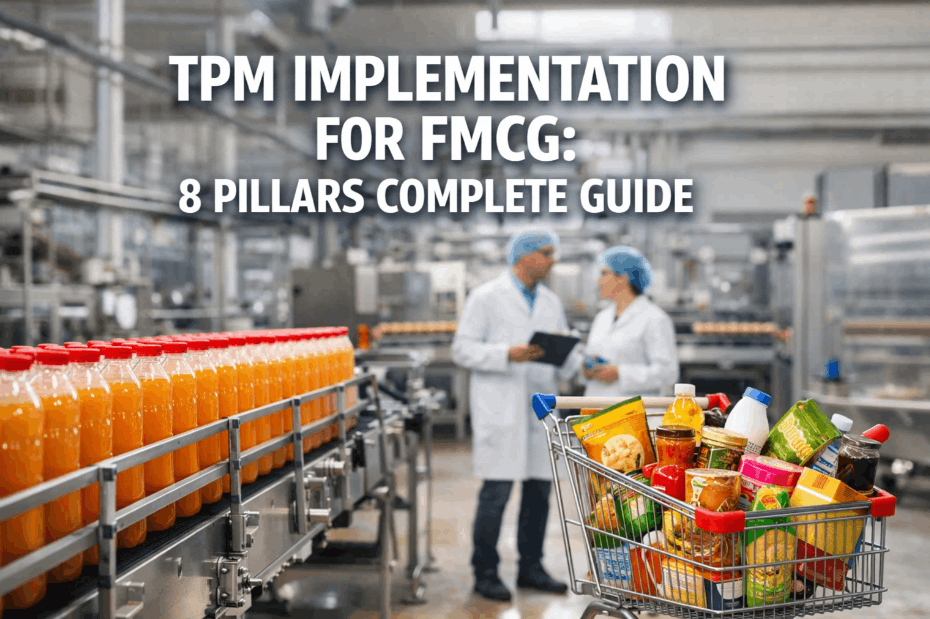
In the high-pressure environment of FMCG production, the "I break, you fix" mentality is the primary driver of operational stagnation. Total Productive Maintenance (TPM) is not just a maintenance strategy; it is a holistic paradigm shift that transfers the stewardship of complex high-speed assets from a siloed technical team to a unified, autonomous workforce. Implementing the **8 pillars of TPM for FMCG** transforms your manufacturing culture into an engine of continuous improvement, where every operator is empowered to identify and eliminate the "Six Big Losses" before they impact your OEE. You can Book a demo or Talk to our engineers to see how our digital intelligence layer automates the task orchestration needed to sustain a world-class TPM program.
Is Your Maintenance Culture Hindering Your Production Agility?
Move from reactive firefighting to autonomous ownership with an AI-driven TPM framework designed for the pace of modern FMCG.
The 8 Pillars of TPM: A Roadmap for FMCG Optimization
The success of **TPM in food manufacturing** depends on the concurrent deployment of eight strategic pillars. While traditional programs rely on paper logs and whiteboards, our integrated platform digitizes these pillars, providing real-time visibility into the health of your TPM mission. This ensures that focused improvements are data-driven rather than anecdotal. If you'd like to Book a demo, we can demonstrate how our autonomous maintenance modules bridge the gap between operators and engineers.
Autonomous Maintenance
Empowering operators to perform basic cleaning, lubrication, and inspection (CIL) tasks. Removing the "I break, you fix" silo.
Planned Maintenance
Transitioning from reactive to time-based and condition-based interventions for critical bottling and packaging high-speed assemblies.
Focused Improvement
Utilizing cross-functional teams to solve recurring "Six Big Loss" issues through systematic root-cause analysis and Kaizen events.
Quality Maintenance
Eliminating quality defects through "Zero Defect" equipment management. Correlating machine health with sub-standard batch output.
Education & Training
Developing multi-skilled operators and technicians through digital training modules and AI-driven competency tracking.
Office TPM
Improving administrative efficiency and supporting production floors by eliminating "non-value-add" tasks in procurement and logistics.
Safety & Environment
Achieving target "Zero Accidents" and "Zero Pollution" by integrating safety sensors and environmental monitoring into the TPM mission.
Integrated Engineering
Using lessons from current assets to design "Maintenance-Free" equipment for future FMCG line expansions and SKU pivots.
Traditional Maintenance vs. TPM Culture in FMCG
The operational delta between a traditional "Firefighting" site and a TPM-mature facility is measured in both OEE gain and workforce morale. The table below illustrates the core differences in mindset and methodology that define a successful Total Productive Maintenance program. You can Talk to our engineers to review our culture-change roadmap.
| Attribute | Traditional Approach | TPM-8 Pillar Strategy | Yield Potential |
|---|---|---|---|
| Ownership | Maintenance Team Only | Unified (Whole Plant) | High |
| Breakdown View | Necessary Evil | Targeted Loss (Zero Goal) | High |
| Data Source | Historical Work Orders | Real-time Asset Telemetry | Medium |
| Skills | Specialized Silos | Multi-Skilled Autonomy | Medium |
| Improvement | Reactive "Patching" | Proactive Innovation | High |
Digitizing Autonomous Maintenance (AM): 2x2 Mission Control
For years, the biggest challenge in **FMCG TPM implementation** was sustaining the Autonomous Maintenance pillar. Without real-time tracking, CIL (Clean, Inspect, Lubricate) tasks are often skipped during high-pressure shifts. Our digital platform coordinates these missions directly on the operator's tablet, providing visual guidance and automated verification. Book a demo to see our AM task-tracker in action.
Step-by-step cleaning and lubrication guides with photo verification to ensure quality and consistency across every shift change.
Allow operators to flag "abnormalities" instantly via the dashboard. AI correlates these tags with specific asset health trends for maintenance review.
Automated tracking of operator training levels. The system only assigns complex AM tasks to certified personnel, ensuring safety and compliance.
Instantly see the impact of CIL compliance on downtime reduction. Data-driven proof that Autonomous Maintenance pays dividends.
Eliminating the "Six Big Losses" Through 8-Pillar TPM
The primary objective of implementing **TPM in the FMCG sector** is the systematic elimination of the "Six Big Losses." These losses prevent your production lines from reaching their true theoretical capacity. By mapping each loss type to a specific TPM pillar, you can create a surgical strike capability for your engineering team. You can Book a demo to see how our AI identifies these loss patterns automatically.
Equipment Failure
Unplanned downtime caused by catastrophic component failure. Targeted by the Planned Maintenance pillar.
Setup & Adjustment
Downtime during SKU changeovers. Targeted by the Focused Improvement and SMED integration.
Idling & Minor Stops
Brief halts that aren't logged by traditional systems. Targeted by the Autonomous Maintenance pillar.
Reduced Speed
Running assets below rated capacity due to wear or lack of control. Targeted by the Quality Maintenance pillar.
The Digital TPM Dashboard: Real-Time Audit Integrity
Sustaining TPM gains requires frequent auditing of each pillar's health. In a digital facility, this audit is automated. The table below illustrates how the **unified TPM dashboard** provides 100% transparency into pillar compliance and execution status. To review our audit-readiness frameworks, you can Talk to our engineers.
| Pillar Focus | Digital Audit Status | Critical Action | Pillar Health |
|---|---|---|---|
| Autonomous (AM) | 92% CIL Compliance | Lubrication Alert (Filler) | Optimal |
| Planned (PM) | 15 Pending Rounds | Spare Part Kit Validation | Active |
| Kaizen (FI) | 4 Events Logged | Root Cause Wrap-up | Improving |
| Safety (SHE) | 0 Incidents (30d) | Standard PPE Audit | Perfect |
Implementing TPM: The 5-Phase Mission Architecture
A successful **TPM program for packaging lines** requires a structured deployment. By utilizing an integrated intelligence layer, you can move through these phases with 100% data visibility, ensuring that each pillar is effectively stabilized before moving to the next level of operational maturity.
Phase 0: Preparation & Awareness
Setting the baseline OEE and reliability metrics. Launching the digital platform to capture real-time loss patterns across the facility.
Phase 1: Pillar Pilot Launch
Deploying Autonomous and Planned Maintenance on a single high-priority line. Identifying the quick-win Kaizen opportunities.
Phase 2: Data-Driven Expansion
Scaling TPM pillars across the full fleet based on pilot data. Integrating Quality Maintenance and Education pillars into the dashboard.
Phase 3: Stabilization & SHE Integration
Full integration of Safety, Health, and Environment (SHE) metrics. Automating the governance loop to prevent metric drift.
Phase 4: Predictive Maturity
Utilizing AI-forecasting to optimize the Planned Maintenance pillar. Reaching "Zero-Breakdown" status through autonomous predictive insights.
Empower Your Workforce, Eliminate the Six Big Losses
Coordinate your Total Productive Maintenance program in a single unified window to maximize OEE and workforce autonomy.
Frequently Asked Questions
What is the biggest challenge in starting a TPM program in an FMCG plant?
Culture. Moving from "maintenance fixes machines" to "operators own asset health" requires significant training and visible leadership support. Digital tools help by making the benefits (like reduced jams) immediately visible to operators.
Does TPM replace traditional preventative maintenance (PM)?
No. TPM enhances it. PM becomes a specialized pillar, while Autonomous Maintenance handles the basic daily health checks, allowing maintenance techs to focus on complex overhauls and predictive analytics.
How long does it take to see OEE gains from a TPM implementation?
Most facilities see a 5-10% OEE stabilization within the first 6 months of the pilot. Full-site pillar maturity typically takes 18 to 24 months, but the digital visibility provides immediate ROI through better data. Book a demo to see the timeline.
Can TPM be applied to the food-safety and regulatory (FDA) standards?
Yes. The "Quality Maintenance" and "SHE" pillars specifically address contamination prevention and compliance. By integrating these into the machine health dashboard, you ensure that safety is never "sacrificed" for production speed.
How does the platform handle operator training for TPM?
The "Education & Training" pillar is digitized into a skills matrix. As operators complete AM tasks on their tablets, their competency score is updated, ensuring that only trained personnel are managing high-criticality assets.