FMCG production benchmarking is no longer optional for manufacturing directors under pressure to protect razor-thin margins, optimize high-speed line efficiency, and achieve sustainability targets. Plants that implement structured FMCG production benchmarks consistently outperform peers in OEE, waste reduction, and cost-per-unit metrics. Whether you are a plant manager launching a performance tracking program for the first time or a corporate engineering director refining metrics across multiple sites, this guide delivers the complete framework for building an OEE and waste measurement system that drives real throughput improvement. Book a Demo to see how iFactory's analytics platform powers FMCG production benchmarks across beverage, snacks, dairy, and personal care lines.
Build a World-Class FMCG Production Benchmarking System
iFactory helps FMCG manufacturers design, deploy, and track production benchmarks across every asset—from high-speed filling and packaging to processing, utilities, and quality lab operations.
Why FMCG Production Benchmarking Defines Modern Manufacturing Effectiveness
FMCG manufacturers face an operational challenge that discrete industries rarely encounter: the compounding effect of micro-losses at high line speeds. Production benchmarking solves this challenge by creating objective, evidence-based comparisons of asset performance, material yield, and utility efficiency. Without structured FMCG performance standards, plants operate on anecdotal evidence rather than data—and capital investments are prioritized by perceived bottleneck severity rather than measurable throughput potential.
The shift toward data-driven FMCG management has accelerated as Industry 4.0 matures. Global standards for World-Class Manufacturing (WCM) and Total Productive Maintenance (TPM) have established that rigorous OEE and waste data is now a baseline expectation for any competitive production facility. Manufacturers that embed benchmarking into shift reviews, monthly operations planning, and corporate sustainability structures consistently deliver 15-20% higher output at lower material cost.
The Four Pillars of FMCG Production Benchmarking
Effective FMCG production benchmarks are organized across four interdependent measurement pillars. Each pillar captures a distinct dimension of manufacturing performance—and together they provide a complete picture of how efficiently a plant is converting raw materials and energy into finished goods. Facilities that measure across all four pillars avoid the common trap of optimizing OEE at the expense of material waste or energy intensity.
Core Pillars of an FMCG Measurement Framework
Asset Performance (OEE)
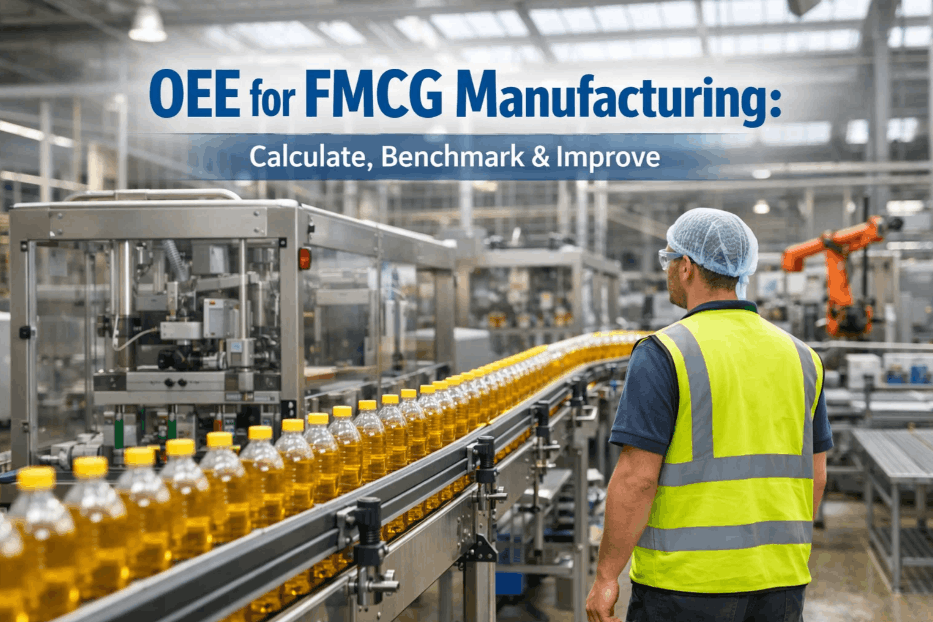
Measures Availability, Performance, and Quality at the asset level. Benchmarking OEE identifies the "hidden factory"—the theoretical capacity lost to micro-stops, speed reductions, and SKU changeovers that manual reporting fails to capture in high-speed environments.
Material Yield & Waste
Tracks the conversion efficiency of raw materials into finished cases. Benchmarking waste rates—from giveaway in filling to packaging scrap—identifies direct margin leakages that are often accepted as "normal" operational variance during SKU startups.
Utility & Energy Intensity
Calculates energy, water, and gas consumption per unit of output. Utility benchmarks allow plants to identify inefficient CIP (Clean-in-Place) cycles and high-load production hours, enabling direct cost reduction and sustainability goal alignment.
Quality & Compliance Metrics
Captures first-pass yield, microbial compliance, and fill-weight precision. Quality benchmarking provides the qualitative context to OEE—ensuring that speed gains do not compromise product safety or regulatory compliance standards.
Essential FMCG Production Benchmarks by Category
FMCG production benchmarks must be tailored to specific product categories and line speeds. Generic metrics fail to account for the operational realities of aseptic dairy filling versus dry snack packaging. The following category-specific metrics reflect best practices from world-class FMCG manufacturers. Organizations looking to Book a Demo can see how iFactory's platform pre-configures category-specific KPI libraries.
Global FMCG Industry Performance Standards
| Product Category / Line Type | Key Performance Indicators | Target Benchmark | Measurement Frequency |
|---|---|---|---|
| Beverage Bottling (PET/Glass) | OEE, Water use ratio (L/L), PET preform scrap rate, CIP duration | >82% OEE / <1.6x Water Ratio | Real-time / Shiftly |
| Dairy & Liquid Food | Aseptic filling yield, first-pass microbial compliance, energy per ton | 99.5% Yield / 0% Re-work | Real-time / Batch |
| Snacks & Confectionery | Film giveaway %, micro-stop frequency, changeover time (SMED) | <1% Giveaway / <15min SMED | Real-time / SKU change |
| Personal Care & HPC | Fill weight precision, labeling accuracy, cost per case produced | CPK >1.33 / >78% OEE | Shiftly / Daily |
| Home Care (Aerosols) | Leak rejection rate, propellant yield, line speed stability | <0.01% Leak rate | Real-time / Hourly |
| Baked Goods | Oven energy efficiency, moisture precision, floor waste percentage | <2% Total Floor Waste | Batch / Shiftly |
How to Build an FMCG Production Benchmarking System That Works
Most production benchmarking initiatives fail because of data latency—reporting cycles that are too slow to influence line-floor decisions. Building an FMCG production benchmarking system that actually changes operator behavior requires a structured implementation approach aligned to high-speed manufacturing realities.
Step-by-Step: Implementing FMCG Production Benchmarking
Align KPIs to Asset Physics and SKU Profiles
Every benchmark must trace directly to a specific asset's theoretical design speed and SKU-specific material constraints. Map each metric to the production schedule and machine state before collecting data — so when OEE drops, the link to the root cause is immediate.
Integrate PLC Data Collection Infrastructure
Eliminate manual operator logs for OEE and waste. Integrate directly with PLC data through OPC-UA or Modbus. Plants that automate data collection report 60–80% higher accuracy in micro-stop identification. Book a Demo to explore IoT options.
Automate Benchmarking Dashboards for Line Leaders
Build separate views for each layer of the plant: operational HMI views for operators (real-time pace), management views for site leads (OEE trends), and corporate views for benchmarking across sites. The right data at the point of action.
Embed Benchmarks into Short-Interval Control (SIC)
Require shift handovers to include benchmark trend data. Set hourly review cycles where deviations from target benchmarks trigger immediate maintenance or quality intervention. Benchmarking only delivers ROI when it drives real-time corrections.
FMCG Industry Benchmarking: Comparing Your Plant Metrics
Internal performance measurement tells you whether you are improving. Peer benchmarking against external FMCG industry standards tells you whether your cost base is competitive. Production benchmarking is the most powerful tool for operations leaders seeking to justify capital investment or to demonstrate efficiency gains to global supply chain oversight bodies.
FMCG manufacturers that participate in structured benchmarking programs consistently identify 10–25% throughput opportunities within 18 months—because cross-site comparison reveals "hidden" losses that internal trend analysis misses. To explore how iFactory's platform enables automated peer benchmarking for your specific category, Book a Demo with our FMCG analytics team.
Industry WCM Datasets
Compare your OEE and waste rates against global cohorts matched by line category and speed. Ideal for establishing competitive positioning and identifying outlier performance across a global network.
Beverage/Dairy/Snack Standards
Adjusted benchmarking accounts for local labor rates, packaging complexities, and SKU profiles. Provides the most defensible efficiency comparison for corporate supply chain management reviews.
Multi-Plant Performance Tracking
Longitudinal tracking reveals improvement trajectories across multiple facilities. Cross-site data is the most credible evidence for rewarding high-performing plants and resource planning for underperformers.
Continuous Production Tracking
Automated real-time dashboards replace weekly shift summaries with continuous visibility. Enables same-hour operational adjustments rather than post-mortem incident reviews—protecting OEE across high-volume shifts.
Common Failures in FMCG Production Benchmarking—and How to Avoid Them
FMCG benchmarking programs fail in predictable patterns, most often due to data silos and manual reporting burdens. Understanding these failure modes before implementation is the most cost-effective way to ensure your benchmarking produces genuine improvement rather than just "reporting theater."
Ignoring Micro-Stops in OEE Benchmarks
Tracking only major breakdowns (>15 min) while ignoring micro-stops (<2 min) hides up to 30% of actual performance loss. High-speed FMCG benchmarking requires sub-second resolution to capture the true production reality.
Measuring Volume instead of Yield
Tracking total cases produced without accounting for material giveaway and startup scrap creates a false "efficiency" that masks significant margin leakage. Always benchmark mass-balance yield alongside OEE throughput.
Manual Shift Logs vs PLC Reality
Operator-entered stoppage reasons are subjective and often miss the root cause. Benchmarking systems built on manual entry suffer from "operator bias" and reporting latency, making them useless for real-time operational improvement.
Inconsistent Benchmarking Standards
Comparing a low-speed manual line to a high-speed automated line without normalizing for automation level makes results meaningless. Effective benchmarking requires grouping lines by "Asset Tier" to ensure apple-to-apple comparisons.
FMCG Sustainability: Publishing Performance Data for Corporate ESG Transparency
ESG and sustainability transparency is increasingly a corporate mandate in the FMCG sector. Plants that proactively publish production benchmarks for water use ratio, energy intensity, and material diversion rates build trust with investors and reduce the burden of annual sustainability audits. Performance transparency also creates positive internal competition—sites can access real-time efficiency rankings, driving a collaborative approach to carbon footprint reduction across the global FMCG network.
Effective ESG benchmarking requires translation of PLC utility data into sustainability-accessible formats. A simple statement that a facility reduced water intensity by 12% per case produced compared to the sector average is immediately meaningful to auditors. For FMCG leaders seeking to build automated sustainability benchmarking into their production analytics, Book a Demo to see iFactory's ESG dashboard configuration options.
Frequently Asked Questions: FMCG Production Benchmarks
What are FMCG production benchmarks and why do they matter?
FMCG production benchmarks are standardized quantitative indicators (like OEE, yield, and utility intensity) used to measure plant performance against internal targets or external industry standards. They matter because they identify efficiency gaps and provide a data-driven basis for operational investment.
What is considered world-class OEE for a beverage bottling line?
World-class OEE for a high-speed beverage line is typically 82-85%. This accounts for necessary sanitation (CIP) and SKU changeovers while maintaining high performance and quality levels during scheduled production hours.
How do you calculate yield benchmarks for food packaging?
Yield is calculated as (Net Good Product ÷ Theoretical Raw Material Used) x 100. Benchmarking this metric specifically identifies giveaway during filling and packaging scrap during startup—major sources of margin loss in snacks and confectionery.
Can a plant manager use automated OEE to drive peer benchmarking?
Yes. Automated OEE platforms like iFactory collect objective PLC data that eliminates operator bias, allowing different shifts and facilities to be compared directly against standardized benchmarks for the same asset types.
How often should FMCG production benchmarks be reviewed?
Operational benchmarks (OEE and micro-stops) should be reviewed shiftly or daily for immediate correction. Strategic benchmarks (yield, energy intensity, multi-site comparisons) should be reviewed monthly during executive operations meetings.
Ready to Modernize Your FMCG Production Benchmarking?
iFactory's FMCG analytics platform helps manufacturers design, automate, and track production benchmarks that drive real margin improvement—with pre-built OEE libraries, real-time KPI dashboards, peer benchmarking tools, and yield transparency across every line.