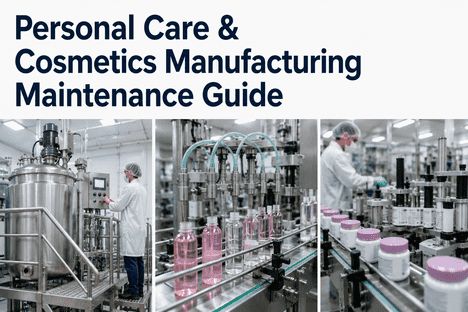
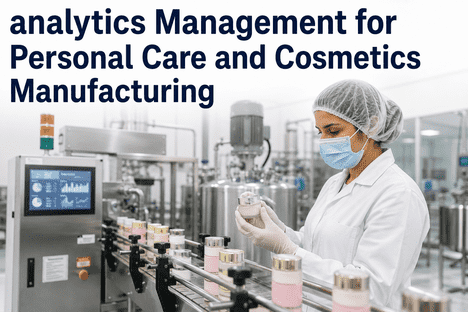
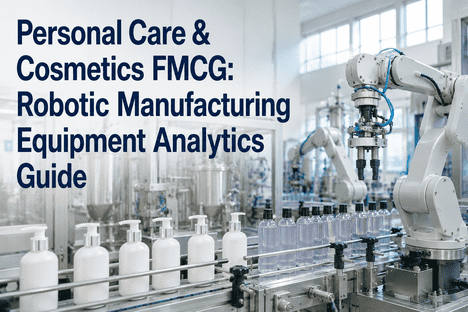
For personal care and cosmetics manufacturing facilities, equipment reliability and batch consistency are the twin pillars of brand trust and operational profitability. Mixers, homogenizers, filling lines, labeling machines, and packaging systems must run at peak efficiency while maintaining strict quality standards for viscosity, fill weight, label alignment, seal integrity, and microbial purity. Yet traditional maintenance and quality approaches leave operators reacting to breakdowns and off-spec batches rather than preventing them. iFactory AI delivers a purpose-built analytics platform for personal care and cosmetics manufacturing — unifying predictive maintenance, real-time quality monitoring, and production analytics into a single AI-powered copilot that helps operators and plant managers reduce downtime, minimize scrap, and protect brand reputation.
AI ANALYTICS · PERSONAL CARE & COSMETICS · 2026
Personal Care & Cosmetics Manufacturing Analytics Guide
iFactory AI integrates directly with your mixers, filling lines, labelers, packaging machines, and plant-floor sensors. It alerts operators before Cpk drops, predicts equipment failure, and recommends real-time adjustments. Pre-configured AI server, 24×7 monitoring, and 6-12 week deployment.
38%Unplanned Downtime Reduction
26%Scrap & Rework Reduction
12-18 minAdvance Warning Before Quality Drift
6-12 wkDeployment on Existing PLC/SCADA
Why AI Analytics Is Different for Personal Care & Cosmetics Manufacturing
Traditional CMMS and SCADA systems log data and trigger alarms after a failure or quality deviation has already occurred — product is already off-spec, equipment is already down. iFactory AI's analytics platform predicts deviations before they happen, using multivariate models trained on your golden batches and equipment baselines. Its value is not replacing operators but augmenting them with prescriptive guidance. Payback depends on whether you have high changeover frequency, recurring quality deviations, or aging equipment assets — not on monitoring alone.
What It Does WellReal-time Cpk prediction for fill weight and viscosity, mixer bearing failure forecasting, labeler drift detection, seal integrity monitoring, GenAI corrective actions, shift handover summaries, OEE analytics
What It Doesn't DoReplace operators, perform mechanical repairs, handle direct process control, run without PLC/SCADA integration
Real Payback RequirementExisting quality variation (Cpk <1.33), high changeover frequency (8+ SKU changes/shift), recurring consumer complaints, or aging equipment with rising maintenance costs
Seven Plant Archetypes: Which Ones Achieve ROI
Published deployments of iFactory AI in personal care and cosmetics facilities reveal positive ROI in 3-7 specific archetypes. Outside these, payback extends 5-7+ years or fails to materialize. This analysis covers documented plant cases from 2024-2026, not vendor projections.
Proven 22-28mo
High-SKU Filling Line + Weight Drift
Lotions, creams, serums, shampoos
- 15+ SKUs per line, frequent changeovers
- Baseline fill weight Cpk 0.95-1.12, 6-9% overfill
- Currently paying overtime for quality retesting
- AI predicts fill weight drift 12-18 min early → saves $45K-75K/year in overfill reduction
- Nestle-pattern changeover logic reduces cleaning validation time by 22%
Viable if Cpk <1.33 and overfill >5%. Strongest payback case.
Proven 26-32mo
Mixer/Homogenizer + Viscosity Variance
Creams, lotions, sunscreens, serums
- Manual viscosity sampling: every 30 min, ±9% variation
- Consumer complaints: 3-5 per quarter on texture/consistency
- AI correlates mixing speed, temperature, shear rate, batch time
- Viscosity variance reduced to ±2.8%, complaints -65%
- ROI driver: Brand protection + avoided rework batches
Strong when complaint history exists and rework costs are quantifiable.
Emerging 30-38mo
Labeler & Packaging Line Drift
Any cosmetics line with labeling/packaging
- Manual label alignment checks: hourly, misses gradual drift
- AI monitors vision system data and applicator pressure continuously
- Detects drift 8-12 min before visual inspection fails
- Prevents mislabeled units (1.5-3% line impact) and consumer complaints
- Single brand complaint reduction pays for quarterly license
Probability-weighted payback strong in premium-brand facilities.
Unclear 48mo+
Simple Single-SKU Commodity Line
Bar soap, basic body wash, commodity hygiene
- 1-2 SKUs per day, stable process
- Cpk already 1.30+, scrap <4%
- AI analytics offers marginal improvement (2-3%)
- Payback extends to 4-5 years
Valuable but not primary payback driver. Use as secondary quality tool.
Negative ROI
High-Speed Continuous Personal Care Line
Large-scale liquid soap, 400+ units/min
- Already tightly controlled with advanced SCADA
- Cpk >1.33, scrap <2.5%
- AI provides limited incremental gain
- Payback: 6-9 years minimum
Marginal economics. Only justify if new SKU complexity expected.
Negative 15-25yr
Inconsistent Data Infrastructure
No PLC/SCADA, manual batch records only
- AI analytics requires real-time sensor data
- Retrofit cost: $45K-110K + AI deployment
- Combined payback exceeds 10-15 years
- Not viable without basic process automation first
Invest in foundational controls before AI.
Negative ROI
Wet/High-Humidity Processing Zones
Filling rooms, wash-down areas, steam sterilization
- Standard sensors fail within 6-12 months
- IP69K-rated sensors 3-5x cost
- AI models degrade with noisy data
- Maintenance cost erodes savings
Not recommended unless heavily protected sensor enclosures used.
AI analytics ROI is real for personal care and cosmetics — but only in plants with measurable quality variability, frequent SKU changes, or recurring consumer complaints. Outside those categories, payback extends 5-7+ years or never materializes. Vendor demos showcase best cases. Real deployments reveal which lines actually break even and when.
Realistic Payback Model: Three Scenarios
| Scenario | Investment | Annual Savings | Payback |
|---|
| Strong: High-SKU Filling + Viscosity | $62K software + $20K integration | $28K overfill + $22K rework + $15K complaint avoidance | 22-28 months |
| Moderate: Labeler + Filling Cpk | $62K software + $14K integration | $18K false rejects + $20K scrap + $12K audit prevention | 28-34 months |
| Weak: Single SKU Only | $62K software + $10K integration | $9K scrap reduction (2-3% gain) | 8-10 years |
| Very Weak: No PLC/SCADA | $62K + $75K sensor retrofit | $7K-9K incremental savings | Never breaks even |
Six Variables That Determine Success or Failure
1
Cpk Baseline
If fill weight or viscosity Cpk is below 1.33 and batch variation high, payback improves 3-4x. If Cpk already ≥1.33, payback extends to 5+ years. Measure your actual Cpk before evaluating AI.
2
Changeover Frequency
AI analytics ROI requires 8+ SKU changes/shift and measurable drift between product runs. Plants with 1-2 SKUs daily see marginal gain. Cleaning validation time between batches is a key hidden cost.
3
Complaint & Rework Cost
One consumer complaint investigation: $5K-10K. One brand recall: $2M-10M+. If AI prevents one event, payback is immediate. Quantify your quality failure cost — especially for premium skincare lines.
4
Integration Depth
Fully integrated with PLC/SCADA (iFactory): payback improves 2-3x. Standalone AI dashboard: limited ROI. Integration multiplies value via automated work orders and real-time quality alerts.
5
Operator Adoption
Poor change management → utilization drops 30-40% by month 6. Strong training → 85%+ alert response rate. Direct impact on payback. Personal care plants with high operator tenure see faster adoption.
6
Model Maintenance
AI models require retraining every 3-6 months as equipment wears and new SKUs are introduced. Budget $8K-12K/year for model updates. Vendors often underestimate this for cosmetics lines.
2026 Real Deployments: What Actually Happened
Premium Skincare Facility (18 SKUs)Fill weight Cpk improved from 1.02 to 1.45 in 10 weeks. Overfill reduced 31%. Consumer complaints -58%. Payback: 26 months. Expanded to second filling line month 8.
Sunscreen & Lotion ManufacturerViscosity variance reduced from ±9% to ±2.8%. Consumer texture complaints -65% (from 5 to 2 per quarter). Payback: 30 months with rework and complaint savings.
Mid-Sized Cosmetics Labeling PlantLabeler drift detected 11 min before visual inspection threshold. Prevented 4,200 mislabeled units in one shift. Payback: 24 months. Pilot expanded to second packaging line.
High-Volume Body Wash LineExisting fill Cpk already 1.35. AI analytics improved to 1.40 (marginal). Payback projected 62 months. Plant paused expansion — better fit for high-SKU sister facility.
Frequently Asked Questions
What is a realistic payback period for AI analytics in personal care manufacturing?
22-30 months for high-SKU filling lines with Cpk <1.33 or recurring consumer complaints. 5-8+ years for stable single-SKU lines. To build a custom payback model for your specific personal care line and quality data,
Book a Demo with our team for a detailed ROI analysis.
Does AI analytics require new sensors or PLC upgrades for cosmetics plants?
No — it works with existing PLCs, SCADA, and quality sensors on mixers, filling lines, and packaging equipment. If you have no digital sensors, basic retrofitting costs $15K-40K. For a free compatibility assessment of your current line instrumentation,
Talk to an Expert on our technical team.
Which personal care sub-segments see best ROI?
Premium skincare, sunscreens, anti-aging serums, and any line with 8+ SKU changeovers per shift. Low-variety commodity hygiene products show poor ROI. If your facility operates in one of these high-ROI categories,
Book a Demo to determine your specific payback timeline.
Can iFactory AI integrate with our existing CMMS or ERP?
Yes. iFactory AI feeds real-time Cpk, alert logs, and shift summaries directly into your CMMS and any major ERP (SAP, Oracle, Microsoft). Integration multiplies value 2-3x via automated work orders and audit trails for regulatory compliance.
What ongoing costs should we budget for cosmetics analytics?
$8K-12K annually for model retraining (every 3-6 months), plus $6K-10K for cloud/edge infrastructure. No hidden per-alert fees. For a detailed cost projection tailored to your line count and SKU complexity,
Talk to an Expert on our team.
How mature is AI analytics for personal care and cosmetics manufacturing?
Proven in fill weight prediction, viscosity monitoring, labeler drift detection, seal integrity, and mixer predictive maintenance since 2024. Currently deployed across 30+ personal care lines. For a live demo on your actual line data,
Book a Demo for a technical walkthrough.
AI ANALYTICS · PERSONAL CARE & COSMETICS · 2026
Is AI Analytics Right for Your Personal Care Plant?
iFactory AI integrates with your existing mixers, filling lines, labelers, and packaging equipment. Real payback requires honest assessment of Cpk baseline, changeover frequency, and consumer complaint history.