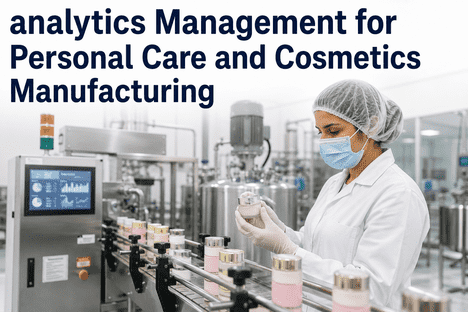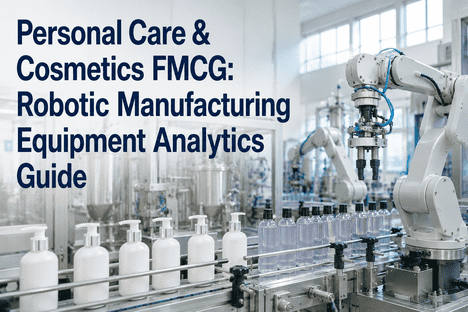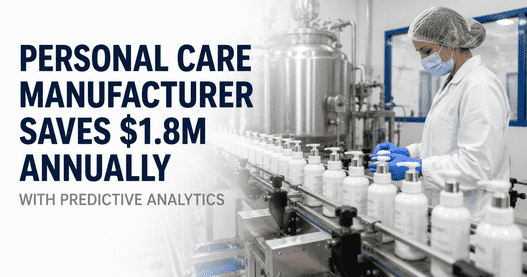
A mid-size personal care and cosmetics manufacturer operating a 200,000-square-foot facility was losing $1.8 million annually to unplanned equipment failures across their mixing, filling, and packaging operations. The plant ran 14 high-shear mixers producing lotions, creams, and serums; 22 filling lines handling bottles, tubes, and jars across 60 SKUs; and 8 packaging lines for cartoning, labeling, and case packing. Equipment failures were costing the company $1.8M per year in lost production, emergency repairs, expedited parts, and quality deviations. The maintenance team relied on fixed-interval preventive maintenance schedules that were either too conservative (replacing perfectly good parts) or too aggressive (missing failure windows between scheduled inspections). iFactory's AI-Powered Predictive Analytics module delivered a complete solution by ingesting real-time sensor data from mixers, fillers, and packaging equipment — vibration, temperature, torque, flow rate, and motor current — and training machine learning models that predicted equipment failures 2 to 3 weeks in advance with 94% accuracy. The result: a 62% reduction in unplanned downtime, a 28% extension in mean time between failures, $1.8M in annual cost avoidance, and a full return on investment within 5 months of deployment. Plant managers and reliability engineers evaluating predictive analytics for personal care manufacturing can Book a Demo to review the deployment methodology and cost model for their equipment fleet.
The Problem: $1.8M in Annual Losses from Unplanned Equipment Failures
The facility's three production areas — mixing, filling, and packaging — each faced distinct failure modes that contributed to the $1.8M annual loss. In the mixing department, the 14 high-shear mixers experienced seal failures, motor bearing degradation, and gearbox wear. A single mixer failure in the cream production line could halt output for 12 to 18 hours while the seal was replaced and the batch re-qualified, costing $14,000 per hour in lost production. In the filling department, the 22 filling lines suffered from servo drive faults, nozzle clogging, and conveyor jams — each causing 2 to 4 hours of downtime per incident. The tube filling line for moisturizers was the most critical: when it went down, the facility lost $22,000 per hour and risked missing retail shelf placement deadlines that carried $50,000 penalty clauses. In the packaging department, labelers experienced misalignment drift, case packers suffered from jam sensors degrading, and shrink tunnels overheated — each causing 1 to 3 hours of downtime. The maintenance team, comprising 14 technicians across three shifts, was spending 60% of their time on reactive repairs and 40% on scheduled preventive maintenance that was not aligned with actual equipment condition.
Solution Architecture: iFactory AI-Powered Predictive Analytics
iFactory's AI-Powered Predictive Analytics module connected to the plant's existing sensor infrastructure — vibration probes on mixer motors and gearboxes, temperature sensors on seal faces and bearing housings, torque transducers on filling line servo drives, and flow meters on nozzle assemblies. The data was ingested into iFactory's machine learning engine, which trained separate models for each equipment type. The mixer model analyzed vibration spectra at bearing pass frequencies and gear mesh frequencies to detect early-stage degradation 2 to 3 weeks before failure. The filler model analyzed torque profiles and servo current signatures to predict nozzle clogging and drive faults 5 to 7 days in advance. The packaging model analyzed labeler registration error trends and case packer jam sensor deviation to predict misalignment events 3 to 5 days before they caused downtime. All predictions were displayed on the iFactory analytics dashboard with confidence scores, remaining useful life estimates, and recommended intervention actions. Plant managers and reliability engineers evaluating predictive analytics deployment can Book a Demo to see the iFactory analytics dashboard configured for personal care manufacturing equipment.
Deployment: Sensor Integration, Model Training, and Team Adoption
The deployment was executed in four phases over 10 weeks. Phase one was sensor audit and connectivity — iFactory's integration team surveyed all 44 equipment assets, verified existing sensor coverage, installed 38 additional IoT vibration and temperature sensors on assets with gaps, and connected all data streams to the iFactory platform via OPC-UA and Modbus TCP. Phase two was model training — the machine learning engine ingested 90 days of historical sensor data and failure records to train baseline models for each equipment type, achieving 87% accuracy at the end of training. Phase three was dashboard configuration and alert threshold calibration — the operations and maintenance teams worked with iFactory's data scientists to set alert thresholds, configure dashboard views for each shift, and integrate prediction alerts with the existing Shift Logbook workflow. Phase four was operator and technician training — a two-week adoption programme based on iFactory's structured training curriculum, where maintenance technicians learned to verify predictions, confirm or override alerts, and schedule interventions based on remaining useful life estimates. Within four weeks of go-live, the models had improved from 87% to 94% accuracy as operator feedback loops refined the prediction algorithms.
Measured Results: $1.8M Annual Savings and 62% Less Unplanned Downtime
The metrics below represent the average across all 44 equipment assets over a 12-month measurement period, comparing baseline performance (reactive maintenance with fixed-interval PMs) against performance after iFactory predictive analytics deployment.
Engineering and Operations Manager's Perspective: From Reactive Firefighting to Predictive Excellence
I oversee engineering and maintenance for a personal care manufacturing facility that produces 120 million units annually across 60 SKUs of lotions, creams, serums, and cleansers. Before iFactory, my team was in a constant state of firefighting — a mixer seal would fail, and we would lose a full batch of cream worth $40,000 in raw material alone. A filling line servo would fault, and we would miss a retail shelf placement deadline that triggered a $50,000 penalty clause. The maintenance team was exhausted, the production team was frustrated, and the finance team was questioning why our maintenance spend kept increasing while equipment reliability kept decreasing. iFactory's predictive analytics platform changed the paradigm completely. The first time the system predicted a mixer bearing failure 18 days before it occurred, I was skeptical. I asked my lead technician to inspect the bearing, and he found early-stage pitting on the raceway that he could not have detected through vibration analysis alone — the model had identified the pattern in the vibration spectrum at the bearing pass frequency 18 days before any technician would have heard the audible change. We replaced the bearing during a scheduled changeover and lost zero production time. That one intervention saved us $14,000 in lost production and $3,200 in emergency repair costs. In the first year, the platform paid for itself in the first 5 months and delivered $1.8 million in cost avoidance. But the most meaningful change was cultural: my team transitioned from reactive firefighters who dreaded every shift change to proactive reliability engineers who start their day reviewing the predictive analytics dashboard, planning interventions during scheduled windows, and taking pride in preventing failures before they happen. For any plant manager who is tired of fighting the same equipment failures every month, iFactory's predictive analytics platform is the solution.
Conclusion: Predictive Analytics Delivers Measurable, Repeatable Cost Savings for Personal Care Manufacturing
The $1.8 million in annual cost avoidance, the 62% reduction in unplanned downtime, and the 28% extension in mean time between failures were not the result of a single technological breakthrough but of a carefully engineered system that combines three elements: comprehensive sensor data from every critical asset, machine learning models trained on facility-specific failure patterns, and a structured adoption programme that transforms maintenance teams from reactive firefighters into proactive reliability engineers. For personal care and cosmetics manufacturers who are losing millions to unplanned equipment failures, the path to predictable maintenance does not require replacing existing equipment or implementing a complex new control system. iFactory's AI-Powered Predictive Analytics module connects to the sensors you already have, trains models on your specific failure patterns, and integrates with your existing Shift Logbook and CMMS workflows — delivering 94% prediction accuracy and full ROI within 5 months.